
Integrated Innovation is a venture development approach where strategy, execution, and communication exist in the same space, at the same time, with the same team. Instead of sequential handoffs between strategists, builders, and marketers, all three capabilities work in real-time harmony.
Building an innovative business requires constant iteration across three dimensions:
- Reframing your ideal customer profile (ICP) as you learn
- Adjusting your product based on real usage
- Evolving your language to match customer understanding
When these happen in isolation, you get dangerous delays. When they happen together, you get rapid convergence on product-market fit.
Table of Contents
Why Integration Matters Now More Than Ever
The startup environment has fundamentally changed. Markets move faster. Customers expect more. Competition is global. The luxury of sequential development—plan, then build, then market—no longer exists.
Here’s what we see weekly:
Founder A: “We spent 6 months building exactly what our strategy said. Now customers don’t want it.”
Founder B: “Our marketing message tested perfectly. But our product can’t deliver what we promised.”
Founder C: “We built an amazing product. We just can’t explain why anyone should care.”
Each founder optimized one element while the others drifted. That’s why integration isn’t a nice-to-have—it’s survival.
The Three-Dimensional Chess of Building Startups
Dimension 1: ICP Refinement (Strategy in Motion)
Your ideal customer profile isn’t static. Every customer interaction teaches you something:
- Who actually has the pain
- How they describe it
- What they’ll pay to solve it
- How they want it solved
Traditional approach: Quarterly strategy reviews Integrated approach: ICP adjustments in real-time
A food-tech founder we work with started targeting “busy professionals.” Through integrated loops, they discovered their real ICP: “groups of 4-6 young adults who eat out together 3+ times per week and waste 20+ minutes deciding where.” That specificity changed everything.
Dimension 2: Product Evolution (Execution with Purpose)
Your product must evolve based on:
- Actual usage patterns (not assumed)
- Customer language (not your vision)
- Market feedback (not internal opinions)
But here’s the catch: If product evolves in isolation, strategy and messaging lag behind. You end up with a product that’s moved past your ability to position it.
Example: A SaaS founder built 20 features because customers asked. But they couldn’t explain their core value because each feature was built without considering the overall narrative. Integration would have forced the question: “How does this feature reinforce our core message?”
Dimension 3: Language-Market Fit (Communication as Discovery)
Your customers’ words matter more than your words. But you only discover their language through execution, and you only validate it through strategy.
A Web3 founder learned this painfully. Six months of demos, zero sales. Why? They led with “blockchain-powered ticketing.” When they integrated customer conversations into their communication strategy, they discovered the magic words: “never lose access to your tickets, even if your phone dies.” Same technology, different language, actual sales.
The Integration Feedback Loop
Here’s how integration actually works in practice:
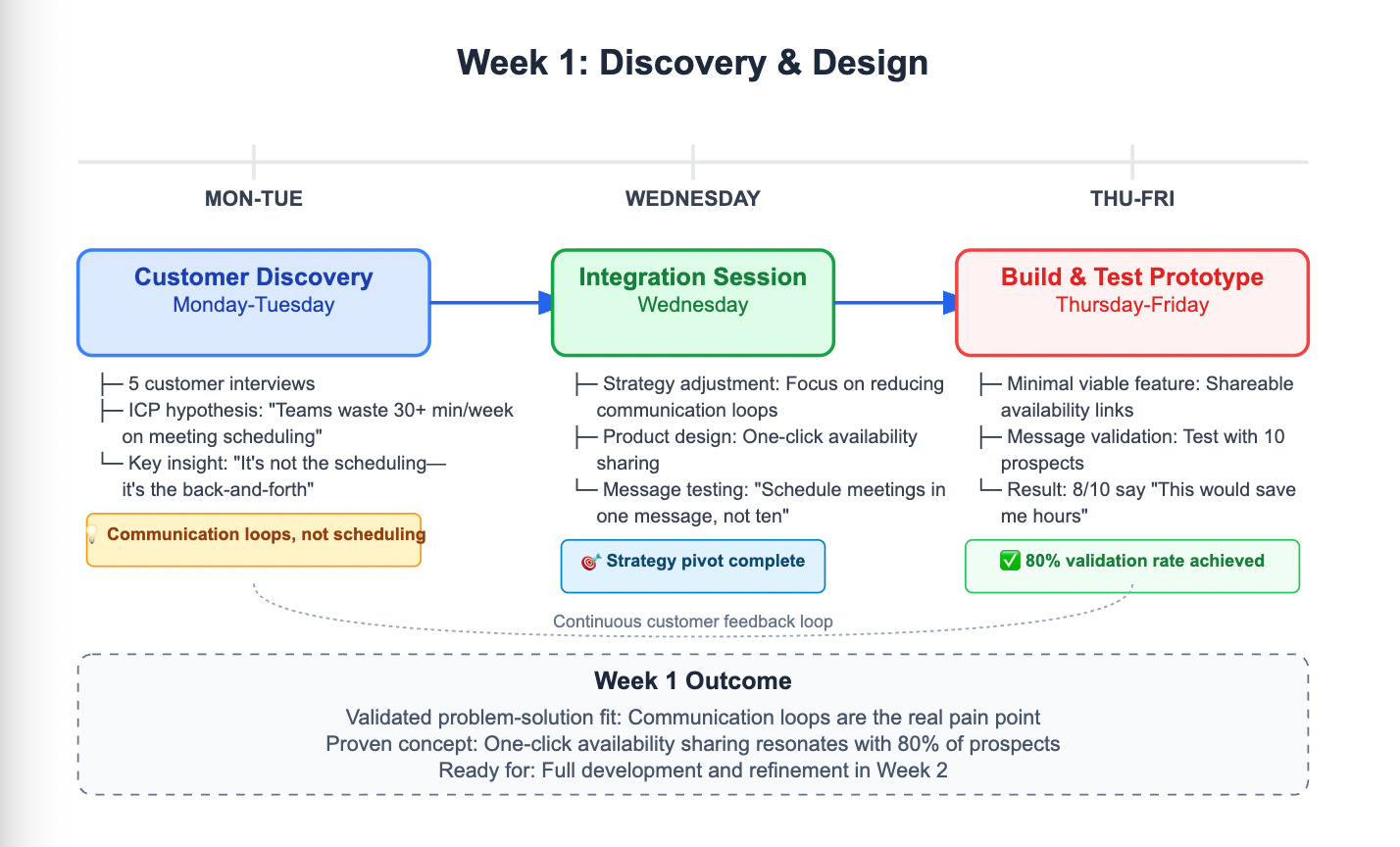
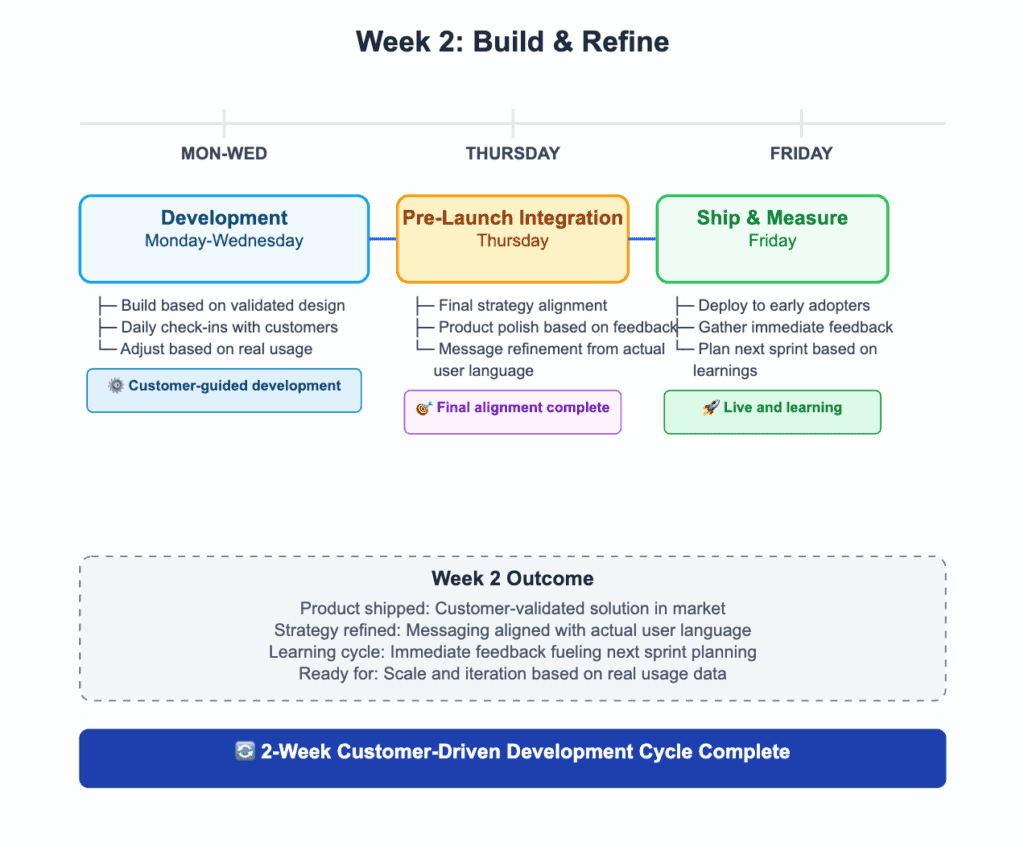
Total time: 2 weeks,
Traditional sequential approach: 5 months
Real Integration Stories from the Field
The Enterprise Builder’s Advantage
When you’ve built for Google, Disney, and Siemens, you learn something crucial: Enterprise clients don’t tolerate gaps. What you promise must match what you deliver, which must solve what they actually need.
This enterprise discipline, applied to startups, creates unfair advantages:
- Strategy grounded in implementation reality
- Products that tell their own story
- Messages that match actual capabilities
At M Studio we have learned this through over 25 years as a solution builder. Client’s requests, the builder’s reality, and the market’s needs—all at once.
The Post-Demo Integration
A B2B founder had 15% close rates after demos. Traditional thinking would attack this three ways:
- Strategy consultant: “Refine your ICP”
- Product manager: “Add better features”
- Sales coach: “Improve your pitch”
Integrated thinking asked: “What happens in the 48 hours after a demo?”
Discovery: Champions couldn’t sell internally because they lacked tools.
Integrated solution:
- Strategy: Identify champion enablement as key objective
- Execution: Build simple ROI calculator and one-pagers
- Communication: Create language champions could actually use
Result: 70% attendance increase and 40% increase in close rate. Same product. Integrated approach.
Building Your Integration Practice
The Daily Stand-Up 2.0
Traditional stand-up: “What did you do yesterday?” Integration stand-up: “What did you learn that affects strategy, product, and messaging?”
Real example from a recent session:
- “Customer call revealed they measure success by time saved, not features used”
- Strategy implication: Reframe value prop around efficiency
- Product implication: Add time-tracking to dashboard
- Message implication: Lead with “Save 10 hours per week”
The Weekly Integration Review
Every Friday, ask three questions:
- How has our ICP understanding evolved?
- What product changes reflect these insights?
- How must our language adjust?
If any answer is “it hasn’t,” you have a gap forming.
The Monthly Reality Check
Map your current state:
- Can we build what we’re promising?
- Can we explain what we’re building?
- Can we deliver what customers actually want?
Misalignment in any direction creates failure modes.
Common Integration Blockers
Blocker 1: The Specialist Syndrome
“I’m the technical founder, I don’t do marketing.” “I’m the business guy, I don’t touch product.”
In early-stage ventures, these boundaries kill integration. Everyone must understand enough about all three dimensions to spot gaps.
Blocker 2: The Perfection Trap
“Let’s finish the product before we talk to customers.” “Let’s perfect the strategy before we build.” “Let’s nail the message before we ship.”
Integration means accepting imperfection in exchange for learning velocity.
Blocker 3: The Handoff Habit
Traditional corporate training teaches handoffs:
- Strategy hands to Product
- Product hands to Engineering
- Engineering hands to Marketing
In startups, handoffs are where insights die. Integration means the same minds touching all three.
The Competitive Advantage of Integration
Why does integration create such powerful advantages?
Speed: When strategy, execution, and communication evolve together, you move at market speed, not organizational speed.
Coherence: Your product does what you promise, which solves what customers want.
Efficiency: No wasted cycles building the wrong thing or selling what doesn’t exist.
Learning Velocity: Every activity informs all three dimensions simultaneously.
A mobility startup discovered this when their head of product joined sales calls. In one week, they learned more about customer needs than six months of feature requests. That learning immediately influenced product prioritization and sales messaging.
Your Integration Checklist
For Strategy Decisions
- Can we actually build this?
- Can we explain the value simply?
- Does customer language support this?
For Product Decisions
- Does this reinforce our strategic position?
- Can we communicate its value clearly?
- Did this come from real customer needs?
For Communication Decisions
- Can our product deliver this promise?
- Does this align with our strategy?
- Do customers actually use these words?
The Path Forward
Integration isn’t a methodology—it’s a mindset. It’s the recognition that in today’s market, the walls between strategy, execution, and communication are artificial barriers that slow you down.
The most successful founders we work with don’t think in silos. They think in systems. Every customer conversation potentially changes strategy. Every product decision impacts messaging. Every message commitment drives product priorities.
This is how you build ventures that achieve product-market fit faster, scale more efficiently, and create lasting value.
Ready to experience integrated innovation?
Join our monthly Founders Meetings where we demonstrate integration in action. Work directly with practitioners who’ve built for Fortune 500s and scaled their own ventures.
What you’ll experience:
- Live integration exercises using your actual challenges
- Frameworks that connect all three dimensions
- Real-time ICP refinement techniques
- Product-message alignment workshops
Reserve your spot at the next Founders Meeting
Limited to 20 founders ready to break down the silos that slow down startups.
Note: Founders using integrated approaches report 65% faster product-market fit achievement and 50% fewer “build the wrong thing” pivots. Because when everything evolves together, you converge on success faster.