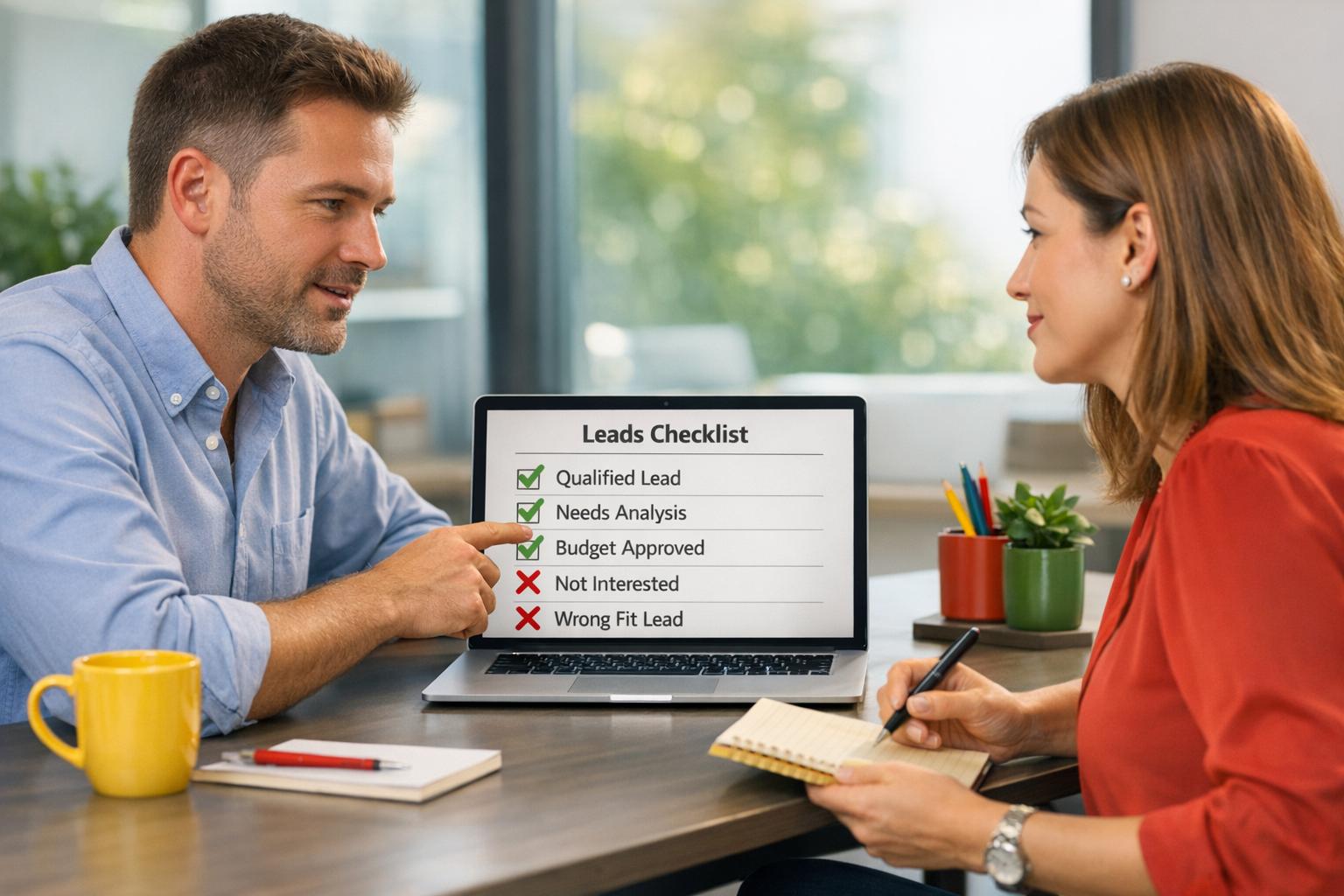
If you’re spending too much time chasing leads that don’t convert, you’re not alone. 67% of lost sales happen because prospects aren’t properly vetted, and focusing on the wrong ones can cost you time, money, and opportunities. The solution? A clear system for identifying and disqualifying poor-fit leads early. Here’s what you need to know:
- Unqualified leads waste resources: If 25% of your pipeline is unqualified, you’re throwing away a quarter of your sales efforts.
- Top sales teams disqualify early: Teams with 40–60% win rates excel at saying "no" to weak leads, unlike average teams closing only 20–25%.
- Common traps to avoid: Fear of missing revenue, lack of an Ideal Customer Profile (ICP), and no disqualification system are major reasons founders chase bad leads.
- Spot red flags quickly: Look for vague answers, lack of budget, no decision-making authority, or technical mismatches.
- Use a checklist: Evaluate leads on five criteria – authority, problem clarity, budget, technical fit, and urgency. If a lead fails on two or more, move on.
- Say no gracefully: Decline leads politely to leave the door open for future opportunities, or nurture them for later.

The Real Cost of Chasing Wrong-Fit Leads: Key Statistics
Why Founders Chase Wrong-Fit Leads
Chasing leads that don’t align with your business isn’t about making bad decisions – it’s often about falling into common psychological and operational traps that many solo founders face.
Fear of Turning Down Potential Revenue
When your business is generating between $100,000 and $1,000,000 in ARR, every single lead can feel like a lifeline. This scarcity mindset can make rejecting any potential opportunity feel like leaving money on the table.
"Every founder loves a full pipeline. But what if many of those leads were never going to buy in the first place or were going to cause you more trouble than they were worth?" – Makena Finger Zannini, Founder and CEO, The Boutique COO
The allure of a "big name" client can make things even trickier. It’s easy to get emotionally attached to well-known brands or prospects with significant budgets, even when their needs don’t match your product’s strengths. This can lead to weeks – or even months – of chasing deals that were never likely to close, all while serious, qualified buyers are left waiting.
Missing a Clear Ideal Customer Profile
Without a well-defined Ideal Customer Profile (ICP), you’re essentially navigating without a map. Sure, you’re moving forward, but there’s no guarantee you’re heading in the right direction.
"Selling without knowing what your ideal customer profile looks like is like driving a car blindfolded: though you might be moving forward, you’re not necessarily going the right direction." – LeadGenius
When there’s no ICP, decisions about leads are often based on gut feelings rather than hard data. A lively conversation or an enthusiastic prospect might seem promising, but true alignment goes deeper. For example, even if someone loves your product, it won’t matter if they lack the authority to sign a contract. The numbers back this up: only 27% of leads sent to sales teams by marketers are actually qualified. Without clear criteria for disqualifying leads, unqualified prospects can clog your pipeline and waste precious time.
No System for Disqualifying Leads
Without a structured way to disqualify leads, every decision becomes a guessing game – and that’s a huge drain on your most valuable resource: time.
This lack of a system leads to bloated pipelines filled with deals that are unlikely to close. It also makes revenue forecasting much harder. On the flip side, high-performing sales teams often achieve win rates of 40–60%. Their secret? They don’t waste time on weak opportunities. Instead, they quickly disqualify unfit leads and focus on those that are a genuine match. Consider this: sales professionals spend just 28% of their week actually selling, with the rest eaten up by manual tasks and chasing dead-end leads. A solid disqualification framework can help free up your time for prospects that actually matter.
What Wrong-Fit Leads Actually Cost You
The hidden toll of chasing wrong-fit leads goes far beyond wasted time – it’s about the revenue that slips through your fingers. Every hour spent on a prospect who’s never going to buy is an hour stolen from someone who might.
The Time Sink of Unqualified Prospects
Here’s the reality: Sales reps dedicate only 28% of their week to actual selling. The rest of their time is swallowed up by administrative tasks, internal meetings, and – most painfully – pursuing leads that will never close. A staggering 67% of lost sales come down to poor lead qualification, making it clear how much time is being squandered. While well-qualified deals typically close within 60–180 days, unqualified ones can drag on for 6–12 months, often going nowhere.
Think about the cost: If a quarter of your pipeline is filled with wrong-fit leads, you’re essentially throwing away a quarter of your sales payroll. For a solo founder billing $150 per hour and spending 20 hours a month on unqualified leads, that’s $3,000 in wasted effort every month. This inefficiency doesn’t just hurt your time management – it directly lowers your overall sales conversion rate.
Every hour spent chasing the wrong lead is an hour you could’ve used to nurture and close a deal that actually matters.
The Deals You’re Letting Slip Away
Wasting time on unqualified leads doesn’t just drain your resources – it also means you’re neglecting the prospects who are ready to buy. A bloated pipeline full of "maybes" forces you to divide your attention. If half your leads aren’t a good fit, you’re spreading yourself too thin, giving only partial effort to the serious buyers who need your full focus to convert.
Top-performing salespeople know the secret: they zero in on the top 20% of deals with the highest potential (calculated by deal size and close probability). This laser focus ensures they give their best prospects the attention they deserve. Companies that excel at lead nurturing generate 50% more sales-ready leads at 33% lower cost.
Every wrong-fit lead you chase isn’t just wasted effort – it’s a right-fit deal slipping through the cracks. And if you’re not giving those prospects the timely, focused attention they need, they might just end up signing with your competitor.
How to Spot and Filter Out Wrong-Fit Leads
The difference between a streamlined pipeline and one bogged down by inefficiency lies in quickly identifying bad-fit leads. Founders who hesitate to disqualify poor leads end up wasting time that could be spent on real opportunities. Spotting red flags early and implementing an automated lead qualification system can help you focus on the prospects that truly matter.
Warning Signs That Signal a Bad Fit
Pay attention to these behaviors during your initial interactions with a lead. Vague or one-word responses, such as "yeah" or "maybe", often indicate a lack of urgency or understanding of their own problem. Similarly, inconsistent answers during the same conversation suggest they might not have the knowledge or authority to move forward.
Leads using personal email addresses (e.g., Gmail, Yahoo) instead of business domains are often not decision-makers. If a prospect resists discussing budget or outright says, "we have no budget", it’s a clear sign they’re not ready to proceed. Another red flag? Prospects who criticize their own team during calls – they tend to become high-maintenance clients that drain resources.
One common pitfall is qualifying a lead simply because they represent a recognizable brand or because the conversation felt pleasant. Even well-known names must meet your fit criteria. As Arnaud Renoux, Co-Founder of Scalelist, explains:
"A staggering 67% of lost sales can be traced back to sales reps not properly qualifying potential customers."
5 Criteria for Disqualifying Leads
When red flags pop up, use clear criteria to disqualify leads without hesitation. Here are five key factors to evaluate:
- Decision-making authority: Does this person have the power to allocate budget and make final decisions? If not, can they connect you with the right stakeholders? If the answer is no, it’s time to move on.
- Defined problem: Can they clearly articulate a specific issue your product solves? If they’re vague or just "exploring options", they’re likely not ready to commit.
- Budget alignment: If they avoid discussing numbers or their potential lifetime value doesn’t justify your acquisition cost, disqualify them immediately.
- Technical compatibility: If their current tech stack won’t integrate with your solution, pursuing them could lead to implementation headaches.
- Timeline urgency: Without a concrete deadline or a compelling reason to act now, they’re better suited for nurturing rather than active pursuit.
Between 2023 and 2024, Belkins achieved an impressive 99.83% opportunity-to-appointment conversion rate by canceling meetings with poor-fit leads. This disciplined approach allowed their sales team to focus solely on prospects with real buying potential.
Create Your Own Disqualification Checklist
A simple checklist can help you consistently disqualify leads that aren’t worth pursuing. Start with a five-to-seven-point list that includes authority, problem clarity, budget, technical fit, and timeline. Use a binary system: if a lead fails on two or more points, disqualify them. This removes emotional bias and prevents wasted effort on unqualified prospects.
To test each criterion, use open-ended questions. For instance, instead of asking, "Is this a priority?" try, "Where does this rank on your list of business priorities?" Look for specific, data-backed answers – vague responses are a red flag. If you’re overwhelmed with low-quality leads, consider adding a small fee (even $1) for trials or discovery calls to weed out those who aren’t serious.
Consistency is key. A straightforward checklist lets you make quick, confident decisions without overthinking. As Sarah Casdorph, Demand Automation Manager at HubSpot, puts it:
"If your lead qualification framework is doing its job, the vast majority of your leads actually will not be qualified."
And that’s exactly how it should be.
sbb-itb-32a2de3
How to Turn Down Leads Without Burning Bridges
Now that you know how to spot leads that aren’t the right fit, the next step is learning how to decline them gracefully. Doing this thoughtfully ensures you protect your time while keeping the door open for future opportunities. When a lead doesn’t meet your criteria, you can use these simple templates to politely decline without damaging the relationship.
Templates for Different Situations
When a lead doesn’t align with your criteria, honesty is better than vague excuses. Here’s how you can respond in various scenarios:
For budget mismatches, say:
"Our pricing starts at $X,XXX, which might not fit into your current budget. I’d love to reconnect in the future – please feel free to reach out when your funding aligns."
Kara Thomas, Founder of Studio KT, supports this approach:
"It is important to accept the reality of the situation and allow them to come back to the project when they have the funds."
For timing conflicts, acknowledge your capacity:
"We’re currently fully booked and want to ensure your project gets the attention it deserves. Can we schedule a call in the future when our timelines align better?"
If there’s a technical or stylistic mismatch, be upfront:
"Your project requires expertise in [specific area], which isn’t our specialty. However, I’d be happy to recommend a partner who focuses on that area."
Theresa Butler, Principal Designer at Theresa Butler Interiors, highlights the value of this approach:
"In such cases, we happily refer them to firms that may be better suited to their needs."
These thoughtful responses not only preserve goodwill but also leave room for future collaboration.
Keep the Door Open for Later
Instead of outright rejecting a lead, consider moving them into a nurturing sequence. Research shows that companies excelling in lead nurturing generate 50% more sales-ready leads at 33% less cost. Adding these leads to a nurturing email campaign can keep them engaged for future opportunities. Sarah Casdorph at HubSpot emphasizes this:
"That nurture experience is what’s going to keep your leads warm, so that maybe when the next budget cycle rolls around… then your brand will be the first one to come to mind."
Set reminders in your CRM to follow up in 6–12 months. A simple message like, "Hi [Name], just checking in to see if your priorities have shifted since we last spoke. I’d love to explore working together if the timing is better now", can revive potential opportunities without feeling pushy.
Why Saying No Helps You Grow Faster
Turning away leads that don’t fit your business is a smart move that directly protects your bottom line. With sales reps spending just 28% of their week actively selling, knowing when to disqualify leads is essential to making the most of that limited time.
By cutting the bottom 50% of your pipeline, you can double the energy and focus you dedicate to high-potential deals. Top-performing sales teams consistently achieve win rates of 40-60%, while average teams linger around 20-25%. The difference? It’s not superior closing skills – it’s their ability to disqualify weak opportunities early. As Tara Minh, Operation Enthusiast at Rework, points out:
"The companies with the highest win rates (40-60%) aren’t better at closing. They’re better at disqualifying. They walk away from weak opportunities early and double down on strong ones."
This disciplined approach doesn’t just save time; it also leads to better revenue results. Deals with qualified leads typically close within 60 to 180 days, while poorly qualified ones can drag on for 6 to 12 months before ultimately falling apart. And every moment spent chasing an unqualified lead is a moment lost with a buyer who’s ready to close.
There’s another hidden cost to pursuing the wrong leads: onboarding customers who aren’t a good fit. These clients often churn quickly, wasting your team’s time and resources. Makena Finger Zannini, Founder and CEO of The Boutique COO, highlights this risk:
"Chasing unqualified leads is one of the most expensive mistakes businesses make. It drains your team’s time and fills your client roster with people who are a poor fit, leading to churn and frustration on both sides."
A streamlined pipeline not only helps you prioritize where to spend your time but also improves your ability to forecast revenue accurately. By focusing on the right opportunities, you can ensure your efforts truly pay off.
Conclusion
Every moment spent chasing a lead that isn’t the right fit robs you of time you could be spending on prospects who are ready to buy. The numbers don’t lie: 67% of lost sales are due to poor qualification[1]. That’s why having a systematic approach to filtering leads isn’t just helpful – it’s essential for driving real growth and avoiding wasted effort.
Streamline your lead qualification process with the help of AI tools. These frameworks can help you identify and disqualify leads faster, saving you valuable time. Want to stay ahead of the curve? Subscribe to our AI Acceleration Newsletter for weekly tips on automating lead scoring and qualification.
To refine your process, start with a simple checklist based on your core criteria. Write it down and use it consistently on every initial call – it’s a small habit that can make a big difference.
Keep in mind, a strong qualification system doesn’t mean rejecting more leads; it’s about saying “yes” to the right ones. By focusing on prospects that align with your Ideal Customer Profile, you’ll avoid deals that drag on and ultimately fall apart. Instead, you’ll create room to build relationships with leads that are more likely to convert.
Still struggling to weed out time-wasters? Consider adopting a real-time qualification framework. Join our next Founders Meeting to learn how to build a lead qualification system that works. It’s an interactive session with limited spots, and you’ll walk away with actionable tools you can implement the same day.
[1] A staggering 67% of lost sales can be traced back to reps failing to properly qualify potential customers.FAQs
How do I create an Ideal Customer Profile (ICP) to avoid wasting time on the wrong leads?
Creating an Ideal Customer Profile (ICP) is a smart way to zero in on prospects who are most likely to convert, while avoiding leads that just aren’t the right fit. To get started, take a close look at your top-performing customers – the ones who generate the most revenue, stick around for the long haul, and transition smoothly during onboarding. Focus on their firmographic details (like industry, company size, annual revenue, and location), technographic insights (such as the tools they use or how they adopt products), and behavioral patterns (like their decision-making process, budget cycles, and the challenges your solution helps solve). The more specific you can get – think "mid-sized healthcare SaaS companies in the U.S. with $5M-$20M ARR using Salesforce" – the easier it becomes to identify leads that truly match your criteria.
After pinpointing these traits, create a checklist of 5-7 key criteria to define your ICP. For example, your list might include items like: industry = healthcare, revenue ≥ $5M, decision-maker = C-level, budget ≥ $50K, and timeline ≤ 12 months. Test this checklist with a small group of leads to fine-tune it. Once it’s solid, integrate it into your workflow, whether that’s your CRM or your outreach strategy. If a lead doesn’t meet any of the mandatory criteria, don’t hesitate to disqualify them. This approach ensures you’re spending your time on leads that align with your business goals, saving effort and improving your chances of success.
What are the most important factors to disqualify a lead quickly?
Disqualifying leads allows you to zero in on prospects who are more likely to benefit from your product or service. Here are six factors to help you determine if a lead might not be the right fit:
- Authority: The lead isn’t in a position to make decisions or doesn’t have enough influence in the buying process.
- Budget: They either lack the funds or are hesitant to discuss budget, hinting at potential affordability concerns.
- Fit: Their needs don’t align with the problems your solution addresses or fall outside your expertise.
- Company Size: Their organization’s size – whether too large or too small – doesn’t match the scope of your solution. This could relate to revenue, team size, or the market they operate in.
- ROI: The potential return on investment they’d get from your product doesn’t justify the cost for them.
- Timeline: They lack urgency or aren’t ready to make a purchase in the near future.
Using these criteria as a guide helps you quickly identify leads that aren’t a good match, allowing you to focus your energy on those with a higher chance of becoming customers.
How can I politely turn down leads that aren’t a good fit without closing the door for future opportunities?
Declining a lead doesn’t have to be a relationship-ending moment if you approach it with care. Start by double-checking your disqualification criteria – make sure your decision is based on clear, objective factors like budget constraints, timeline issues, or a mismatch in needs. When you respond, take a moment to express genuine gratitude for their interest, and reference something specific from your earlier conversation to show you were actively engaged.
Be honest but brief in explaining why your solution isn’t the best fit right now. Frame it as an alignment issue rather than outright rejection. For example, you might say the timing or scope isn’t ideal for what you offer. Whenever possible, suggest an alternative, like a resource or another provider that might better suit their needs.
Lastly, keep the door open for future opportunities. A simple line like, “If your priorities or needs shift down the road, I’d be happy to revisit this conversation,” conveys professionalism and leaves room for future collaboration. This thoughtful approach helps preserve goodwill, keeps the interaction positive, and ensures your focus remains on leads that are the right match.
Related Blog Posts
- Revenue Plateau at $2-3M? Your Sales Process (Not Your Product) Is the Problem
- First Sales Hire Checklist for Solo Founders
- How to Build a Sales Process You Can Hand Off
- Lead Prioritization Framework for Solo Founders