Struggling to scale your sales process? Founder-led sales rely on intuition and personal connections but can’t keep up as your business grows. Automated revenue systems solve this by creating repeatable processes that handle more leads, improve follow-ups, and boost close rates.
Here’s what you need to know:
- Manual systems work well early on for learning the market but lack scalability.
- Automation ensures consistent follow-ups, filters unqualified leads, and reduces lost opportunities.
- Transitioning at the $500K ARR mark can prevent revenue leaks and increase efficiency.
Key takeaway: Founder-led sales gather insights; automation scales them. Waiting too long to automate costs time, deals, and growth.
Manual Sales vs. Automated Systems: The Core Difference

Founder-Led Sales vs Automated Revenue Engines Comparison
The distinction between manual and automated sales isn’t just about using technology – it’s about creating processes that can scale. Founder-led sales often thrive on intuition. A founder instinctively adjusts their pitch, reads the room, and closes deals. But here’s the catch: you can’t bottle up that instinct or expect a new hire to match your 40% close rate based on gut feeling alone. That’s where automation steps in. It transforms your personal sales expertise into a system that others can follow. For more tips on scaling your sales process, Join the AI Acceleration Newsletter. At M Studio / M Accelerator, we specialize in helping founders turn their sales instincts into efficient, automated revenue systems.
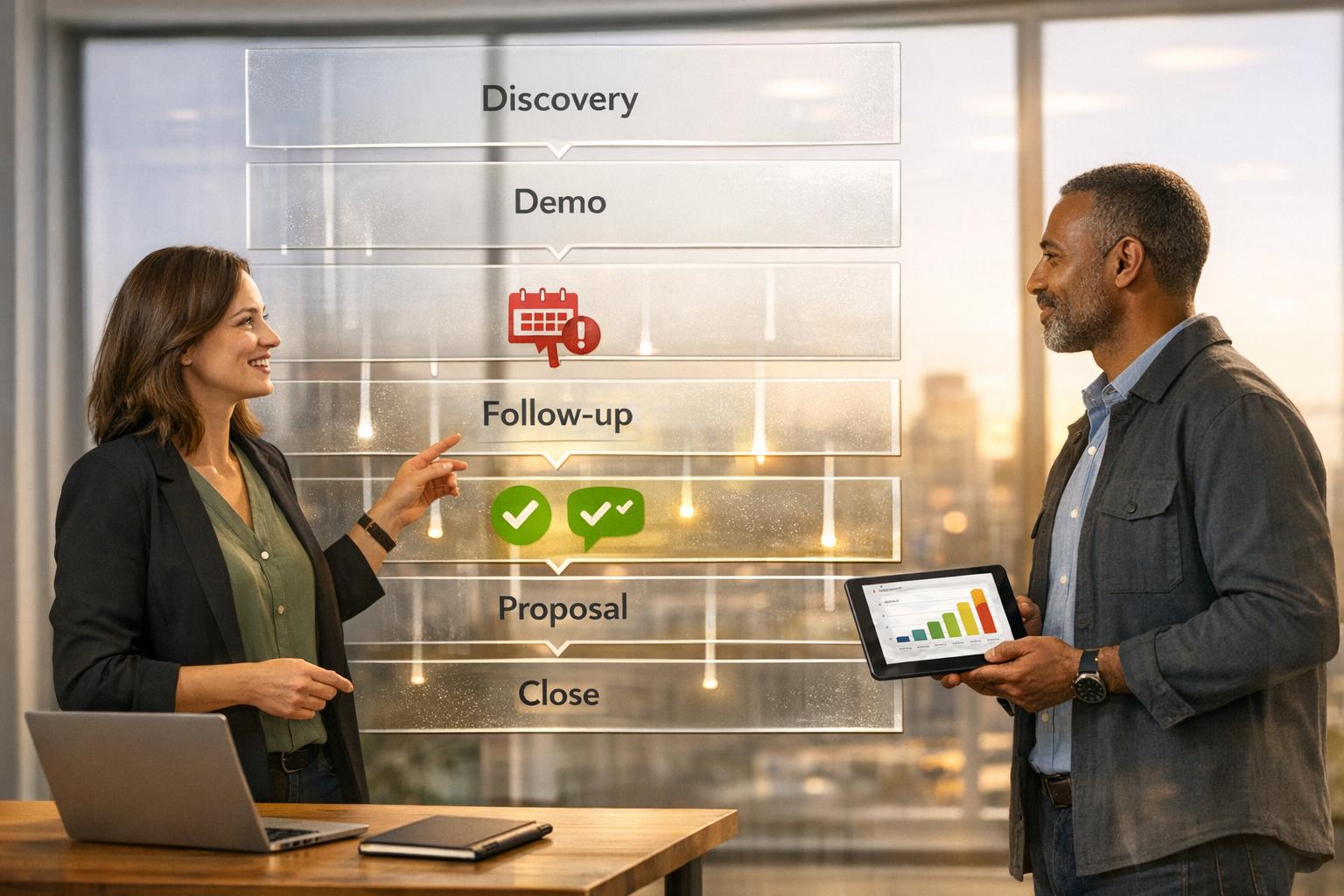
The biggest challenge with manual sales is that it lacks the repeatability needed to grow. Automated systems solve this by creating clear, repeatable steps for every stage of the sales pipeline. For example, instead of relying on memory to follow up, the system might automatically send a personalized video recap two hours after a demo, followed by a champion enablement document 24 hours later, and an ROI calculator at 48 hours. This doesn’t replace the human touch – it ensures no opportunity slips through the cracks, even when you’re managing multiple deals at once.
Manual systems also hit a wall when you can no longer handle every interaction yourself. AI-powered tools can filter out 60% of unqualified leads before they even reach your calendar, saving you up to 7.5 hours a week that would otherwise be spent on fruitless discovery calls. Automation smooths out the highs and lows of manual efforts, offering consistent results. Better close rates create more revenue, which funds lead generation, while automated tools handle the growing pipeline. This allows you to focus on closing deals instead of screening prospects.
"You cannot hire someone to replicate your pattern recognition. You cannot write a training programme that teaches a hired rep to have your company founder’s instinct." – TechGrowth Insights
The numbers back this up: companies using manual processes often see quarterly forecast variances of 20% to 40%, while automated systems keep variances within 10% to 15%. This isn’t just about efficiency – it’s about staying competitive. While you’re perfecting your process, your competitors are already building “good enough” automations and refining them over time.
Comparison Table: Founder-Led Sales vs. Automated Revenue Engines
| Feature | Founder-Led Sales | Automated Revenue Engines |
|---|---|---|
| Scalability | Limited by the founder’s time; reaches a ceiling quickly | Can handle three times the leads with the same effort |
| Resource Dependency | Relies on individual talent and intuition | Driven by systems, AI, and clean data |
| Data Usage | Based on instincts; tracked in spreadsheets or basic CRMs | Structured, machine-readable data that enables predictive analytics |
| Predictability | Unstable pipeline; 20-40% forecast variance | Consistent results; 10-15% forecast variance |
| Focus Areas | Closing deals through personal connections | Building a self-sustaining "revenue machine" |
| Hiring Impact | New hires struggle without clear guidance | New reps productive immediately with automated systems |
| Follow-up Consistency | Manual emails; deals often stall after 48 hours | Automated follow-ups keep deals moving forward |
Automated systems aren’t just tools – they’re a way to scale your sales process without losing the personal touch that makes your approach effective.
sbb-itb-32a2de3
Why Founder-Led Sales Work in Early Stages
Founder-led sales go beyond just closing deals – they’re about learning what truly resonates with your market. In the early stages, whether you’re pre-seed or just past product-market fit, every sales conversation doubles as market research. You’re not just pitching; you’re figuring out which problems matter most to your prospects, uncovering common objections, and learning whether your product is viewed as a "nice-to-have" or an essential solution. This kind of feedback is something no automated system can fully capture. Founders can pick up on subtle cues, like hesitation, adjust their pitch on the spot, and uncover hidden challenges like budget constraints or internal politics that a CRM simply won’t reveal. These real-time discoveries help refine your messaging and set the stage for a smooth transition to scalable sales systems.
Want to learn how AI can help refine your sales process and build a scalable revenue engine? Check out our free AI Acceleration Newsletter here. These insights are the building blocks for transitioning to automation while ensuring sustainable growth.
The numbers back this up. Most founders hit around $500K ARR through direct sales before needing to formalize their approach. During this phase, founder-led sales operate more like a discovery engine than a revenue generator. You’re testing your messaging, validating pricing, and building a knowledge base about what drives deals to close. It’s not about charisma – it’s about gathering the insights you’ll need to scale effectively. Without this groundwork, you risk scaling based on untested assumptions, which can lead to costly mistakes.
Credibility is key in early-stage sales. When selling to enterprise buyers, especially those with low risk tolerance, you’re not just selling a product – you’re selling your vision. As the founder, you bring a level of authority that no early sales hire can match. You know the product inside and out, understand the roadmap, and can clearly communicate your company’s future direction. This builds trust, especially in niche enterprise markets where buyers need confidence that you’ll be there to support them long-term.
"Founder-led sales is not about personality-driven selling. It is about discovery at a strategic level." – Housipro
Most B2B deals fall apart within 48 hours, but founder-led personal follow-ups can counter this trend. Founders can keep the momentum alive with direct outreach, personalized video summaries, or tailored materials that help prospects champion your product internally. This hands-on approach also avoids locking your messaging into rigid frameworks too early, which can make it harder to pivot down the line.
The Advantages of Founders Leading Sales
The biggest benefit of founder-led sales is the depth of learning that comes from every interaction. Each meeting offers a chance to uncover valuable insights: Did the prospect object to pricing? Mention a competitor you hadn’t considered? Request a feature that hints at a broader market need? These details are gold and only come from direct engagement. At Elite Founders, we help founders capture this knowledge and turn it into actionable strategies that can later be integrated into scalable systems.
Another advantage is the ability to make decisions on the fly. If a prospect needs a custom integration, you can commit to it in real time. If pricing flexibility is a sticking point, you can adjust terms on the spot. This kind of agility gives you a competitive edge that diminishes once sales are handed off to a team that requires approval for deviations from the playbook. The key is to document what works – how to handle objections, identify buyer triggers, and use language that turns skeptics into advocates – so you can eventually build a repeatable process.
The data supports this approach: 89% of founders in a recent study found they were losing over $4,000 per week due to preventable revenue leaks, particularly in post-demo follow-ups. The goal isn’t to eliminate founder-led sales entirely but to know when you’ve gathered enough insights to start automating the most critical gaps. This shift allows you to move from discovery mode to scaling mode, using automation to amplify what you’ve learned rather than replacing the strategic foundation you’ve built. With these insights in hand, founders can start addressing revenue leaks without losing the benefits of hands-on discovery.
When and How to Transition to Automated Revenue
Once you’ve established a solid foundation with a founder-led approach, it’s time to take things to the next level with automation. The $500,000 ARR milestone is the sweet spot to start implementing automated systems. By this point, you’ve nailed down your market, refined your messaging, and closed enough deals to know what works. But here’s the catch: sticking to manual processes beyond this point can leave you trailing behind competitors. Why? Automated systems allow them to handle 3x the lead volume and achieve 40% close rates, compared to the typical 15%. That gap could cost you $150,000 in just 90 days.
Want to stay ahead? Consider subscribing to our free AI Acceleration Newsletter for weekly tips on building scalable, automated revenue systems.
The key is to act now. Waiting for perfection isn’t an option because your competitors are already automating and fine-tuning their processes. Research shows that 89% of founders lose over $4,000 every week due to preventable revenue leaks, with 67% of those leaks happening during post-demo follow-ups. The solution? Start small. Focus on plugging your biggest leak – usually the critical 48-hour window after demos. Automate that first, track the results, and then move on to the next area. Below, we’ll break down actionable steps and tools to help you build a scalable revenue engine.
Steps to Build Your Revenue Engine
1. Identify your biggest revenue leak.
For most businesses, this is the post-demo phase. Create a 48-hour automated follow-up sequence to capture momentum right after the demo:
- 2 hours post-demo: Send a personalized video recap.
- 24 hours post-demo: Share a champion enablement document to help prospects secure internal buy-in.
- 48 hours post-demo: Provide a pre-filled ROI calculator to highlight the value of your solution.
This simple automation targets the most critical window when deals are often won or lost.
2. Automate lead qualification.
Save time by filtering out unqualified leads early. Use an AI-powered system to ask key questions like:
- What problem are you trying to solve?
- What solutions have you already tried?
- What’s your timeline?
- Who makes the final decision?
- What’s your budget range?
This conversational approach filters out 60% of bad-fit leads, freeing up 7.5 hours per week that would otherwise go to unproductive calls.
3. Map the buyer journey.
Document the patterns that have worked in your founder-led sales process. Pinpoint where prospects usually get stuck and identify the resources that help them move forward. For example:
- If prospects ghost after pricing, automate a value-reinforcement sequence.
- If internal buy-in is a hurdle, create shareable templates for decision-makers.
Each automation should address a specific challenge in your pipeline, making the buyer journey smoother and more predictable.
Tools and Frameworks for Revenue Automation
Once you’ve set up your core automations, it’s time to integrate advanced tools to refine and scale your processes. AI-powered systems can unify your CRM, marketing automation, and sales enablement into a cohesive revenue engine. Tools like N8N, Make, and Zapier help connect your tech stack, while OpenAI and Claude enhance lead scoring and personalize outreach. The goal isn’t to replace human judgment but to handle repetitive tasks, so you can focus on high-impact conversations.
For example, an automated outbound engine can generate 15–20 qualified conversations per month by identifying sales triggers – like funding announcements or new hires – and launching multi-channel outreach campaigns across LinkedIn and email.
Many founders struggle not with finding tools but with connecting them into a system that delivers results. Instead of spending $12,000 per month on strategy consultants, you can invest $350 per month in hands-on coaching to build functional automations in just one week. At M Studio, we offer live sessions where you can screen-share and build systems on the spot – whether it’s setting up AI-powered lead qualifiers, automating post-demo follow-ups, or syncing your CRM with other tools. You leave with live automations running in your business, not just a theoretical plan.
"Stop trying to build the perfect system. Your competitor didn’t wait for perfect – they built good enough, shipped it, and optimized while it was running." – Alessandro Marianantoni, M Accelerator
The best approach is to start small and scale step by step. Implement your first automation, measure its impact over 30 days, and refine it based on real data. For instance, if a 48-hour follow-up sequence boosts your demo-to-close rate from 15% to 40%, you’ve proven the concept. From there, you can confidently add more automations, like AI-driven lead qualifiers or automated onboarding flows. This method ensures each system delivers measurable results, allowing you to grow revenue without overwhelming your team or increasing headcount.
Metrics That Define Success
Once your automated revenue engine is in place, tracking the right metrics ensures that every automation delivers measurable results. One of the most critical metrics is forecast variance, which measures how accurately you can predict revenue 90 days in advance. In founder-led sales, this variance often swings between 20% and 40% each quarter, making it tough to plan for hiring or budgeting. However, a well-designed automated system can narrow this variance to just 10%–15%, providing the predictability that investors look for. Want to learn more about how AI frameworks can refine these metrics? Join our free AI Acceleration Newsletter for weekly tips on scaling your sales process. These metrics don’t just highlight operational efficiency – they also build the investor confidence needed for growth.
Other key indicators include demo-to-close rates and Customer Acquisition Cost (CAC) payback periods. If your demo-to-close rate fluctuates wildly – like jumping from 10% one month to 30% the next – this could signal issues with your positioning. A well-optimized system aims for a consistent 40% conversion rate. Similarly, automation should shorten your CAC payback period by handling higher volumes without requiring a larger team.
Another major sign of success is reducing dependency on the founder. When new sales hires can hit the ground running on Day 1, armed with thorough playbooks and proven automations, you’ve reached a scalable model. At this point, CRM adoption should exceed 80%, and Net Revenue Retention (NRR) should surpass 110%, proving that growth is driven by a systematic approach rather than one-off opportunities. These operational benchmarks align closely with the strategic metrics that investors prioritize.
What Investors Evaluate in Scalable Revenue Models
When your automated system consistently delivers, it demonstrates scalability to investors. They don’t care about raw activity metrics; they want predictability and leverage. Investors look for proof that your revenue engine can handle 3x the lead volume without needing 3x the team size. Metrics like CRM adoption, forecast accuracy, and steady conversion rates are essential. If the founder is still personally closing every deal, it’s a red flag that the business might struggle to scale.
The transition from founder-led to founder-informed sales happens when your insights are captured in documented playbooks, automated follow-ups, and AI-driven qualification systems. When your data shows that deals close at the same rate whether or not you’re involved, you’ve built a system that investors can trust.
If you’re ready to move from manual processes to automated revenue generation, M Studio / M Accelerator offers hands-on expertise to help you create AI-powered go-to-market systems that improve these critical metrics.
Choosing the Right Approach for Your Stage
For startups generating less than $5 million in ARR, founder-led sales offer an irreplaceable advantage. They allow you to uncover objections, experiment with pricing, and pinpoint key factors that drive deals – insights that automated systems simply can’t provide. Wondering how AI can help transform these manual efforts into a scalable revenue engine? Subscribe to the AI Acceleration Newsletter for weekly tips and actionable strategies.
As your startup grows, your personal network and manual methods will eventually struggle to keep up with increasing demand. This is when automation becomes crucial. Most B2B companies hit this breaking point between $3 million and $10 million ARR. At this stage, the founder can no longer single-handedly manage the revenue function, and there’s often no documented process for others to follow. Alessandro Marianantoni from M Studio emphasizes a practical approach: “Perfection isn’t the goal – build a system that works, ship it, and refine it as you go.”
Once scaling becomes a necessity, it’s time to formalize what you know. Start by documenting your intuitive approach to closing deals. Convert these patterns into clear playbooks, complete with exit criteria for each stage of your pipeline. Next, identify your biggest revenue leak. Did you know that 89% of founders lose over $4,000 per week to preventable issues? And 67% of these leaks happen during the post-demo follow-up stage. Address this by building one targeted automation to plug that gap. Run it for 30 days, analyze the results, tweak as needed, and then tackle the next challenge.
Looking to move from manual processes to a systematic revenue strategy? Check out our Elite Founders program for hands-on automation sessions. For more complex requirements, GTM Engineering can help you design and optimize your entire revenue tech stack.
FAQs
How do I know it’s time to move beyond founder-led sales?
When your sales process leans too much on gut feelings and lacks structure, it’s a clear signal to move beyond founder-led sales. Some telltale signs? Hitting a plateau – like seeing your closing rates drop – or recognizing that your success hinges on unwritten, hard-to-replicate strategies. Shifting to data-driven systems and automated processes not only makes scaling possible but also eliminates bottlenecks caused by manual efforts. This shift helps you streamline operations and drive growth more effectively.
What sales steps should I automate first without losing personalization?
The key to automating sales while keeping it personal lies in recognizing the right signals and leveraging smart tools. Start by identifying deal-driving signals – think urgency, interest, or specific patterns – from call recordings or other customer interactions. These insights can guide your approach.
Next, streamline repetitive tasks like lead routing, follow-ups, and qualification using automation tools such as Zapier or n8n. These tools handle the tedious work, freeing up your team to focus on what really matters: meaningful, personalized conversations.
The goal isn’t to replace human interaction but to create workflows that enhance it. By automating the right processes, you can scale your efforts while ensuring that human insights remain at the heart of high-value discussions.
Which metrics prove an automated revenue engine is working?
Key indicators that an automated revenue engine is functioning effectively include higher conversion rates (such as improved demo-to-close or lead-to-customer ratios), shorter sales cycles (for instance, responding to leads in under 5 minutes), and steady revenue growth. Additionally, accurate pipeline tracking and consistent forecasting signal that automation is delivering predictable and scalable outcomes. Monitoring these metrics over time helps ensure the system is driving better performance and efficiency.
Related Blog Posts
- How to Hire Your First Sales Rep (Complete Playbook for B2B Founders)
- Signs You’ve Hit the Founder Sales Ceiling
- Revenue Engine vs Sales Process: What Seed Investors Actually Check
- The Scaling Switch: Moving from Sales “Firefighter” to GTM “Project Manager”