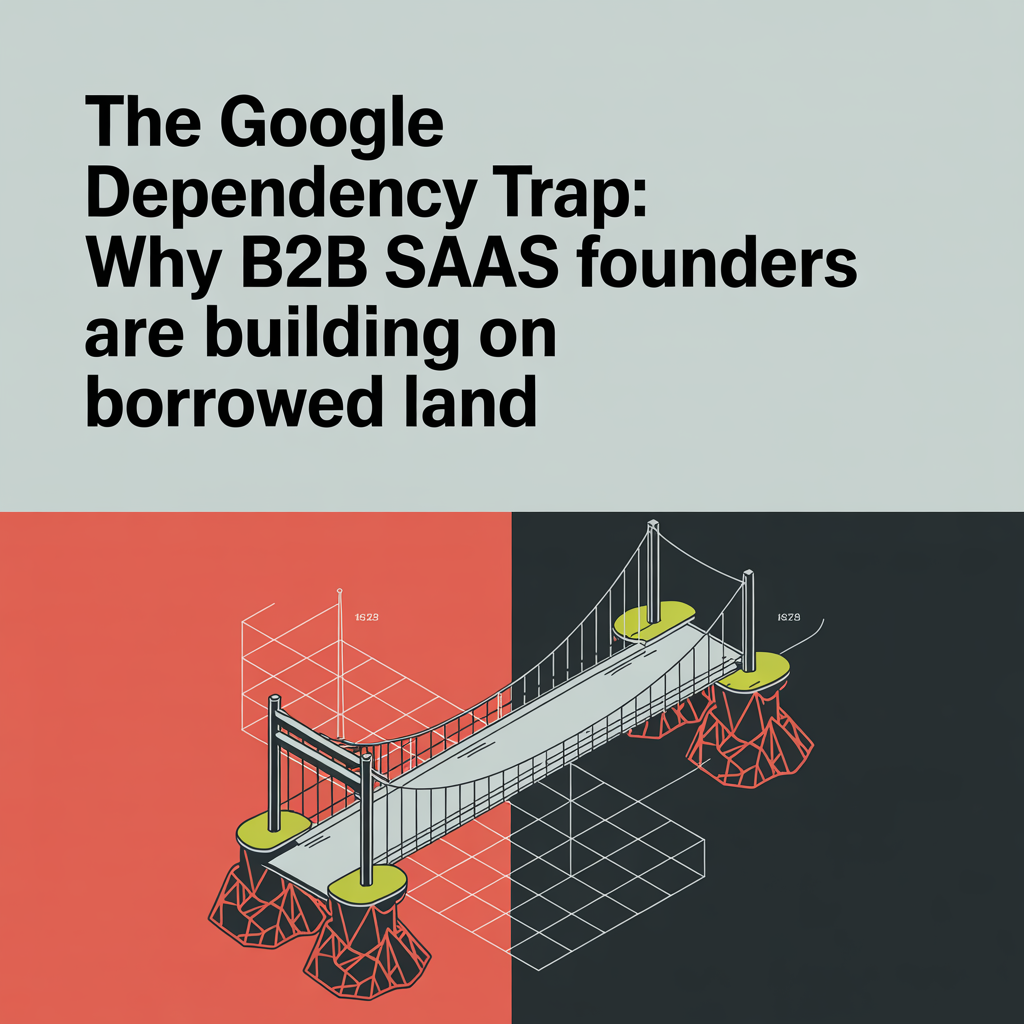
Google controls 91.9% of global search traffic, making it the primary gateway between your B2B SaaS and potential customers. But here’s what keeps founders up at night: you’re building your entire growth engine on someone else’s platform, subject to algorithm changes that can destroy overnight what took years to build.
Picture the founder who built their entire acquisition strategy around SEO best practices. Organic traffic climbing month over month. Pipeline full. Then March 2024 hits. Google’s core update rolls out, and 70% of their traffic vanishes in 48 hours. Not because they did anything wrong. Because the rules changed.
This isn’t a horror story. It’s happening right now to thousands of B2B SaaS companies who confused Google success with sustainable growth.
The Three Dependencies That Define Your Google Relationship
Most founders think about Google as a traffic source. That’s like thinking about oxygen as just air. Google shapes three fundamental aspects of your business, each compounding the others.
First comes Discovery Dependency. This is the obvious one. Data shows 68% of B2B purchase journeys start with a Google search. Your potential customers type their problems into that search box before they know you exist. If you’re not there, you’re invisible. But visibility is just the entry fee.
Second is Authority Dependency. Google doesn’t just send traffic — it validates your existence. When prospects research your company, they judge you by what Google says about you. Your SERP real estate becomes your digital credibility. No presence equals no trust. Weak presence equals weak trust.
Third, and most dangerous, is Revenue Dependency. This is where the math gets scary. Track your customer acquisition paths. How many start with organic search? For most B2B SaaS companies hitting their first million in ARR, it’s 60-80% of new customers. But here’s the trap: those Google-sourced customers often represent only 20% of total revenue value.
Why? Because Google sends you problem-aware traffic, not solution-aware buyers. They’re comparison shopping, not relationship building. Lower intent means lower LTV.
“We analyzed traffic sources across 500+ B2B SaaS founders we’ve worked with. The pattern is consistent: companies with the highest Google dependency show 3x more volatile month-to-month revenue growth. One algorithm update can shift their entire trajectory.”
These three dependencies create a compound effect. The better you get at SEO, the more your business architecture bends toward Google’s requirements. Your content strategy. Your keyword research. Your product positioning. Even your feature roadmap starts optimizing for search intent rather than customer success.
You become fluent in Google’s language while forgetting how to speak directly to customers.
Want to track how these dependencies evolve as you scale? The AI Acceleration newsletter breaks down the signals successful founders monitor to maintain balance while growing.
The Hidden Cost of Google Success
Here’s what nobody talks about at SEO conferences: the opportunity cost of optimization obsession. Every hour spent chasing algorithm updates is an hour not spent building direct customer relationships.
The math reveals the paradox. A B2B SaaS founder we worked with discovered their Google-sourced customers had these characteristics: 47% lower lifetime value than referral customers, 2.3x higher churn rate in the first 90 days, and 82% less likely to expand their accounts. Yet they were spending 70% of their marketing resources on SEO.
Success was making them weaker.
Think about what Google traffic actually is: borrowed attention. You’re renting access to someone else’s audience. The terms of that rental can change without notice. And they do. The March 2024 core update decimated established sites. Some lost 80% of organic traffic overnight. Years of content investment vanished.
But the real cost runs deeper than traffic volatility. When you optimize for Google, you optimize for the algorithm’s understanding of intent, not actual human needs. You write for robots first, humans second. Your headlines become keyword puzzles instead of customer promises.
“A mobility startup we built alongside had this realization at $1.2M ARR. They calculated that each Google visitor cost them $0.32 in content creation and optimization effort, while each email subscriber delivered 23x more revenue over 12 months. They shifted focus. Revenue grew 340% in the next year with 50% less Google traffic.”
The hidden cost compounds through your entire organization. Your product team starts building features that sound good in search queries. Your sales team learns to handle low-intent leads instead of high-value conversations. Your success metrics warp around vanity traffic numbers instead of revenue quality.
You’re not building a business. You’re building a Google-optimized lead generation machine.
The Algorithm Arbitrage Window
Google isn’t just changing its algorithm. It’s changing its entire business model. The search engine is becoming an answer engine, and that shift will devastate unprepared B2B SaaS companies.
The numbers tell the story. Google’s own data shows 64.82% of searches now end without a click, up from 50.33% in 2019. Let that sink in. Nearly two-thirds of searches never leave Google. AI Overviews and Search Generative Experience (SGE) will push that number higher.
For B2B SaaS, this creates an arbitrage window. The old SEO playbook — ranking for keywords — is dying. The new game is owning the answer itself. Not appearing in results, but becoming the cited source in AI-generated responses.
A founder in the analytics space saw this early. Instead of chasing keyword rankings, they focused on becoming the definitive source for data benchmarks in their niche. When Google’s AI needs to answer questions about their industry metrics, it pulls from their research. Traffic dropped 30%. Revenue increased 400%.
This shift accelerates the dependency trap. Traditional SEO metrics become meaningless. You can rank #1 for your target keywords and still get zero clicks. The algorithm now decides not just who ranks, but whether anyone clicks at all.
Smart founders are reading the signals. They’re building for the post-click world. Creating value that can’t be summarized in an AI snippet. Developing relationships that transcend search intent. The window to make this transition is closing. Google’s infrastructure investments in AI aren’t slowing down.
Those still playing the ranking game in 2025 will wonder why their traffic graphs look healthy while their bank accounts don’t.
The Portfolio Approach to Google Risk
Wall Street figured out concentration risk decades ago. No professional investor puts everything in one stock. Yet B2B SaaS founders routinely bet their entire growth engine on a single platform. Time to apply portfolio theory to customer acquisition.
The 20-30-50 rule creates sustainable growth architecture. No more than 20% of revenue from any single acquisition source. At least 30% from owned channels you control completely. The remaining 50% diversified across multiple platforms and partnerships.
This isn’t about abandoning Google. It’s about right-sizing its role.
At $100K ARR, this might look like: 20% Google organic, 30% email list and community, 20% LinkedIn outreach, 20% partner referrals, 10% paid acquisition. The exact mix matters less than the discipline of diversification.
A B2B SaaS founder at $800K ARR shared their evolution: “First year, 90% Google. Nearly died in an algorithm update. Year two, we built email automation and a Slack community. Year three, we added strategic partnerships. Now at $3.2M ARR with no source over 20%. Sleep much better.”
The portfolio approach changes how you evaluate opportunities. Elite Founders focus on this distribution discipline because it creates compound resilience. Each channel reinforces the others instead of competing for resources.
“Portfolio thinking saved multiple founders during the March 2024 update. Those with balanced acquisition barely noticed the algorithm change. Those dependent on Google scrambled to survive. The difference was architectural, not tactical.”
Key insight: Channels have different jobs at different stages. Google excels at problem-aware discovery. Email nurtures consideration. Community drives expansion. Referrals accelerate enterprise deals. Use each for its strength rather than forcing one channel to do everything.
The Direct Relationship Advantage
There’s a fundamental difference between traffic and relationships. Google delivers the former. Sustainable businesses are built on the latter. Understanding this distinction changes everything about how you grow.
Rented audiences come through platforms: Google searches, social media feeds, marketplace listings. You access them through intermediaries who set the rules and take their cut. Owned audiences connect directly: email subscribers, community members, past customers. You control the relationship terms.
One direct relationship is worth 10 Google visitors. Here’s the math that proves it.
Direct relationships compound in five ways Google traffic never can. First, lifetime value jumps 2.3x because trust starts higher. Second, word-of-mouth referrals activate naturally — people recommend relationships, not search results. Third, product feedback arrives unfiltered, enabling faster iteration. Fourth, upsell conversations happen in context rather than cold. Fifth, churn drops because switching costs include breaking human connections.
A wellness platform founder discovered this after building their email list to 5,000 subscribers. Those 5,000 drove more revenue than 50,000 monthly Google visitors. Why? Email subscribers opted in for the journey. Google visitors were just passing through.
B2B SaaS companies with strong direct channels show 2.3x higher valuations at exit. Investors understand the durability difference. Traffic can vanish overnight. Relationships endure algorithm changes.
The tactical shift is straightforward. Every Google visitor should have a path to becoming a direct relationship. Not through aggressive pop-ups, but through genuine value exchange. Free tools. Educational email courses. Community access. Turn anonymous traffic into known relationships.
Then compound those relationships through consistent value delivery. Your email list becomes a growth engine. Your community becomes a moat. Your past customers become your sales team.
Signals of Sustainable Growth Beyond Google
How do you know when you’ve escaped the Google trap? Five signals mark the transition from dependency to diversification. Track these quarterly to measure real progress.
Signal 1: Branded search exceeds non-branded. When more people search for your company name than your category keywords, you’ve built real awareness. This typically happens around $2M ARR for focused B2B SaaS companies. It means people know you exist before they hit Google.
Signal 2: Direct traffic passes 40% of total. This includes bookmarks, typed URLs, and dark social sharing. High direct traffic indicates strong word-of-mouth and repeat usage. It’s unshakeable traffic that no algorithm can steal.
Signal 3: Customer acquisition cost decreases over time. As owned channels mature and referrals increase, CAC should drop even as you scale. If CAC keeps rising, you’re still buying growth rather than earning it.
Signal 4: Referral percentage grows quarter-over-quarter. Healthy B2B SaaS sees 20-30% of new revenue from referrals by year three. This compounds as happy customers create more happy customers. No SEO required.
Signal 5: Community engagement metrics rise. Whether it’s email open rates, community post frequency, or user-generated content volume — increasing engagement shows deepening relationships. Engaged users don’t need Google to find you again.
A B2B SaaS founder tracked these signals religiously from $500K to $5M ARR: “Month 1, we were 90% non-branded search. By month 24, the signals had completely flipped. That’s when we knew we’d built something defensible.”
These signals interconnect and reinforce each other. Branded search drives direct traffic. Direct traffic lowers CAC. Lower CAC enables community investment. Community drives referrals. Referrals boost branded search. The flywheel accelerates.
FAQ
Isn’t Google still the best source of high-intent B2B traffic?
Yes, but high intent doesn’t equal high value. Google delivers problem-aware traffic — people who know they have an issue but haven’t committed to solving it. They’re researching, not buying. Compare this to referral traffic, where someone trusted already validated your solution. Or email subscribers who’ve been following your content for months. Intent without context is just curiosity. The highest-converting traffic comes from relationships, not algorithms.
How long does it take to reduce Google dependency?
Timeline varies by ARR and current dependency level. The pattern we see across founders: 6-12 months to build your first meaningful owned channel (usually email), 18-24 months to achieve true portfolio balance across sources. A founder at $1M ARR with 80% Google dependency took 14 months to reach the 20-30-50 distribution. The key is starting before you need to — building alternate channels while Google still works, not after it breaks.
What if our competitors dominate Google?
Often an advantage in disguise. While they fight expensive SEO wars, you build moats they can’t copy. Direct relationships. Community bonds. Partner networks. A competitor can outrank you tomorrow with enough investment. They can’t steal your email list or community trust. Plus, dominating Google often creates complacency. Companies get so good at one channel they forget to build others. When the algorithm shifts, they’re exposed while you’re diversified.
The choice isn’t whether to use Google, but whether Google uses you. Smart founders are already building beyond the algorithm, creating sustainable engines that compound rather than fluctuate.
If you’re ready to explore what this looks like for your specific situation, join other founders who are tackling this challenge in our next session. Limited to 20 founders ready to build growth that lasts.