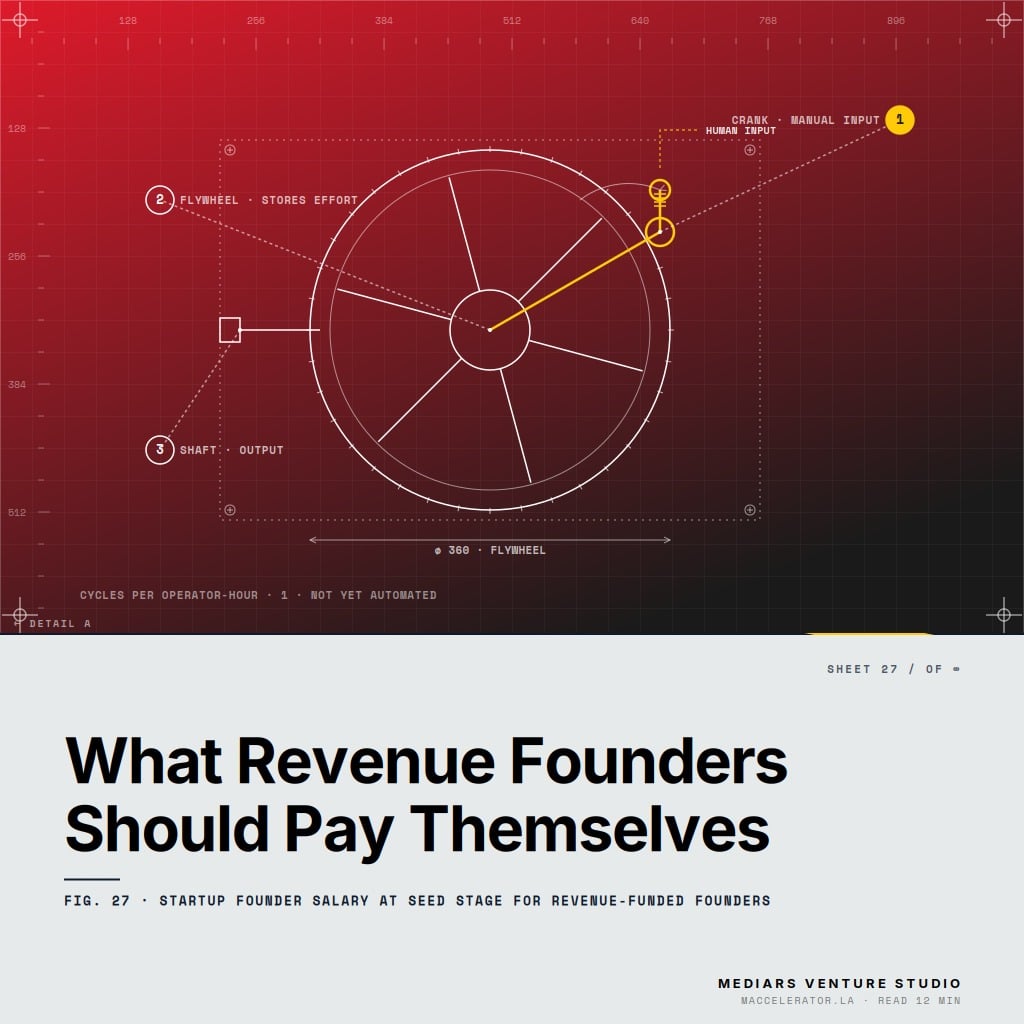
The startup founder salary at seed stage for revenue-funded founders is the deliberate amount you draw from operating cash — typically between $50,000 and $100,000 annually — anchored to a percentage of monthly recurring revenue or net cash flow (commonly 5–10% of ARR) rather than a market-rate benchmark borrowed from VC-backed companies. That distinction matters because your salary comes from the same pool that funds your growth, not from an investor’s balance sheet.
Here’s the tension nobody prepares you for. Every dollar you pay yourself is a dollar not spent on hiring, inventory, ads, or runway. There’s no investor to ask permission, no board to set a comp policy, no raise that explicitly budgets for founder burn.
So you default to one of two extremes.
Across the 500+ founders we’ve worked with across 30 countries, the ones who get this wrong either pay themselves nothing until they quietly resent the business — or pay themselves a corporate salary that slowly starves the thing they’re trying to build. Both feel responsible in the moment. Both compound into bad decisions later.
Why “Just Pay Market Rate” Is the Wrong Advice for You
Most founder-salary advice is written for VC-backed companies. It assumes a raise exists. It assumes salaries are a budgeted line item inside burn that someone already approved.
That advice actively misleads you.
A VC-backed founder draws from investor capital explicitly earmarked for salaries and operating burn. The money was raised to be spent. A revenue-funded founder draws from operating cash — the exact same pool that funds growth.
For you, founder salary isn’t a line item on someone else’s balance sheet. It’s a direct trade-off with reinvestment.
There’s a second trap hidden in the word “seed.” For most people it signals a funding event. For revenue-funded founders, it’s a revenue stage — roughly $50K to $3M ARR — reached without a priced round. You can be at “seed stage” by revenue and have raised exactly zero dollars.
This applies across business models. SaaS, agencies and services, e-commerce, marketplaces — the margin profiles differ wildly, but the core tension is identical. Your pay comes out of the business’s ability to grow.
The benchmarks make this clearer. Salary surveys from OpenVC and Fondo put VC-backed seed founders around $100K–$150K. Those numbers assume external capital behind them.
Now look at a revenue-funded company running on thin net margins. At $800K ARR with a 15% net margin, founder pay swings profitability by double digits. The same $100K that’s a rounding error for a funded startup can be the difference between default-alive and default-dead for you.
That’s why copying the benchmark is dangerous. The number isn’t wrong — the context behind it doesn’t apply to you.
Key Takeaways
- Revenue-funded founders typically pay themselves $50K–$100K at seed stage, anchored to 5–10% of ARR or net cash flow — not to VC-backed market rates.
- Your salary comes from the same cash that funds growth, making it a reinvestment trade-off, not a budget line.
- Both extremes carry compounding costs: underpaying breeds scarcity-driven decisions, overpaying silently erodes runway.
- The right number lives where your personal survival floor overlaps with your business’s capacity to pay.
- The healthiest founders can explain their salary logic in one sentence and review it on a revenue-tied cadence.
The Hidden Price of Underpaying (and Overpaying) Yourself
Salary is a leading indicator. It tells you more about founder psychology and company discipline than almost any other number on the P&L.
Get it wrong in either direction and the cost compounds quietly.
The underpaying trap
Paying yourself nothing feels noble. It’s often the most expensive decision a founder makes.
When your personal finances are under strain, that stress bleeds into every business call you make. You take the wrong client because you need the cash this month. You skip the hire you need because the draw already feels indulgent.
We call it the martyr tax. Undercompensated founders make short-sighted, scarcity-driven decisions — and they rarely see the connection.
The pattern we’ve seen across post-PMF founders is consistent: the ones who paid themselves $0 for 18+ months were disproportionately the ones making rushed, cash-driven moves. Resentment creeps in. Then disengagement. Then a premature exit that looked like burnout but started as a compensation decision made two years earlier.
“The founders who pay themselves nothing aren’t being disciplined. They’re accumulating a debt the business eventually pays back with interest — usually in bad decisions.”
The overpaying trap
The opposite failure is quieter and harder to spot. You set a comfortable salary, lifestyle inflates to match, and the business becomes hostage to your draw.
Runway erodes with no single dramatic moment. You can’t afford the first key hire. If you ever do raise, a bloated founder salary signals poor capital discipline to investors.
Founder burnout surveys consistently show the majority of founders report burnout — and financial pressure sits near the top of the causes. Both extremes feed it. One from scarcity, one from the weight of a business you’ve made dependent on your paycheck.
We break down operational decisions like this weekly — the AI Acceleration newsletter is where founders go to pressure-test the unglamorous stuff.
Should Startup Founders Pay Themselves At All?
Yes. The question isn’t whether — it’s how much and anchored to what.
The “founders should sacrifice everything” narrative produces worse companies, not better ones. A founder operating from personal financial panic is a liability to the business. Clear thinking requires a baseline of stability.
Paying yourself a deliberate, defensible salary is a discipline move, not a reward.
The real work is triangulating the number. Here are three lenses to reason through it. This is a thinking tool, not a formula.
Three Lenses for Setting Your Number
Lens 1: The Survival Floor
This is the minimum you need to stop making scarcity-driven decisions. Not your aspirational lifestyle — your actual personal burn.
Rent or mortgage. Food. Healthcare. Childcare. Debt payments. The real number that lets you sleep and think clearly.
Most founders have never calculated this precisely. They operate off a vague sense of “enough” that’s either too low to be stable or too high to be honest.
Your survival floor is the hard constraint. Pay below it and the martyr tax kicks in.
Lens 2: The Business Capacity Ceiling
This is what the business can pay without compromising its growth engine. Frame it as a percentage of net cash flow or ARR — commonly that 5–10% band at seed stage.
The ceiling protects the company. It answers: what can we draw and still fund the next hire, the next inventory cycle, the next quarter of runway?
If your survival floor sits above your business capacity ceiling, you have a different problem. The business isn’t ready to support you full-time yet — and no salary decision fixes that. Revenue does.
Lens 3: The Replacement Cost Reference
What would you pay someone to do your highest-value role? Not all your roles — your most valuable one.
Use this as a sanity check, never a target. If you’re doing the work of a $180K head of sales but paying yourself $45K, the gap tells you something about how the business is funding itself. It doesn’t mean pay yourself $180K tomorrow.
The right number lives in the overlap of these three lenses — most often in the $50K–$100K band at this stage, varying by business model and personal situation.
Across founders we’ve advised, the healthiest salaries cluster where the survival floor and business capacity genuinely overlap. When those two numbers meet, the decision stops being emotional. It becomes operational.
“The number isn’t the hard part. The hard part is being honest about your real personal burn and your real business capacity in the same conversation.”
What a Healthy Founder Salary Decision Actually Looks Like
You can spot a founder who’s gotten this right. Not by the number — by the calm around it.
Five characteristics show up consistently:
- The salary is a deliberate decision tied to a number, not a default or an afterthought.
- It’s reviewed on a cadence tied to revenue milestones — not frozen, not arbitrary.
- It covers their real personal burn, so money stress isn’t leaking into strategy.
- It leaves the growth engine funded.
- They can explain the logic in one sentence.
Contrast that with the “haven’t thought about it” founder who draws whatever’s left over at month-end. That founder’s compensation swings with cash flow, which means their personal stability swings too. Their decisions follow.
Two patterns from the field
A bootstrapped e-commerce founder at $1.2M ARR indexed pay to a fixed percentage of trailing-three-month profit. When profit grew, the draw grew automatically. When it dipped, so did the salary — but the floor stayed covered. No monthly agonizing. The system made the call.
A services founder at $600K ARR took a different route. She set a modest survival-floor salary and took profit distributions quarterly instead. The salary kept her stable; the distributions rewarded performance without locking the business into a high fixed cost.
Different models. Same underlying clarity. Both could explain their logic in one sentence, and both had removed money anxiety from their day-to-day decisions.
Getting to this clarity is easier alongside founders making the same calls — that’s a lot of what peer rooms like Elite Founders exist for.
Founder Salary: $50K At Pre-Seed, $100K At Seed, $150K At Series A
Here’s the rough staircase the data supports — with a critical caveat for revenue-funded founders.
- Pre-seed: roughly $50K. Often less for bootstrappers still proving the model.
- Seed: roughly $100K for funded founders; frequently lower for revenue-funded ones.
- Series A: roughly $150K, once external capital explicitly budgets for it.
These figures track with OpenVC and Fondo benchmark surveys, which put funded seed founders near a $100K–$130K median. Pre-seed founders land lower, with wide variance.
But that staircase was built on funding events. For revenue-funded founders, the ladder is a revenue ladder, and every rung is paid out of your own cash flow. The $100K “seed” figure assumes someone else funded it.
Read the benchmark as context, not instruction. The funded median tells you what the market pays when the money isn’t yours. Your number stays anchored to your three lenses.
What the Data Says About Founder Pay in 2026
Seed-stage founder salaries are trending upward, but the variance is enormous. The median hides a range that runs from $0 to well above $150K depending on funding, geography, and model.
A few trends matter for revenue-funded founders specifically.
The shift to distributions
More founders are keeping base salary modest and taking profit distributions instead. The logic is partly tax-driven and partly disciplinary — distributions reward actual performance and keep fixed costs low. For a profitable, revenue-funded business, this structure often beats a high salary.
Business model drives the number
A SaaS founder at 80% gross margin has very different capacity than a services founder at 35% or an e-commerce founder managing inventory and thin net margins. The benchmark shifts with the margin profile. Blanket numbers ignore this — which is exactly why generic advice fails revenue-funded operators.
The default-alive mindset
In a tighter capital environment, more founders are staying revenue-funded longer by choice. “Default alive” — the ability to reach profitability on current cash — has moved from a nice-to-have to a core operating philosophy.
That makes this salary question more common and more urgent than it was five years ago. When you’re not raising, your compensation discipline is your capital discipline.
Notably, the mainstream content ranking for founder salary barely addresses the revenue-funded distinction. Most of it assumes a raise. That gap is the entire reason this article exists.
The Secret Of Founder Compensation
The secret is that founder salary was never really a finance question. It’s a psychology question wearing a finance costume.
The number on the pay stub shapes how you make every other decision. Too low and you decide from scarcity. Too high and you decide from obligation to a lifestyle.
Set your salary so money stops being the loudest voice in your strategic decisions.
That’s the whole game. Everything else — the percentages, the benchmarks, the distribution structures — serves that single outcome.
“We’ll Figure This Out Later” — Why That’s the Expensive Choice
Three objections come up every time this topic surfaces. Each deserves a direct answer.
“We don’t have budget for this”
This isn’t a spending decision. It’s a clarity decision.
Thinking clearly about your own compensation costs nothing but honesty and a few hours. Getting it wrong costs far more — in bad decisions, eroded runway, or a burnout exit. The budget objection misreads what’s actually on the table.
“We can figure this out ourselves”
You can. You’re capable of running the numbers.
But founders consistently underestimate how much their own psychology distorts this specific call. Your compensation is the one decision where you’re least able to be objective — you’re too close, too invested, too tangled in guilt or entitlement. An outside lens on your own pay is the hardest perspective to self-generate.
“We’re too early-stage”
Post-PMF with real revenue is exactly when this matters most. Now there’s real money to allocate and real consequences attached to each dollar.
Early is precisely when the default gets set. And here’s the pattern worth remembering: founders who defer this decision rarely make it deliberately later. They just accumulate a default they never actually chose.
The question isn’t whether you’ll have a founder salary. You already do — even if it’s $0. The question is whether you chose it on purpose.
If you want to see how operators at your stage reason through calls like this, the Founders Meetings are a direct way to sit in the room. Limited to founders ready to think seriously about the unglamorous decisions that actually move the business.
FAQ
How much do seed stage founders pay themselves?
Seed-stage founders typically pay themselves between $50,000 and $100,000 annually. For revenue-funded founders specifically, the figure anchors to 5–10% of ARR or net cash flow rather than a market benchmark, because the salary is drawn from the same cash that funds growth. The right number sits where your personal survival floor overlaps with what the business can pay without starving its growth engine.
What is the average salary for a startup founder?
Across funded startups, the average founder salary lands near $100K–$130K at seed stage per OpenVC and Fondo survey data, rising to roughly $150K at Series A. Revenue-funded and bootstrapped founders consistently sit below these figures because they pay themselves from operating cash rather than investor capital. Averages also hide enormous variance driven by business model, geography, and margin profile.
What is the average salary for pre-seed founders?
Pre-seed founders average roughly $50,000, with many bootstrappers taking significantly less while they prove out the model. At this stage, the survival floor — your actual personal burn — matters more than any benchmark. If the business can’t yet cover your real personal needs, that’s a revenue signal, not a salary problem.
What is the typical CEO salary for a $100 million company?
CEO salaries at $100M-revenue private companies commonly run from $300K to $600K+ in base, often with substantial performance-based compensation on top. This is a different universe from seed-stage founder pay — at $100M the salary is a small fraction of revenue and governed by board compensation policy, whereas at seed stage for a revenue-funded founder, every dollar of pay is a direct trade-off with growth.
Founder compensation is one of the quietest decisions you’ll make and one of the loudest in its consequences. Set it on purpose. Review it on a cadence. And make sure money stress never becomes the voice making your strategy for you.