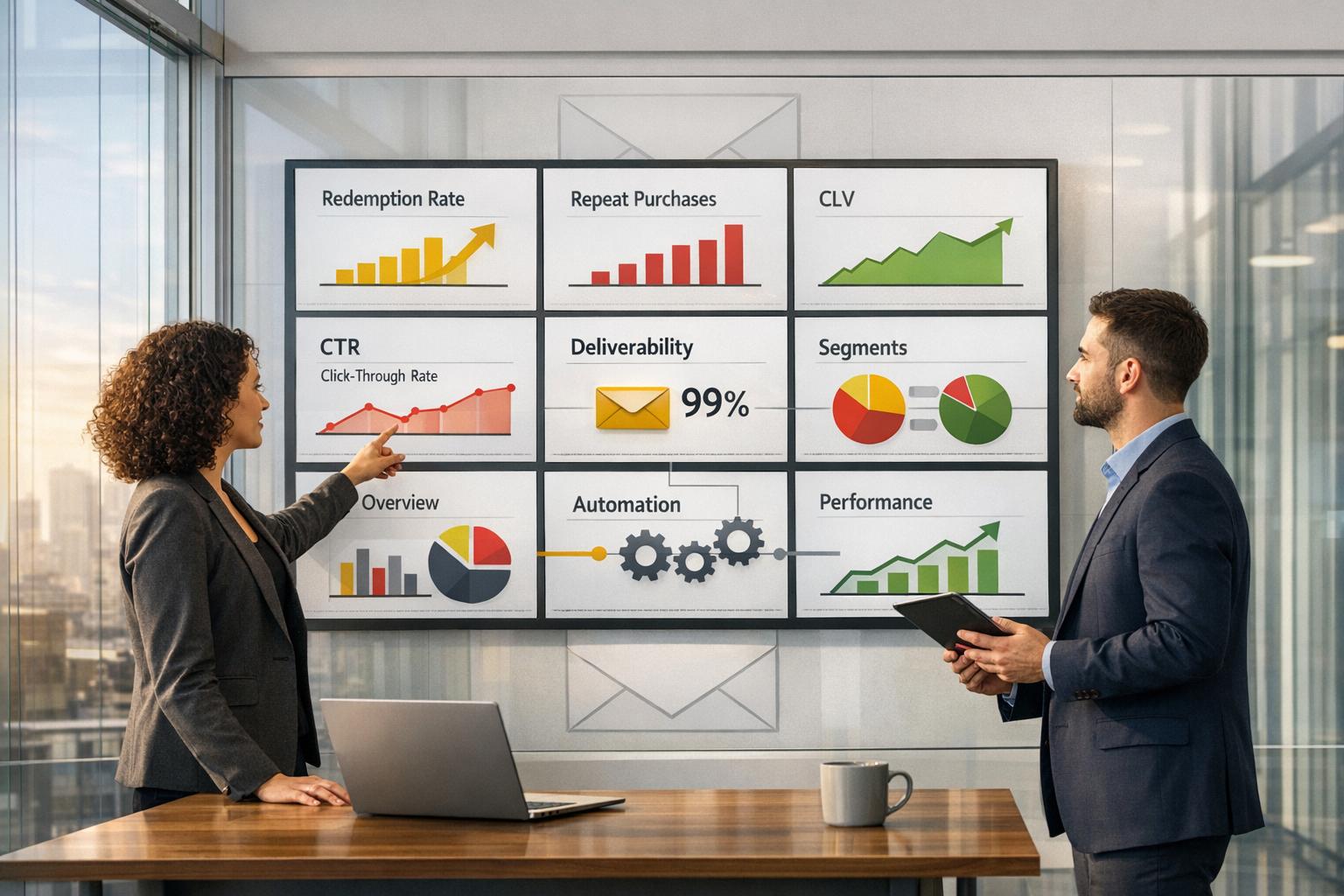
Are your loyalty emails driving revenue, or are you stuck measuring surface-level stats like open rates? Here’s what actually matters: redemption rates, repeat purchases, and customer lifetime value (CLV). Loyalty programs thrive when emails inspire action, not just clicks. Start tracking these key metrics to connect your campaigns directly to revenue growth:
- Open Rate: Aim for 30%-40% by personalizing subject lines and filtering out inaccurate "Apple Privacy Opens."
- Click-Through Rate (CTR): A good CTR is 2%-3%. Use action-driven CTAs and visuals to encourage clicks.
- Conversion Rate: Showcases completed actions like purchases or redemptions. Tie campaigns to tangible outcomes.
- Redemption Rate: Tracks how often rewards are used. Low rates may mean your rewards aren’t relevant.
- Repeat Purchase Rate: Measures how often loyalty members return to buy again.
- CLV Improvement: Evaluates the long-term financial impact of engaged customers.
To ensure success, focus on email deliverability (keep bounces under 2%) and engagement (track actions beyond clicks). Use segmentation, urgency triggers, and automation to refine performance. Loyalty emails aren’t just about communication – they’re about measurable results.
Core Metrics to Monitor
These three metrics are the backbone of a successful loyalty email strategy. They reveal whether emails are delivered, noticed, and – most importantly – whether they inspire action. Let’s dive into each metric and see how they contribute to driving loyalty email revenue.
Discover how AI can elevate your loyalty email campaigns. Join the AI Acceleration Newsletter for weekly insights. At M Accelerator, we create AI-powered systems that simplify campaign management and deliver measurable results.
Open Rate
Open rate tells you the percentage of delivered emails that recipients actually open. For loyalty programs, unique open rates typically range between 30%–40%, outperforming the general benchmark of 15%–25%. Why? Loyalty emails often include updates on points or rewards – things customers actively look forward to.
However, Apple’s Mail Privacy Protection has complicated this metric, with 53.67% of email clients potentially reporting "opens" from server preloads instead of actual engagement. Filtering out these "Apple Privacy Opens" helps you get a clearer picture of genuine interest.
"We know that a 60% open rate doesn’t mean 60% of people actually opened your email. But if we had a 60% open rate on Monday, and on Tuesday we see a 40% open rate, we can compare campaigns and make decisions from there."
– Ananda Farge, Associate Director of Email and SMS Marketing at Accenture
Subject lines are key to driving opens. Keep them under 40 characters (about seven words) to avoid mobile truncation. Personal touches – like the recipient’s name, points balance, or tier status – can make all the difference. Add urgency with phrases like "points expiring" or "limited time offer." A/B testing and segmenting by loyalty tier (e.g., VIPs) can further refine your approach.
With open rates covered, let’s move on to clicks and how they deepen our understanding of engagement.
Click-Through Rate (CTR)
CTR measures the percentage of recipients who click on links in your email – whether it’s a button to redeem points, a special offer, or a product recommendation. A good CTR hovers around 2%–3%, signaling that your content and calls-to-action are hitting the mark.
"Click rate is a true indicator of customer engagement."
– Erin Aguilar, Senior Customer Success Manager at Klaviyo
To improve CTR, use action-driven CTAs like "Claim Your Reward" or "Redeem Now." Highlight progress toward a goal – like "Only 20 points away from a free gift" – to motivate clicks. Including visuals, such as GIFs, photos, or videos, can boost CTR by up to 300%, making rewards feel more appealing and within reach.
A related metric, Click-to-Open Rate (CTOR), divides unique clicks by unique opens. This helps evaluate how engaging your email content is beyond the subject line. For example, a high open rate but a weak CTOR might suggest your subject line is enticing, but the email body falls short in delivering value or clear calls-to-action.
Conversion Rate
Conversion rate measures the percentage of email recipients who complete a desired action, like making a purchase, redeeming a reward, or referring a friend. This metric ties email success directly to revenue. In fact, 54% of consumers report making a purchase via email in the past year, surpassing other marketing channels.
A great example comes from Peacock’s personalized "year-in-review" campaign in July 2025. By showcasing users’ favorite genres and viewing habits, the campaign led to a 20% decrease in churn rate over 30 days and a 6% increase in upgrades from free to paid subscriptions. This highlights how personalized, relevant content can drive results.
To boost conversions, segment your audience by loyalty tier, points balance, or purchase history to ensure emails feel tailored.
"One common mistake ecommerce store owners make is failing to segment their email lists properly. Sending the same generic message to all customers can lead to disengagement."
– Kate Ross, Specialist at Irresistible Me
Simplify the purchase path and use urgency triggers – like points expiration – to encourage immediate action. The easier and more relevant the process feels, the higher your conversions will climb.
sbb-itb-32a2de3
Customer Engagement Metrics
Beyond the basics, these metrics reveal how loyalty emails influence customer behavior, focusing on repeat purchases, reward usage, and lifetime revenue. If you’re looking for more tips to maximize these results, check out our free AI Acceleration Newsletter. While core metrics like delivery rates and clicks are useful, these engagement-focused indicators connect actions directly to revenue growth. Here’s a closer look at how each metric drives customer engagement.
Redemption Rate
Redemption rate tracks the percentage of rewards or points that customers actually redeem. A higher rate shows that your rewards resonate with your audience, while a lower rate might suggest a mismatch between your offerings and their preferences. To optimize this, monitor redemptions tied to specific triggers like birthday rewards, points expiration alerts, or monthly balance updates. For instance, 40% of shoppers are more likely to open emails that mention loyalty offers, proving how targeted messaging can drive engagement.
"If your redemption rate is low, you may want to consider changing your reward options as they are not aligning with your customer needs."
– Ellie Bradford, Influence.io
To boost redemption rates, create urgency with "points expiring" emails, targeting members who have accumulated points but haven’t redeemed them. Short-term offers, like a 30-day expiry reward, can also help identify what works best. However, keep in mind that extremely high redemption rates can increase program costs, so it’s essential to balance appeal with financial sustainability.
Building on reward usage, the next key metric focuses on purchase behavior.
Repeat Purchase Rate
Repeat purchase rate (RPR) measures how often loyalty program members make additional purchases after engaging with your emails. Comparing the behavior of members who opened or clicked on emails against those who didn’t provides valuable insights. RPR reflects customer satisfaction and loyalty, showcasing whether your program fosters habitual purchasing rather than one-time transactions. Considering it costs five times more to acquire a new customer than to retain an existing one, improving RPR can significantly enhance profitability.
"Smart enterprises don’t just count users. They measure behavior change and revenue impact."
– Emil Sarkissian, CEO, Loyalty Methods
Boost RPR by implementing tiered loyalty structures that encourage customers to "level up" for better rewards. Offering double or triple points on bundled or complementary products can also increase both purchase frequency and basket size. Automated "nearness to reward" emails are another effective strategy, creating a sense of urgency and motivating customers to make their next purchase.
Now, let’s shift to the broader financial impact of loyalty programs.
Customer Lifetime Value (CLV) Improvement
CLV improvement measures the additional revenue generated by loyalty email recipients compared to non-recipients, emphasizing the long-term value of your campaigns. To calculate this, compare the CLV of engaged members with non-engaged ones, factoring in transaction value, purchase frequency, and relationship duration. Tracking how quickly email-engaged members move through loyalty tiers can also reveal improvements in CLV.
For example, in January 2025, Ofra Cosmetics combined loyalty, referrals, and automated email marketing to boost customer spending by 59%, generating over $183,000 in revenue. Similarly, Nuud’s automated referral emails led loyalty members to spend 153% more than non-members.
To enhance CLV, automate milestone triggers for birthdays, anniversaries, and tier upgrades to strengthen emotional connections and extend relationships. Use points expiry reminders to drive immediate conversions while managing liabilities. A/B testing subject lines and CTAs – like "points balance" versus "reward available" – can also help identify what drives the highest average order value.
Here’s a quick summary of these key metrics:
| Metric | What It Measures | Why It Matters |
|---|---|---|
| Redemption Rate | Percentage of rewards redeemed | Shows if rewards align with customer preferences |
| Repeat Purchase Rate | Frequency of repeat purchases | Indicates loyalty and reduced churn |
| CLV Improvement | Incremental revenue from engaged members | Reflects long-term profitability of your program |
Email Delivery and Technical Metrics
Getting loyalty emails into your customers’ inboxes is just as important as crafting the perfect offer. Even the most enticing loyalty campaign won’t work if your emails end up in spam. That’s where the deliverability rate comes into play. This metric shows the percentage of emails that actually make it to the inbox, as opposed to just being accepted by the recipient’s server (which is what the delivery rate measures). As of 2024, email providers require authentication protocols like SPF, DKIM, and DMARC to reduce the chances of emails being flagged as spam. Without these safeguards, your emails may never reach your audience.
Another critical factor is maintaining a strong sender reputation. This starts with proactive list management. Remove hard bounces (emails that fail due to invalid addresses) immediately and keep an eye on soft bounces (temporary issues like full inboxes) – if they exceed 2%, it’s time to investigate. Email lists naturally degrade by about 25% each year, so regularly cleaning out inactive users who haven’t engaged in six months is essential. Top email service providers can achieve a 99% delivery rate, but only if you’re sending personalized, relevant content to well-segmented groups, like your VIP customers. By bolstering your sender reputation, you’ll also make tracking key metrics like sign-up and engagement rates much more impactful.
Once your emails are reaching inboxes, it’s time to focus on how recipients interact with them. If you’re looking to refine your loyalty campaigns with AI-driven insights, consider subscribing to our free AI Acceleration Newsletter Join the AI Acceleration Newsletter. M Studio, based in Los Angeles and part of M Accelerator, collaborates with founders to create automated revenue solutions.
"The best way to improve deliverability and lower your email bounce rate is to send good emails to people who asked to receive them."
– Klaviyo
Sign-up rate is a key metric that measures how many email recipients join your loyalty program. If your sign-up rate is low, it could mean your targeting is off or your incentive isn’t attractive enough. Using double opt-in can ensure higher-quality sign-ups while tools like ReCaptcha help block bot enrollments. Testing different rewards – such as bonus points versus exclusive discounts – can reveal what drives conversions and improve the entry point for your automated welcome flows. A strong sign-up rate sets the stage for a successful loyalty program.
Engagement rate takes things a step further by analyzing how members interact with your emails. It’s not just about clicks – track actions like earning points, updating profiles, or participating in gamified promotions. A click-through rate of 2% to 3% is a good baseline, but understanding what happens after the click (e.g., browsing product pages or adding items to carts) gives you a clearer picture of member behavior. Since most people check emails on their phones, optimizing for mobile is crucial. Additionally, monitoring engagement by domain (e.g., Gmail vs. Outlook) can help pinpoint any rendering issues that might be limiting interaction.
Performance Benchmarks and Comparison

Loyalty Email Metrics Benchmarks and Target Performance Guide
Tracking loyalty email metrics is important, but knowing how your numbers measure up to industry standards is just as crucial. Comparing your results to benchmarks helps you spot areas where you excel – or where you might need to step up. The table below highlights key metrics for loyalty programs, showing both ideal targets and industry averages. Need help improving your performance? Check out our free AI Acceleration Newsletter.
| Metric | Target | Average | Optimization Tip |
|---|---|---|---|
| Open Rate | 30%–40% | 15%–25% | Personalize subject lines with member names or point balances. |
| Click-Through Rate (CTR) | >3% | 2%–3% | Use clear, engaging CTAs and visuals to boost clicks. |
| Redemption Rate | 70%–80% | Varies by sector | Send reminders for expiring points to create urgency. |
| Bounce Rate | <2% | <2% | Regularly clean your email list and use double opt-in. |
| Unsubscribe Rate | <1% | <2% | Segment your audience to deliver more relevant content. |
Compare Your Results to Industry Standards
Use these benchmarks to assess your performance. For example, if your open rate is 20%, you’re falling short of the 30%–40% target for loyalty programs. This might mean your subject lines lack personalization – try including point balances or tier status to grab attention. On the other hand, a CTR under 2% could signal that your calls-to-action aren’t strong enough or that your content isn’t connecting with specific groups, like VIP members or at-risk customers.
Redemption rate is a standout metric for loyalty programs. As Loyalty Expert Paweł Dziadkowiec explains:
"Financial reserves should be at the level of the overall redemption rate, which usually is at 70-80%."
If your redemption rate is below 70%, it could mean your rewards aren’t enticing enough or that the redemption process is too complicated. Automated reminders about expiring points can help create urgency and drive higher redemption rates. Similarly, keeping your unsubscribe rate below 1% (compared to the industry average of under 2%) shows that your content is hitting the mark with your audience.
Real-world examples show how these benchmarks translate into success. In 2025, Peacock (NBCUniversal) ran a "year-in-review" email campaign highlighting individual viewing milestones. The result? A 20% drop in churn within 30 days and a 6% increase in upgrades from free to paid subscriptions. Meanwhile, Mercari improved its seller experience with targeted messaging, leading to a 70% year-over-year growth in U.S. gross merchandise volume and reaching 2 million monthly active users. Use these examples and benchmarks to uncover areas where your program can improve.
Next Steps
Tracking loyalty email metrics requires consistent attention and adjustments. To drive revenue effectively, focus on key metrics like open rates, click-through rates (CTR), redemption rates, and customer lifetime value (CLV). Open rates and CTR help gauge how well your content connects with your audience, while redemption rates and CLV provide insights into the financial performance of your loyalty program. Aim to keep your bounce rate below 2% and your unsubscribe rate under 1% to maintain a healthy and engaged email list. For more tips on using AI in loyalty campaigns, subscribe to the AI Acceleration Newsletter here for weekly strategies.
Set a structured schedule to review your performance – daily for anomalies, bi-weekly for campaign analysis, and quarterly for broader customer loyalty trends. Segment your audience into groups like VIP members, at-risk customers, or new sign-ups to uncover targeted opportunities for improvement.
AI tools can significantly simplify and enhance this process. Automation can handle tasks like cleaning your email list, filtering out bot clicks that distort data, and triggering re-engagement campaigns for inactive subscribers. Predictive analytics can also identify customers at risk of leaving, giving you the chance to act early and retain them with personalized outreach.
Incorporating these insights into your workflow creates a strong foundation for long-term success. For step-by-step guidance on building these systems, check out M Studio’s Elite Founders program. This program helps founders integrate CRM systems, marketing automation, and AI tools into streamlined dashboards, combining strategic planning with hands-on execution to create automated systems that deliver immediate results.
FAQs
What are the 3 most important loyalty email metrics for revenue?
The three most important loyalty email metrics for driving revenue are customer lifetime value (CLV), redemption rate, and incremental revenue per member. These metrics help you understand the long-term value of loyal customers, evaluate how effectively rewards are being used, and assess their direct impact on revenue growth. By keeping an eye on these numbers, you can ensure your email campaigns deliver impactful results while fostering ongoing customer engagement.
How do I filter out Apple Mail Privacy “opens”?
Apple Mail’s privacy features can skew open rate data by logging email opens automatically, even if the recipient hasn’t interacted with the email. This makes open rates less reliable as a measure of engagement.
To get a better understanding of how recipients are interacting with your emails, shift your focus to other metrics, such as:
- Click-through rates (CTR): Measure how many recipients are clicking on links within your email.
- Conversions: Track actions taken after clicking, like purchases or sign-ups.
- Website activity: Monitor user behavior on your site after they’ve engaged with the email.
Additionally, using unique tracking links and analyzing behavioral patterns – like time spent on your website or specific page views – can help provide a more accurate picture of recipient engagement. These strategies allow you to work around the limitations imposed by Apple Mail’s privacy settings.
How can I calculate CLV lift from loyalty emails?
To figure out the CLV lift from loyalty emails, start by comparing customer lifetime value before and after launching the email campaigns. Look at key metrics like purchase frequency, average order value, and customer retention rates. Then, assess how these factors work together to influence overall CLV. This approach will give you a clear picture of how effective your loyalty email efforts are.