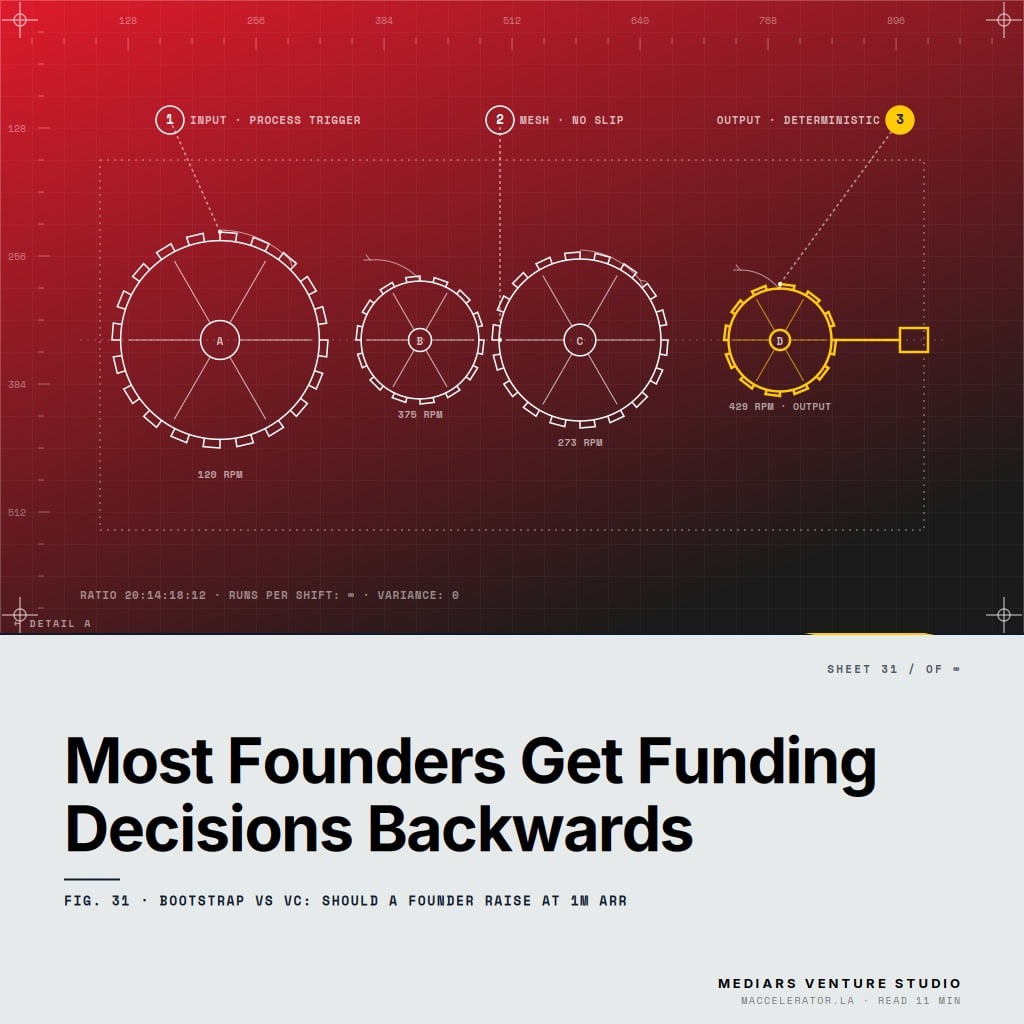
At $1M ARR, most founders should not raise VC by default. The question of bootstrap vs vc: should a founder raise at 1m arr is not a financing decision — it is a diagnostic about whether your business compounds faster with outside capital than without it, and whether you actually want the outcome venture capital requires. Raise only when you have a genuine capital-dependent growth lever and real appetite for a venture-scale exit.
Here is the moment this article is written for. You just crossed $1M ARR. Cold investor emails are landing in your inbox. Two founders in your peer group just announced seed rounds on LinkedIn. And a quiet voice is asking whether staying bootstrapped is leaving growth — or money — on the table.
That pressure is real. It is also the worst possible reason to raise.
$1M ARR is the exact threshold where VC outreach turns on. It feels like validation. It is actually just a signal that your metrics crossed a screening filter. If you want frameworks like this one before you make irreversible calls, the AI Acceleration newsletter breaks them down weekly.
The Real Question Isn’t “Bootstrap vs VC” — It’s “What Outcome Are You Building Toward?”
Bootstrap vs VC is downstream of the exit you want. Most founders get this backwards. They choose the financing path first, then discover — sometimes years later — that it locked them into a destination they never chose.
Venture capital is a machine. It is optimized for one thing: 10x-plus, fund-returning outcomes. Bootstrapping optimizes for different things entirely — owner cash flow, optionality, and control.
A $30M acquisition is a career-defining win for a bootstrapped founder who owns 80% of the company. The same $30M is a rounding error — a disappointment — for a fund that needs your company to return the entire fund.
“The financing you choose encodes the outcome you’re allowed to be happy with. Pick the destination first, or the capital will pick it for you.” — Alessandro Marianantoni
Consider a B2B SaaS founder at $1.2M ARR we worked with. They raised a seed round because the terms were good and the timing felt right. Eighteen months later, they mapped their realistic ceiling: a $40M strategic acquisition.
For them personally, $40M was a phenomenal outcome. For the fund now sitting on their board, it was below the line. The misalignment did not show up on day one. It showed up in every board meeting afterward, in the pressure to chase a trajectory the business was not built to deliver.
The order is the whole game: destination first, capital second. Reverse it and you inherit someone else’s definition of success.
Key Takeaways
- The bootstrap vs VC decision at $1M ARR is a destination choice, not a financing choice — decide the exit you want before you decide how to fund the journey.
- Raise VC only when capital is your binding constraint and a fund-returning exit genuinely exists in your market.
- AI tooling and leaner operations have made it realistic to reach $3M–$10M ARR without external capital — bootstrapping past $1M is more viable than it was five years ago.
- Bootstrap-then-raise is the reversible path. Raise-then-unwind is not. Sequence accordingly.
- Making the wrong call at $1M ARR costs far more than the effort of deciding well.
5 Signals That Tell You Whether to Raise at $1M ARR
You can run this diagnostic today. Five signals determine your answer. Read each one honestly — the goal is clarity, not the answer you want.
1. Capital-dependency of your growth
Ask the hard question: can you grow faster only with more cash? Or is your real constraint something money does not fix — distribution, product maturity, a hiring bottleneck you can solve with cash flow?
Lean VC if capital is the binding constraint. Lean bootstrap if your constraint is non-financial and capital just buys speed you do not need yet.
2. Market timing and winner-take-most dynamics
Is there a genuine land-grab window? Some categories reward the first company to lock up distribution, data, or network effects. Most do not.
Lean VC in winner-take-most markets with a closing window. Lean bootstrap if your market rewards durability over speed.
3. Gross margin and unit economics
Can the business fund its own growth? A company with 85% gross margins and healthy CAC payback is a self-funding engine. A company with thin margins needs external fuel to scale.
Lean bootstrap with high margins and fast payback. Lean VC when the model needs capital to reach efficient scale.
4. Founder appetite for dilution, governance, and timeline
VC adds a board, growth expectations, and a 7-to-10-year clock you cannot pause. Some founders thrive inside that structure. Others find it corrosive.
Lean VC if you want partners holding you accountable to an aggressive trajectory. Lean bootstrap if control and optionality matter more than acceleration.
5. Realistic TAM and exit comparables
Does a fund-returning outcome actually exist in your market? Pull the comparable exits. If the ceiling is $40M–$60M, the venture math does not work — regardless of how good your business is.
Lean VC when credible billion-dollar comps exist. Lean bootstrap when the realistic exit range is a great personal outcome but a weak fund return.
Two patterns make this concrete. A mobility startup we worked with had capital as the binding constraint — fleet expansion was physical and cash-intensive. Capital was the lever. They leaned VC, correctly.
A vertical SaaS founder with 85% gross margins and organic inbound had no such constraint. More cash bought marginal speed and real dilution. They leaned bootstrap, correctly.
The signals rarely all point the same direction — but three or more pointing one way is your answer.
When Raising at $1M ARR Is the Right Call
Let me make the strongest fair case for raising. No strawman. There are real scenarios where VC at $1M ARR is the sharpest move you can make.
The first is a time-sensitive market. If a window is closing and whoever captures distribution first locks the category, speed is survival. Capital buys speed.
The second is funding a proven sales motion. When you have validated CAC payback and every dollar in produces predictable dollars out, raising to pour fuel on a working engine is rational. Speed compounds when the unit economics already work.
The third is hiring ahead of a moat. Some defensibility — proprietary data, regulatory position, network density — requires getting big before competitors do. Capital funds that land grab.
The honest upside of VC is more than money. It brings credibility, a network, and hiring leverage you cannot replicate from a bootstrapped balance sheet alone.
The honest trade is equally real: dilution, board accountability, and a forced growth trajectory you cannot opt out of once you are on it.
Consider a B2B SaaS founder at roughly $1M ARR with a validated 6-month CAC payback. They raised to triple their sales team and captured the category before two funded competitors could establish themselves. The growth velocity justified the dilution — because the money was pointed at a lever that genuinely needed capital.
VC works when capital is aimed at a proven lever that compounds with speed — not when it’s aimed at buying confidence.
When Bootstrapping Past $1M ARR Beats Raising
Now the equally rigorous case for staying bootstrapped. This is not the consolation prize. For many businesses, it is the superior strategy.
Profitable or near-profitable businesses have the best capital source in existence: their own revenue. It is non-dilutive, it compounds, and it answers to no one.
If your growth is organic and referral-driven, you have something most funded startups spend millions trying to buy — distribution that does not require external capital to sustain. High margins make that engine self-reinforcing.
There is a structural tailwind here that did not exist five years ago. AI tooling and leaner operations have collapsed the cost of building and scaling. More businesses now reach $3M–$10M ARR without a single outside dollar.
We worked with a bootstrapped founder who used AI-driven operations to scale from $1M to $3M ARR with essentially the same headcount. They retained 100% of their equity. The leverage that used to require a funding round came from tooling instead.
“Slower but fully owned beats faster but diluted more often than the venture narrative admits. The math only favors speed when speed actually compounds.” — M Studio operator
Address the “slower growth” objection directly. Yes, bootstrapping is often slower. But slower growth on 100% ownership frequently produces more founder wealth than faster growth on a diluted, board-governed cap table chasing an exit that may never materialize.
Founders who need a room of post-PMF peers pressure-testing exactly this call often work through it inside Elite Founders, where the people across the table have made both choices and can tell you what each one cost them.
Control is not a consolation for failing to raise. For the right business, it is the entire point.
How We Help Founders Make This Call Without the Hindsight Bias
Our approach starts where most founders finish: with the destination. Before we discuss a cap table, we establish what outcome actually serves this specific founder and this specific business.
Then we stress-test capital fit. Does outside money accelerate a real lever, or does it just feel like progress? We separate the two ruthlessly, because they look identical in the moment.
Then we model the counterfactual. What happens to this business in 24 months under each path? Not the optimistic deck version — the realistic one, with churn, hiring lag, and market reality priced in.
The asymmetry matters more than most founders realize. Bootstrap-then-raise is reversible. Raise-then-unwind is not. You can almost always raise later from a position of strength. You cannot un-dilute or remove a board once they are in.
Across 25+ years in enterprise environments — Google, Disney, Siemens — and 500+ founders across 30 countries, one pattern holds. The founders who model the counterfactual explicitly make more confident decisions and regret them less, regardless of which path they choose.
We do not default to the “raise equals success” narrative. That narrative serves the people selling capital. Our job is to serve the founder’s actual outcome.
“The founders who regret their financing choice almost never modeled the other path. They chose in the dark and called it conviction.” — Alessandro Marianantoni
You can see more of how this philosophy shapes everything we build in the Studio Approach.
The Objections We Hear (And Honest Answers)
“We don’t have budget for this right now”
Framing the decision costs nothing. The expensive mistake is raising — or not raising — blind.
Making the wrong call at $1M ARR dwarfs any cost of deciding well. A founder who raises reactively and spends the next five years serving a fund that wanted an outcome their business could never produce paid a far higher price than the cost of thinking clearly first.
The decision is cheap. The wrong decision is the most expensive line item in your company’s history.
“We can figure this out ourselves”
Many founders do. That is a fair position. The risk is not competence — it is hindsight bias and investor-led framing.
When the only people narrating your options are the ones who profit from you raising, your frame gets distorted without you noticing. External pressure-testing reduces the chance you optimize for the wrong destination entirely.
You do not need permission. You need a counter-frame to the one being sold to you.
“We’re too early-stage for this”
$1M ARR with inbound interest is precisely the decision window. Not too early — exactly on time.
Wait until a term sheet is on the table and you have already lost your leverage and your clarity. A founder who raised reactively off a term sheet later realized their business was a cash-flow machine, not a venture bet. By then the board was seated and the trajectory was locked.
The best time to decide is before anyone hands you a reason to decide badly.
“We already have advisors — how is this different from a regular accelerator?”
Advisors give opinions. A regular accelerator gives a curriculum and a demo day pointed at raising.
What post-PMF founders need is different: operators who have built at scale, model the counterfactual with you, and are aligned to your outcome rather than a cohort graduation metric. The difference is substance, not format.
FAQ
Is it better to bootstrap or get funding?
Neither is universally better — it depends on your destination. Bootstrap when your business is high-margin, growing organically, and your realistic exit is a strong personal outcome rather than a fund-returning one. Raise when capital is your binding growth constraint, a time-sensitive market window exists, and a billion-dollar outcome is genuinely on the table. Decide the outcome you want first; the financing follows from there.
How many startups reach $1M ARR?
Very few. Reaching $1M ARR already places you in a small minority of startups — most never achieve meaningful, durable revenue at all. That scarcity is exactly why $1M triggers investor outreach: you have crossed a screening filter most companies never clear. Treat that interest as a signal to decide deliberately, not as a mandate to raise.
Should cofounders be 50/50 or 51/49?
Equity splits should reflect contribution, risk, and role — not a reflexive default. A clean 50/50 works when contributions are genuinely equal and both founders trust each other to break ties. A 51/49 or weighted split makes sense when one founder carries decisively more risk or responsibility. Whatever the ratio, vest it over four years with a one-year cliff. The structure matters more than the exact number.
Is 1% equity a lot in a startup?
It depends entirely on the company’s trajectory and stage. At a bootstrapped company staying private, 1% is a modest ongoing stake. At a venture-backed company heading toward a large exit, 1% is a significant grant — and it will dilute across future rounds. Always evaluate equity against the realistic exit range and the dilution you will face before you get there.
Make the Call From Strength, Not Pressure
The founders who get this right are not smarter. They decide before the term sheet arrives, model both paths honestly, and refuse to let someone else’s fund math define their success.
If you are past first revenue and want to make this call with operators who have built at scale and a room of post-PMF peers who have lived both outcomes, this is the room. Apply to Elite Founders — limited to founders ready to scale deliberately rather than reactively.
Decide the destination. Then choose the capital. In that order.