


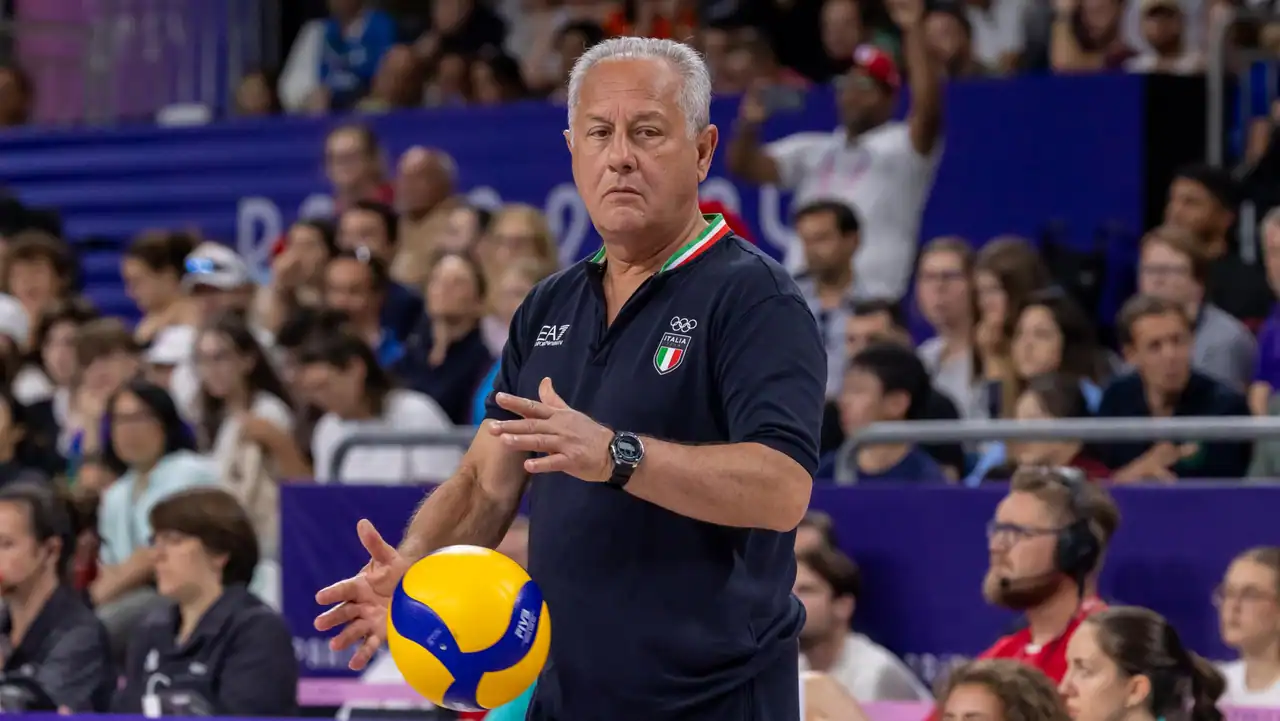
Lessons from Julio Velasco on managing emotions, creating breakthroughs, and building winning cultures
The Coach Who Revolutionized Performance Psychology
Julio Velasco’s journey from philosophy student to legendary volleyball coach mirrors the kind of pivot story familiar to many entrepreneurs. Born in La Plata, Argentina in 1952, Velasco was studying philosophy at university when the 1976 military coup forced him to abandon his studies and flee the country. What seemed like a devastating setback became the foundation of an extraordinary career that would revolutionize how we think about performance, learning, and leadership.
In his recent honorary doctorate speech at the University of Trieste, Italy, Velasco reflected on this turning point: “One of the few good things, actually the only good thing the military did for me was that thanks to that, I started coaching volleyball.”
A Track Record That Speaks Volumes
Velasco’s achievements span over four decades and read like a masterclass in sustained excellence:
With Italy’s Men’s National Team (1989-1996):
- 2 World Championships (1990, 1994)
- 3 European Championships (1989, 1993, 1995)
- 1 Olympic Silver Medal (1996)
- 5 World League titles
With Italy’s Women’s National Team (2023-present):
- Olympic Gold Medal (Paris 2024)
- World Championship Gold (2022)
His coaching philosophy has influenced not just sports, but business leadership worldwide. Today, his insights are taught in MBA programs and quoted by Fortune 500 executives.
The Pressure of Repetition: Why Winning Again Is Harder
At the SPIKE Series and Elite Founders, we often discuss the challenges of scaling success. Velasco offers a unique perspective on perhaps the most challenging aspect of high performance: the obligation to repeat excellence.
“There’s nothing more difficult than repeating a victory,” Velasco explains. “There’s nothing more ephemeral than victory, but we don’t know why. When things aren’t known, people force an explanation. They say ‘there’s no motivation.’ But yes, there is. ‘There’s no commitment.’ But yes, there is. So what happens? I don’t know, but it’s difficult. It’s more difficult.”
This insight cuts to the heart of what many successful entrepreneurs and executives face: the psychological burden of sustained performance. The market doesn’t care about last quarter’s results. Investors don’t care about yesterday’s innovations. The pressure to deliver again and again creates unique emotional challenges.
“Often the most unbearable burden for teams is the obligation to win,” Velasco notes. “This is something fans often don’t understand, and unfortunately, sometimes presidents don’t understand either.”
The Quantum Leap Philosophy: One Change at a Time
Velasco’s approach to improvement directly contradicts the “move fast and break everything” mentality often celebrated in startup culture. Instead, he advocates for what he calls “quantum leaps” – focused, singular improvements that transform the entire system.
“All improvements, whether in sports, intellectual pursuits, or music, happen through quantum leaps,” he explains. “It’s like heating water – it goes from cold to warm to hot to very hot, but it’s still water. At 100 degrees, there’s a qualitative change: it becomes steam. Steam isn’t water anymore, it’s something else.”
His practical application is striking: “If I have seven players on a volleyball team, and each player improves just one thing while everything else remains the same, the team improves seven things. A team that improves seven things in a season isn’t the same team performing a little better – it’s a different team. It changes category.”
For business leaders, this translates to a powerful principle: instead of trying to fix everything at once (the typical consultant approach), focus on one critical improvement per team member or department. The cumulative effect creates systemic transformation.
“If we propose 10 things to improve, in the best case, if they’re very disciplined with great work capacity, they’ll improve a little bit. If we propose one thing to improve at a time, a volleyball team quickly improves seven things.”
The Learning Brain: Processing at Light Speed
Velasco’s understanding of how high performers operate under pressure offers valuable insights for executives managing rapid decision-making in complex environments.
“When a player plays, they interpret, recognize, or read a game situation in milliseconds, without being conscious of how they do it,” he explains. “This is enormously different from intellectual activity. Intellectual activity uses concepts that one is conscious of elaborating. The player isn’t conscious because the processing is too fast.”
This isn’t intuition or magic, as Velasco learned from neuropsychologists: “Intuition isn’t magic – it’s a rational brain operation so fast that the person doing it isn’t conscious of doing it.”
The business parallel is clear: in high-stakes, fast-moving situations, the best leaders aren’t consciously processing every variable. They’re accessing pattern recognition developed through deep practice and experience.
Building Autonomous Excellence
Perhaps Velasco’s most relevant insight for our audience concerns developing autonomous, authoritative team members. His philosophy directly challenges the micromanagement tendencies that plague many growing organizations.
“I want autonomous and authoritative players,” he states. “They need to know volleyball, they need to know how to play, they need to know how to take care of their bodies. Not ‘I know, they do.’ If anything, ‘I teach and they learn,’ but they need to know.”
The reason is practical: “When playing at 24-24 [match point], players are alone. There’s no coach who can help, even if you’re close. In those moments of great tension and stress, players must be autonomous.”
For business leaders, this principle is crucial. In critical moments – investor presentations, crisis management, key negotiations – your team members need to be capable of independent, excellent decision-making. They can’t wait for your direction.
The Courage to Embrace Fear
Velasco’s definition of courage offers a refreshing perspective for entrepreneurs who often feel pressured to project fearlessness:
“It’s not courageous who has no fear. Who has no fear is unconscious. It’s courageous who knows how to manage fear, who knows how to fight it and manages to do the things they need, despite having fear.”
This reframes the startup journey entirely. The goal isn’t to eliminate fear but to build the capability to perform excellently while afraid.
The Feedback Revolution: Correction vs. Judgment
Velasco’s approach to error correction offers a masterclass in performance coaching. He draws a crucial distinction that many leaders miss:
“Correcting is important, judging is harmful. We must correct young people, we must say ‘this is wrong, it shouldn’t be done this way.’ Judging them only makes them close up, only makes them feel they’re not adequate for the circumstances they must face.”
He points to how children master technology: “When they make mistakes with a phone or device, there’s no one judging them. The device corrects them – it doesn’t work. So the signal is clear: ‘that way doesn’t work, you need to press another button.'”
The lesson for business culture is profound: create systems that provide clear, immediate feedback without personal judgment. The goal is learning, not evaluation.
Building the Right Mindset
Velasco challenges the popular notion that individual identity must be sacrificed for team success:
“There’s a phrase often used: ‘the I must become we.’ I believe the I never becomes we, and the I always survives. The point is to build a team where different I’s function better together, not lose their individual identity.”
This insight is particularly relevant for startup culture, where the pressure to be “culture fits” can sometimes suppress the diversity of thought that drives innovation.
“Why should you play as a team? Because it’s convenient. It must be convenient for the different I’s to play as a team, then the team functions.”

The Path Forward
Velasco’s philosophy offers a framework for sustainable high performance that goes beyond the typical “growth at all costs” mentality. His approach emphasizes:
- Focused improvement over comprehensive change
- Autonomous development over dependent execution
- Emotional intelligence over fearless bravado
- Constructive feedback over harsh judgment
- Individual excellence within collective purpose
For the entrepreneurs, executives, and investors in the SPIKE Series community, these insights provide a different path to excellence – one that acknowledges the psychological realities of high performance while building systems that create sustainable competitive advantage.
As Velasco reminds us, “Maybe we need to think about our psyche, our central nervous system, and our mentality, not just think about theirs, and maybe think that the method we’re using isn’t the best.”
The question isn’t whether you have what it takes to succeed. The question is whether you’re building the systems, culture, and capabilities that allow excellence to emerge consistently, even under pressure.