

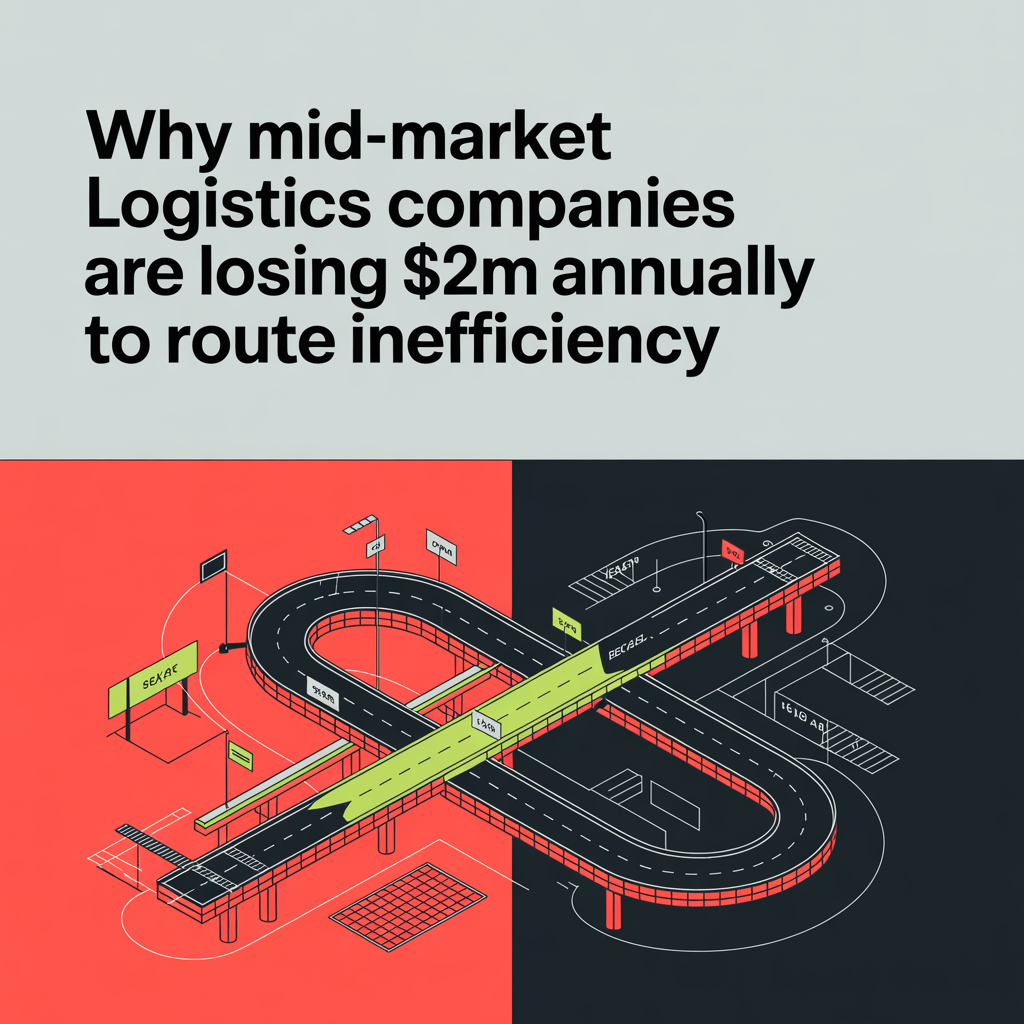
AI route optimization for mid-market logistics isn’t about fancy algorithms—it’s about the $2M annual bleed from inefficient routing that most logistics founders discover only after they’ve scaled past $1M ARR. AI route optimization for mid-market logistics refers to the use of artificial intelligence to dynamically plan and adjust delivery routes in real-time, reducing operational costs by 25-30% while improving delivery performance. Picture this: You just lost your largest client. Not because of service quality or pricing, but because your delivery times couldn’t match a competitor who figured out route efficiency first.
The founder on the other end of that call had built something remarkable. A logistics operation with loyal drivers, solid technology, and genuine customer care. Revenue had crossed $1.8M ARR. Everything looked good on paper. Then came the email: “We’ve decided to consolidate with another provider who can guarantee 2-hour delivery windows.”
What that founder didn’t know—what most don’t realize until it’s too late—is that their routing inefficiency was bleeding $2,000 every single day. Not from one obvious source, but from a thousand small cuts across fuel waste, driver overtime, missed delivery windows, and customer churn.
We’ve worked with over 500 founders across 30 countries, and the pattern is consistent: logistics companies between $500K-$3M ARR lose 15-20% of potential revenue to routing inefficiencies. The tragedy? Most think they’re “not ready” for AI optimization, waiting for some mythical future scale. By then, competitors have already eaten their lunch.
This framework will show you exactly where that money goes—and more importantly, when to act before it’s too late.
The Hidden Cost Structure Most Founders Miss Until It’s Too Late
Every logistics founder knows about fuel costs. It’s the line item staring at you from every P&L. But fuel is just the visible tip of a much larger cost iceberg that compounds as you scale.
Here’s what actually happens: Poor routing creates a cascade effect across three cost layers, each more damaging than the last. The first layer—direct fuel waste—is obvious. Your drivers zigzag across delivery zones, burning 20-30% more fuel than necessary. At $2M ARR, that’s roughly $120K annually in unnecessary fuel spend.
The second layer hides in your payroll. Driver overtime caused by inefficient routes costs mid-market logistics companies an average of $180K annually. A logistics startup we worked with at $2M ARR discovered their drivers were averaging 2.5 hours of overtime daily—not from volume, but from route sequencing that had them crossing the same neighborhoods multiple times.
But the third layer delivers the killing blow: customer churn from inconsistent delivery windows. When routes are inefficient, delivery promises become fiction. “Between 2-5 PM” becomes “hopefully before 6 PM.” One founder tracked this precisely: every hour of delivery delay increased churn probability by 12%. Do the math on your customer lifetime value. It’s devastating.
“We thought we had a customer service problem. Turns out we had a routing problem. Once we saw the real numbers—$2.1M in annual hidden costs—the AI investment became obvious.” – A last-mile delivery founder we worked with who transformed their operation in 6 months
Industry data reveals something shocking: 68% of mid-market logistics companies don’t track true cost-per-delivery including these hidden variables. They see fuel and driver wages. They miss overtime patterns, customer lifetime value erosion, and operational complexity costs.
The compounding effect accelerates after $1M ARR. Every new customer adds complexity. Every new driver multiplies routing permutations. Every market expansion exponentially increases optimization difficulty. Without systematic routing intelligence, costs don’t just grow—they explode. Stay ahead of these industry shifts by joining our AI Acceleration newsletter where we break down the latest logistics optimization patterns.
The Route Optimization Maturity Framework
Not all routing chaos looks the same. After analyzing hundreds of logistics operations, clear patterns emerge in how companies handle route planning. Understanding where you sit on this maturity curve determines everything—from daily firefighting to strategic growth capacity.
The framework breaks into four distinct stages, each with specific symptoms and constraints:
Stage 1: Manual Chaos
This is spreadsheets and driver knowledge. Routes live in Excel files and experienced drivers’ heads. Daily planning means printing maps, highlighting stops, and hoping for the best. Key symptom: When a driver calls in sick, panic ensues because their route knowledge can’t be transferred.
A furniture delivery startup we worked with spent 3-4 hours each morning manually sequencing 40 daily deliveries. The owner personally assigned routes based on “who knows that area best.” It worked until they hit 60 deliveries daily. Then it broke completely.
Stage 2: Basic Digital
Simple routing software enters the picture. Static routes get uploaded, basic optimization runs, drivers receive digital manifests. Progress, but limited. The software treats every day identically, missing patterns and exceptions.
Symptoms at this stage: Drivers regularly deviate from planned routes because “the system doesn’t understand rush hour.” Same-day order additions require complete re-routing. Customer delivery windows stay wide because the system can’t predict accurately.
Stage 3: Adaptive Intelligence
Dynamic routing with real constraints emerges. The system considers vehicle capacity, driver schedules, traffic patterns, and delivery time windows simultaneously. Routes adjust based on conditions, not just distance.
A B2B parts distributor at this stage saw immediate impact: 35% reduction in miles driven, 2-hour daily time savings per driver, customer delivery accuracy jumping from 65% to 88%. But they still couldn’t predict next-day optimal loading sequences or identify systemic inefficiencies.
Stage 4: Predictive Optimization
True AI-driven optimization that learns and predicts. The system identifies patterns humans miss: “Tuesday medical deliveries take 18% longer,” or “Driver C performs 20% better with residential afternoon routes.” Predictive elements anticipate problems before they occur.
Companies reaching Stage 4 report transformational metrics: sub-2-hour delivery windows with 95% accuracy, 30% reduction in total operational costs, driver retention improving because routes match their strengths.
Here’s the critical insight: Companies stuck in Stage 2 lose 3x more to inefficiency than those in Stage 3. Yet most mid-market logistics companies plateau at Stage 2, thinking “good enough” when competitors advance to Stage 3 and 4.
The question isn’t whether to advance stages. It’s how quickly you can move before market pressures force your hand.
Why Traditional Route Planning Breaks at $1M ARR
There’s a mathematical wall every logistics company hits. It arrives suddenly, usually between $800K and $1.2M ARR. One day, route planning takes an hour. The next day, it’s impossible to optimize manually. What changed? You crossed the complexity threshold where human calculation becomes mathematically futile.
Consider the numbers. At 50 daily deliveries across 3 delivery windows with 10 drivers, you face billions of possible route combinations. Not millions. Billions. The human brain—even the best operations mind—cannot process this optimization space.
A B2B logistics founder at $1.2M ARR shared their breaking point with us. They spent 4 hours daily on route planning, used three different spreadsheets, and still missed 20% optimal efficiency. “I knew every customer, every driver preference, every shortcut. Didn’t matter. The combinations overwhelmed everything.”
The Constraint Stacking Problem
Simple distance optimization is solvable. But real logistics operations stack constraints:
- Time windows (“must deliver between 10 AM-12 PM”)
- Vehicle capacity (weight and volume limits)
- Driver schedules (including break requirements)
- Traffic patterns (time-of-day variations)
- Customer preferences (dock appointments, receiving hours)
- Service level agreements (priority vs. standard delivery)
Each additional constraint multiplies complexity exponentially. At 6 simultaneous constraints with 50 deliveries, manual optimization becomes literally impossible—the calculation time exceeds the delivery window itself.
“I thought I was bad at math until I learned the routing problem I was trying to solve would take a computer from the 1990s about 10,000 years to calculate perfectly. That’s when I stopped feeling guilty about our inefficiencies and started looking for AI solutions.” – Mobility startup founder who scaled from $1M to $3M ARR
The inflection point varies by business model but follows predictable patterns. Pure B2B operations hit the wall around 40 daily stops. Mixed B2B/B2C operations break at 60-70 stops. Last-mile B2C delivery compounds fastest, breaking around 80-100 stops.
Traditional solutions—hiring more dispatchers, buying basic routing software, creating delivery zones—provide temporary relief. But they’re bandages on a mathematical problem. The complexity curve is exponential. Linear solutions fail. Only algorithmic intelligence can navigate the possibility space effectively.
This is where top performers separate from the pack. Elite Founders recognize the mathematical impossibility early and implement AI-driven solutions before the complexity overwhelms their operation. The rest discover it during a crisis—usually after losing a major customer or facing a driver revolt.
The AI Advantage: Pattern Recognition vs. Rule Following
Most “AI route optimization” isn’t AI at all. It’s rule-based software with good marketing. Understanding this distinction determines whether you solve the routing problem or just digitize it.
Rule-based systems follow programmed logic: “Minimize distance between stops.” “Respect delivery windows.” “Balance driver workload.” These rules stack into algorithms that produce decent routes. But they miss the hidden patterns that actually drive efficiency.
True AI optimization learns patterns from your operational data. Pattern recognition identifies non-obvious correlations that rule-based systems can’t see. “Thursday afternoon deliveries to downtown take 23% longer.” “Driver B performs 15% better on residential routes.” “Medical facility deliveries before 10 AM average 8 minutes shorter dwell time.”
The Pattern Advantage in Practice
A last-mile delivery startup discovered their AI system identified something strange: Monday morning commercial deliveries completed 40% faster when sequenced in reverse geographic order. The pattern made no sense until they investigated.
Turns out, loading dock availability followed a predictable pattern. Businesses furthest from the distribution center opened receiving earlier. By delivering in reverse order, drivers hit each dock during optimal windows. No human would have spotted this. No rule-based system would have suggested it.
The result? Two hours saved daily across their fleet. $300K annual impact from one pattern among dozens the AI identified.
Industry research confirms the gap: pattern-based routing delivers 35% better efficiency than rule-based systems. But the real advantage compounds over time. Rule-based systems stay static. AI systems get smarter with every delivery.
What AI Actually Learns
- Temporal patterns: How delivery times vary by day, season, weather
- Driver patterns: Individual performance variations by route type
- Customer patterns: Actual vs. stated delivery preferences
- Geographic patterns: Micro-level traffic flows and obstacles
- Operational patterns: Loading sequences that minimize sort time
The learning accelerates. A distribution company we worked with saw their AI system identify 15 efficiency patterns in month one. By month six, it was finding 3-4 new optimizations weekly. Each pattern might save just minutes per route. Multiply by every route, every day, every driver. The compound effect transforms operations.
This is not about replacing human judgment. It’s about augmenting it with pattern recognition humans simply cannot perform. Your experienced dispatchers know their territories. AI knows the mathematical relationships between a million variables. Together, they create routing intelligence no competitor can match.
What Excellence Actually Looks Like (Without the Hype)
Forget the vendor promises of “revolutionary transformation” and “clean integration.” Real AI route optimization excellence looks surprisingly mundane from the outside. The drama happens in the metrics, not the interface.
Picture a typical morning at a well-optimized logistics operation. Drivers arrive to find routes already loaded on their devices. Not just any routes—routes that match their historical performance patterns. The system knows Driver A excels at tight urban deliveries while Driver B handles suburban sprawl efficiently.
New orders flow in throughout the day. The system adapts without fanfare. A priority shipment appears? Routes adjust automatically, maintaining all delivery windows while minimizing disruption. Traffic incident on the highway? Alternative routing triggers before drivers hit the congestion.
The operational reality centers on trust. Drivers trust the routes because the system learned their capabilities and preferences. It doesn’t send the driver with a bad knee to locations requiring stairs. It doesn’t schedule lunch breaks during traffic lulls that experienced drivers use for personal time.
The Metrics That Matter
Excellence appears in specific measurements:
- Cost per delivery dropping 25-30% within 6 months
- Delivery window accuracy exceeding 90%
- Driver overtime reduced by 50-60%
- Customer delivery complaints approaching zero
- Route planning time reduced from hours to minutes
A regional food distributor achieved these numbers without adding a single vehicle or driver while growing volume 40%. Their operations manager spent 80% less time on daily planning, redirecting that energy to customer relationships and strategic improvements.
But here’s what excellence doesn’t look like: It’s not about replacing human judgment. The best systems augment human experience with computational power. Experienced dispatchers remain valuable—they just focus on exceptions and relationships instead of routine optimization.
Excellence also means accepting imperfection. No AI system achieves 100% optimization. The goal is consistent 85-90% optimization versus the 60-70% most companies achieve manually. That 20-25% improvement, sustained daily, transforms the business model.
The companies achieving true excellence share one trait: they view route optimization as a core competency, not a back-office function. They invest in data quality, train teams properly, and iterate continuously. The AI is just a tool. Operational excellence comes from using it systematically.
FAQ
How much data do I need before AI route optimization becomes effective?
The minimum viable data requirement typically spans 90 days of delivery history. This provides enough seasonal variation and pattern density for AI systems to identify meaningful optimizations. You need at least 30 deliveries per day during this period to generate statistically significant patterns. Less than this, and you’re better off with rule-based optimization until you scale. The data should include: complete address information, actual delivery times (not just planned), driver assignments, vehicle types used, and any delivery exceptions or issues. Many founders wait too long thinking they need years of data. Three months of quality data beats three years of sparse records.
What’s the real ROI timeline for implementing AI routing?
The value curve follows a predictable 3-6-12 month pattern. Month 1-3: System learning and basic optimization, expect 10-15% efficiency gains primarily from better route sequencing. Month 4-6: Pattern recognition kicks in, efficiency gains accelerate to 20-25% as the system identifies non-obvious optimizations. Month 7-12: Full optimization maturity, reaching 25-35% total efficiency improvement with predictive capabilities preventing problems before they occur. A logistics company at $1.5M ARR typically sees ROI breakeven by month 4 and generates 3-5x return on investment by month 12. The key is maintaining data quality and system adoption throughout this curve.
Can AI routing work with my existing driver team and fleet?
AI optimization enhances your current resources rather than requiring new assets. The system learns each driver’s strengths—some excel at dense urban routes, others at highway efficiency—and assigns routes accordingly. Your existing fleet gets utilized more effectively; companies typically discover 20-30% excess capacity they didn’t know existed. The biggest challenge isn’t technical but cultural: experienced drivers may initially resist algorithmic routes. Success comes from positioning AI as a tool that makes their jobs easier (fewer angry customers, predictable schedules, optimized breaks) rather than a replacement for their expertise. Most resistance disappears after drivers experience a few weeks of AI-optimized routes.
The routing inefficiency bleeding your logistics operation won’t fix itself. We’ve seen the pattern hundreds of times: founders who know their routes need optimization but feel trapped between “too early” and “too complex.” They watch competitors with inferior service win deals through better delivery promises.
The hidden costs compound daily. Driver overtime from inefficient sequencing. Customer churn from missed windows. Fuel waste from overlapping routes. At typical mid-market scale, this adds up to $2M annually—money that could fund expansion, technology upgrades, or simply drop to your bottom line.
The question isn’t whether to optimize. It’s how to approach it strategically without disrupting current operations. AI route optimization for mid-market logistics has moved from competitive advantage to table stakes. The companies thriving in 2025 made this transition look effortless. Behind the scenes, they followed systematic frameworks to transform their routing operations.
If you’re seeing these inefficiencies in your logistics operation and want to explore frameworks for addressing them systematically, we run founder meetings where we dive deeper into implementation strategies. No fluff, just founders sharing what’s actually working. Limited to 20 operators ready to transform their routing operations.