

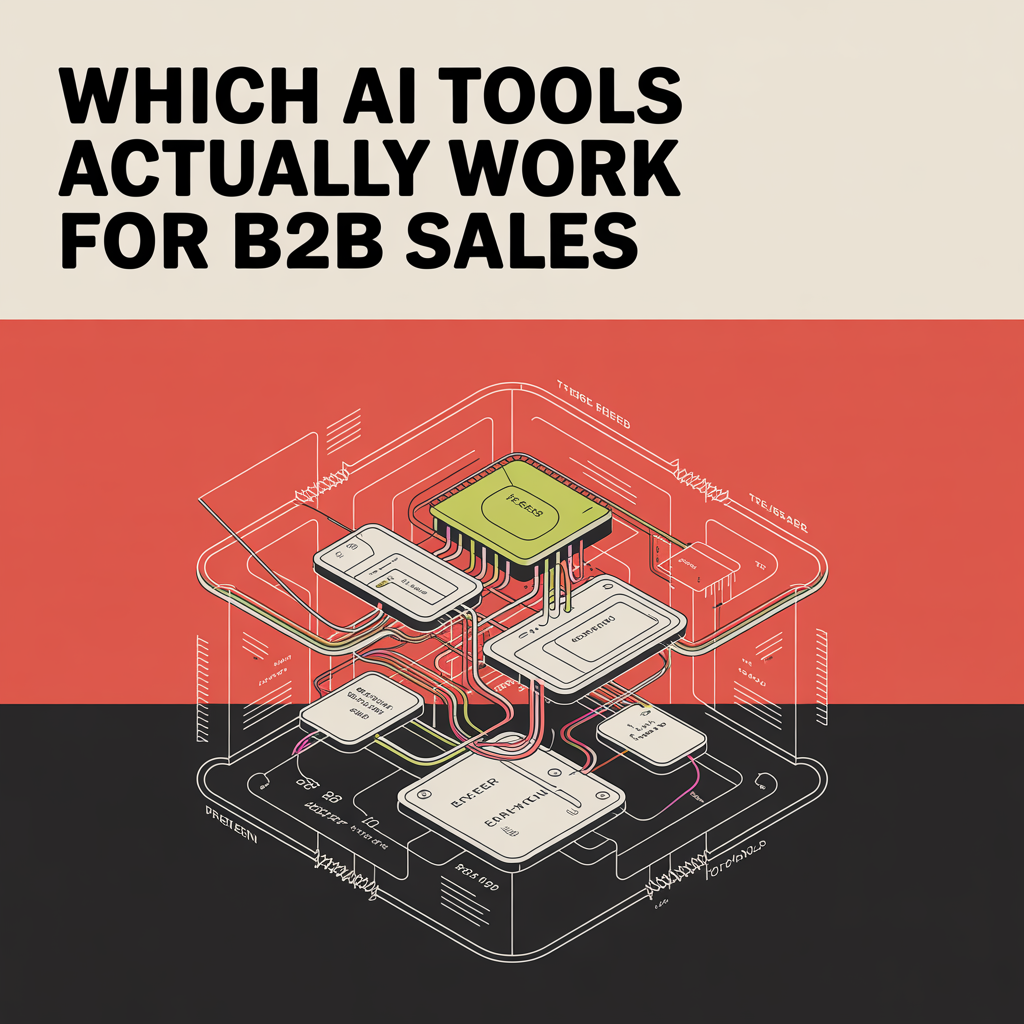
Most AI tools for B2B sales are expensive distractions that drain budgets and deliver minimal results. After working with over 500 founders, we’ve identified exactly which AI tools actually work for B2B sales: conversation intelligence platforms, lead scoring systems (but only at scale), email personalization engines, and pipeline analytics tools — everything else is noise until you hit $3M ARR.
Picture this: You’re a founder at $500K ARR. Your inbox overflows with AI tool demos. You’re already spending $3,000 monthly on sales tools your team barely touches. Meanwhile, your close rate sits at 15% and you’re still doing most of the selling yourself.
Sound familiar?
Here’s what nobody tells you: The AI sales tool industry is built for enterprise sales teams with 50+ reps, not early-stage founders who need leverage. You don’t need more tools. You need the right ones.
A B2B SaaS founder we worked with recently cut their AI tool stack from eight platforms to three. Their qualified meetings jumped 40% in 60 days. Their monthly tool spend dropped from $3,200 to $900.
The difference? They learned which categories actually move the needle versus which just move money out of their account.
The Real Problem With AI Sales Tools (It’s Not What You Think)
The issue isn’t that AI doesn’t work. The issue is that 90% of AI sales tools are built for companies that don’t look like yours.
These tools assume you have:
- A 10-person sales team to manage the platform
- Six months of clean CRM data
- Established sales processes to automate
- A dedicated ops person to maintain everything
- $10K+ monthly budget for tools alone
A founder at $800K ARR learned this the hard way. They spent three months implementing an AI SDR tool that promised to “automate your entire outbound motion.” The result? The tool required more management than hiring an actual SDR. It needed daily prompt adjustments, constant monitoring for hallucinations, and produced generic messages that tanked their 23% reply rate down to 4%.
The data backs this up: 73% of AI sales tools show less than 20% adoption after 90 days in companies under $5M ARR.
Why? Because these tools solve enterprise problems, not startup problems.
Enterprise sales teams need tools that coordinate complexity — managing territories, routing leads across dozens of reps, maintaining compliance standards. Your problem is different. You need tools that create leverage — helping one or two people do the work of five.
A mobility startup we worked with discovered this distinction after burning through $50K in AI tools over four months. Their head of sales spent more time managing the tools than actually selling. They finally developed what they call the “2-week kill rule” — if a tool doesn’t show clear value in 14 days, it’s gone.
That rule eliminated 80% of their stack.
The 4 Categories That Actually Work (With Proof)
After analyzing patterns across hundreds of B2B startups, four AI tool categories consistently deliver ROI before $3M ARR. Not twenty. Not ten. Four.
Here’s exactly what works and why:
1. Conversation Intelligence (The Fastest Path to Sales Process Clarity)
These tools record, transcribe, and analyze your sales calls. Simple concept, transformative results.
A B2B founder at $600K ARR discovered their “aha moment” pitch was happening 23 minutes into calls — way too late. They restructured their demo flow to hit that moment in minute seven. Close rate jumped from 18% to 31% in six weeks.
Minimum viable setup: Start recording all calls. Review one call daily. Look for patterns in closed-won deals. You’ll spot your winning talk tracks within 30 calls.
ROI threshold: Works from day one if you’re doing 5+ demos weekly.
2. Lead Scoring (But Only If You Have Volume)
AI lead scoring is worthless until you hit 500+ leads monthly. Below that, you’re teaching the AI with insufficient data.
A SaaS founder at $1.2M ARR implemented lead scoring after reaching 800 monthly leads. The AI identified that leads who visited their pricing page twice within three days had 4x higher close rates. They restructured their follow-up sequence around this insight. Qualified meetings increased 52%.
Minimum viable setup: 500+ monthly leads, six months of historical data, clear definition of what makes a good lead.
ROI threshold: Not worth it below 500 leads/month. Period.
3. Email Personalization at Scale (The One Place AI Beats Humans)
Humans write better individual emails. AI writes better emails at scale. Once you’re sending 50+ outbound emails daily, AI personalization tools become essential.
A fintech startup we worked with used AI to personalize first lines based on LinkedIn activity and company news. Their cold email reply rate jumped from 8% to 22%. The key? They still wrote the core value prop manually — AI only handled the personalization layer.
Minimum viable setup: Template library of 5-10 proven messages, clear ICP definition, 50+ daily email volume.
ROI threshold: Becomes valuable at 50+ emails/day, essential at 200+.
4. Pipeline Analytics (Spotting Deal Risks Before It’s Too Late)
These tools analyze your pipeline behavior and flag at-risk deals. The magic happens in the early warning system.
A B2B founder at $2M ARR discovered that deals with no executive engagement after demo had an 85% loss rate. They built an executive intro requirement into their sales process. Win rate increased 28%.
Minimum viable setup: 20+ active opportunities, consistent CRM usage, defined sales stages.
ROI threshold: Valuable at 20+ monthly opportunities, critical at 50+.
Notice what’s not on this list? AI SDRs, chatbots, predictive analytics platforms, intent data tools. These work great at $10M+ ARR. Before that, they’re expensive distractions.
Want to see how these tool categories evolve as you scale? Our AI Acceleration newsletter breaks down the progression from $50K to $50M ARR.
The Evaluation Framework That Cuts Through the BS
Every AI vendor promises transformation. Here’s the three-signal qualification method that cuts through the noise:
Signal 1: Time to First Value
If a tool takes more than 2 weeks to show results, it’s not for you. Enterprise tools require months of setup because enterprises have months to spare. You don’t.
Ask vendors: “Show me a founder who got value in week one.” If they can’t, walk away.
A B2B founder at $400K ARR shared their experience: “The vendor said implementation would take 6-8 weeks. Red flag. We pushed for a 2-week pilot instead. By day 10, it was clear the tool needed more data than we had. Saved us $15K and two months.”
Signal 2: The 10x Rule
Simple math: Will this tool save 10x its cost in time or generate 10x in pipeline value?
Break it down:
- $500/month tool = needs to save 50 hours or generate $5K in pipeline monthly
- $2,000/month tool = needs to save 200 hours or generate $20K in pipeline monthly
A founder at $1.2M ARR applied this rule to their stack. Result: Kept conversation intelligence ($600/month, generated $8K monthly in faster deal velocity). Killed their $2K/month intent data platform that generated zero qualified leads in 90 days.
Signal 3: The Single User Test
Can one person get value without coordinating a team? If not, you’re too early for that tool.
Enterprise tools require teams because enterprises have teams. Your sales “team” might be you plus one SDR. Maybe.
Test question: “Can I get value if I’m the only user for the first month?” If the answer is no, you’ll never reach critical mass for adoption.
Let’s evaluate a real tool using these signals:
Tool: Popular AI Email Sequencing Platform ($1,200/month)
- Time to First Value: 4-6 weeks (needs integration, data import, sequence building) ❌
- 10x Rule: Needs to generate $12K monthly pipeline — possible but unproven ⚠️
- Single User Test: Requires coordination between sales, marketing, and ops ❌
Verdict: Not ready for this tool until $2M+ ARR with dedicated ops support.
“The biggest mistake founders make is buying tools for the company they want to be, not the company they are. Start with tools that work at your current stage.” – Alessandro Marianantoni
What Nobody Tells You About Implementation
Here’s the dirty secret: Implementation kills more AI initiatives than bad tools.
The pattern repeats across every founder we’ve worked with. Exciting demo. Ambitious rollout plan. Two months later, adoption hits 15% and the tool becomes shelfware.
The Data Hygiene Trap
Most AI tools need six months of clean CRM data to work properly. Look at your CRM right now. How clean is that data? Really?
A B2B founder at $900K ARR learned this lesson: “The vendor said our data was ‘mostly fine’ for their lead scoring AI. Three weeks into implementation, the model was scoring our best customers as low-quality because half our ‘closed won’ deals were tagged as ‘closed lost.’ Garbage in, garbage out.”
The Pilot Purgatory Problem
Free trials sound free. They’re not. Every pilot costs:
- 20-40 hours of setup time
- Daily management attention during the trial
- Team disruption from another “priority” project
- Opportunity cost of not fixing actual problems
A wellness tech startup tracked their true pilot costs: $8,000 in time per tool tested. They tested 12 tools in six months. Do the math.
The Champion Dependency Risk
Your best salesperson becomes the AI tool champion. They leave. The tool dies. We’ve seen this pattern dozens of times.
Implementation without redundancy is implementation failure waiting to happen.
The 30-Day Proof Framework
Here’s the framework that actually works:
Week 1: Single Use Case Sprint
Pick ONE specific use case. Not five. One. Implement only that.
Week 2: Measure and Adjust
Track one metric. Did it move? If not, pivot the use case.
Week 3: Expand or Exit
Clear improvement? Add a second use case. No movement? Kill it.
Week 4: Document or Delete
Working? Document the process. Not working? Cancel immediately.
A mobility startup used this framework to test five tools in five months. Result: Two tools made the cut, both showing ROI within 14 days.
Implementation separates successful AI adoption from expensive failures. In our Elite Founders sessions, members share their implementation war stories and what actually worked.
Alternative Approaches (Including Why Some Founders Skip AI Entirely)
Not every path to sales success runs through AI tools. After working with hundreds of founders, we’ve seen three distinct approaches — each with clear trade-offs.
Path 1: The DIY Implementation Route
Buy tools, figure them out internally. A founder becomes the champion.
Pros:
- Lowest upfront cost
- Complete control over implementation
- Deep internal knowledge develops
Cons:
- 60-90 day implementation timeline
- High failure rate without external guidance
- Founder time becomes the bottleneck
A B2B SaaS founder at $700K ARR took this path. Six months later: “We got there eventually, but I spent 200 hours that should have gone to selling. Looking back, that time cost us at least $200K in delayed revenue.”
Path 2: Managed AI Services
Hire agencies or consultants to implement and run AI tools for you.
Pros:
- Fastest implementation
- Expertise included
- No internal resource drain
Cons:
- $10K-30K monthly cost
- Dependency on external team
- Less internal capability building
A fintech founder at $1.5M ARR tried this: “Great results for six months. Then we brought it in-house and realized we didn’t understand our own systems. Had to basically start over.”
Path 3: AI-Assisted Human Teams
Hire humans, augment with selective AI tools.
Pros:
- Flexibility and judgment of humans
- AI handles repetitive tasks
- Lower tool costs
Cons:
- Higher salary costs
- Still requires tool selection and implementation
- Scaling constraints
This hybrid approach often works best for founders between $500K-2M ARR. A B2B founder at $1.1M ARR built this way: “We hired two good SDRs and gave them conversation intelligence plus email personalization tools. Cost less than one enterprise AI platform and delivered better results.”
The Deliberate Minimalists
Some successful founders deliberately minimize AI until much later stages.
A B2B founder at $2.3M ARR explained their logic: “Every hour spent on tools is an hour not spent understanding our customers. We use basic conversation intelligence and nothing else. Our close rate is 34% because we know our buyers cold.”
This works when:
- Your market is relationship-driven
- Deal sizes exceed $50K ACV
- You have exceptional salespeople
- Customization matters more than scale
The key insight? There’s no universal answer. The right approach depends on your market, team, and growth trajectory.
Accelerators help founders navigate these choices by sharing patterns from similar companies. Not prescriptions — patterns. The difference matters.
Where These Patterns Come From
One note on the source of this framework. M Studio operates as a venture studio — we design and deploy sales infrastructure for large enterprise organizations: pipeline intelligence, signal-based scoring, automated qualification layers that run unattended. That same infrastructure gets installed, unmodified, into the tech stack of founders who earn a seat inside Elite Founders. The categories above aren’t theoretical. They’re what we port from enterprise environments into founder-scale ones.
We don’t open the cohort often. Seat openings for the next tryout get announced to the AI Acceleration newsletter first.
Addressing the Elephants in the Room
Let’s address the three objections every founder has about investing in AI sales tools.
Objection 1: “We Don’t Have Budget”
Translation: “We’re not sure this will pay off.”
Fair concern. Here’s the real cost calculation:
If you’re doing founder-led sales past $1M ARR, you’re already paying a hidden tax. Your hourly rate as CEO is roughly your ARR divided by 2,000. At $1M ARR, that’s $500/hour.
Spending 30 hours weekly on sales? That’s $15,000 in CEO time monthly.
A conversation intelligence tool at $600/month that cuts your sales time by 20%? That saves $3,000 monthly in CEO time alone.
The question isn’t whether you can afford AI tools. The question is whether you can afford not to systematize.
A founder we worked with did this math at $800K ARR. They immediately invested in two tools that cut their personal selling time from 30 to 18 hours weekly. Four months later, they crossed $1M ARR — two months ahead of projection.
Objection 2: “We Can Figure This Out Ourselves”
Yes, you can. But at what opportunity cost?
Data from our portfolio shows:
- Solo implementation: 90-120 days average to positive ROI
- Guided implementation: 30-45 days average to positive ROI
- Failed implementations: 37% solo vs 8% with guidance
A B2B founder at $600K ARR shared their experience: “We spent four months trying to implement conversation intelligence ourselves. Finally got help from other founders who’d done it. Turns out we were analyzing the wrong metrics entirely. Those four months of wrong analysis cost us at least $150K in missed optimizations.”
You can learn through trial and error. Or you can learn from others’ trials and errors. One costs time you don’t have.
Objection 3: “We’re Too Early-Stage for This”
There’s truth here. Below $50K ARR, skip AI entirely. Focus on founder-led sales and finding product-market fit.
But the window opens quickly:
- $50K-250K ARR: Conversation intelligence only
- $250K-500K ARR: Add email personalization
- $500K-1M ARR: Add pipeline analytics
- $1M+ ARR: Consider lead scoring if volume justifies
A founder who waited until $3M ARR to implement any sales tools told us: “I thought we were being smart by staying lean. In reality, we burned out two sales hires who quit because they had no tools. The replacement cost alone would have funded our tool stack for two years.”
Too early is real. But most founders err on the side of too late.
“The best time to implement sales tools is right before you desperately need them. The second best time is right now.” – M Studio operators
Key Takeaways
- Only 4 AI tool categories work before $3M ARR: conversation intelligence, lead scoring (at scale), email personalization, and pipeline analytics
- The 3-signal evaluation framework (Time to First Value, 10x Rule, Single User Test) cuts through vendor BS
- Implementation fails more often than tools fail — use the 30-day proof framework
- Alternative approaches (DIY, managed services, hybrid teams) each have clear trade-offs
- Budget concerns usually mask ROI uncertainty — do the real math on founder time
FAQ
What’s the minimum ARR to start using AI sales tools?
$50K ARR is the threshold where you have enough data and activity to make AI worthwhile. Below that, focus on founder-led sales and learning your market. The first tool should always be conversation intelligence — it works from day one if you’re doing 5+ demos weekly. Don’t add a second tool until you hit $250K ARR and have consistent sales patterns to optimize.
How much should we budget for AI sales tools?
Start with 5-10% of your monthly sales expenses. For a $500K ARR company, that’s typically $500-1000/month maximum. This assumes your sales expenses are roughly 30% of revenue. As you scale, the percentage can increase, but only if each tool passes the 10x ROI test. A $1M ARR company might budget $2,000/month, but should see $20K+ in monthly value from that spend.
Can AI tools replace our need to hire salespeople?
No. AI tools amplify human performance, they don’t replace it. Plan to hire your first salesperson by $300K ARR, then use AI to make them more effective. The pattern we see repeatedly: founders who delay hiring while hoping AI will save them end up burning out and stunting growth. AI tools help your salespeople close more deals, not eliminate the need for salespeople.
The path to effective AI implementation isn’t about finding perfect tools. It’s about matching the right tools to your stage and implementing them properly.
Most founders discover this through expensive trial and error. The smart ones learn from others who’ve already made those mistakes.
Ready to skip the expensive learning curve? Our Founders Meeting brings together B2B founders who’ve tested these tools in the trenches. Real implementation stories, real results, no vendor pitches.
Limited to 20 founders ready to move past tool tourism and into systematic growth.