

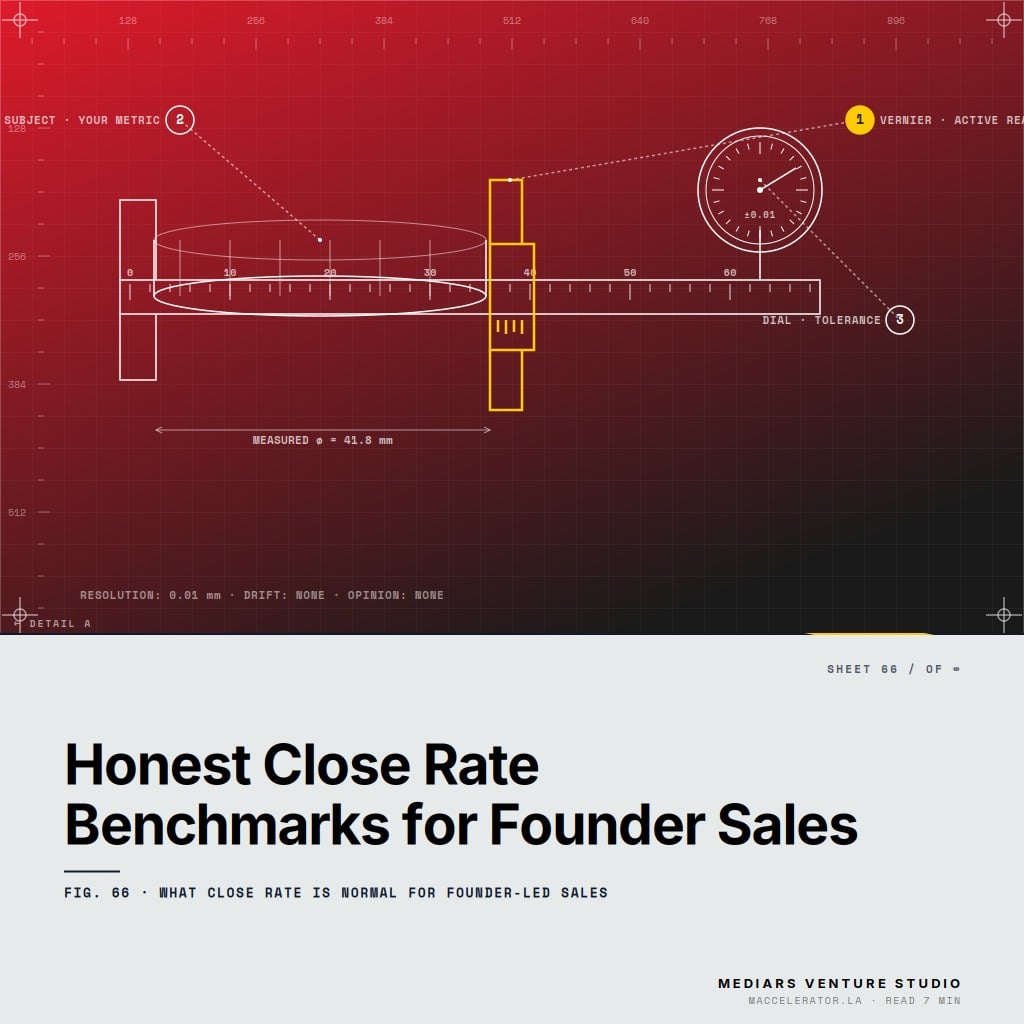
It’s 11pm and you’re refreshing your CRM again, staring at a close rate you can’t interpret. So let’s answer the real question directly: what close rate is normal for founder-led sales typically falls between 15% and 30% of qualified opportunities, with strong performers reaching 30-40% on well-qualified pipeline. Warm and inbound deals close higher than cold outbound. Every time.
But here’s the part nobody tells you. The “normal” number matters far less than the quality of what you’re measuring.
You’ve probably scrolled through founder communities looking for a benchmark. One Reddit thread swears 10% is the floor. A Facebook group member brags about 60%. The spread is useless because none of those numbers are comparable — different deal stages, different qualification standards, different business models entirely.
Across 500+ founders in 30 countries, we’ve seen the same pattern: the founder with the “lower” close rate often has the healthier business. The number is just a symptom. What it’s a symptom of is the actual story.
Why “What’s a Normal Close Rate?” Is a Trap Question
A 60% close rate on 5 warm referrals and a 20% close rate on 100 cold leads are not the same achievement. In fact, the 20% founder may be building the more scalable company.
Raw close rate is meaningless without a denominator. Close rate on what?
Three variables distort any comparison:
- Lead source and temperature. Referrals close far higher than cold outbound. Mixing them produces a blended number that describes nothing.
- What counts as an “opportunity.” One founder counts every curious reply. Another counts only budget-confirmed buyers. Same word, different universe.
- Deal stage where you start counting. Measuring from first touch versus from a qualified demo changes the math completely.
Consider two archetypes. A B2B SaaS founder at $600K ARR closes 55% — but only sells to referral-only deals. A consumer-subscription founder closes 18% off paid acquisition at real volume.
The 55% founder has no engine. They have a network. When the referrals slow, growth stops. The 18% founder has a repeatable acquisition motion that scales with spend.
The higher number is the fragile one.
Key Takeaways
- A normal founder-led close rate is 15-30% blended; 30-40%+ on well-qualified ICP pipeline is strong.
- Close rate is uninterpretable without defining source, stage, and fit.
- A very high rate often signals too little pipeline, not elite selling.
- Technical and introverted founders frequently out-close polished reps.
- Hire a salesperson only when you can predict close rate by segment and explain wins and losses.
The Three Lenses: Source, Stage, and Fit
To read your own number honestly, run it through three lenses before you judge yourself.
Source. Segment your close rate by where the lead came from — referral, inbound, outbound, partner. A single blended rate hides everything that matters. The segments tell you which channel actually works.
Stage. Define where “opportunity” begins. Is it a booked call? A scoped need? A verified budget? Pick a line and hold it. Without a fixed starting point, your rate drifts with your mood.
Fit. Measure close rate on ICP-matched prospects separately from everyone else. This is where the truth lives.
A healthy engine shows a clear gradient: high close on warm and ICP-aligned prospects, lower on cold and off-ICP. When there’s no gradient, something is broken. Either you’re over-qualifying and leaving pipeline on the table, or you’re chasing bad-fit deals that were never going to close.
“Most founders who think they have a bad close rate actually have a strong ICP rate diluted by unqualified volume. They’re not bad at selling. They’re bad at measuring.” — Alessandro Marianantoni
We worked with a SaaS founder who “felt” like a 15% closer and was quietly convinced they couldn’t sell. Segmented by fit, they closed 38% within ICP. The 15% was real — but it was a measurement problem, not a selling problem.
Founders who want benchmark breakdowns and weekly operating frameworks can follow along through the AI Acceleration newsletter.
What Good Looks Like: Realistic Benchmarks by Context
Here are directional ranges for founder-led sales. These are patterns, not laws.
- Inbound / referral: 30-50%. Trust and intent are already high.
- Warm outbound: 15-30%. Some signal, some relationship.
- Cold outbound: 3-10%. Starting from zero context.
- High-ticket considered B2B: 20-35% on qualified pipeline.
- Transactional / lower-ACV consumer: lower per-deal, higher volume.
Most founders early post-PMF land in a 15-25% blended range. That is normal. It is not a red flag.
The real signal of “good” isn’t a single percentage. It’s two things working together.
First, your close rate stays stable or improves as volume scales. Second, you can articulate why each deal was won or lost. A founder who closes 22% and knows exactly why is in better shape than one who closes 35% and shrugs.
Legibility beats the number.
“I’m a Technical Founder — I Can’t Sell”
This belief costs founders more revenue than any pricing mistake. Let’s dismantle it.
Selling at this stage is not a personality trait. Technical and introverted founders often out-close polished salespeople — because early sales is about understanding the problem deeply, not performing charisma.
“Founder-led sales is diagnosis, not persuasion. The prospect isn’t buying your confidence. They’re buying your understanding of their problem.” — M Studio operators
The “I feel pushy” objection usually points to a fit problem, not a skill problem. Pushiness comes from selling to people who don’t need what you’ve built. When you lead with fit, selling feels like helping. Because it is.
We worked with a technical founder at $900K ARR who closed better than their first sales hire. The reason was simple: they answered every objection with substance. Prospects trust the builder who knows the system over a rep reciting a script.
Your depth is an asset. Stop apologizing for it.
Should You Hire a Salesperson Instead?
The instinct to escape founder-led sales by hiring is understandable. Hired too early, it fails more than half the time.
Here’s the common sequence. The founder hands off sales before the motion is repeatable. The rep can’t sell what the founder never codified. The deals dry up, and the founder concludes “sales is hard” — when the truth is the playbook never existed.
The readiness bar is conceptual, not revenue-based:
“You can hire when you can predict your close rate by segment and explain every win and loss. Until the engine is legible, a rep is just an expensive guess.” — Alessandro Marianantoni
Until then, founder-led sales is doing double duty as product research. Every call teaches you something a rep would never surface.
We worked with a founder who hired at $400K ARR, churned two reps, and nearly gave up on the model. They succeeded only after codifying the motion themselves first. Founders working to make their sales motion legible before scaling often do this alongside a peer group of post-PMF operators — which is the core of the Elite Founders group.
Why Founder-Led Sales Benchmarks Matter More in Today’s Market
Knowing your real number used to be a nicety. Now it’s survival.
Tighter capital means you must prove an efficient go-to-market before anyone funds a sales team. Investors want to see a legible engine, not a hopeful hire.
Buyers are more skeptical than they’ve been in years. They respond to founder credibility precisely because they’re tired of being sold. Your technical depth is now a conversion advantage.
AI tooling has flooded inboxes with outbound volume. That makes qualification — and the ability to interpret close rate by segment — more critical than ever. Volume without fit is noise.
Sales cycles have stretched. Longer cycles compress close rates and spook founders who don’t know what normal looks like.
The founder who knows the benchmarks makes calmer, better decisions. That’s the entire edge — drawing on 25+ years across Google, Disney, and Siemens, and 500+ founders, the pattern holds: panic is expensive, and context is free.
FAQ
What is a good close rate for a founder doing their own sales?
15-30% blended is normal. 30-40%+ on well-qualified ICP pipeline is strong. Warm and referral deals close higher than cold outbound. Context determines “good” — segment before you judge.
Is a 50% close rate good, or does it mean I’m not generating enough pipeline?
A very high rate often signals too little top-of-funnel or over-qualifying. It can mean you’re leaving growth on the table, not winning. Balance rate with volume — a 50% rate on 6 deals is weaker than 25% on 80.
Is a 20% close rate good?
For blended founder-led sales, 20% is squarely normal and healthy — especially if it includes cold and outbound leads. If that 20% is referral-only, it’s low. Source changes the verdict entirely.
How many deals do I need before my close rate is meaningful?
A handful of deals tells you almost nothing. Look for patterns across at least a few dozen qualified opportunities, segmented by source, before drawing conclusions. Small samples produce confident nonsense.
Knowing your number is step one. Building an engine where that number is predictable, explainable, and improving as you scale — that’s the work that actually changes the company.
If you want to see how other post-PMF operators pressure-test their sales motion, join one of the Founders Meetings. Limited to founders ready to make their engine legible before they scale it.