

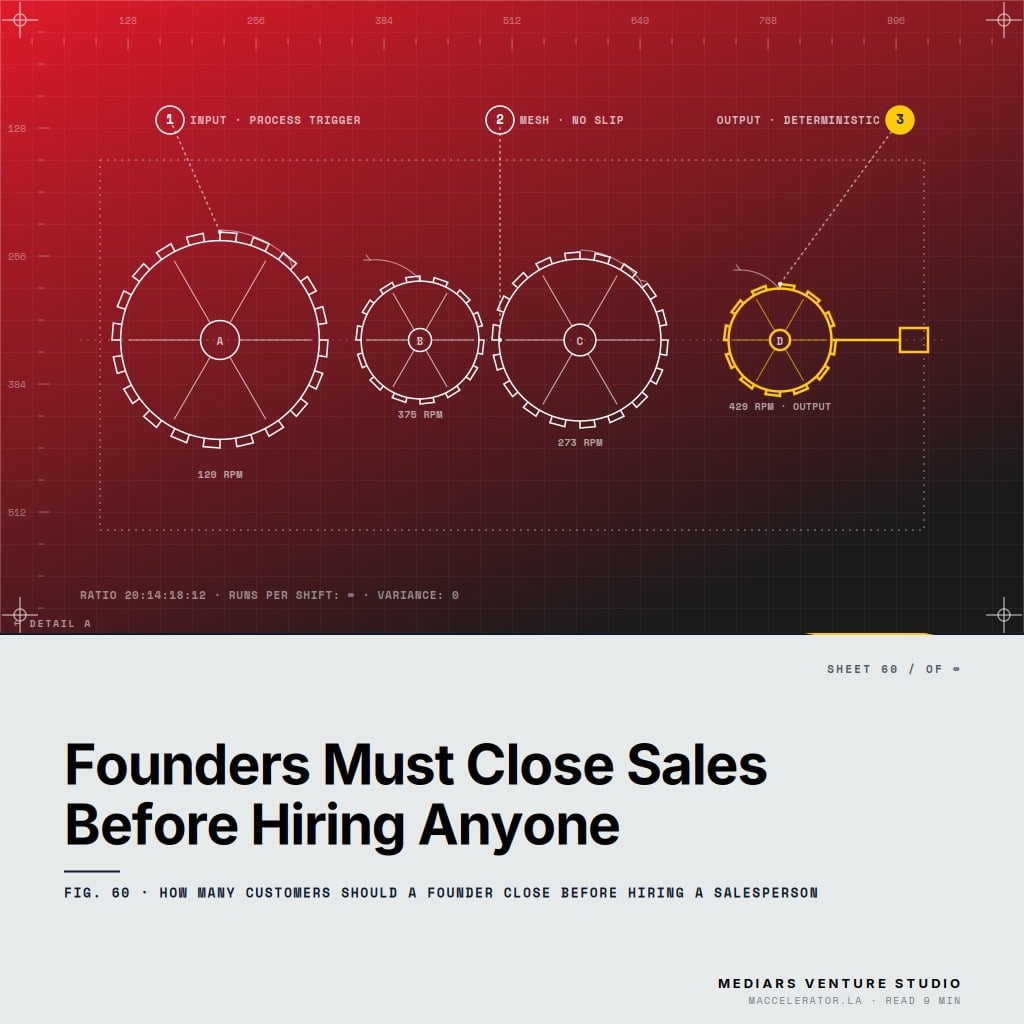
Here is the direct answer: how many customers should a founder close before hiring a salesperson comes down to closing at least 10-15 customers personally — not just closing them, but closing them repeatably across a consistent, documented process. The raw number matters less than what those closes prove about your sales motion.
Picture the founder at midnight. A job post draft open in one tab. A calendar buried in demos in the other. The logic feels airtight: hire a salesperson, buy back the calendar, escape the grind of selling.
That logic is the trap. Hiring sales to escape selling is one of the most expensive mistakes a post-product-market-fit operator makes.
We’ve seen this exact inflection point play out with 500+ founders across SaaS, services, marketplaces, and physical-product businesses. The pattern is remarkably consistent. The founders who get the timing right share one trait — and it is not the number of logos on their wall.
Why “How Many Customers” Is the Wrong First Question
Founders fixate on a number because a number feels concrete. Five? Ten? Twenty? You can check it off a list.
But the number is a proxy for something harder to measure: repeatability. The real question is whether your sales motion is documented, predictable, and transferable to someone who is not you.
Consider two founders. One closed 30 deals through raw founder charisma — showing up, improvising, winning on force of personality. The other closed 8 through a written, repeatable process that names the buyer, the trigger, the objections, and the close steps.
The second founder is more ready to hire. By a wide margin.
You are not hiring a salesperson to sell more. You are hiring them to replicate something that already works. If nothing works yet, you are hiring them to replicate chaos.
Here is the pattern we see when founders hire too early. The rep lands with no playbook. They flounder for 6 to 9 months. They try to reverse-engineer a motion from a founder who never wrote it down.
Eventually the founder blames “a bad hire.” The real gap was an un-codified motion. The rep never had a chance.
That is why the number is the wrong first question. The right question is: can I hand this to someone else and expect it to work?
Key Takeaways
- The number is a symptom, repeatability is the signal. Most founders need 10-15+ closes AND a documented process before a rep can succeed.
- Hiring sales to escape selling fails. You hire to replicate a working motion, not to delegate one you haven’t built.
- Timing is the budget decision. A failed first sales hire sets a company back roughly a year when you count hiring, ramp, and recovery.
- The threshold shifts by business model. High-ACV B2B needs fewer closes with deep process clarity; high-volume and PLG need dozens.
- AI tools extend founder-led selling. Automating outreach and follow-up lets you carry more pipeline solo and codify the motion before you hire.
The Hidden Cost of Hiring Sales Too Early (or Too Late)
There are two ways to get this wrong. Both are expensive.
Too early. You burn 3 to 6 months of runway on a rep ramp with no playbook to anchor it. Worse, you muddy your read on product-market fit — when the rep struggles, you cannot tell if the problem is the market, the message, or the hire.
And you lose the direct customer feedback loop. Founder-led selling is the richest source of product intelligence you will ever have. Hand it off too soon and you go blind.
Too late. You become the permanent bottleneck. Growth plateaus at the ceiling of your personal bandwidth. Burnout sets in. The business cannot scale beyond you because every deal routes through your calendar.
The math makes the stakes real. A fully loaded first sales rep often runs $120K to $200K per year. Full productivity typically takes 3 to 6+ months of ramp.
Stack those together. A failed first sales hire sets a company back roughly a year once you account for the search, the ramp, the churn, and the recovery.
In a tighter capital environment, that mis-timed hire costs more than money. It costs your next funding milestone. Twelve lost months is often the difference between raising from strength and raising from desperation.
We break down founder-led growth inflection points weekly in the AI Acceleration newsletter — including how operators read these signals before they commit headcount.
The Readiness Signals That Actually Matter
Forget the magic number for a moment. Assess these four signals instead. They tell you whether you’re ready far better than any customer count.
- Repeatability. You can predict who buys and why. The same type of customer, the same trigger, the same reasons — showing up again and again.
- Documentation. The pitch, the common objections, and the close steps exist outside your head. Written down. Someone else could read them and act.
- Economics. Your CAC-to-LTV ratio and sales cycle are known and stable. Without this, you cannot judge whether a new rep is performing or failing.
- Demand overflow. You are losing deals purely because you are out of hours — not out of skill. That distinction is everything.
These are signals to assess, not boxes to tick in sequence. When most of them light up, you are genuinely ready.
We worked with a B2B SaaS founder at roughly $800K ARR who delayed hiring until they could articulate a written objection-handling guide. Every common pushback, every answer, documented. When they finally hired, the rep ramped in half the typical time.
Contrast that with a services founder who hired on headcount envy — a competitor had three reps, so they wanted reps too. No documented motion. They churned two hires in a single year.
Same ambition. Opposite outcomes. The difference was whether the motion lived on paper or only in the founder’s instincts.
The Magic Number Changes by Business Model
Most advice online assumes every startup is B2B SaaS. That assumption breaks the moment you look across real business models.
The threshold for “ready” shifts depending on what you sell and how.
- High-ACV B2B SaaS: Fewer closes — maybe 10 to 15 — but you need deep process clarity. Long cycles and big contracts mean each deal teaches a lot, but the motion has to be airtight before you delegate it.
- Low-ACV or PLG: You need dozens of closes to see the pattern. High volume means the signal only emerges at scale. Ten deals tells you almost nothing here.
- Services and consulting: The focus is repeatable scoping and delivery, not just closes. If you cannot scope a project the same way twice, a salesperson will sell things you cannot deliver.
- Marketplaces and physical products: Supply-and-demand dynamics change what “a salesperson” even means. Your first hire might be in supply acquisition, not demand closing.
A mobility startup we worked with faced a demand-generation reality that looked nothing like a vertical SaaS founder’s enterprise sales cycle. One needed volume and channel experiments. The other needed a handful of deep, documented enterprise wins.
Define “ready” by process maturity relative to your model — never by a universal number pulled from someone else’s business.
What the Data Says About Founder-Led Sales in 2025
Founder-led sales stopped being a scrappy phase to rush through. It is now treated as a durable advantage.
Nobody sells the vision like the founder. Nobody absorbs objections and feeds them back into the product like the founder. The best operators stretch this phase deliberately rather than escaping it.
Since 2022, the shift toward leaner teams pushed first-sales hires later. Capital got expensive. Founders learned to do more with less, and that discipline reshaped when headcount makes sense.
AI changed the calculus directly. Tools that automate outreach, capture notes, and handle follow-up let a single founder carry far more pipeline than was possible a few years ago.
A founder who used to max out at 15 active deals can now run 40 — because the admin and follow-through run themselves. That extends the runway for founder-led selling by quarters, not weeks.
There is also a well-documented truth from startup post-mortems: premature scaling is among the leading causes of startup death. Scaling a sales team before the motion is proven is one of the purest forms of it.
Founders navigating this exact transition compare notes inside our Elite Founders sessions — operators who have carried pipeline solo and know precisely when the overflow signal becomes real. Members also access the AI tools that extend solo selling as part of the membership.
The consensus is clear. Hire late, document early, and use AI to buy yourself more time before you commit a salary.
“But We’re Not Ready to Think About This Yet”
Three objections come up every time. Each one deserves a direct answer.
“We have no budget for this.” Exactly the point. This entire exercise exists to help you avoid wasting $150K+ on a premature hire. Getting the timing right is the budget move. The cheapest sales hire is the one you make at the right moment.
“We’ll figure it out ourselves.” Most founders do, eventually. But the cost of learning by trial is measured in quarters of runway. The real question is whether you want to learn the lesson before or after a failed hire burns six months.
“We’re too early-stage for this.” If you are closing deals at all, you are not too early to build the process that makes your eventual hire succeed. The documentation starts now. Not at the hire — now, while every deal is fresh.
Founders who codify their motion early ramp their first rep roughly twice as fast when they do hire. The work you do today is not premature. It is the foundation the hire stands on.
You are not deciding whether to think about this. You are deciding whether to think about it now or after it costs you a year.
FAQ
Is 5 customers really enough before hiring a salesperson?
Rarely, for most business models. Five customers proves demand exists — but not repeatability. Most founders need 10-15+ closes and a documented, predictable process before a rep can succeed. Five deals won on founder charisma teach you almost nothing a new hire can replicate.
What’s the ideal profile for a first sales hire?
Not a senior VP of Sales. Usually a hungry, adaptable individual contributor who can execute and refine an existing playbook — not invent one from scratch. Hiring a sales leader before you have a documented process is a common and expensive mistake. Leaders build teams on top of proven motions; they do not create the motion for you.
Can AI tools delay the need for a first sales hire?
Yes. Automating outreach, follow-up, and admin lets founders carry more pipeline solo. That pushes the hire later and buys more time to codify the motion before you spend a salary. A founder running AI-assisted follow-up handles pipeline that used to require a second person.
How do I know I’m losing deals to time rather than skill?
Track why deals slip. If prospects go cold because you never followed up, booked a demo, or returned a call — that is a time problem, and the overflow signal is real. If they go cold after your pitch, that is a skill or fit problem a salesperson will not fix.
The number was never the answer. Repeatability is. The founders who get this timing right treat the customer count as a symptom and the documented, transferable motion as the real readiness test.
Getting this one decision right is among the highest-leverage moves a post-PMF operator makes. If you want to pressure-test your own readiness against operators who have seen this pattern across hundreds of businesses, come join the Founders Meetings and see how operators like you think through the transition — before the job post goes live.