It’s a risky endeavor to take an idea, build out a product, then launch it out into the world. Take the story of Amazon’s first smartphone: the Fire Phone. The device allowed users to find scanned items on Amazon. But Amazon didn’t look for a market fit to determine if it was the right product to build. About a year after releasing the Fire Phone, it was scrapped.
If Amazon had added a product discovery step in the process, they might have found a viable idea or realized that the Fire Phone wasn’t a product that there were users that wanted it. Amazon lost time, resources, and money that not all startups or companies could afford those costs. We’ll talk about the product discovery process, why it’s important, how to use it, and more.
What is Product Discovery?
Product discovery is the initial stage of the product development process that is where the problem is stated and the target audience that needs a solution is identified. It occurs before the product delivery stage. On product teams, the product manager is typically responsible for the discovery phase.
The intent behind product discovery is to provide a constant learning loop that enables the team to get feedback. This allows the product team to better understand what the market needs. Asking these questions will help define where, when, and whether the product should evolve.
Various techniques, frameworks, and tools are used in product discovery to uncover the answers to these questions. Customer interviews, A/B tests, demand tests, assumption tests, usability tests, story mapping, assumption mapping, OKRs, and customer visits are among the tactics and frameworks often associated with this stage.
The process has two major activities that occur during this stage:
- Exploration – These activities include the research stage of the product, communicating with stakeholders, and customer pains, and reviewing existing problems, and solutions. Research, ideation, and evaluation are all part of this stage. People typically think of the discovery stage as these activities.
- Validation – During these sets of activities, we test the assumptions we’ve made in the exploration process. The product should pass a test to ensure that the ideas generate value for the end-user before anything is designed. Prototyping, customer feedback, and testing using data are used to help with validation. Prototyping, testing, and learning are all activities that are part of this stage.
Exploration and validation are both iterative processes. They take place before the delivery stage of product development. A good way to think of product discovery is as a scientific method for building software. Experiments and tests are used as tools. All of this happens before spending significant time and money building the product.
There are two types of product discovery: timeboxed and continue discovery explained below:
Timeboxed Product Discovery
A timeboxed product discovery period is useful for creating new products or making big changes to an existing one. During the discovery phase, the key deliverables include:
- Validating the business model and product strategy
- Deliver an actionable product roadmap
- Validated business model
- Creation of the initial product backlog
- High-level UX design concepts
The innovation process starts with an idea, product discovery, product development, and finally, the product. There’s an overlap between the product discovery and product development stages.
Continuous Product Discovery
The continuous product discovery approach aims to launch a minimum viable product (MVP) instead of a fully built product from the timeboxed method. The MVP is good enough to launch and satisfy the early market.
The product discovery stage is a continuous loop where you continue discovery work to find product-market fit. Activities include:
- Reviewing key performance indicators to determine performance
- Looking for opportunities such as social, technological, or regulatory trends that provide a chance to innovate, add, etc. a product feature or build a new product
- Reviewing changes to the business strategy to see if there are consequences for your product
- Watching your competitors see if they are launching new products or features. Looking for new market entrants. Determining if you should respond to any of these changes.
Why is it Important?
By utilizing the product discovery phase, a business can build a stronger product strategy and roadmap. The example of the Fire Phone from Amazon is a prime example of what could have been prevented by an iterative discovery process. Amazon would have identified that there was no product fit with the intended market, and potentially the insights to find other problems that needed solutions.
According to the book, Inspired by Marty Cagan, the product discovery phase reduces four types of risks:
- Value risk – Will customers buy or choose to use this solution?
- Usability Risk – Will customers understand how to use this solution?
- Execution risk – Do we have the capacity to build this solution?
- Viability risk – Does this solution work for our business?
Product discovery at its core is about reducing uncertainty to whether a problem is worth solving and solutions are worth building through data-informed information.
When you build a product based on assumptions, they could be wrong which leads to wasted time, money, resources, and efforts. Using product discovery, we can bring as much value as possible to a product. The idea is already validated and tested on users before reaching the delivery stage. This mitigates the risks of not building the right thing. It may also improve the UX.
When to use Product Discovery
Your teams should use product discovery when there are unknowns about what they are building, who it is for, and why. Some of the situations in which you should use product discovery include:
- New opportunities – If your business is expanding to a different country or to be used for people with different demographics, you should include a discovery phase. Some of the activities that might be part of these efforts include researching the target audience, competitors, opportunity size, and the scope of the product.
- New product development – Let’s say you have a new idea involving building a new product that you’re considering. Before starting the development phase, you should discover more about the customer segment, their preferences, and needs. By focusing on the problem that your customers have, you can build what they actually need.
- Product upgrades – New features that you plan to add to your product should run through the discovery phase first. It allows you to find and analyze what problem the feature is solving for your users and how it impacts the overall product experience.
- Acquisitions or mergers – When two companies combine, there are systems, processes, and tools that also need to be merged. Using discovery, you can focus on finding mutual problems to find solutions that effectively serve the needs and support operations.
The product discovery phase is all about understanding the user’s problems. Ideas for solutions can be generated at this stage that can be tested. However, some projects may never move on to the next product development stage because it’s determined there isn’t a user need or viable solution.
Product Development Team Structure
Using product discovery, teams can choose the right direction and set a common goal and vision for a project. All team members and stakeholders must be involved in the process to be effective.
Teams that work in product development are either in the problem space or solution space. Depending on the size of the organization, the product discovery team may look a little different. However, here are some of the players you typically find and their roles:
- Key stakeholders – These members are responsible for managing the budget and approving ideas. Business owners, CPOs, and CTOs are common stakeholders.
- Product managers (sometimes the project manager) – They manage and plan the meetings with end-users. . Gathering insights and documenting these meetings also fall into their area of responsibility.
- Business or market analysts – Responsible for reviewing and analyzing the present solutions and market trends.
- Teach lead – Looks at the technical feasibility of solutions that are discovered.
- Solution Architect – Responsible for creating the solution strategy that’s based on the problem statement(s).
- UI/UX research and designers – Work with the usability of the problem and develop designs
Other roles you may find on product discovery teams include QA specialists, engineers, product designers, engineers, and data scientists. It’s important to understand that in the product discovery phase, everyone should be part of the team effort of discovery. That means not limiting developers to coding or business analytics to analyzing market data.

Understanding the Product Discovery Process
So you’ve got an idea for a new product or feature that you’re considering and have a team to work on the product discovery stage. Before you start the process, you need to state the purpose of the new product or feature and identify what problem it solves.
Armed with the purpose, the team can be presented with the desired outcomes, success criteria, and more. To develop a goal statement, ask yourself some critical questions to challenge your idea and assumptions. Here are some general questions that you could be asking:
- Is this problem present for users?
- What makes the product different or stand out?
- How is this problem solved today if it does?
- Are these current solutions good?
- Are the user’s pain points sufficient enough for them to seek other solutions beyond what’s currently available?
- Are users willing to pay for it? Would they pay more?
- How does the user know the problem is resolved? How does the user evaluate the results?
- What other users have this problem?
Answering questions like these with assumptions will provide you with a hypothesis that can be tested later with less uncertainty. The goal of discovery is to have outcomes. These outcomes may include:
- Well-defined problem statement
- User-journey maps
- User-needs statements
- User personas
- A service blueprint
- High-level wireframes
- Business Value Propositions
Exploration phase
The exploration phase is made up of research, ideation, and evaluation stages. During the research stage, we are looking at a general problem overview. Market conditions, market gap research, existing market problems/solutions, competitors/non-competitive overviews, and audience overviews are things we look at during this stage.
By gathering this data, we can develop a better understanding of the market, customers, and potential solutions that can be built. Recruiting customers from the market is one of the best approaches to understanding the problem. You can uncover insights into real problems that exist and learn about their pain points. It also allows you to build more realistic user personas that can be used to generate assumptions.
With this information, your team can move on to the ideation stage. During this stage, the team gathers to brainstorm ideas for potential products. These ideas are formed using the user’s perspective to address their current problem.
The ideas that are generated will go through the evaluation process in the final stage of the exploration phase. Each idea is prioritized by importance, value, difficulty, and risk factor.
Validation phase
The validation phase includes prototyping, testing, and learning. This phase begins once we’ve come up with ideas and evaluated each of them to validate the possible solutions. User feedback is heavily relied on during the product discovery process and this is especially important at this point.
To begin testing ideas, one option is to use idea mapping. This technique can be performed at the ideation or validation stage. Idea mapping is a visual representation of the ideas that you want to test. With your ideas mapped out, you can begin the prototyping phase.
A prototype must be created for every idea. Prototypes are typically in the form of a low-cost wireframe or sketch. Tools like Figma, Sketch, and UXPin are convenient and easy to share among teams. Multiple ideas can often be tested with one prototype.
With a prototype on hand, you can start testing it. You’ll need to test it against at least 5 of your customers. The focus during testing is to validate the core idea.
After testing is complete, you’re ready to begin the learning stage. The testing results are analyzed during this stage to determine whether it answers the earlier questions with the purpose statement.

Frameworks in Product Discovery
Among the most popular frameworks in product discovery is design thinking and jobs to be done. We’ll explain these below.
Design Thinking
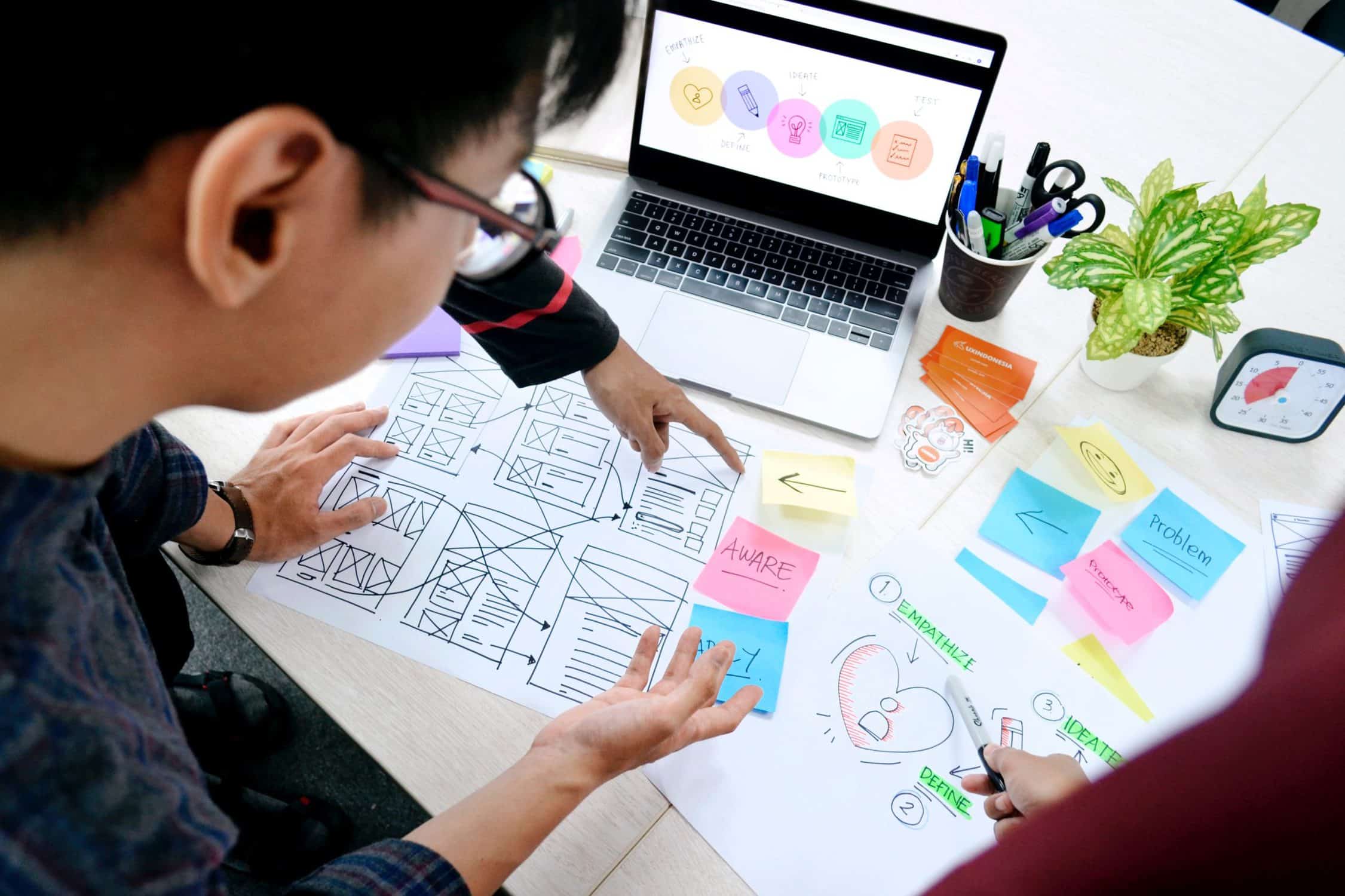
Design thinking is a customer-centered approach to analyzing product requirements. It looks at an idea based on three major elements:
- Desirability – The demand for a product or feature by the target customer
- Feasibility – Your company’s skills and resources that make it technically possible
- Viability – Does it make sense for your business model?
Five steps make up the design thinking process:
- Empathize – understand the problem and users
- Define – Interpret your feelings
- Ideate – Generate creative solutions
- Prototype – Build a representation of solutions
- Test – Gather feedback from users
Jobs to be Done
Jobs to be Done looks at the requirements from the job perspective of the target person instead of the exact customer. It analyzes the ideas as a set of activities that the user tries to complete. There are five steps in this framework:
- Market identification – Exploration phase where the market problem is defined, and we gain an understanding of user personas.
- Jobs identification – During this step, the goal is to understand the actions and objectives that the customers want to complete. The motives a user is reaching while doing a “job” are also identified.
- Job categorization – The main and secondary jobs are identified
- Job statement – Job specifics are described
- Opportunity prioritization – Developing solutions to the customer’s problems