


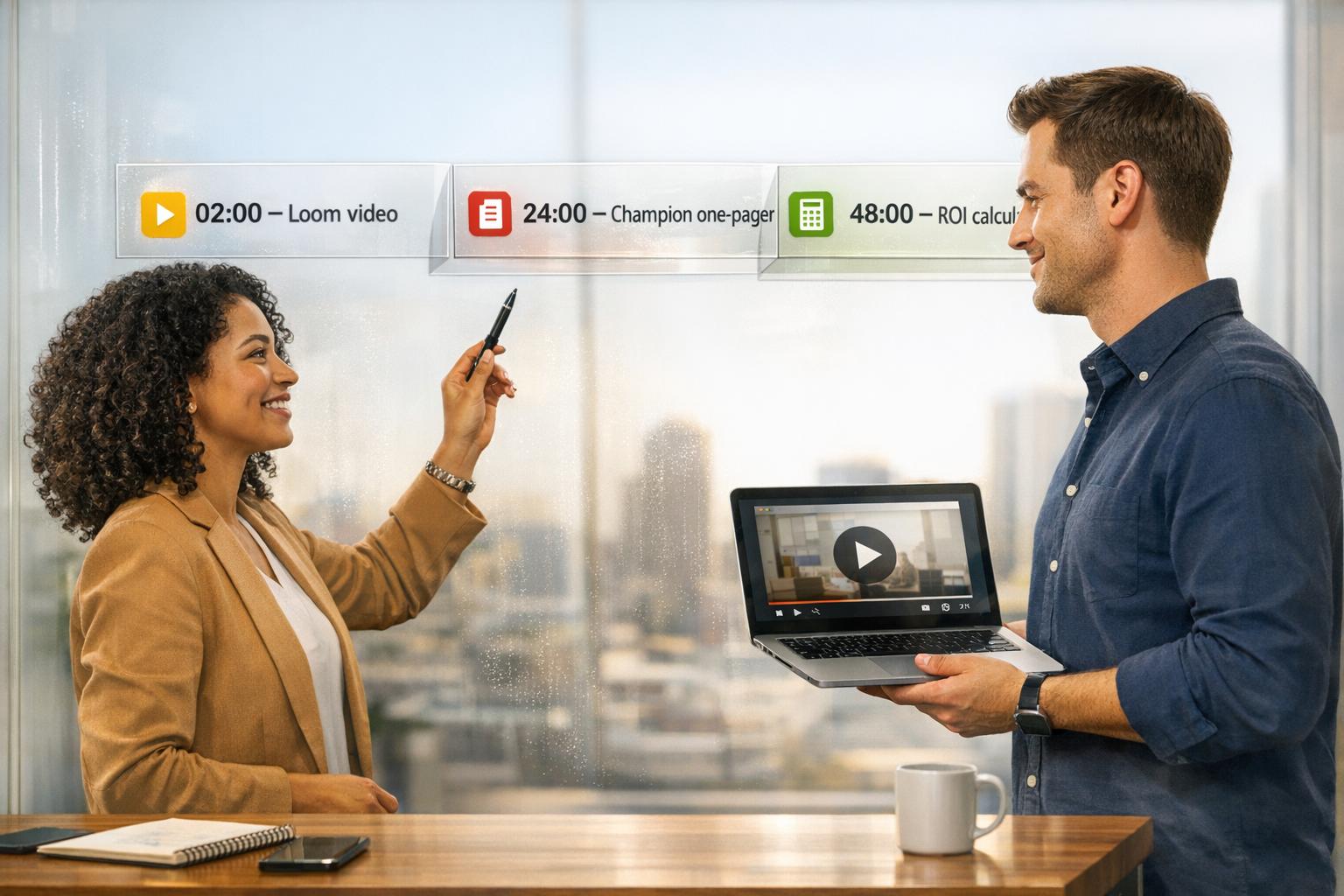
Most B2B SaaS deals fall apart due to poor follow-up. After a demo, 70% of deals die within 48 hours, not because the product isn’t good, but because follow-ups are inconsistent or ineffective. The solution? A 48-hour framework with three timed touchpoints that maintain momentum and address common obstacles like ghosting, stakeholder misalignment, and financial objections.
Here’s the strategy:
- Hour 2: Send a personalized video recap via Loom to reinforce key points and address objections.
- Hour 24: Share a one-pager to help your internal champion advocate for your solution.
- Hour 48: Provide an ROI calculator to justify the investment and tackle financial concerns.
This process increases engagement, boosts reply rates by 40%, and can improve demo-to-close rates by up to 60%. The key is delivering the right message at the right time while equipping prospects to sell your solution internally.
Want to close more deals? Stick to this system and avoid common mistakes like generic follow-ups, waiting for responses, or sending irrelevant marketing content.

48-Hour B2B SaaS Demo Follow-Up Framework with Timed Touchpoints
Why Most B2B Deals Die Within 48 Hours After Your Demo
Did you know that 70% of B2B deals fall apart within just 48 hours of your demo? Surprisingly, it’s not because prospects dislike your product. The real issue lies in the follow-up – or lack thereof. Research shows that a prospect’s willingness to move forward is at its highest – around 80% – on the very first day. But by Day 7, that enthusiasm drops to a mere 40%. This isn’t a product problem; it’s a process problem.
Here’s what happens during that critical delay: competitors swoop in. While you’re waiting for a reply, they’re taking action – sending follow-ups, addressing objections, and scheduling next steps. Within 72 hours, your prospect’s inbox fills up with dozens of new messages, burying your demo recap under the noise.
"The vendor who stays most present (without being annoying) typically wins the deal – regardless of price." – Rita Ndubi, AI & Business Automation Strategist
The numbers paint a clear picture. A whopping 40% of closed-won deals attribute their success to effective follow-ups. Yet, 44% of salespeople stop after just one follow-up. For context, 80% of deals require at least five follow-ups to close. By failing to follow through, salespeople risk losing up to 40% of their pipeline – not because of product flaws, but due to poor execution.
The problem doesn’t stop there. Internal decision-making dynamics within buying teams amplify the damage. Most B2B buyers need to loop in other stakeholders – whether it’s a manager, partner, or committee. Without sending demo recaps, recordings, or ROI tools within 48 hours, you make it harder for them to advocate for your solution while the pain point is still top of mind.
"Silence is not rejection. Silence usually means the buyer is busy, distracted, or pulled into something more urgent." – Vaishali Badgujar, Avoma
What’s the fix? It’s not about bombarding prospects with more emails. It’s about sending the right content at the right time. Effective follow-ups – those that provide tailored, data-driven insights – can boost reply rates by 40%. Reaching out promptly, within hours, demonstrates reliability and organization. These qualities are essential for building trust in long-term B2B partnerships. The 48-hour window is your golden opportunity to keep momentum alive before decision fatigue sets in and your deal goes cold.
The 48-Hour Framework: 3 Timed Touchpoints That Close Deals
Timing is everything when it comes to follow-ups. The 48-Hour Framework is built around three carefully timed touchpoints, each designed to tackle common obstacles like generic responses, misaligned messaging, and financial objections. When done right, this approach can breathe life into deals that might otherwise stall.
Here’s the big idea: each touchpoint delivers a specific message at just the right moment, ensuring your deal keeps moving forward. From initial engagement to internal advocacy and financial validation, this system creates a seamless flow.
| Touchpoint | Timing | Primary Asset | Challenge Addressed |
|---|---|---|---|
| Touch 1 | Hour 2 | Personalized Loom Video | Generic follow-up/Ghosting |
| Touch 2 | Hour 24 | Champion One-Pager | Stakeholder misalignment (6-10 buyers) |
| Touch 3 | Hour 48 | ROI Calculator | Financial justification/CFO hurdles |
Companies using this framework often see proposal acceptance rates jump by 35% to 60%. Why? Because it aligns with the reality of B2B sales: deals typically involve six to ten decision-makers, and most require at least five follow-ups to close. This framework equips your internal champion with everything they need to advocate for you while the problem you’re solving is still top of mind.
Hour 2: Send a Personalized Loom Video Addressing Their Specific Objections

The first touchpoint is all about keeping the conversation alive. Within two hours of your demo, send a personalized Loom video. This isn’t just any follow-up – it’s a targeted recap that highlights the key points discussed during the call, addressing specific objections and reinforcing the value of your solution.
Keep the video short and focused (5-10 minutes), and tailor it to their needs. Mention their company name, their pain points, and the outcomes they’re aiming for. For instance:
"You mentioned that manual data entry takes your team 15 hours a week. With our automation, you could cut that by 50%, saving 7.5 hours weekly."
"The Demo Isn’t the Close – It’s the Opening" – Zack Hanebrink, SaaS Growth Marketing
Why video? It’s personal, engaging, and effective. Including video in your outreach can boost click-through rates by 65% and open rates by 19%. It also shows that you’ve invested time in their specific needs, not just sent a generic email.
Even if you’re short on time, tools that personalize screen recordings can help you scale this process. A quick walkthrough of the demo highlights tailored to their use case will outperform any text-based follow-up.
Hour 24: Deliver a Champion Enablement One-Pager
By the 24-hour mark, it’s time to arm your internal champion with the tools they need to sell your solution internally. This is where the champion enablement one-pager comes in. Think of it as a cheat sheet that simplifies your value proposition for their team.
This isn’t a generic marketing flyer. It’s a focused document that highlights the strategic benefits of your solution – ROI, cost savings, efficiency gains, and competitive advantages. Skip the technical jargon and feature lists; instead, focus on high-level metrics and visuals that resonate with decision-makers.
"Sales are won when you empower a prospect to champion your product internally." – Neil Mclean, CEO, Navattic
Customize the content based on your audience. For example:
- CFOs care about ROI and budget alignment.
- IT Managers need to know about security and integration.
- Sales Managers want to see productivity and conversion improvements.
Timing is key. By 24 hours, your champion has likely mentioned your solution to someone else. This one-pager ensures they have the right talking points to keep the conversation going. If you wait too long, they might pitch your solution without the proper context, and that could hurt your chances.
Hour 48: Provide an ROI Calculator and Internal Selling Tools
The final touchpoint addresses financial objections head-on. At the 48-hour mark, send an ROI calculator or interactive spreadsheet that quantifies the benefits of your solution. This tool should make it easy for the prospect to justify the investment to their CFO or procurement team.
Make the calculator simple and interactive. Let them input their own numbers – like current costs, team size, or hours spent on manual tasks – and instantly see the financial impact. For example:
"With 500 monthly leads and 2 hours per lead for manual qualification, you’re spending $20,000/month. Our automation reduces that to $4,000/month, saving $192,000 annually."
| Stakeholder | Primary Focus Areas | Success Metrics | Follow-up Tool Focus |
|---|---|---|---|
| CFO / Finance | Cost reduction, ROI visibility | ROI, cost savings, efficiency | ROI Calculators, pricing scenarios |
| IT Manager | Security, integration, compliance | System uptime, user adoption | Technical deep-dives, whitepapers |
| Sales Manager | Team productivity, lead quality | Quota attainment, time savings | Workflow automation, productivity |
| Executives | Strategic risk, competitive edge | Revenue impact, growth | Strategic context, ROI demonstration |
Make sharing easy. Avoid gating these tools – no logins, no barriers. The faster your champion can share the calculator with key stakeholders, the quicker you’ll move through the approval process. Any friction at this stage could derail the deal, especially when financial justification is the final hurdle.
Case Study: How One Founder Increased Demo-to-Close Rate from 15% to 40% in 60 Days
A B2B SaaS founder running a workflow automation platform faced a frustrating challenge: a 15% demo-to-close rate. Despite delivering strong demos, prospects often said "looks good" but disappeared after three follow-ups. The issue wasn’t the product – it was the follow-up strategy.
This case highlights how the 48-Hour Framework can turn theory into action with measurable results. The founder revamped their follow-up process using n8n automation, focusing on three key touchpoints:
- Hour 2: A personalized Loom video addressing specific objections raised during the demo.
- Hour 24: A one-pager designed for champion enablement, packed with ROI metrics and talking points.
- Hour 48: An interactive ROI calculator that allowed prospects to input their own data.
The only change made was to the follow-up process, yet the results were dramatic. Within 60 days, the demo-to-close rate skyrocketed to 40%. By tracking Loom analytics and CRM pipeline stages, the founder noticed that prospects who engaged with all three touchpoints moved through the sales funnel more consistently than those who received generic follow-ups.
One of the biggest hurdles was transitioning from generic screenshots to customized mockups. Early attempts at personalization relied on templated videos, which failed to connect with prospects. However, tailored videos that focused on each prospect’s specific use case and pain points made a significant difference. Providing exactly two actionable next steps at each touchpoint helped avoid overwhelming prospects and bridged the “demo-to-close gap.” This strategic adjustment proved that addressing objections and simplifying decisions can transform sales outcomes.
Want more actionable strategies to close deals with less manual effort? Join our AI Acceleration Newsletter for weekly tips and insights.
3 Follow-Up Mistakes That Kill Your Conversion Rates
Many founders lose out on deals because their follow-up strategies fall flat. Research highlights that 40% of all closed-won deals attribute follow-up as a key factor, yet salespeople often give up too soon. This disconnect explains why 60–70% of interested prospects vanish after a demo.
To keep your conversion rates strong, avoid these three common follow-up mistakes.
Mistake 1: Sending Generic "Thanks for Your Time" Emails That Add No Value
The classic "just checking in" email is a deal killer. When your follow-up lacks personalization, it leaves prospects unsure about the next steps and stalls momentum.
"Just checking in" is a follow-up death sentence. If it could be sent to anyone, it means nothing to everyone." – Peter Emad, GTM Expert, SalesCaptain
Personalized follow-ups make a big difference. Companies that focus on tailored outreach generate 40% more revenue than those that don’t. Instead of a generic message, recap the specific pain points discussed during the demo, address potential concerns, or share a relevant case study that speaks to their challenges. End with an easy, actionable next step – something as simple as "Reply with 1 if you’re still interested, 2 if the timing isn’t right" can make it effortless for the prospect to respond and provide clarity.
Mistake 2: Waiting for Prospects to Respond (Most Won’t)
Silence doesn’t always mean disinterest. Often, prospects go quiet because they’re busy, distracted, or facing internal hurdles – not because they’ve decided against your solution. Still, many founders misinterpret this silence and stop following up, even though 80% of sales require at least five follow-ups.
Timing is everything. Following up within 24 hours can lead to a 14% boost in win rates and an 11% shorter deal cycle, with the best results coming from follow-ups sent 5–10 hours after the initial interaction. Sellers who send a second email to unresponsive prospects more than double their win rates compared to those who give up.
"Inconsistent follow-up is where most B2B deals die. Process saves them." – Peter Emad, GTM Expert, SalesCaptain
Never leave a demo without scheduling the next step. Aim for 3–4 follow-ups within the first 10 days, gradually spacing them out. If a prospect remains unresponsive for two weeks, send a "breakup email" asking if they’d like to end the conversation. Surprisingly, this approach often gets a reply from 30–40% of ghosted prospects, as it removes the pressure of constant follow-ups.
Mistake 3: Sending Marketing Content Instead of Internal Selling Tools
For deals over $3,000, most prospects need to consult with a partner or decision-maker. Many go quiet because they don’t have the tools to effectively advocate for your solution. Sending a generic brochure or feature list doesn’t help them make your case internally.
60% of B2B buyers prefer not to rely on a sales rep as their main source of information, so your follow-up materials need to be clear, relevant, and actionable. Equip your internal champion with resources that address specific objections, like pricing concerns or implementation challenges, rather than generic marketing content.
| Tool Type | Purpose for the Champion | Recommended Format |
|---|---|---|
| Battle Cards | Compare your solution to internal options | PDF or video |
| ROI Calculator | Justify the investment with hard numbers | Spreadsheet or interactive tool |
| Proposal Walkthrough | Simplify complex details for stakeholders | Personalized video |
| Phased Options | Offer tiered plans to ease budget concerns | Tiered pricing table |
For example, you can provide a battle card that highlights how your product outshines competitors, or an ROI calculator tailored to their business needs. Tiered investment options – like "Full Scope", "Scaled Back", or "Phase 1 Only" – can make the decision easier for their team. A quick, 2-minute personalized video walking through your proposal can also work wonders. In fact, personalized videos in follow-up emails increase click-through rates by 65% and open rates by 19%.
"The vendor who stays most present (without being annoying) typically wins the deal – regardless of price." – Rita Ndubi, AI & Business Automation Strategist
sbb-itb-32a2de3
How to Build Your 48-Hour Sequence: Loom Templates, n8n Workflows, and A/B Testing

Creating a solid 48-hour follow-up sequence boils down to three main ingredients: personalized video templates, automated workflows, and constant testing. Start by using Loom to record a quick, engaging video recap. With Loom Variables, you can personalize at scale – automatically swapping in the prospect’s name in the transcript and audio. Reference specific details from your demo, like a technical hiccup or a pricing question, and include a brief screen share to address their concerns. Keep your video short – under three minutes is ideal – and use Loom AI to add clickable CTA buttons that direct prospects to schedule a follow-up call or explore your ROI calculator. Want more automation tips? Join our AI Acceleration Newsletter.
Once your personalized video is ready, focus on automating the delivery process. Use n8n to build a workflow that triggers follow-ups at the right times. For example, set up your CRM to kick off the sequence as soon as a demo is marked "completed." Then, automate the process: send the Loom video within two hours, follow up with a one-pager for your champion at the 24-hour mark, and share the ROI calculator at 48 hours. Use "if/then" logic to ensure follow-ups only go out if the prospect hasn’t already replied or moved forward in the deal. This seamless integration of your CRM, email tool, and Loom account ensures the entire sequence runs smoothly without manual effort.
But automation alone isn’t enough – your messaging needs to hit the mark. This is where A/B testing comes in. Experiment with different sending times (e.g., 8:00 a.m., 2:00 p.m., or 5:00 p.m.) to pinpoint when your audience is most likely to engage. Subject lines are critical too – 64% of recipients decide to open an email based solely on the subject line. Test options like "Action items from today’s call" versus "Your custom ROI breakdown is ready." Keep a close eye on open rates, click-through rates, and replies at every stage. If your 48-hour touchpoint performs better than the initial 2-hour video, it’s a sign to tweak your early messaging or CTA. As Peter Emad, GTM Expert at SalesCaptain, explains:
"If your third follow-up step outperforms the first, why? Was it shorter? Did it offer more insight? Reverse-engineer performance patterns to optimize your message logic, not just delivery timing." – Peter Emad, GTM Expert, SalesCaptain
Lastly, shift your focus to micro-conversions rather than just closed deals. Track key actions like replies, calendar link clicks, or ROI calculator downloads to see where prospects are engaging – or dropping off. Try simplifying your CTAs, such as asking for a quick reply: "Reply with 1 if you’re ready to move forward, or 2 if you need more time." This reduces friction and keeps the conversation moving. By continuously reviewing performance data and iterating your approach, you’ll ensure your sequence is automated, highly personalized, and constantly improving with every cycle.
Integrated Innovation Model: How Execution and Communication Work Together to Close Deals
Closing B2B deals isn’t just about having a great product. It’s about combining precise execution with effective communication. The Integrated Innovation Model highlights how these two elements – execution (timing, precision, and follow-through) and communication (personalization, value delivery, and objection handling) – work as a unified system. Together, they guide prospects from initial interest to a signed deal. For example, sending a personalized Loom video that addresses specific objections not only shows attentiveness but also lightens the workload for your internal champion.
Here’s the real challenge: most B2B deals hinge on internal buy-in. Your champion often has to persuade 6 to 10 decision-makers, which means your follow-up strategy needs to do more than just nudge the deal along. It should actively support their internal advocacy efforts. This includes timely follow-ups to keep your proposal top of mind and tailored communication that arms your champion with the information they need to win over others. Tara Sakhuja, Founder of Data Dumpling, shared in August 2025 how her company nearly doubled its demo-to-close conversion rates. The secret? Ending every product demo with two clear action steps and consistently reinforcing those steps in follow-ups to eliminate confusion. Want to streamline your follow-ups? Join our AI Acceleration Newsletter for tips on leveraging AI in your sales process.
Timing and Personalization: The Balancing Act
Even the best-crafted message falls flat without proper timing. Picture this: you create a personalized video addressing a prospect’s concerns, but you wait too long – say, more than two hours – to send it. By then, your prospect may have mentally moved on. On the flip side, if you hit the timing but send a generic "thanks for your time" email, you miss the chance to deliver meaningful value. It’s all about delivering value at the right moment.
Another key to strong follow-up is engaging all relevant stakeholders early in the process. Multi-threading – reaching out to multiple contacts like procurement, IT, and leadership – reduces friction and minimizes the risk of deal stalls. Use your CRM to track buyer signals (like email opens or website visits) and trigger targeted follow-ups. Being proactive, rather than waiting for a prospect’s inquiry, can more than double your win rates. Automate repetitive tasks like reminders and follow-up triggers, but make sure your messages are tailored to address the specific pain points of each stakeholder.
Aligning Execution with the Buying Cycle
Your tools and actions should align with where the prospect is in their journey. This means mapping out tasks like sending a recap email or providing a technical one-pager to the appropriate stage of the buying cycle. For example, if a prospect has gone quiet for 14 days, sending a "breakup email" can often reignite the conversation – these emails typically prompt responses from 30% to 40% of silent prospects. As Peter Emad, GTM Expert at SalesCaptain, puts it:
"Follow-up isn’t just follow-through. It’s where deals get won." – Peter Emad, GTM Expert, SalesCaptain
When execution and communication are in sync, you’re not just chasing prospects – you’re building a system that turns interest into closed deals.
Conclusion
The 48-Hour Framework zeroes in on a critical challenge: prospects’ decision-making energy drops drastically after the first day. The truth is, most B2B deals don’t fall apart because of product flaws – they stall due to process breakdowns in the crucial hours following your demo. By using three well-timed touchpoints – Hour 2: a personalized Loom video, Hour 24: a champion enablement one-pager, and Hour 48: an ROI calculator – you tap into early engagement, keeping momentum alive. This approach transforms follow-ups into a structured, actionable strategy. Want more proven AI-powered follow-up techniques? Join our AI Acceleration Newsletter.
As mentioned earlier, tailoring your follow-up touchpoints is key to overcoming common B2B sales challenges. Consider this: 40% of closed-won deals attribute follow-up as a major factor, yet 44% of salespeople stop after just one attempt. The 48-Hour Framework ensures you hit the 5+ touchpoints typically needed to close most B2B deals, while also standing out from those who rely on generic "just checking in" emails. By equipping your champion with tools that help them sell internally – not just polished marketing materials, but real selling resources – you empower them to navigate the 6 to 10 decision-makers who often stand between initial interest and a signed contract.
If you’re ready to take this further, check out our live implementation sessions. You’ll learn how to build automated follow-up sequences using tools like n8n workflows, Loom templates, and A/B testing frameworks. Turn manual follow-ups into a repeatable revenue system. For personalized, hands-on guidance, visit our Elite Founders program. You’ll leave with fully functional sequences running in your business within the same week.
FAQs
Why is the 48-hour follow-up framework more successful than traditional follow-ups?
The 48-hour follow-up framework works so well because it targets the crucial window when most B2B deals fall apart – within 48 hours after a demo. Research reveals that over 70% of deals fail during this period, not because of issues with the product, but due to ineffective follow-up.
This framework takes a structured, personalized approach with three key touchpoints:
- Within 2 hours: A customized video recap that addresses objections.
- Within 24 hours: A "champion enablement" one-pager to help your contact advocate internally.
- Within 48 hours: An ROI calculator or internal selling tool to provide actionable value.
By equipping prospects with the tools they need to make a case internally, this method avoids common pitfalls like sending generic emails or simply waiting for a reply.
The results speak for themselves. For example, one founder saw their demo-to-close rate jump from 15% to 40% in just 60 days by implementing this approach. The framework keeps you proactive and relevant during the most critical decision-making period, turning interest into actual conversions.
How can I quickly personalize follow-ups after a demo?
You can streamline your follow-ups while keeping them personal by using automation tools and customizable templates. Start by creating a personalized video recap that addresses key points from the demo, such as major objections or highlights. Tools like Loom make it simple to record and share these videos in no time. Next, craft email templates with dynamic fields that allow you to insert specific details, like the prospect’s goals or recent milestones, making each message feel unique. Finally, use workflow tools like n8n to automate the timing of your follow-ups, ensuring they go out at just the right moment.
This method not only saves time but also ensures your follow-ups feel personal, which is crucial – research shows that generic follow-ups often fail to get a response. By blending automation with thoughtful, tailored content, you can boost engagement and improve your chances of sealing the deal.
Why is it important to follow up quickly after a demo?
Timing is everything after a demo. Did you know that over 70% of B2B deals fall apart within the first 48 hours? Interestingly, it’s not because of product issues – it’s due to breakdowns in the process. Acting quickly sends a message of professionalism, keeps your prospect engaged, and greatly improves the odds of advancing the deal.
A well-planned follow-up during this critical window can tackle objections, provide your internal champions with the resources they need, and clearly showcase the return on investment (ROI). This makes it much easier for prospects to take the next step. On the flip side, waiting too long risks losing momentum, giving the opportunity time to cool off.