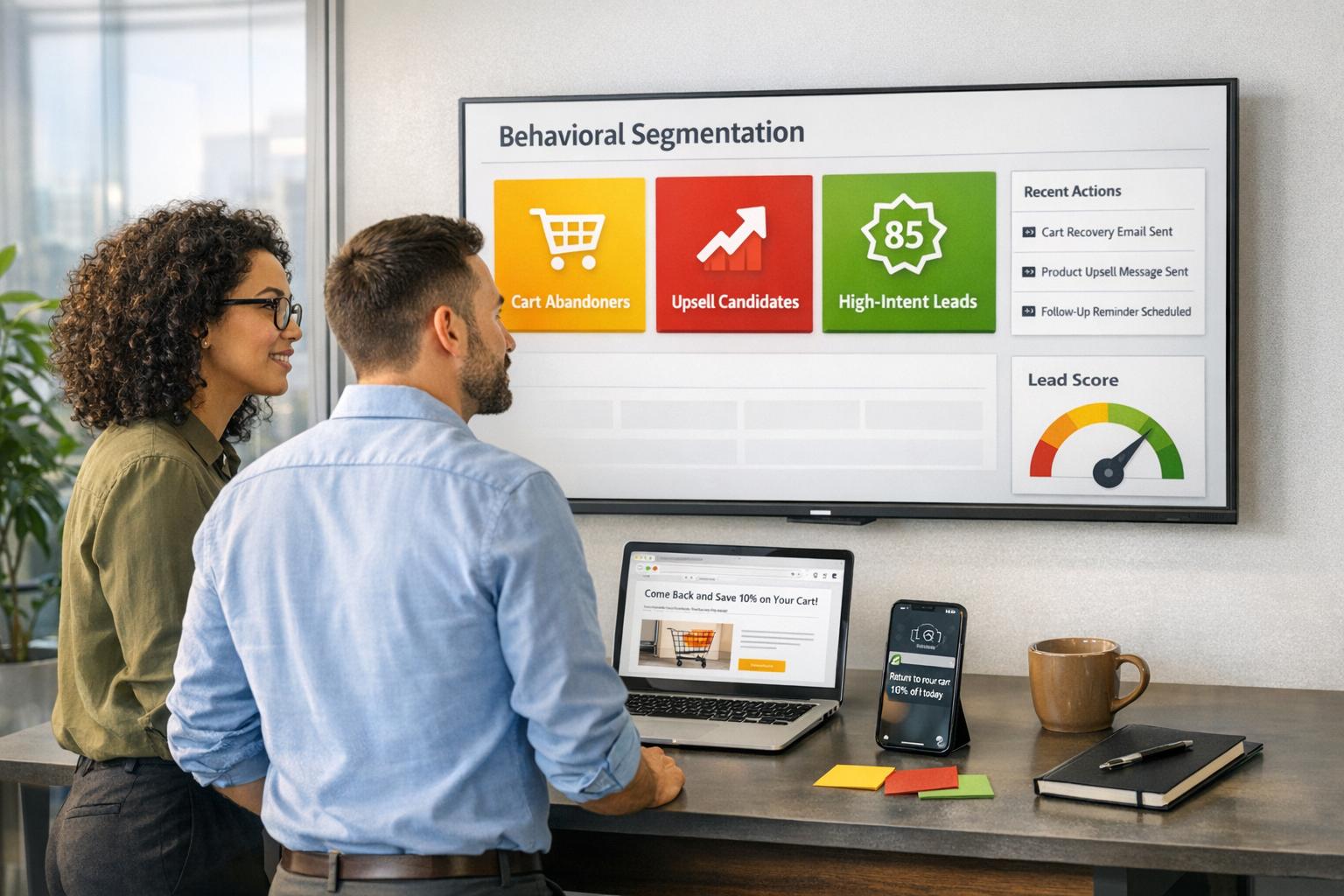
Behavioral segmentation groups customers based on their actions – like purchase patterns, app usage, or engagement – rather than static demographics. Why does this matter? 71% of U.S. consumers want personalized experiences, and businesses using this approach see 10%-15% revenue growth. It’s a proven way to improve marketing, sales, and retention by understanding what customers actually do.
Here’s when to use it:
- High-Intent Leads: Identify prospects ready to buy (e.g., repeated visits to pricing pages) and prioritize follow-ups.
- Cart Abandonment: Recover lost sales with targeted emails or ads based on checkout behavior.
- Upselling Loyal Customers: Spot power users and tailor premium offers to their habits.
To succeed, you need accurate data, integrated tools, and clear goals. Companies like Showmax and JOBKOREA have achieved 204% subscriber growth and 4-5X higher click-through rates using these techniques. Start with small tests, refine your strategy, and scale through automation to see results.

Behavioral Segmentation Impact: Key Statistics and ROI Metrics
What You Need Before Using Behavioral Segmentation
Behavioral segmentation doesn’t just happen overnight. To make it work, you need accurate data, integrated systems, and well-defined objectives. Without these elements, you risk creating segments that don’t deliver results. Want to learn more about advanced segmentation? Sign up for the AI Acceleration Newsletter for weekly tips.
Data Volume and Quality
An effective segmentation strategy starts with a solid base of active users. Without enough data, your segments won’t be reliable. When done right, segmented campaigns can achieve 14.31% higher open rates and boost revenue by 10%-15%. But that’s only possible if you have enough data to spot real behavioral patterns.
Data quality is just as important as quantity. You need first-party engagement data like website visits (e.g., multiple views of pricing pages), email opens and clicks, and content downloads. For SaaS companies, product usage data – such as login frequency, feature adoption, and inactivity periods – is critical. Technographic data, like the tools prospects already use (e.g., CRM or marketing automation platforms), can hint at their organizational readiness and budget. Sales and purchase history, including deal sizes, sales cycles, and demo requests, helps pinpoint high-intent segments.
Behavior Tracking Infrastructure
If your data is scattered across tools, segmentation becomes a challenge. A unified data stack is essential. This means integrating tools for data collection (like analytics platforms or CDPs), storage (your CRM), and activation (marketing automation software). These systems should work together to capture, store, and act on customer actions.
Your tracking setup also needs to support real-time monitoring across all touchpoints. For example, integrating your CRM (like HubSpot or Salesforce) with marketing tools (Marketo, Pardot) and analytics platforms (Mixpanel, Google Analytics) creates a seamless system. A common mistake is allowing behavioral data to stay siloed in analytics tools, leaving sales teams without actionable insights. Start by tracking a few high-value signals – like a prospect visiting a pricing page three times – before expanding. Make sure these insights are operationalized in your CRM so sales and marketing teams can act on them.
Clear GTM Goals
Once your data and tracking are in place, you need clear go-to-market (GTM) objectives. Without specific goals, segmentation can feel like busy work. Every segment should tie to measurable outcomes, like boosting retention or increasing order value. Companies with strong GTM strategies see 27% faster profit growth and 36% higher customer retention compared to those without one.
"A go-to-market strategy is not a static launch plan but a dynamic framework that guides continuous market interaction, informs product iteration, and adapts to real-time customer feedback." – Vivaldi Group
Set SMART goals (e.g., "Acquire 1,000 trial users in 3 months") to ensure each segment has a clear purpose. Map behaviors to different stages of the customer journey – for example, multiple visits to documentation pages might indicate the "Consideration" stage, while pricing page visits suggest the "Decision" stage. This helps your team know when and how to act.
sbb-itb-32a2de3
When to Use Behavioral Segmentation in GTM
Once you’ve set up tracking and defined clear GTM goals, behavioral segmentation becomes a powerful tool to drive results. The idea is to align specific behavior patterns with targeted GTM actions to achieve outcomes. Interested in leveraging AI to refine your GTM strategy through advanced behavioral segmentation? Join the AI Acceleration Newsletter for weekly insights and actionable strategies. M Studio equips founders with AI-driven systems to seamlessly implement these segmentation techniques.
Here are three practical scenarios where behavioral segmentation can transform your GTM approach.
High-Engagement Prospects Ready to Convert
Focus on prospects showing clear buying intent at key decision-making points. For example, Evaluators – those who repeatedly visit pricing pages, compare competitors, or request demos – are prime candidates for personalized follow-ups. These behaviors signal they’re in the decision stage, making timely engagement crucial. Companies that act on these insights often see a direct boost in revenue.
The most effective approach combines behavioral scoring with automated lead routing. Assign points to specific actions in your CRM – like 20 points for a demo request or 10 points for a pricing page visit. When a prospect reaches a certain threshold (e.g., 30 points), they’re flagged as "Tier 1" and routed to your sales team immediately. In product-led growth (PLG) models, Product Qualified Leads (PQLs) can be identified by actions like inviting team members, adopting key features, or using premium options during a trial.
JOBKOREA, a career recruitment platform in South Korea, used dynamic segmentation to personalize outreach based on user behavior and custom attributes. This approach drove a 4–5x increase in click-through rates and significantly improved conversions. Their CRM Manager, Eunpa Han, shared:
"Braze has allowed me to try different things as a CRM manager… being able to configure personalized messages with Liquid, A/B test with color and creative variations, diversify campaigns, and review performance reports without having to ask the development team has made my job more efficient."
Cart Abandoners and Early-Stage Customers
Cart abandonment is a common challenge – globally, about 70.22% of ecommerce carts are abandoned, with 48% of users leaving due to unexpected costs like shipping fees. Behavioral segmentation helps recover these lost opportunities by triggering targeted emails or retargeting ads based on the customer’s behavior.
For instance, track friction signals like repeated or failed clicks during checkout. If a customer exits after seeing shipping fees, you can send a personalized discount email within an hour. These recovery emails often outperform generic promotions, achieving a 41.8% open rate and a 10.7% conversion rate.
Too Good To Go, a platform fighting food waste, used automated campaigns segmented by user app sessions and purchase history. This strategy led to a 135% increase in purchases driven by CRM efforts and doubled message conversion rates. For early-stage customers, tracking "Golden Moments" – like completing onboarding steps or engaging with a core feature within the first 14 days – can help predict long-term retention and success.
Loyal Customers Ready for Upsells
Your most loyal users, or Power Users, are often the best candidates for upsells. These are customers who frequently use your product, adopt multiple features, and engage collaboratively. Since they already see value in your product, they’re more open to premium upgrades or expansion offers.
RFM (Recency, Frequency, Monetary) analysis can help you segment customers into tiers, allowing you to tailor upsell opportunities and perks for your most valuable users. Tiered loyalty programs, for instance, deliver 1.8 times higher ROI than non-tiered ones. In a 2022 survey, 88% of respondents said they’re more likely to stick with brands offering personalized experiences.
Showmax, a South African video subscription service, used Braze to segment users by lifecycle stage and content preferences. By aligning content recommendations with viewing habits and prompting upgrades at key engagement points – like watching multiple shows in a short time or exploring premium content – they achieved a 204% increase in subscribers, a 71% retention rate, and a 37% rise in ROI.
How to Implement Behavioral Segmentation
Integrating behavioral segmentation into your GTM (Go-to-Market) strategy can unlock significant opportunities for growth. Here’s a breakdown of the process into three main steps: choosing the right metrics, testing strategies, and scaling through automation. If you’re looking for more actionable insights, consider subscribing to our free AI Acceleration Newsletter for weekly tips.
Choosing the Right Segmentation Metrics
The first step is to categorize customer behaviors into four key areas:
- Product usage: Metrics like feature adoption and login frequency.
- Content engagement: Actions such as pages visited, downloads, or email clicks.
- Sales engagement: Behaviors like attending demos or opening sales emails.
- Support behavior: Indicators such as ticket volume or satisfaction scores.
Each of these dimensions provides a unique lens into customer intent and readiness to buy.
To make these insights actionable, assign numerical scores to specific behaviors. For instance, visiting a pricing page might earn 10 points, while requesting a demo could be worth 20 points. When a prospect reaches a certain score – say, 30 points – they can be flagged as "Tier 1" and routed directly to your sales team. As Alexander Chua from PipelineRoad emphasizes:
"A segment that is not tagged in your CRM is a segment that does not exist."
For teams using product-led growth strategies, identifying Product Qualified Leads (PQLs) is critical. Track behaviors such as reaching usage milestones, inviting team members, or consistent logins (e.g., five consecutive days). Data shows that companies with strong GTM strategies are 60% more likely to meet revenue goals within a year of launching a product. High-performing teams aim for trial-to-PQL conversion rates of over 25%.
Testing and Iterating Campaigns
Behavioral segmentation isn’t a one-and-done process – it thrives on continuous testing and refinement. Conduct A/B tests on campaigns targeting different segments to evaluate which triggers and messages perform best. Experiment with various scoring thresholds, message formats, and timing to determine what resonates most with each group.
Leverage tools like Gong to analyze live sales calls and assess whether your segment-specific messaging is hitting the mark. Regularly revisit your scoring models – quarterly updates based on closed-won data can ensure your metrics remain predictive of revenue outcomes. Segmented campaigns, on average, achieve email open rates that are 14.31% higher than non-segmented ones, proving that fine-tuning your approach yields measurable results. Once your metrics and campaigns are optimized, scaling through automation becomes the next logical step.
Using Automation to Scale
Automation is the secret to turning behavioral segmentation into a scalable system. Platforms like N8N, Make, and Zapier can automate real-time actions based on customer behaviors. For example, they can send a discount email within an hour of cart abandonment, notify users when a favorited item is back in stock, or route high-scoring leads directly to sales teams.
Take Rocket, a food delivery app, as an example. They used behavioral segmentation to track customer order habits and applied machine learning to tailor their communication strategies. The result? A 152% increase in ROI.
At M Studio, we specialize in helping founders build these automated systems. Whether it’s integrating CRM tools, creating lead-scoring workflows, or setting up API-triggered campaigns, our Elite Founders sessions focus on creating solutions that can be implemented immediately. Automation also drives efficiency – retention campaigns for current users cost 5% to 7% less than acquisition campaigns, and selling to an existing customer has a success rate of 60-70%, compared to just 5-20% for new prospects. Automation makes scaling these advantages possible.
Making Behavioral Segmentation Work for Your GTM Strategy
Key Takeaways
To make behavioral segmentation truly effective, it’s essential to treat it as an evolving strategy rather than a one-time task. Start by establishing a strong foundation: ensure your data is clean, your tracking systems are reliable, and your GTM (go-to-market) goals are aligned across teams like product, marketing, sales, and customer success. This alignment is critical for turning insights into action. If you’re looking for more tips on leveraging AI in your GTM approach, consider signing up for our free AI Acceleration Newsletter.
Behavioral segmentation becomes impactful when it’s integrated into your tools – like CRM systems, sales playbooks, and marketing automation platforms – rather than staying as a theoretical exercise. Once the groundwork is in place, the next step is to test and refine your strategy rigorously.
A/B testing is a powerful way to identify which triggers and messages resonate best with each segment. Adjust your scoring models quarterly based on closed-won data to keep your approach sharp. Did you know that segmented campaigns account for 77% of total marketing ROI? This shows how precision can directly impact results. As Nathan Thompson from Fullcast puts it:
"Segmentation must be a dynamic process, not a static document."
Reassess your segments annually by analyzing your top 20% of customers based on Net Revenue Retention. This helps uncover new patterns and ensures your strategy stays aligned with current market trends.
Automation is where segmentation becomes scalable. Real-time triggers – like sending cart abandonment emails within an hour or routing high-priority leads directly to sales – make personalization efficient and effective. Companies with strong GTM strategies are 60% more likely to hit their revenue targets within the first year of a product launch, and automation is a key enabler of this success. Expert guidance can help you implement these strategies quickly and effectively.
How M Studio Can Help

At M Studio, we specialize in creating AI-driven behavioral segmentation systems that integrate seamlessly into your business. Through our Elite Founders program, we provide weekly implementation sessions to help you build lead-scoring workflows, set up CRM integrations, and launch automated campaign triggers – no engineering skills required.
With over 500 founders already benefiting from our expertise, we’ve seen sales cycles cut in half and conversion rates jump by 40%. Whether you need GTM Engineering to overhaul your revenue tech stack or focused sessions to automate specific segments, we work with you to ensure your automations are up and running before the session ends. Best of all, these systems remain yours to use and refine.
Ready to shift from manual processes to AI-powered efficiency? Join our live sessions and start seeing results in weeks, not months.
FAQs
What behaviors should I track first?
Tracking buyer intent and engagement indicators early on is crucial. Pay attention to actions like website visits, content downloads, email opens, and click-through rates. These behaviors can highlight prospects with strong interest, making it easier to prioritize follow-ups. By analyzing these digital signals, your segmentation model becomes more refined, enabling you to respond more effectively to the changing paths buyers take.
How do I know if I have enough data to segment?
To figure out if your data is ready for segmentation, look for clear behavioral patterns. These could include things like purchase history, how often customers engage, or their responses to campaigns. Consistent, high-quality data makes segmentation much more effective. If the patterns in your data seem scattered or inconsistent, it might be time to focus on gathering more detailed information. Successful segmentation hinges on spotting distinct customer behaviors that help you craft personalized and impactful strategies.
How do I turn segments into automated GTM actions?
To create campaigns that genuinely resonate with your audience, start by using behavioral data to guide your efforts. Dive into the patterns within each customer segment to uncover key triggers – like recent purchases, browsing habits, or engagement milestones. Once you’ve identified these triggers, you can set up marketing automation workflows that respond in real-time. For example, send personalized emails, exclusive offers, or relevant content based on specific actions your customers take.
By defining clear triggers and automating your responses, you can scale your go-to-market strategies while still maintaining a personal touch – all without the need for constant manual intervention. It’s a smart way to connect with customers at the right moment.