
You’ve decided Los Angeles represents real opportunity for your sports tech company. The $8.9 billion annual sports economy, 12 professional teams, 54 collegiate programs, and upcoming 2026 World Cup plus 2028 Olympics create compelling reasons to establish presence.
But you’re not relocating your company. Your headquarters, team, and operations stay where they are. You’ve built $1-5M in revenue in your current market through disciplined execution—you’re not abandoning that foundation for the uncertainty of a complete geographic pivot.
The question isn’t whether to enter LA. It’s how to enter LA effectively while maintaining your existing business strength.
This guide provides the implementation roadmap for $1-5M sports tech companies entering the LA market without relocating headquarters—based on verified market data and proven remote expansion strategies.
Why Remote LA Entry Works for Sports Tech
Many founders assume effective market entry requires physical presence—offices, relocated teams, substantial local infrastructure. For certain businesses and stages, that’s true. But sports tech companies in the $1-5M range have structural advantages enabling remote market entry.
Your Product Travels Digitally
Unlike restaurant chains or retail businesses requiring physical locations, most sports tech solutions deploy remotely. Whether you’re providing analytics software, fan engagement platforms, performance tracking systems, or content tools, customers access your solution through internet connectivity, not physical proximity.
This means you can serve LA customers from anywhere. A collegiate athletics program in Pasadena cares whether your platform solves their problem, not whether your headquarters is local.
Relationships Trump Geography
The LA sports market is relationship-driven. Decision-makers at professional teams, colleges, and venues prioritize trusted relationships over vendor geography.
A single well-connected LA-based team member with sports industry relationships provides more value than an entire team of outsiders working from a local office. You don’t need office space—you need someone who knows the LA sports ecosystem and can open doors.
The Mega-Events Create Urgency
The 2026 FIFA World Cup (bringing 8 matches to LA, generating $594 million in economic impact) and 2028 Olympics (projected $18 billion California impact) create procurement urgency that overrides normal vendor preferences.
Organizations preparing for mega-events need solutions that work, delivered by vendors who can execute. If your solution addresses their needs and you can demonstrate capability, your headquarters location becomes secondary to your ability to deliver.
Proof: Remote Entry Success Pattern
The global sports technology market reached $21.5 billion in 2025, projected to grow to $68.7 billion by 2030. Many companies successfully serving this market operate with distributed teams, remote-first cultures, and customers across multiple geographies.
Los Angeles specifically has 244 sports tech startups and major companies. Not all are LA-headquartered. Remote market entry is proven and increasingly common as sports organizations embrace technology vendors regardless of location.
The Remote LA Entry Model: Core Components
Successful remote entry requires four core components working together. Missing any component significantly reduces success probability.
Component 1: LA-Based Human Presence
Remote entry doesn’t mean zero local presence—it means strategic local presence without relocating your headquarters.
Hire one LA-based team member who:
- Lives in Los Angeles and can meet customers in person same-day or next-day
- Has existing sports industry relationships in LA (collegiate athletics, professional teams, venues, or agencies)
- Understands LA market dynamics (geography, buyer behavior, competitive landscape)
- Can work independently with remote team support but doesn’t require daily in-person management
Role options:
Sales/Business Development: If your primary go-to-market is direct sales to teams or organizations. This person prospects, runs demos, negotiates deals, and closes business. Typical compensation: $60-80K base plus 10-15% commission on closed deals.
Partnership Development: If your model involves partnerships with leagues, venues, or technology platforms. This person identifies partnership opportunities, negotiates agreements, and manages ongoing relationships. Typical compensation: $65-85K base plus success-based bonuses.
Market Development: If you’re earlier in LA market understanding and need someone to validate customer needs, test positioning, and build ecosystem relationships before scaling sales. Typical compensation: $70-90K base with lower variable component.
Where to find this person:
The 54 collegiate athletics programs in LA employ hundreds of people in athletics administration, marketing, and operations. Many of these professionals have relationships across LA sports but may be open to private sector opportunities offering growth potential.
Professional teams, venues, and sports agencies in LA also employ people in business development, partnerships, and client services. Someone with 3-5 years experience in these roles understands LA sports ecosystems intimately.
Use LinkedIn to identify candidates currently working at LA sports organizations, attend LA sports industry events (including SPIKE Series gatherings), and leverage your existing customer networks for referrals to LA-based talent.
Component 2: Remote Infrastructure Excellence
Your LA team member must feel fully integrated despite geographic distance. Poor remote infrastructure creates isolation, reduces effectiveness, and increases turnover.
Communication Systems:
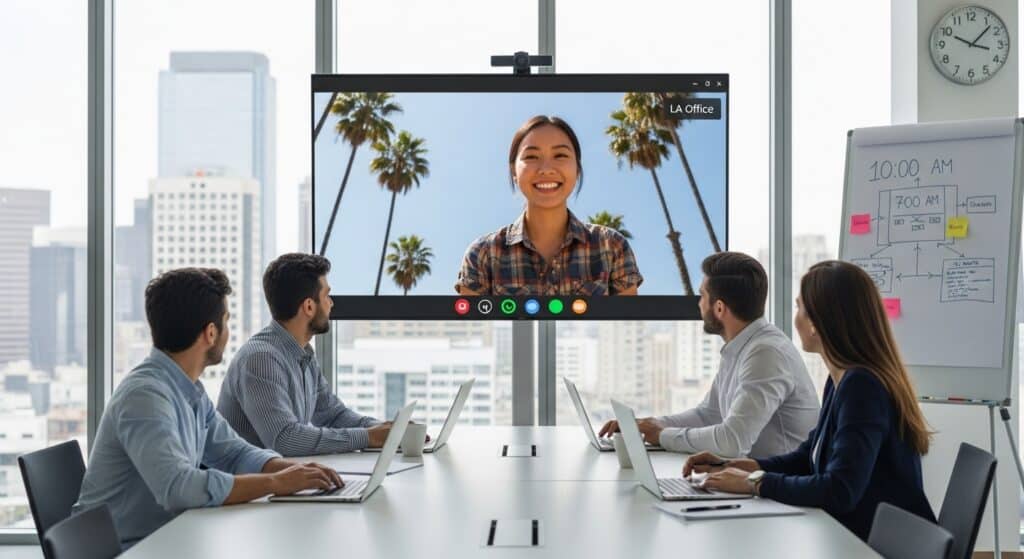
Daily stand-ups (15 minutes) via video keep everyone aligned. Your LA person shares yesterday’s activities, today’s priorities, and any blockers needing resolution.
Weekly pipeline reviews (60 minutes) where LA team member walks through every active opportunity: customer name, current stage, next actions, timeline to close, risks or concerns. Use shared CRM so entire team has visibility.
Bi-weekly strategic sessions (90 minutes) focused on market learning: what’s working, what’s not, competitive intelligence gathered, positioning adjustments needed, new opportunities identified.
Instant messaging (Slack or Teams) for quick questions and informal communication. Remote team members need to feel they can reach colleagues easily, not that every interaction requires scheduled meetings.
Technology Stack:
CRM (required): HubSpot or Salesforce to track all LA prospects, opportunities, and customer interactions. Your LA team member logs every call, email, and meeting. Founder and team can monitor pipeline health without constant status meetings.
Video conferencing (required): Zoom or Google Meet for customer demos and internal meetings. Invest in quality webcam, microphone, and lighting for LA team member—professional video presence matters when selling remotely.
Document collaboration (required): Google Workspace or Microsoft 365 for shared access to proposals, presentations, case studies, and sales materials. LA team member must be able to customize materials for specific customers without waiting on headquarters.
Project management (optional but recommended): Asana, Monday, or Notion for tracking action items, onboarding tasks, and strategic initiatives. Particularly valuable during first 90 days when LA team member has many learning tasks.
Sales enablement (grows with scale): Loom for async video messages, DocuSign for contracts, Calendly for scheduling, LinkedIn Sales Navigator for prospecting.
Avoid this trap: Requiring LA team member to use different systems than rest of company. They should have access to everything headquarters team uses, with same permissions appropriate to their role.
Component 3: Systematic LA Market Knowledge
Your LA team member brings relationships and local knowledge. But systematic market intelligence must be built collectively.
Customer Segmentation Mapping:
Create spreadsheet tracking all potential LA customers by segment. For the 12 professional teams: team name, league, key decision-makers (athletics director, GM, COO, innovation lead depending on your solution), technology budget estimate, current vendor relationships if known, warm connection paths (who do you know who knows them?).
For the 54 collegiate programs: institution name, division level (NCAA D1, D2, D3, NAIA), athletics department size, technology sophistication, budget constraints, decision-maker names and titles.
Update this continuously as LA team member learns market. Over 6-12 months, this becomes your LA market intelligence database worth far more than any purchased list.
Competitive Intelligence:
Who are your direct competitors in LA? What are they selling, at what price points, to which customers? Where are they strong (features, relationships, pricing) and where are they vulnerable?
Los Angeles has 244 sports tech startups. Not all compete with you directly, but understanding the ecosystem helps positioning. Your LA team member should attend competitor events, demo their products, and monitor their messaging.
Ecosystem Relationship Mapping:
Beyond direct customers, who influences technology adoption in LA sports? System integrators who implement technology for teams. Consultants who advise on technology strategy. Industry associations that convene decision-makers. Media covering sports technology. Investors funding sports tech companies.
Your LA team member should build relationships across this ecosystem, not just with direct prospects. These relationships generate referrals, provide market intelligence, and create partnership opportunities.
Component 4: Founder Engagement Cadence
Remote LA entry doesn’t mean “hire someone and forget about it.” Founder involvement remains critical, but structured differently than managing co-located team.
Time commitment: Expect 10-15 hours weekly for first 90 days (heavy training and support), decreasing to 5-8 hours weekly months 4-12 (strategic guidance and deal support), then 3-5 hours weekly for established operations (pipeline reviews and major deals).
Visit schedule: Travel to LA 1-2 times monthly during first 6 months, 3-4 days per visit. Schedule customer meetings, join LA team member for in-person relationship building, attend industry events together, provide coaching and feedback.
After month 6, reduce to 1 visit every 6-8 weeks as LA team member operates more independently. Maintain regular visits—relationships in LA sports market benefit from periodic founder presence.
Deal involvement: For first 3-6 months, founder participates in significant customer meetings (discovery, demos, negotiations). This provides training for LA team member while ensuring customers see experienced leadership commitment.
After month 6, founder involvement becomes selective: complex deals over certain threshold, strategic partnerships, or situations where LA team member specifically requests support.

Implementation Timeline: First 90 Days
The first three months determine whether remote entry succeeds or fails. Follow this structured timeline.
Days 1-30: Foundation and Training
Week 1: Orientation
LA team member learns company thoroughly: product capabilities and limitations, target customer profiles, competitive positioning, pricing and deal structures, case studies and reference customers, company values and culture.
Provide access to all systems (CRM, documents, communication tools). Set up daily stand-ups, weekly pipeline reviews, and instant messaging expectations.
Week 2: Market Research
LA team member researches LA sports market systematically: identifies 25-50 potential target customers, documents decision-maker names and contact information, maps competitive landscape, identifies industry events over next 12 months, researches major technology deployments or initiatives announced publicly.
Week 3: Relationship Activation
LA team member reactivates their existing sports industry network: reaches out to 10-20 key contacts informing them about new role, requests informational meetings with people who might provide LA market insights, attends 2-3 industry events or gatherings to show face and make connections.
Week 4: First Prospect Meetings
LA team member begins scheduling meetings with friendly prospects: targets 5-10 initial conversations with less critical prospects (practice before approaching top targets), founder participates in first 3-5 meetings providing training, documents learnings from each conversation.
Deliverable by Day 30: List of 50+ potential LA customers, 10+ completed prospect conversations, draft LA market positioning based on early feedback, initial pipeline of 3-5 opportunities even if early-stage.
Days 31-60: Pipeline Building
Focus shifts from learning to activity: LA team member should complete 15-25 prospect meetings during this period, with founder involvement decreasing as LA team member demonstrates competence.
Qualification criteria established: Not every LA sports organization is a good prospect. Define clear qualification framework: Do they have the problem you solve? Do they have budget? Can they implement within reasonable timeframe? Are decision-makers accessible?
Objection patterns identified: LA team member tracks recurring objections and develops responses. Common early objections include “we already work with [competitor],” “budget is committed this year,” “we need to see other LA customers first.”
First pilot programs or POCs initiated: Even if not full sales yet, getting 1-2 organizations testing your solution in pilot programs provides LA case study material and feedback for positioning refinement.
Deliverable by Day 60: Pipeline of 10-15 active opportunities at various stages, 3-5 qualification criteria that predict likelihood to close, documented objection handling responses, 1-2 pilot programs or POCs in progress with LA organizations.
Days 61-90: First Revenue and Optimization
Close first LA deals: Even if smaller deals or pilot programs converting to paid, generating first LA revenue validates market entry strategy.
Refine targeting based on results: Which customer segments are responding positively? Which are difficult? Adjust focus toward segments showing traction.
Establish LA presence signals: Join relevant industry associations, get quoted or featured in LA sports media, attend (or sponsor if budget allows) LA industry events, connect with ecosystem influencers.
Systematic process documentation: LA team member documents what’s working: which outreach messages get responses, which demo approaches resonate, which objections are surmountable versus showstoppers, which timing and seasonality factors affect buying.
Deliverable by Day 90: $25-100K in closed LA revenue (or committed pilot programs), refined LA market segmentation based on actual results, documented sales process specific to LA market, decision on next phase expansion (maintain current model, add resources, adjust strategy).
Partnership Strategies for Remote Entry
Direct sales isn’t the only path. Strategic partnerships often accelerate remote market entry by leveraging established organizations’ LA presence and relationships.
Partnership Model 1: Systems Integrators
Many sports organizations use technology consultants or systems integrators for implementation. Rather than selling directly to every team, partner with integrators who deploy solutions across multiple customers.
How it works: Integrator includes your solution in their service offerings. When they work with LA teams or colleges on technology projects, they recommend and implement your platform. You provide training, support, and revenue share (typically 15-25% of recurring revenue generated through partnership).
Best for: Complex solutions requiring significant implementation, products that integrate with multiple systems, platforms serving enterprise customers with professional services expectations.
LA advantage: Major sports technology consulting firms operate in LA serving professional teams and major colleges. Partnering with 2-3 firms provides distribution without building large direct sales team.
Partnership Model 2: Complementary Technology Platforms
Other sports technology vendors serve overlapping customers but solve different problems. Partnership structures where both solutions work better together create win-win situations.
How it works: Partner with established LA platform (analytics, CRM, content management) that already has customer relationships. Integrate your solution with their platform, enabling their customers to access your capabilities through existing vendor relationship. Revenue shared based on contribution.
Best for: Point solutions that enhance broader platforms, technologies with clear integration points, solutions where bundling creates customer value.
LA advantage: Los Angeles hosts major sports tech companies including Genius Sports (1,800 employees) and Fanatics (7,500 employees). Smaller integrations with LA-based platforms provide market entry without competing directly.
Partnership Model 3: League and Association Channels
Professional leagues, collegiate conferences, and sports associations serve multiple member organizations. Partnership with league or association provides endorsed distribution to all members simultaneously.
How it works: League negotiates preferred vendor agreement where you provide your solution to all league members at negotiated pricing. League may take revenue share, or partnership may be non-monetary in exchange for member value creation.
Best for: Solutions providing value across multiple teams (officiating technology, player safety, data standards), platforms benefiting from network effects where more participants increases value, technologies requiring league-level coordination or governance.
LA advantage: While leagues themselves may not be headquartered in LA, LA hosts teams from every major professional league plus numerous collegiate conferences. Pilots with LA teams can lead to league-wide partnerships.
Leveraging Mega-Events Without Mega-Investment
The 2026 World Cup and 2028 Olympics create opportunities, but many founders assume participation requires enormous investment or existing enterprise relationships. Remote entrants can engage strategically.
World Cup 2026: 8 LA Matches
The World Cup generates $594 million in estimated economic impact for LA County. Technology procurement typically happens 12-18 months before events.
Opportunity 1: Venue Technology Pilots
Venues hosting World Cup matches need technology validation before deploying at scale during the event. Offer 3-6 month pilot programs in 2025 allowing venues to test your solution before committing to World Cup deployment.
Cost to you: Provide software free or heavily discounted during pilot. Investment: your time and support, not cash outlay.
Value received: World Cup deployment on your case studies, relationships with major venues, feedback improving product before scale.
Opportunity 2: Fan Experience Innovation
The 2026 World Cup emphasizes fan experience and engagement. Solutions enhancing in-venue experience, mobile engagement, or content delivery align with event priorities.
Position your solution as World Cup fan experience enhancement. Target event organizers, sponsors (who want fan engagement), and broadcasters (who need content).
Opportunity 3: Operational Efficiency
Mega-events create operational complexity: credentialing, security, logistics, volunteer management, real-time communication. If your solution addresses operational challenges, position for deployment supporting event operations.
Olympics 2028: $18 Billion California Impact
Olympic technology procurement operates on longer timelines—24-36 months before games. This means 2025-2026 represents critical procurement window for 2028.
Opportunity 1: LA28 Innovation Partners
LA28 (the organizing committee) actively seeks technology partners. While major sponsorships require substantial investment, smaller technology partnerships may be accessible.
Monitor LA28 announcements for requests for proposals or technology partner opportunities. Your LA team member should build relationships with LA28 innovation and technology staff.
Opportunity 2: UCLA and USC Roles
UCLA and USC will host Olympic events and serve as athlete villages. Both universities are among the 54 LA collegiate programs. Building relationships with these specific institutions creates inside track on Olympic technology needs.
Opportunity 3: Post-Olympic Legacy
Technology deployed for Olympics doesn’t disappear after closing ceremonies. Venues, teams, and organizations maintain systems proven during high-profile events.
Focus on solutions creating lasting value beyond 2028—not just event-specific deployments. This positions you for multi-year relationships rather than two-week engagements.
Critical Timing Note:
If mega-events factor into your LA expansion, act in 2025. World Cup procurement for 2026 is happening now. Olympic procurement extends through 2026, but earlier positioning creates advantages.
Companies entering LA market in 2027 arrive too late for World Cup and late for optimal Olympic positioning. Either commit in 2025-2026, or explicitly plan for post-Olympics market entry when different dynamics apply.
Managing Costs: The Remote Entry Budget
Remote entry costs significantly less than full relocation, but requires realistic budgeting to sustain through first 12-18 months before meaningful revenue.
Year 1 Budget: Remote LA Entry
Personnel (largest cost):
- LA-based team member compensation: $60-80K base salary
- Commission/bonuses: $15-30K (assuming partial performance)
- Benefits (health insurance, payroll taxes): $15-20K
- Personnel total: $90-130K
Travel and Engagement:
- Founder travel to LA (12-18 visits): $15-20K (flights, hotels, meals)
- LA team member local travel and entertainment: $5-8K
- Industry event attendance and sponsorships: $5-10K
- Travel total: $25-38K
Technology and Operations:
- CRM and sales tools: $3-5K annually
- Coworking day passes or meeting spaces: $2-3K
- Marketing materials and collateral: $2-3K
- Operations total: $7-11K
Total Year 1 Investment: $122-179K
This represents minimum viable remote entry. Companies investing less than $100K annually typically fail because insufficient resources prevent building real presence.
Budget for 12-18 months of investment before expecting meaningful revenue. Most LA customers won’t close in first 6 months. Budget accordingly to avoid cutting investment prematurely.
Revenue Expectations Timeline:
Months 1-6: $0-50K LA revenue (pilots, small deals, early adopters) Months 7-12: $100-300K LA revenue (first significant customers closing) Months 13-18: $300-800K LA revenue (pipeline built in year 1 converts) Months 19-24: $600K-1.5M LA revenue (full pipeline operation)
By month 24, LA revenue should cover LA costs with contribution to overall company profitability. If not on trajectory toward this by month 18, reassess strategy.
Common Remote Entry Mistakes
Learn from mistakes other companies made so you don’t repeat them.
Mistake 1: Hiring LA Person Without LA Relationships
Founders often hire based on resume (sales experience, sports industry background) while underweighting LA network strength. Someone with 5 years sports sales experience in another market may know sports but doesn’t know LA ecosystem.
Fix: Prioritize LA relationships over general sports experience. Better to hire someone with 2-3 years LA sports industry experience and modest sales skills than someone with 8 years sports sales elsewhere but no LA connections.
Mistake 2: Treating LA Market as “Bigger Version” of Current Market
LA sports market has distinct dynamics: relationship-driven decision-making (not purely RFP-driven), entertainment industry crossover creating unique expectations, higher competition forcing sharper positioning, seasonal timing tied to sports calendars and mega-events.
Fix: Invest time learning LA market specifics. Don’t assume selling approach that works in Midwest or Southeast translates directly. LA team member needs authority to adapt approach based on local market dynamics.
Mistake 3: Insufficient Founder Involvement
Some founders view remote entry as “hire someone and they handle it.” First 6 months require substantial founder time—10-15 hours weekly for training, customer meetings, strategic guidance.
Fix: Block calendar time for LA support as non-negotiable commitment. Missing LA team member calls, declining LA customer meetings, or being unavailable for guidance signals low priority and undermines remote team member effectiveness.
Mistake 4: No Clear Success Metrics
Without defined metrics, you can’t assess whether remote entry is working. Is 5 customer meetings per week good or bad? Is $50K revenue after 6 months success or failure?
Fix: Set clear metrics at launch. Months 1-3: X prospect meetings, Y opportunities created. Months 4-6: Z opportunities in late stage, $A revenue or committed pilots. Months 7-12: $B revenue target, C customers closed. Review monthly and adjust if needed.
Mistake 5: Giving Up Too Soon
Some companies invest 6 months, see limited results, and conclude “LA doesn’t work for us.” Most remote entry strategies require 12-18 months before meaningful assessment possible.
Fix: Commit to minimum 12-month timeframe before evaluating success. Market entry takes time. Premature withdrawal wastes investment already made and prevents learning whether strategy would have worked with persistence.

How M Studio Supports Remote LA Entry
M Studio provides hands-on support for sports tech companies implementing remote LA market entry, combining 25+ years enterprise experience building for Google, Disney, and Siemens with deep Los Angeles sports technology ecosystem knowledge.
Remote Entry Implementation Services:
We help document your sales process for LA market adaptation, recruit your LA-based team member from our sports industry network, implement CRM and automation systems supporting remote operations, provide ongoing coaching for your LA team member through first year, and facilitate introductions to potential customers and partners.
Our venture studio approach means we’ve supported 500+ founders across 30 countries, with portfolio companies raising $75M+ collectively. We understand both enterprise sales sophistication required for professional teams and practical constraints of $1-5M companies operating without venture capital.
SPIKE Series: Your LA Ecosystem Access
M Studio launched SPIKE Series as Los Angeles’s premier platform connecting sports technology founders, investors, and industry executives. With JPMorgan as founding partner, SPIKE Series provides invitation-only access to decision-makers from entertainment companies (Warner Bros., Disney, Paramount), sports organizations (Golden State Warriors, Unrivaled Basketball League), and investment firms (Family Office Club, Bryant Stibel, Aperture VC).
For remote entry companies, SPIKE Series solves the relationship-building challenge: rather than cold outreach to LA sports organizations, gain warm introductions through quarterly events, intimate gatherings, and strategic showcases where your LA team member builds credibility within established ecosystem.
Companies implementing remote LA entry gain immediate ecosystem access typically requiring 18-24 months to build organically through individual networking—compressed dramatically through SPIKE Series participation.
Typical Engagement for Remote Entry:
3-6 month intensive phase supporting LA team member hiring, onboarding, and initial market penetration, plus 6-12 month ongoing support as LA presence scales and operations become more independent.
[Schedule Strategy Call] to discuss your remote LA entry approach and SPIKE Series ecosystem access.
Download the Complete LA Sports Tech Market Report
This implementation guide provides tactical roadmap for remote market entry. The complete LA Sports Tech Market Report delivers comprehensive data supporting your expansion decision and execution:
- Detailed profiles of all 12 professional teams and 54 collegiate programs with decision-maker information and technology priorities
- Technology trend analysis covering AI applications (driving 30% of current sports tech investment), streaming innovation ($12.5B annual rights investment), wearables market ($94.17B in 2025), and betting integration opportunities ($13.71B market)
- Customer segment buying behavior including Generation Z mobile-first consumption (67% prefer mobile content) and subscription frustration data (35% of consumers need too many services)
- Competitive landscape mapping identifying the 244 LA sports tech startups and positioning strategies for market entry
- Mega-event procurement timelines with specific technology selection windows for 2026 World Cup and 2028 Olympics
- Investment landscape analysis including the $51.9B in H1 2025 sports tech investment and active investor profiles
[Download Complete Market Report]
Frequently Asked Questions
Can I successfully enter the LA sports tech market without relocating my company?
Yes, remote LA market entry works effectively for $1-5M sports tech companies when implemented with four core components: (1) one LA-based team member with existing sports industry relationships who can meet customers in person, (2) excellent remote infrastructure including daily communication, shared CRM, and video collaboration tools, (3) systematic LA market intelligence documenting all 12 professional teams and 54 collegiate programs with decision-makers and technology priorities, and (4) consistent founder involvement averaging 10-15 hours weekly for first 90 days, decreasing to 5-8 hours weekly thereafter. Budget $90-130K annually for LA team member compensation plus $25-38K for travel and engagement, totaling $122-179K first-year investment. Most companies see first meaningful revenue ($100-300K) in months 7-12, with LA operations covering costs by month 18-24. Remote entry fails when companies hire LA team member without sports relationships, provide inadequate remote support, or give up before 12-month minimum timeframe required for market establishment.
How do I find the right LA-based team member for remote market entry?
Find LA sports tech talent through three primary channels: (1) The 54 LA collegiate athletics programs employ hundreds in athletics administration, marketing, and operations—many have strong relationships across LA sports and may consider private sector opportunities offering growth potential, (2) Professional teams, venues, and sports agencies employ business development, partnerships, and client services professionals with 3-5 years experience understanding LA ecosystems intimately, and (3) SPIKE Series events and LA sports industry gatherings provide direct access to actively networked professionals. Use LinkedIn to identify candidates currently at LA sports organizations, prioritizing LA network strength over general sports experience—someone with 2-3 years LA sports industry experience and modest sales skills often outperforms someone with 8 years sports sales elsewhere but no LA connections. Compensation expectations: $60-80K base plus 10-15% commission on closed deals for sales/BD roles, or $65-85K base plus success-based bonuses for partnership development roles. Verify candidates have existing relationships at target customer types (professional teams, colleges, or venues depending on your solution) before hiring.
What’s the timeline for generating revenue from remote LA market entry?
Realistic revenue timeline: Months 1-6 generate $0-50K from pilots, small deals, and early adopters while LA team member builds relationships and pipeline. Months 7-12 generate $100-300K as first significant customers close from opportunities created in first 6 months—professional teams have 6-12 month procurement cycles while collegiate programs move faster at 3-6 months. Months 13-18 generate $300-800K as full pipeline built during year one converts to closed business. Months 19-24 target $600K-1.5M as LA operations reach maturity. By month 24, LA revenue should cover LA costs ($122-179K annually) with contribution to overall profitability. Companies targeting 2026 World Cup ($594M LA economic impact) or 2028 Olympics ($18B California impact) face compressed timelines—mega-event procurement happens 12-24 months before events, creating urgency. Budget minimum 12-18 months investment before expecting break-even, and commit to minimum 12-month evaluation period before assessing whether remote entry strategy is working.
Should I pursue direct sales or partnerships for LA market entry?
Choose based on your solution complexity, target customer size, and available resources. Pursue direct sales if you serve well-defined customer segments (professional teams, collegiate athletics, specific venues), have $50K+ average deal sizes supporting dedicated sales investment, can support 6-12 month enterprise sales cycles, and have proven sales process documented and teachable. Direct sales provides maximum control and customer relationships but requires $90-130K annual investment in LA sales team member. Pursue partnerships if your solution integrates with broader platforms, requires complex implementation where systems integrators add value, serves multiple customers through league or association channels, or if limited resources prevent building dedicated sales team. Partnership models (systems integrators, complementary platforms, league channels) provide distribution leverage but sacrifice margin (15-25% revenue share typical) and some customer relationship control. Most successful remote entry strategies use hybrid approach: partnerships for initial market credibility and pilot customers, transitioning to direct sales as LA presence establishes and revenue justifies dedicated team investment.
How do I compete with LA-based sports tech companies when I’m remote?
Win remote by focusing on five competitive advantages that override geography: (1) Specialized expertise—own specific category (e.g., “collegiate athletics performance analytics”) rather than generic positioning (“sports technology platform”), making you the expert regardless of location, (2) Proven customers elsewhere—LA teams value solutions with track record more than local presence, showcase customers from other markets demonstrating capability, (3) Stronger product—superior product solving LA customer problems more effectively than local competitors beats proximity, invest in product excellence, (4) Better relationships—one LA team member with deep sports industry connections outcompetes LA-based company with weak relationships, prioritize hiring for network strength, and (5) Strategic partnerships—leverage relationships with systems integrators, complementary platforms, or leagues providing LA access without building full local infrastructure. Los Angeles has 244 sports tech startups, not all succeed despite being local. The $21.5B global sports tech market (projected $68.7B by 2030) includes many successful remote companies. Focus on solving customer problems better than alternatives, not on matching competitor office locations.
What are the biggest risks of remote LA market entry?
Four primary risks require mitigation: (1) Relationship deficit—LA sports market is relationship-driven, remote companies without strong LA team member connections struggle to access decision-makers, mitigate by hiring LA person with existing sports industry network and investing in SPIKE Series or similar ecosystem access, (2) Insufficient founder support—remote team members fail when founders provide inadequate time investment (10-15 hours weekly first 90 days required), mitigate by blocking non-negotiable calendar time for LA support and traveling to LA 1-2 times monthly during first 6 months, (3) Premature withdrawal—companies giving up after 6 months waste investment before strategy could prove successful, mitigate by committing to minimum 12-month evaluation period and budgeting 12-18 months before expecting meaningful revenue, and (4) Market timing misalignment—entering LA in wrong procurement cycle misses opportunities, mitigate by understanding 2026 World Cup and 2028 Olympics procurement timelines (decisions happening now through 2026) and targeting customers whose buying cycles align with your entry timing. Companies addressing these risks systematically achieve remote entry success, while those underestimating relationship building requirements, founder involvement needs, or timeline realities typically fail regardless of product quality.
Ready to enter the LA sports tech market without relocating?
Download Complete LA Sports Tech Market Report – Verified market data, customer profiles, procurement timelines, and competitive intelligence supporting your remote entry strategy.
Schedule Strategy Call with M Studio – 45-minute assessment of your remote entry readiness, LA team member recruitment approach, and SPIKE Series ecosystem introduction.
SPIKE Series: LA’s premier sports tech ecosystem connecting founders, investors, and industry leaders