Your sports tech company generates $1-5M in revenue serving teams, athletes, or sports organizations. You’ve built sustainable business through disciplined execution, not venture capital hype.
Now you’re watching Los Angeles prepare for the biggest sports events in a generation. The 2026 FIFA World Cup brings 8 matches to LA, generating an estimated $594 million in economic impact. Two years later, the 2028 Olympics and Paralympics are projected to create $18 billion in economic impact for California.
These aren’t just sporting events—they’re technology procurement catalysts. Organizations hosting mega-events need solutions tested, validated, and deployed months or years before opening ceremonies. Procurement decisions are happening now, not in 2026 or 2028.
The question isn’t whether opportunity exists. It’s whether you can position your company to capture it before procurement windows close.
This guide shows $1-5M sports tech CEOs exactly how to engage mega-event opportunities in Los Angeles—with realistic timelines, specific technology categories in demand, and practical positioning strategies based on verified market data.
Understanding the Mega-Event Procurement Timeline
Most founders misunderstand when mega-event technology decisions actually happen. By the time events begin, procurement is long finished.
2026 World Cup: Critical Decisions in 2024-2025
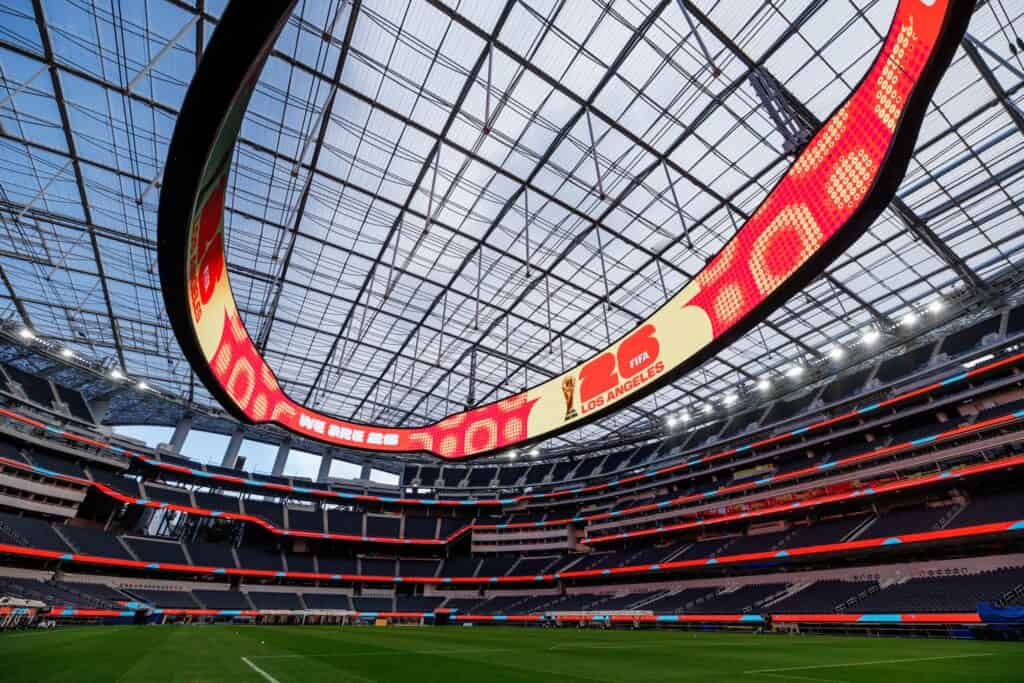
The 2026 FIFA World Cup brings 8 matches to Los Angeles across June and July 2026. The $594 million economic impact for LA County includes venue operations, fan services, broadcast technology, and security systems.
Procurement Reality:
Major technology systems for World Cup deployment require 12-18 months before the event for vendor selection, contract negotiation, system integration, testing, and staff training. This means primary procurement decisions for 2026 World Cup technology are happening now through mid-2025.
Venues hosting World Cup matches—primarily SoFi Stadium in Inglewood—began technology planning in 2023-2024. By late 2025, most technology decisions will be finalized. Companies entering the market in 2026 arrive too late.
Critical Dates:
- 2024 (now): Major system vendors selected
- Early 2025: Point solution vendors evaluated
- Mid-2025: Final procurement decisions made
- Late 2025: Implementation and testing phase
- Q1 2026: Final validation before matches begin
- June-July 2026: World Cup matches in LA
If your solution addresses World Cup needs, you must be positioned in the LA market before mid-2025 to participate in procurement.
2028 Olympics: Extended Timeline Creates Opportunity
The 2028 Olympics and Paralympics generate $18 billion in economic impact for California. This massive figure includes venue operations, transportation systems, security infrastructure, broadcast technology, athlete services, and fan engagement platforms across 17 days of Olympic competition plus Paralympic Games.
Procurement Reality:
Olympic technology procurement operates on 24-36 month timelines. The International Olympic Committee (IOC) and LA28 organizing committee require extensive vendor vetting, security clearances, and system integration planning.
Critical Dates:
- 2024-2025: Major platform and infrastructure vendors selected
- 2025-2026: Point solution and specialist technology vendors evaluated
- 2026-2027: Implementation and integration phase
- 2027-2028: Testing, training, and validation
- July-August 2028: Olympic Games
- August-September 2028: Paralympic Games
Companies seeking Olympic technology deployment must engage 2025-2026 to participate in procurement cycles. Unlike World Cup’s compressed timeline, Olympics offer slightly longer window—but competition is more intense and requirements more stringent.
Post-Event Legacy: The Continuing Opportunity
Technology deployed for mega-events doesn’t disappear after closing ceremonies. Venues, teams, and organizations maintain and expand systems proven during high-profile events.
Los Angeles uses existing world-class venues rather than building temporary infrastructure. The Intuit Dome (opened for the 2024-25 season), SoFi Stadium, and other permanent facilities create ongoing technology deployment opportunities beyond the events themselves.
Companies establishing relationships during mega-event procurement often retain customers for years afterward, making the initial investment worthwhile even beyond the events.
Technology Categories in High Demand
The global sports technology market reached $21.5 billion in 2025 and is projected to grow to $68.7 billion by 2030, representing 20-23% compound annual growth rate. Within this broad market, specific categories align with mega-event needs.
Category 1: Fan Experience and Engagement
Market Context:
Generation Z represents critical customer segment with distinct consumption patterns. 67% of Gen Z consumers prefer consuming sports content primarily on mobile devices while on the go, compared to 54% of millennials and only 23% of Gen X. This mobile-first behavior creates massive addressable markets for integrated digital experiences.
Additionally, 90% of Gen Z and millennial fans use social media for sports content, competing directly with traditional paid subscription models. 40% of Gen Z and millennials want more documentary-style content about sports and players during the offseason, indicating demand for year-round engagement beyond live games.
Mega-Event Application:
World Cup and Olympics attract global audiences expecting premium digital experiences. Fan engagement solutions must work across:
- Mobile-first platforms delivering real-time updates, scores, and highlights
- Multi-language support for international audiences
- Social media integration enabling fans to share experiences instantly
- In-venue experiences enhancing physical attendance through technology
- Accessibility features meeting Paralympic requirements
Your Opportunity:
If your platform delivers mobile-first fan engagement, multi-language content distribution, social integration, or accessibility-focused experiences, position for mega-event deployment.
Positioning Strategy: Frame your solution as “World Cup-ready” or “Olympic-capable” emphasizing scalability, security, and proven performance under high-traffic conditions.
Category 2: Broadcast and Media Technology
Market Context:
The global sports streaming platform market reached $33.93 billion in 2024 and is projected to grow to $68.7-85 billion by 2030, representing 12.6-24.6% CAGR. Streaming providers are investing $12.5 billion annually in sports rights, creating massive opportunities for companies providing differentiation through interactive features, multi-angle viewing, real-time statistics overlays, and integrated social experiences.
Mega-Event Application:
Olympics and World Cup represent peak broadcast technology challenges: simultaneous events across multiple venues, global distribution requirements, real-time translation needs, and unprecedented viewership volumes.
Technology categories in demand include:
- Multi-camera systems enabling viewers to select viewing angles
- Real-time statistics integration overlaying data on broadcast streams
- AI-powered commentary providing personalized or translated audio
- Cloud-based production reducing on-site infrastructure requirements
- Interactive features allowing viewers to access additional content during broadcasts
Your Opportunity:
If your solution enhances broadcast production, enables interactive viewing, provides real-time data integration, or supports cloud-based media workflows, target broadcast rights holders and production companies serving mega-events.
Positioning Strategy: Demonstrate scalability to handle Olympic viewership volumes (billions of viewers globally) and World Cup traffic spikes.
Category 3: Artificial Intelligence and Automation
Market Context:
AI and automation technologies are driving approximately 30% of current sports tech investment deals, reflecting fundamental shift toward practical implementations delivering measurable ROI. Investment focus has shifted from experimental AI to proven applications generating revenue or reducing costs.
Current AI use cases include facial recognition systems, object recognition for sports analysis, personalized workout generation, real-time commentary translation, and scheduling optimization. Generative AI enables hyper-personalized fan engagement, real-time content delivery, and data-driven marketing at scale.
Mega-Event Application:
Mega-events create perfect AI deployment opportunities due to:
- Security requirements where facial recognition and threat detection prove value
- Operational complexity where scheduling optimization and resource allocation reduce costs
- Content generation where AI creates personalized highlights and social content at scale
- Language translation where real-time AI translation serves international audiences
- Performance analysis where AI processes massive data volumes for athlete insights
Your Opportunity:
If your solution leverages AI for security, operations optimization, content generation, translation, or performance analysis, position as proven technology ready for mega-event deployment.
Positioning Strategy: Emphasize that your AI delivers specific measurable outcomes (cost reduction, revenue generation, enhanced security) rather than general “AI-powered” positioning.
Category 4: Wearables and Performance Technology
Market Context:
The wearable devices in sports market reached $94.17 billion in 2025 and is projected to reach $115.57 billion by 2030. The connected gym equipment market grew from $1.05 billion in 2023 to $1.64 billion in 2024, with projections reaching $7 billion by 2030, representing 26.93% CAGR.
Mega-Event Application:
Olympics specifically create wearables and performance technology opportunities:
- Athlete monitoring during training and competition
- Performance optimization using real-time biometric data
- Injury prevention through load management and fatigue detection
- Training facilities at athlete villages equipped with connected equipment
- Recovery technology supporting athlete wellness between competitions
Your Opportunity:
If your solution provides athlete monitoring, performance tracking, injury prevention, or training optimization through wearables or connected equipment, target Olympic teams, training facilities, and athlete service providers.
Positioning Strategy: Emphasize data privacy and security (critical for Olympic athletes) and ability to serve diverse sports with different monitoring needs.
Category 5: Venue Operations and Management
Market Context:
Los Angeles generates $8.9 billion in annual economic output from sports, supporting 83,430 jobs. This economic foundation creates demand for technology solutions improving venue operations efficiency.
Mega-Event Application:
World Cup and Olympics stress-test venue operations at unprecedented scale:
- Crowd management handling capacity crowds safely and efficiently
- Wayfinding technology helping visitors navigate large venue complexes
- Concessions and retail processing high-volume transactions quickly
- Parking and transportation coordinating arrival and departure of massive crowds
- Credentialing and access control managing athletes, staff, media, and spectators
Your Opportunity:
If your solution addresses venue operations challenges—crowd flow, wayfinding, point-of-sale, transportation coordination, or access management—position for mega-event deployment proving scalability.
Positioning Strategy: Emphasize that mega-event deployment provides case study for every future major sporting event, creating long-term market value beyond 2026 and 2028.
How to Position Your Company for Mega-Event Opportunities
Understanding procurement timelines and technology categories is insufficient without practical positioning strategy.
Strategy 1: Pilot Programs Before Mega-Events
Organizations need technology validation before deploying at mega-events. Pilot programs in 2024-2025 allow venues, teams, or organizers to test solutions before World Cup or Olympic commitments.
Implementation Approach:
Offer 3-6 month pilot programs at venues hosting mega-events. Provide your solution free or heavily discounted during pilot in exchange for:
- Deployment rights during World Cup or Olympics if pilot succeeds
- Case study permission documenting pilot results
- Reference customer relationship for future sales
- Feedback improving your product before scale deployment
Target Organizations:
- SoFi Stadium (World Cup venue, also hosts Rams, Chargers, and major events)
- Rose Bowl (potential Olympic venue, UCLA football)
- Intuit Dome (new venue, Clippers home, hosts major events)
- LA28 organizing committee (direct Olympic organizers)
- UCLA and USC (Olympic athlete villages and event hosts)
Timeline: Propose pilots in Q4 2024 through Q1 2025 for validation before mid-2025 World Cup procurement decisions and 2025-2026 Olympic procurement.
Strategy 2: Partnership with Established Vendors
Rather than competing directly with enterprise technology vendors already engaged with mega-events, partner with them as specialized solution provider.
Implementation Approach:
Identify systems integrators, broadcast technology providers, or venue operations companies already working on World Cup or Olympic projects. Position your solution as complementary capability enhancing their offerings.
Partnership Value Proposition:
You bring specialized functionality they lack. They bring mega-event relationships and contracts. Revenue share (typically 15-25%) is acceptable because you gain access to opportunities otherwise unavailable.
Target Partners:
Major sports technology consulting firms operating in LA serve professional teams and handle Olympic planning. Partner with 2-3 firms providing distribution without building large direct sales team.
Strategy 3: Olympic Team and National Federation Relationships
The Olympics involve over 200 countries and thousands of athletes. Rather than targeting LA28 organizing committee directly (highly competitive), target Olympic teams and national federations preparing for 2028.
Implementation Approach:
Many countries use Los Angeles as training base before Olympics. National federations and Olympic committees need technology supporting athlete preparation, performance analysis, and training optimization.
Engage these organizations 2025-2026 as they establish LA training operations. Your solution deployed for their preparation often extends to Olympic competition.
Geographic Targets:
Countries with strong LA connections include Australia, Japan, South Korea, Canada, and European nations. Many have existing training facilities or partnerships with LA universities.
Strategy 4: Leverage LA Sports Infrastructure
Los Angeles hosts 12 professional teams across major leagues and 54 colleges and universities with athletic programs. These organizations aren’t directly involved in mega-events but benefit from technology validated for World Cup or Olympic deployment.
Implementation Approach:
Build LA customer base with professional teams and colleges during 2024-2025, positioning these deployments as proof points for mega-event procurement.
“Our solution serves Lakers, Dodgers, UCLA, and USC—proven at championship and high-profile event levels” creates credibility for World Cup and Olympic opportunities.
Multiplication Effect:
One professional team customer in LA creates more credibility for mega-event sales than five customers elsewhere. LA market success signals you understand world-class sports technology requirements.
Cost-Benefit Analysis: Is Mega-Event Pursuit Worth It?
Pursuing mega-event opportunities requires investment. Realistic cost-benefit analysis determines whether pursuit makes sense for your company.
Investment Requirements
Minimum Viable Pursuit:
- LA-based team member: $60-80K salary plus commission
- Travel and events: $15-20K for founder and team travel
- Pilot program costs: $10-20K in discounted/free service delivery
- Marketing and positioning: $5-10K for materials emphasizing mega-event readiness
- Total minimum investment: $90-130K over 12-18 months
Aggressive Pursuit:
- 2-3 person LA team: $150-200K compensation
- Partnership development: $20-30K in relationship building and events
- Pilot programs at multiple venues: $30-50K in service delivery
- Ecosystem engagement: $10-20K in SPIKE Series sponsorship and event participation
- Total aggressive investment: $210-300K over 12-18 months
Revenue Potential
World Cup Deployment:
Single venue deployment for World Cup: $50-200K depending on solution type and scope. Legacy relationship with venue after event: $25-100K annually in ongoing service.
Olympic Deployment:
Olympic organizing committee or major venue contract: $100K-1M+ depending on solution type. Multiple venue or team deployments: $50-500K per relationship. Post-Olympic legacy business: $50-200K+ annually from ongoing relationships.
Intangible Value:
“As seen at 2026 World Cup” or “Official technology provider for 2028 Olympics” in marketing materials provides credibility worth significant customer acquisition cost reduction for years after events.
Break-Even Analysis
Scenario 1: Single World Cup Deployment
Investment: $90-130K Revenue: $50-200K one-time + $25-100K annual legacy Break-even: 12-24 months if legacy relationship materializes
Scenario 2: Multiple Olympic Opportunities
Investment: $210-300K
Revenue: $200K-1M+ from multiple deployments + ongoing relationships Break-even: 12-36 months depending on contract size and duration
Decision Framework:
Pursue mega-events if your solution naturally aligns with demand categories (fan engagement, broadcast, AI, wearables, venue operations) AND you can sustain 12-24 month investment before break-even AND you have capacity to deliver at mega-event scale without breaking existing operations.
Don’t pursue if your solution doesn’t address mega-event needs clearly OR you lack financial runway for extended sales cycles OR you can’t support high-profile deployment successfully.
The Sports Tech Investment Landscape Context
Understanding broader investment trends provides context for mega-event positioning decisions.
Current Investment Reality
The sports tech sector saw $51.9 billion invested in H1 2025 alone, demonstrating continued strong investor interest despite broader economic uncertainty. This validates sports tech as growth category attracting sustained capital.
However, investor sentiment has shifted. Focus moved from engagement metrics to revenue generation. Fan engagement solutions that directly generate revenue in venues and broadcasts see remarkable growth. Technologies leveraging AI for faster, better services at lower operational costs attract investment. The media rights landscape represents both biggest challenge and opportunity, with innovative broadcast experiences in high demand.
What This Means for Mega-Event Positioning
Investors understand mega-events create validation opportunities. “Deployed at 2028 Olympics” significantly improves fundraising prospects for companies seeking capital post-event.
If you currently operate without venture capital but may consider raising funds 2027-2029, Olympic or World Cup deployment provides compelling investor narrative beyond revenue metrics alone.
How M Studio and SPIKE Series Support Mega-Event Positioning
M Studio provides hands-on GTM (Go-to-Market) engineering for sports tech companies positioning for mega-event opportunities, combining 25+ years enterprise experience building for Google, Disney, and Siemens with deep Los Angeles sports technology ecosystem knowledge.
Mega-Event Positioning Services:
We help document your solution’s alignment with mega-event needs, develop pilot program proposals for target venues and organizations, facilitate introductions to LA28 organizing committee and venue operators through our network, position your technology through SPIKE Series ecosystem visibility, and provide ongoing strategic guidance through procurement cycles.
Our venture studio approach means we’ve supported 500+ founders across 30 countries, with portfolio companies raising $75M+ collectively. We understand both enterprise sales sophistication required for Olympic procurement and practical constraints of $1-5M companies operating without venture capital.
SPIKE Series: Your Mega-Event Ecosystem Gateway
M Studio launched SPIKE Series with JPMorgan as founding partner, creating Los Angeles’s premier platform connecting sports technology founders, investors, and industry executives specifically around mega-event opportunities.
SPIKE Series provides access to decision-makers from entertainment companies (Warner Bros., Disney, Paramount), sports organizations (Golden State Warriors, Unrivaled Basketball League), investment firms (Family Office Club, Bryant Stibel, Aperture VC), and importantly, connections to LA28 organizing committee members and venue operators preparing for 2026 and 2028.
Quarterly events beginning September 2025 create platforms to demonstrate solutions to qualified audiences including potential Olympic and World Cup technology decision-makers, eliminating cold outreach to procurement committees.
Companies pursuing mega-event opportunities gain ecosystem access, credibility through association with established sports and entertainment leaders, warm introductions to procurement influencers, and visibility among investors specifically interested in Olympics-validated technology.
Schedule Strategy Call to discuss your mega-event positioning approach and SPIKE Series participation.
Critical Action Timeline
If mega-events factor into your Los Angeles expansion strategy, time-sensitivity demands immediate decisions.
Q4 2024 Actions (Now)
- Research which mega-event technology categories align with your solution
- Identify target venues, organizing committees, or Olympic teams to approach
- Develop pilot program proposals offering validation opportunities
- Begin LA market entry execution (hire team member, establish presence)
- Connect with M Studio regarding SPIKE Series participation
Q1 2025 Actions
- Launch pilot programs with target organizations
- Attend SPIKE Series inaugural event (September 2025) for ecosystem access
- Build relationships with procurement influencers through LA sports ecosystem
- Collect validation data from pilot deployments
- Prepare World Cup procurement proposals
Q2-Q3 2025 Actions
- Finalize World Cup vendor agreements (procurement window closing)
- Expand Olympic positioning efforts (procurement window extending through 2026)
- Scale successful pilot programs to broader deployments
- Build case studies from early deployments
- Engage partnership discussions with systems integrators
Q4 2025 – Q1 2026 Actions
- World Cup implementation and testing phase
- Continue Olympic procurement engagement
- Prepare for World Cup deployment validation
- Position Olympic opportunities based on World Cup success
The Window Is Closing:
World Cup procurement decisions finalize mid-2025. Olympic procurement extends through 2026 but earlier positioning creates advantages. Companies acting now gain 6-12 month lead over competitors entering later.
Download the Complete LA Sports Tech Market Report
This mega-event opportunity guide provides strategic overview. The complete LA Sports Tech Market Report delivers comprehensive data supporting your positioning decisions:
- Detailed procurement timeline analysis for World Cup and Olympic technology selection with specific decision windows and key stakeholders
- Technology category deep-dives covering all solution types in demand with market size data and competitive landscape
- Venue and organization profiles for all 12 professional teams, 54 collegiate programs, and mega-event facilities with decision-maker information
- Investment landscape analysis including the $51.9B H1 2025 investment data, active sports tech investors, and funding strategies
- Customer behavior insights including Generation Z mobile-first patterns (67% preference) and subscription frustration data (35% of consumers)
- Partnership strategy frameworks for working with systems integrators, broadcast companies, and Olympic teams
[Download Complete Market Report]
Frequently Asked Questions
When do World Cup and Olympics technology procurement decisions actually happen?
World Cup 2026 technology procurement decisions are happening now through mid-2025—12-18 months before the 8 LA matches in June-July 2026 generating $594 million economic impact. Major system vendors were selected in 2024, point solutions are being evaluated in early 2025, and final procurement decisions will be made by mid-2025 before implementation and testing phases. Olympic 2028 technology procurement operates on 24-36 month timelines, with major platforms selected 2024-2025, specialist technology vendors evaluated 2025-2026, and implementation running 2026-2027 before the $18 billion California economic impact events. Companies must be positioned in LA market before mid-2025 for World Cup opportunities and during 2025-2026 for optimal Olympic positioning. Entering in 2027 misses World Cup entirely and arrives late for Olympics primary procurement.
Which technology categories are most in demand for mega-events?
Five categories align with mega-event needs based on global sports tech market trends ($21.5B in 2025 growing to $68.7B by 2030): (1) Fan experience and engagement addressing Generation Z mobile-first consumption (67% prefer mobile content) and social integration (90% use social media for sports), (2) Broadcast and media technology serving the $33.93B streaming market and $12.5B annual sports rights investment with interactive features and multi-angle viewing, (3) AI and automation driving 30% of current sports tech investment deals through security applications, operational optimization, real-time translation, and content generation, (4) Wearables and performance technology in the $94.17B market serving athlete monitoring, training optimization, and injury prevention, and (5) Venue operations managing crowd flow, wayfinding, transactions, and access control at unprecedented scale. Solutions in these categories with proven scalability and security position best for mega-event deployment.
How much does it cost to position for World Cup or Olympics opportunities?
Minimum viable mega-event pursuit costs $90-130K over 12-18 months including LA-based team member ($60-80K salary plus commission), travel and events ($15-20K), pilot program delivery costs ($10-20K discounted/free service), and marketing materials ($5-10K). Aggressive pursuit costs $210-300K including 2-3 person LA team ($150-200K), partnership development ($20-30K), multiple venue pilots ($30-50K), and ecosystem engagement through SPIKE Series ($10-20K). Revenue potential ranges from $50-200K for single World Cup venue deployment plus $25-100K annual legacy, to $100K-1M+ for Olympic organizing committee or multi-venue contracts plus ongoing relationships. Break-even typically occurs 12-24 months for World Cup opportunities and 12-36 months for Olympic deployments depending on contract size. Budget minimum 12-18 months before expecting return, and only pursue if your solution clearly aligns with demand categories and you can sustain extended sales cycles.
Can my company participate in mega-events without relocating to LA?
Yes, through three approaches: (1) Remote entry model hiring one LA-based team member with sports industry relationships who can meet procurement decision-makers in person and represent your company locally while headquarters remains elsewhere, costing $90-130K annually, (2) Partnership model where you provide specialized technology to established vendors already engaged with mega-events, sharing revenue (15-25% typical) in exchange for access to opportunities otherwise unavailable, requiring less LA investment but sacrificing margin, or (3) Olympic team relationships targeting the 200+ countries and national federations preparing for 2028, many establishing LA training bases 2025-2026, allowing you to serve preparation needs that extend into Olympic competition. Most successful approaches combine remote LA presence for relationship building with strategic partnerships for mega-event contract access. Full relocation unnecessary unless mega-events represent primary multi-year business focus.
What happens after World Cup and Olympics end—is the opportunity temporary?
No, post-event legacy creates sustained opportunities. Technology deployed for mega-events doesn’t disappear after closing ceremonies—venues, teams, and organizations maintain systems proven during high-profile events. Los Angeles uses existing world-class venues (SoFi Stadium, Intuit Dome, Rose Bowl) rather than temporary infrastructure, ensuring technology remains operational for ongoing events. Companies establishing relationships during mega-event procurement often retain customers for years afterward: single World Cup deployment ($50-200K) creates venue relationship worth $25-100K annually ongoing, while Olympic deployments lead to sustained contracts with venues and teams. Additionally, “deployed at 2028 Olympics” or “used at 2026 World Cup” in marketing provides credibility reducing customer acquisition costs permanently. The $8.9 billion annual LA sports economic output continues beyond 2026 and 2028, with mega-event technology validation improving your position across all LA sports market opportunities.
Ready to position your sports tech company for World Cup and Olympics opportunities?
Download Complete LA Sports Tech Market Report – Verified procurement timelines, technology category analysis, venue profiles, and positioning strategies.
Schedule Strategy Call with M Studio – Assessment of your mega-event alignment, pilot program strategy, and SPIKE Series ecosystem introduction.
Time-sensitive: Olympic positioning is optimal during 2025-2026.
Join the movement now!