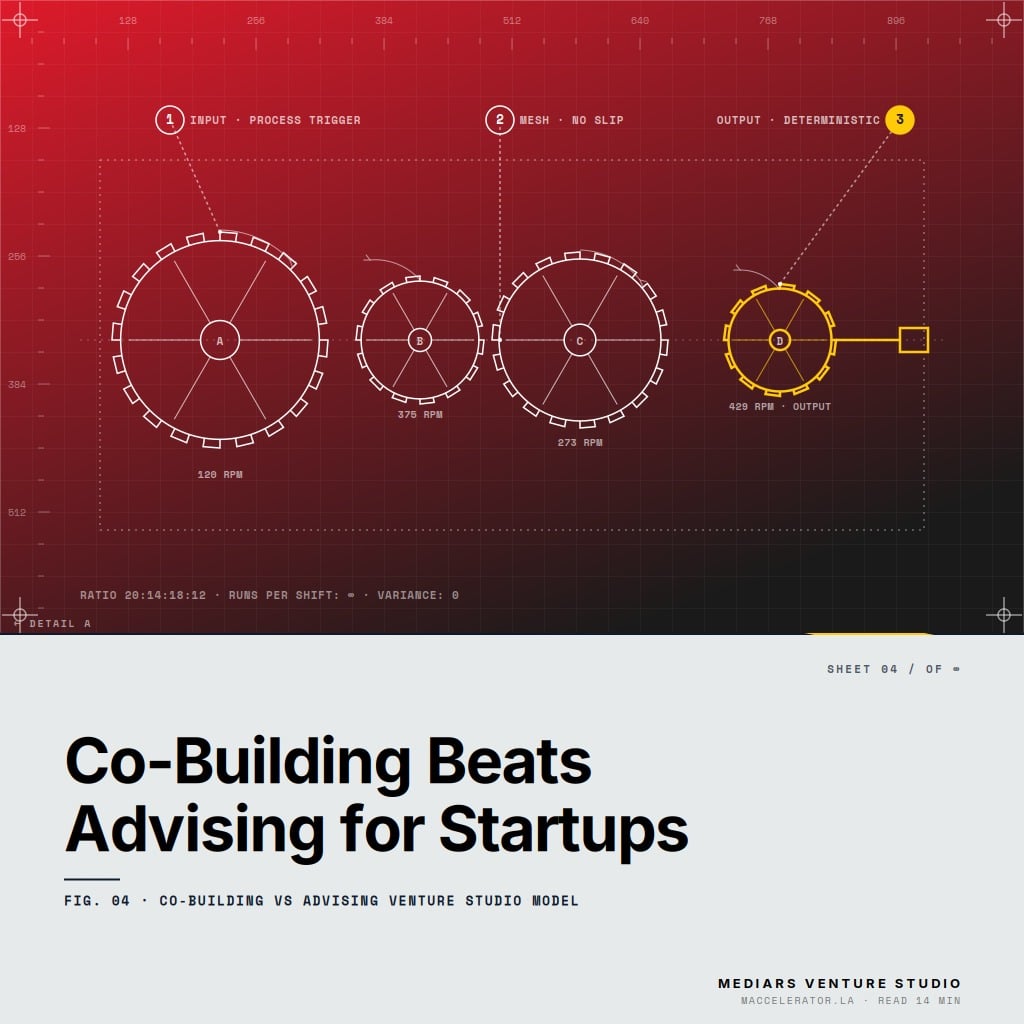
You’re post-PMF. Revenue is real but uneven — somewhere between $50K and $3M ARR. Growth is happening, but in fits and starts. You’ve outgrown the generic accelerator, and now you face a sharper question: bring in operators who do the work, or advisors who shape the work? The co-building vs advising venture studio model decision comes down to this: co-building means operators build alongside you with shared ownership and execution responsibility, while advising means experts guide your decisions and your team executes. Co-building suits founders who lack hands-on capacity and need de-risked execution. Advising suits founders who already have execution capacity but lack strategic clarity.
Here’s what nobody tells you. Most founders at this stage misdiagnose what they need.
They hire advisors when they’re capacity-constrained — and end up with brilliant frameworks they have no bandwidth to execute. Or they bring in co-builders when they really just needed a sharp sounding board for two decisions. Both mistakes cost the same three things: equity, time, and momentum. At your stage, momentum is the one you can’t buy back.
This article gives you the diagnostic to choose correctly. We’ll define both models past the jargon, show you where accountability actually lives, and walk through six criteria you can apply this week.
What Co-Building and Advising Actually Mean in a Venture Studio
The term “venture studio” is poorly defined across the industry. Ask ten studio operators what one is, and you’ll get ten answers. That vagueness is your problem — and your evaluation advantage if you know what to look for.
Let’s set clean terms.
Co-building means studio operators embed and own deliverables. They run the GTM build. They handle hiring sprints. They prep the fundraise. They ship product alongside your team. Compensation is usually tied to equity, a hybrid structure, or success fees — because they’re accountable to outcomes, not hours.
Advising means structured guidance. Frameworks, pattern-matching, network access, decision support. The advisor shapes the call. Your team makes the move. Compensation is typically a retainer or a smaller advisory equity grant. The advisor is right or wrong — but they don’t carry the execution weight.
Most real engagements are hybrids. That’s not a dodge — it’s the honest reality. A good engagement co-builds the highest-risk function and advises the rest.
“Any provider who can’t tell you exactly who does the work — their team or yours — on each deliverable is selling you ambiguity. Walk away from ambiguity.” — M Studio operator
This is where the venture studio space hides. The label sounds premium. The deliverable is often undefined. So before you sign anything, force the question: for each thing that needs to happen, whose hands are on the keyboard?
That single clarification separates a real partner from a re-branded consultant. Over 25+ years building inside Google, Disney, and Siemens, then working with 500+ founders across 30 countries, the pattern holds: clarity on ownership predicts whether an engagement ships or stalls. Nothing else comes close.
The Real Difference: Where Does Accountability Live?
The conventional framing is “hands-on vs hands-off.” That’s wrong. The real distinction is accountability — who loses what when something fails.
In advising, accountability stays 100% with you. The advisor gives you the playbook. If it doesn’t work, they were wrong on paper, but they bear no execution consequence. Their downside is mild reputational. Yours is a lost quarter.
In co-building, accountability is shared. That changes behavior on both sides. When operators have equity or success-tied comp, they don’t hand you a deck and leave. They’re in the build when it gets ugly.
Incentive structure reveals the true model, regardless of what the engagement is called.
A pure retainer with no outcome tie? That’s advising wearing a studio costume. Equity plus a success fee plus named deliverables? That’s co-building, even if the contract says “advisory.”
Here’s the diagnostic question. Ask it before every engagement:
“If this initiative fails in 90 days, who loses what?”
If the only person who loses is you, you’re buying advice. Price it accordingly.
What This Looks Like in Practice
A consumer subscription founder at roughly $1.2M ARR came to us after a retention problem. Churn was eating their growth. They had hired advisors — sharp ones — who delivered excellent frameworks on cohort analysis and win-back sequences.
The frameworks were correct. The problem was that no one owned execution.
The advisors advised. The founder’s team was already underwater on product. The retention work became a backlog item. A quarter passed. Churn held. The lost ARR compounded because retention compounds — every month of leak makes the next month’s base smaller.
Contrast that with the same problem when execution ownership was shared. An operator owned the win-back build end to end, accountable to a churn number, not a deliverables list. The frameworks were the same. The outcome was not.
That is the difference accountability makes. We break down these accountability traps weekly in the AI Acceleration newsletter — practical breakdowns, not theory.
Key Takeaways
- Co-building means shared ownership and execution; advising means guidance while your team executes. The label matters less than where accountability lives.
- Incentive structure reveals the real model. Equity and success fees signal co-building. Pure retainers signal advising, whatever the contract says.
- Most founders misdiagnose their gap. Capacity-constrained teams buy advice they can’t execute. Clarity-rich teams over-buy execution they don’t need.
- The best engagements match mode to function — co-building the highest-risk function, advising the rest.
- Post-PMF with real revenue is the right stage. Pre-PMF is usually too early for either model.
How to Choose: 6 Criteria for Co-Building vs Advising
Run your decision through these six criteria. Each one points toward a model. Tally them up by function, not for your whole company at once.
1. Capacity Gap vs Clarity Gap
Do you lack hands or direction? If you know exactly what to do but can’t get it done, that’s a capacity gap → co-building. If your team can execute but you’re unsure which direction to point them, that’s a clarity gap → advising.
Most founders confuse these. Be honest about which one is actually true.
2. Speed Requirement
How fast must this ship? If the window is 48 hours to 6 weeks and missing it costs real money, advice won’t move fast enough — you need hands. Tight timelines point toward co-building. Slow-burn strategic shifts tolerate advising.
3. Equity Tolerance
What dilution or comp are you willing to trade? Co-building usually costs equity or success fees. If you’re protective of the cap table and the initiative is reversible, advising preserves ownership. If the upside of getting it right dwarfs the dilution, co-building pays for itself.
4. In-House Talent
Can your team execute with guidance alone? A senior team with a gap in direction needs advising. A capable team missing a specific skill — like a GTM motion no one has built before — needs co-building on that function.
5. Reversibility
How costly is a wrong move? Low-stakes, easily reversible decisions are fine to advise and iterate. High-stakes, hard-to-undo moves — a pricing overhaul, a category repositioning, a key hire — justify shared accountability through co-building.
6. Stage of the Specific Initiative
Is this a 0-to-1 build or an optimization? Building something from nothing carries execution risk that advice doesn’t cover — co-building wins. Optimizing an existing motion where the playbook is known? Advising is enough.
A Worked Example
A B2B SaaS founder at $800K ARR came in with a strong product team and no GTM motion. Run the criteria:
- Capacity vs clarity → GTM capacity gap. They knew they needed outbound; no one could build it.
- Speed → they needed pipeline this quarter.
- In-house talent → product-deep, sales-empty.
- Reversibility → a botched GTM build burns budget and morale.
- Stage → 0-to-1 on the sales motion.
The answer wasn’t one model for the whole company. It was co-building on GTM specifically, advising everywhere else.
Their product roadmap didn’t need operators — it needed occasional input. Their GTM needed someone owning the number. Match the mode to the function, and you stop overpaying for the parts that are already working.
Where Each Model Wins — and Where It Quietly Fails
Both models work. Both fail. The failure modes are predictable, and most founders only learn them after the equity is spent. Here’s the honest map.
Where Advising Wins
Advising wins when you’re an experienced founder with a capable team. You’ve shipped before. You don’t need someone in the build — you need pattern-matching, a network, and a sharp second opinion on the bets that matter.
It wins when you want to preserve equity and the decisions are reversible. You’re trading money or a small grant for compressed learning. That’s a good trade when execution isn’t your bottleneck.
Where Advising Quietly Fails
Advising fails when your team is capacity-constrained. The advice is correct. The backlog is infinite. Every framework becomes a task nobody has time to run.
Advice without execution capacity is just a more expensive way to feel stuck.
This is the most common failure we see. Founders buy strategy when their real problem is hands. The deck is beautiful. Nothing ships.
Where Co-Building Wins
Co-building wins on capacity gaps and 0-to-1 builds. When you need a function stood up fast and you can’t hire the talent quickly enough, operators who own the outcome compress months into weeks.
It wins when you want de-risked execution with aligned skin in the game. Equity-tied operators are in the trench with you. Their incentive is your result.
Where Co-Building Quietly Fails
Co-building fails when ownership boundaries are unclear. If no one knows who owns what, accountability evaporates and you get the worst of both — slow execution and confused decision-making.
It fails when a founder wants control but outsources accountability. You can’t direct every move and also expect operators to own the result. Pick one.
And it fails when the studio over-builds and creates dependency. If the engagement ends and your team can’t run the function, you didn’t get capability — you got a crutch. That’s a design failure, and it’s avoidable.
Two Patterns Side by Side
A marketplace founder used advising successfully. They had a senior operations team that could execute anything — they just needed someone who’d scaled marketplaces before to tell them which lever to pull first. Advising fit perfectly. Their team ran with every recommendation.
A hardware-adjacent founder needed co-building. The build required specialized execution they couldn’t hire fast enough. Advice would’ve sat in a backlog while the market window closed. Operators owned the build, hit the milestone, and handed off a working function.
Same stage. Opposite needs. The variable was always capacity, not quality of the team.
How We Approach the Build-vs-Advise Decision
Our position is simple: it’s not co-build or advise. It’s diagnosing which functions need which mode, then matching intensity to the actual gap.
Most engagements start by separating clarity gaps from capacity gaps — function by function. Your fundraise might need co-building while your hiring needs advising. Your product might need nothing but a quarterly gut-check while your GTM needs operators in the build.
We apply co-building selectively, where execution risk is highest. We advise the rest. That keeps your equity intact and your team building muscle instead of leaning on ours.
“The goal is for the founder to graduate, not to need us forever. If your team can’t run the function after we leave, we built it wrong.” — M Studio operator
That anti-dependency principle is deliberate. Over-building is the quiet failure mode of the whole studio category. We design against it from day one.
What This Looks Like
A Series A founder we worked with came in wanting full co-building across the board. Everything. Product, hiring, GTM, fundraise — operators on all of it.
The diagnostic told a different story.
They had clarity gaps in two functions and capacity gaps in one. They needed co-building only on the fundraising narrative — where execution risk was highest and the window was tight — and advising on hiring, where their team was strong and just needed structure.
Co-building everything would have cost more equity and built less internal capability. The selective approach saved dilution and left their team stronger. That’s the point.
This selective, function-matched support is the core of how Elite Founders works — operators who diagnose first and build only where the risk justifies it. The integrated view matters here: strategy, execution, and communication move together, because a brilliant fundraise narrative with no execution behind it is just a story.
The systems we build at enterprise scale inform this. Designing infrastructure for ventures managing dozens of moving parts taught us which signals predict whether an initiative ships or stalls. That signal framework is what we bring to the diagnostic — not enterprise deliverables, the judgment behind them.
“But We’re Not Sure We Need This” — 3 Honest Objections
You’re evaluating seriously. So let’s handle the real objections honestly — including the cases where the answer is to walk away.
1. “We Don’t Have the Budget Right Now”
Fair. But separate cost from cost-of-delay. The invoice is visible. The lost quarter is not — and it’s usually bigger.
If your growth bottleneck is fixable and you sit on it for two quarters, you don’t pay zero. You pay in compounding lost ARR. A retention leak or a missing GTM motion doesn’t stay the same size — it grows against you.
Sometimes bootstrapping the decision yourself is the right call. If the initiative is reversible, low-stakes, and your team has bandwidth, do it in-house. The engagement is worth it when a wrong quarter costs more than the engagement itself. Run that math before the budget conversation.
2. “We Can Figure This Out Ourselves”
Many founders can. We mean that. If you’ve solved harder problems with less, you don’t need anyone.
Here’s the honest test. If you’ve been stuck on the same growth bottleneck for two or more quarters, the issue is rarely information.
You probably already know what to do. The gap is capacity, accountability, or an outside operator who’s built this exact thing twenty times and won’t let you re-learn it the slow way. Information you can Google. Execution-with-ownership you can’t.
If you’re stuck and it’s not for lack of knowing — that’s the signal.
3. “We’re Too Early-Stage for This”
Usually the opposite is true. Post-PMF with real revenue is the right stage for this decision. You have something working that’s worth accelerating, and the cost of an uneven scale is high.
Pre-PMF is the stage that’s too early. Before product-market fit, neither model helps much — you need to find the fit, and no operator or advisor can hand that to you. That’s founder work.
So if you’re sitting at $50K to $3M ARR with growth that’s real but lumpy, you’re not too early. You’re exactly on time. Founders who wait two quarters on a fixable GTM bottleneck don’t save money — they watch the compounding work against them.
If the fit isn’t there, walk. We’d rather you build internal muscle than sign something you don’t need. The strongest engagements start with founders who’ve already run their own diagnostic.
Venture Studio Definition: Model Vs Implementation
One distinction clears up most of the confusion in this category: the model versus the implementation.
The model is the promise — “we build companies” or “we accelerate ventures.” It’s the brand. The implementation is what actually happens day to day: who owns deliverables, how comp is structured, whether your team graduates or stays dependent.
Two studios with identical models run completely different implementations. One embeds operators with equity and outcome accountability. Another sends a partner to a monthly call and bills a retainer. Same words on the website. Opposite reality.
Evaluate implementation, not model.
Ask for the specifics. Who’s on the keyboard? What’s the comp tied to? What happens to our capability when you leave? The answers tell you whether you’re getting co-building, advising, or a label with nothing behind it.
If you want to see how an implementation-first approach works in practice, the Studio Approach lays out the philosophy of matching mode to function. And founders scaling past PMF with specific function gaps explore growth partnerships built around exactly this diagnosis.
FAQ
What is the difference between a venture builder and a venture studio?
The terms overlap heavily and the industry uses them interchangeably. In practice, a venture builder emphasizes creating companies from the ground up — often starting with the studio’s own idea and recruiting founders into it. A venture studio is a broader term that includes building from zero and co-building or advising existing ventures. The distinction that matters isn’t the label. It’s the implementation: who owns execution, how incentives are structured, and whether your team graduates with new capability.
Is co-building always more expensive than advising?
No. The invoice for co-building often looks larger, but total cost depends on cost-of-delay and equity tolerance — not invoice size. Advising costs more when execution stalls and a fixable bottleneck compounds for two quarters. A cheaper retainer that produces a backlog nobody runs is the most expensive option of all. Price the lost quarter, not just the engagement.
Can a venture studio do both co-building and advising in one engagement?
Yes — and the best ones do. Strong engagements match mode to function rather than forcing one model across everything. Co-build the highest-risk function where execution can break the company. Advise the functions where your team is already capable and just needs direction. A studio that insists on one mode for your whole company isn’t reading your actual gaps.
Will co-building make my team dependent on the studio?
It can, if the engagement is poorly designed. Over-building is the quiet failure mode of the category. Well-structured co-building does the opposite — it builds internal capability and plans for the founder to graduate. Ask any potential partner directly: what does our team look like after you leave? If they can’t answer, that’s the dependency risk talking.
How is this different from a regular accelerator?
A standard accelerator runs cohorts through a fixed curriculum and demo day. The model here is the opposite of one-size-fits-all: diagnose which functions need co-building versus advising, then match intensity to the specific gap. You’re not learning a generic playbook — you have operators owning execution where the risk is highest, stage-appropriate to your actual revenue and bottlenecks.
The Decision Is Yours — Here’s the Invitation
You now have the diagnostic. Separate clarity gaps from capacity gaps. Run the six criteria function by function. Ask the only question that matters: if this fails in 90 days, who loses what?
If your honest answer is that you’re stuck on the same bottleneck two quarters running, and the issue isn’t information — that’s the signal to bring in operators who own outcomes, not just opinions.
We work with a limited number of post-PMF founders ready to match the right mode to the right function — and protect their equity by not over-building. If that’s where you are, explore Elite Founders to see if the fit is right for your stage. The strongest fits come from founders who’ve already done the diagnosis themselves.