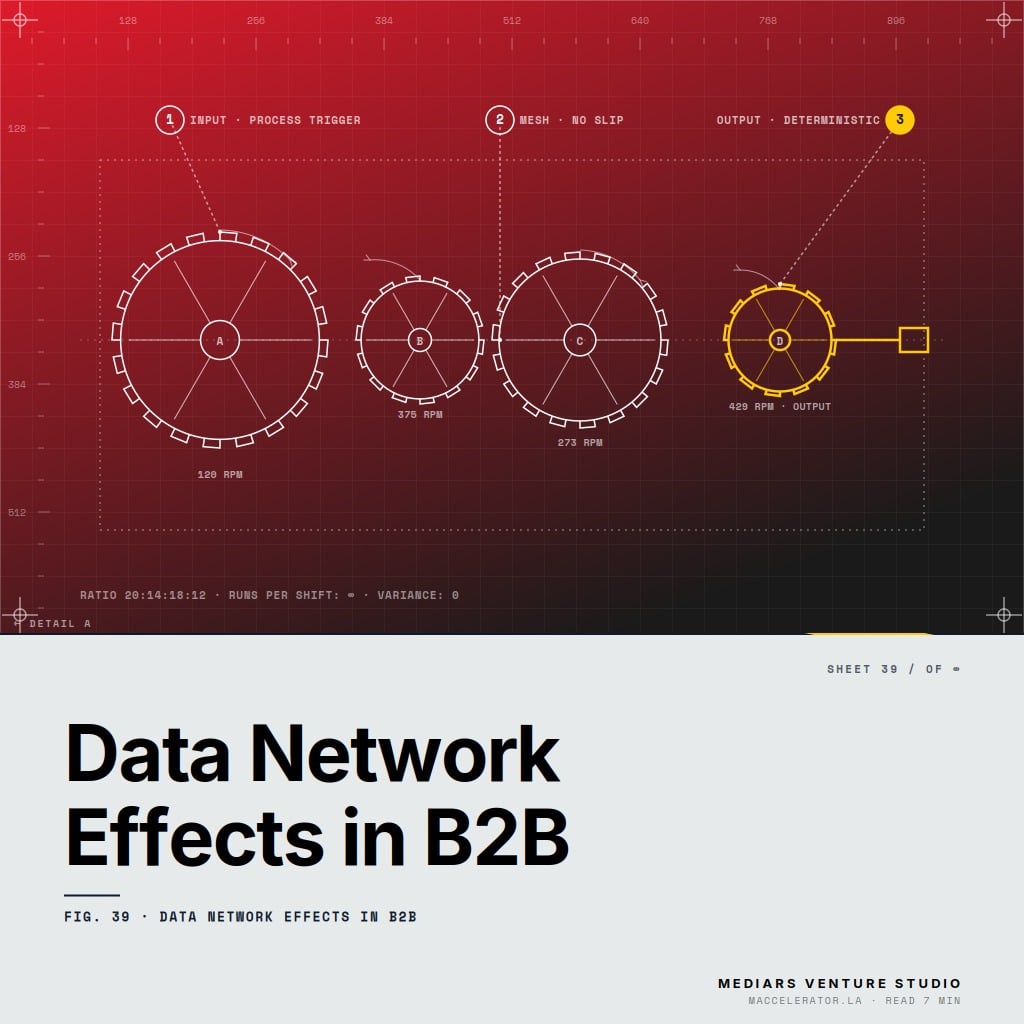
Data network effects in B2B occur when each customer’s usage generates data that makes the product measurably better for every other customer — creating a moat that compounds with scale instead of eroding. That is the definition. The reality on the ground is messier.
You’ve hit product-market fit. You’re somewhere between $50K and $3M ARR. And you keep hearing investors and competitors talk about “data moats” — but you can’t tell if you actually have one.
Here is the uncomfortable truth. Most companies that claim a data moat have data accumulation, not a data network effect. They have a warehouse full of records doing nothing. The two get confused constantly, and the confusion is expensive.
Across 500+ founders we’ve worked with in 30 countries, this is one of the most common self-deceptions: believing that collecting data, by itself, builds defensibility. It does not. This article gives you the lens to tell the difference.
Making Data Valuable: The Difference Between Hoarding Data and a Real Network Effect
A data network effect exists only when three links hold together:
- New data improves the product experience.
- That improvement is felt by other customers.
- The improvement is hard for competitors to replicate without the same data volume.
Break any link and you have a cost center, not a moat. A data lake with no loop back into the product is a storage bill.
Picture two examples. A vertical SaaS tool whose benchmarking gets sharper with every customer that joins — the 200th customer makes the comparison data more accurate for the first 199. That compounds.
Now picture a logistics platform whose routing engine gets smarter as more shipments flow through it. Each delivery teaches the system. Every shipper benefits from every other shipper’s volume.
The test is simple: can you point to the exact place where one customer’s data makes the product better for another? If you can’t, you don’t have a network effect. You have an archive.
Most accumulated B2B data is never re-fed into the product loop. It sits in a table. Someone runs a quarterly query against it. That is analytics — useful, but not defensible.
“The most expensive mistake we see is a founder confusing a full database with a defensible one. Volume is not a moat. The loop is the moat.” — Alessandro Marianantoni
Why Data Network Effects Got Harder — and More Valuable — in the AI Era
Two trends are converging, and they pull in opposite directions.
First, AI and LLMs commoditized generic intelligence. Anyone can bolt a model onto a product in a weekend. The model is no longer the edge. Proprietary data is now one of the few durable differentiators left.
Second, that same commoditization made generic data worthless. Scraped, public, or easily purchased data improves nothing — every competitor has it. Only structured, domain-specific, hard-to-acquire B2B data compounds.
B2B has a structural advantage here. Fewer customers, but each one is deeper. High switching costs. Regulated or private datasets that nobody can scrape. The data you hold is often impossible to recreate from the outside.
The flip side is real. B2B has fewer users, so the network effect is harder to ignite. It will not happen by accident the way it sometimes does in consumer products. In B2B, the data network effect is deeper but narrower — and it must be deliberately designed.
We break down how post-PMF founders are turning proprietary data into AI-era moats in our AI Acceleration newsletter.
Key Takeaways
- Data accumulation is not a data network effect. The loop — data improving the product for other customers — is what makes it a moat.
- In the AI era, generic data is worthless and proprietary, domain-specific data is one of the few durable moats.
- B2B data effects are deeper but narrower than consumer ones — fewer customers, higher value per data point.
- Network effects are designed early, not retrofitted late. The architecture decision happens before $5M ARR.
- Four diagnostic questions tell you whether you have a real moat or a storage cost.
#1 Data Network Effects, 6 Elements: The Four Questions That Tell You If You Actually Have One
Before you tell an investor you have a data moat, answer these four questions honestly.
1. Does each new customer’s data make the product better for existing customers — and can you point to where? If the improvement is real, you can name the feature. “Our churn prediction gets more accurate with each account.” If you can’t name it, the answer is no.
2. Is the data loop automatic, or does it require manual analysis? A real network effect closes the loop without a human in the middle. If extracting value means an analyst running reports, you have a service, not a compounding asset.
3. Is the data uniquely yours, or could a competitor buy or scrape an equivalent? Private transaction data, regulated records, and behavioral data generated inside your product are hard to replicate. Public data is not a moat.
4. Does the value compound or plateau? Does the 1,000th data point matter as much as the 10th? In a real effect, accuracy keeps climbing. In a fake one, you hit a ceiling fast.
That fourth question catches the most people. We worked with a vertical SaaS founder who believed their moat was deepening — until they realized accuracy plateaued after a few hundred records. The marginal data point added nothing. The moat was an illusion.
Contrast that with a B2B marketplace whose matching quality kept improving past 10,000 transactions. The 10,000th match was visibly better than the 100th. That is the difference between a plateau and a compounding curve — and it determines whether you have defensibility or a database.
#2 Data Scale Can Give Your Startup Some Defensibility: What a Working Data Network Effect Actually Looks Like
When the effect works, the symptoms are unmistakable.
Onboarding gets faster for every new customer — the product already “knows” their industry from everyone who came before. Benchmarks and predictions sharpen every quarter without you shipping a single new feature.
Churn drops, because leaving means losing comparative intelligence the customer can’t get anywhere else. Sales cycles shorten, because the data becomes the demo. The accuracy sells itself.
Watch for two strategic signals. The product gets cheaper to improve over time, because the data does the work. And competitors who can quote you on features cannot quote you on accuracy.
“When the data depth shows up in your won-deal post-mortems as the primary reason you won — not the features, the accuracy — that’s when you know the effect is real.” — M Studio operator
This is an outcome of deliberate design, not luck. Founders working through these moat questions alongside peers in Elite Founders tend to spot the broken links in their loop faster than founders staring at the problem alone.
#3 Data Embedding: “We’re Too Early / Too Small / Can Figure This Out Ourselves”
Three objections come up every time. Each one is a sequencing mistake disguised as a resource problem.
“We’re too early-stage.” The architecture decisions that enable a data loop are made early. Wait until $5M ARR and retrofitting becomes expensive or impossible. This is precisely an early-stage conversation, not a later one.
“We have no budget.” Designing for data effects is a strategy and architecture decision, not a spend decision. The cost is clarity, not capital. You are choosing how the product captures and re-feeds data — that costs thinking, not money.
“We can figure it out ourselves.” Most founders can. But the failure mode is spending 18 months collecting data that never closes the loop. The cost is time, not capability. And 18 months is the difference between leading and being copied.
The pattern across 500+ founders is clean. Those who designed the loop early compounded. Those who bolted it on late hit structural ceilings they couldn’t engineer their way out of.
My First Wake Up Call That Data Isn’t Always Valuable
Twenty-five years across enterprise systems at companies like Google, Disney, and Siemens taught me one thing about data that early-stage founders learn the hard way: the volume of data you hold tells you nothing about its value.
I watched teams sit on 4TB of customer data that improved no product decision. Meanwhile a small, structured dataset re-fed into the right loop outperformed it. Scale without a loop is overhead. The loop without scale still compounds.
FAQ
What is an example of a data network effect?
A logistics platform whose routing engine improves as more shipments flow through it. Each delivery teaches the system, and every shipper benefits from the combined volume — even though shippers never interact with each other.
What is the network effect of B2B?
In B2B, network effects are deeper but narrower than in consumer products. There are fewer customers, but each generates high-value, hard-to-replicate data. The effect comes from that data structurally improving the product, not from millions of users connecting.
What are network effects in business strategy?
A network effect is any mechanism where a product gets more valuable as more people use it. A regular network effect adds value through users connecting. A data network effect adds value through usage data improving the product — even when users never interact.
Is collecting more data always good for defensibility?
No. Data becomes a moat only when it is unique, automatically improves the product, and compounds with scale. Otherwise it is a storage cost.
Make Data an Advantage for Your Startup
Data network effects in B2B are designed, not stumbled into. The window to architect them opens earlier than most founders assume — and closes quietly once your data model hardens.
You don’t need more data. You need to know whether the data you already have closes a loop or fills a lake.
If you want to pressure-test whether what you’ve built is a real moat or just a data lake, come talk it through at a Founders Meeting. Bring your four answers. We’ll find the broken link together.