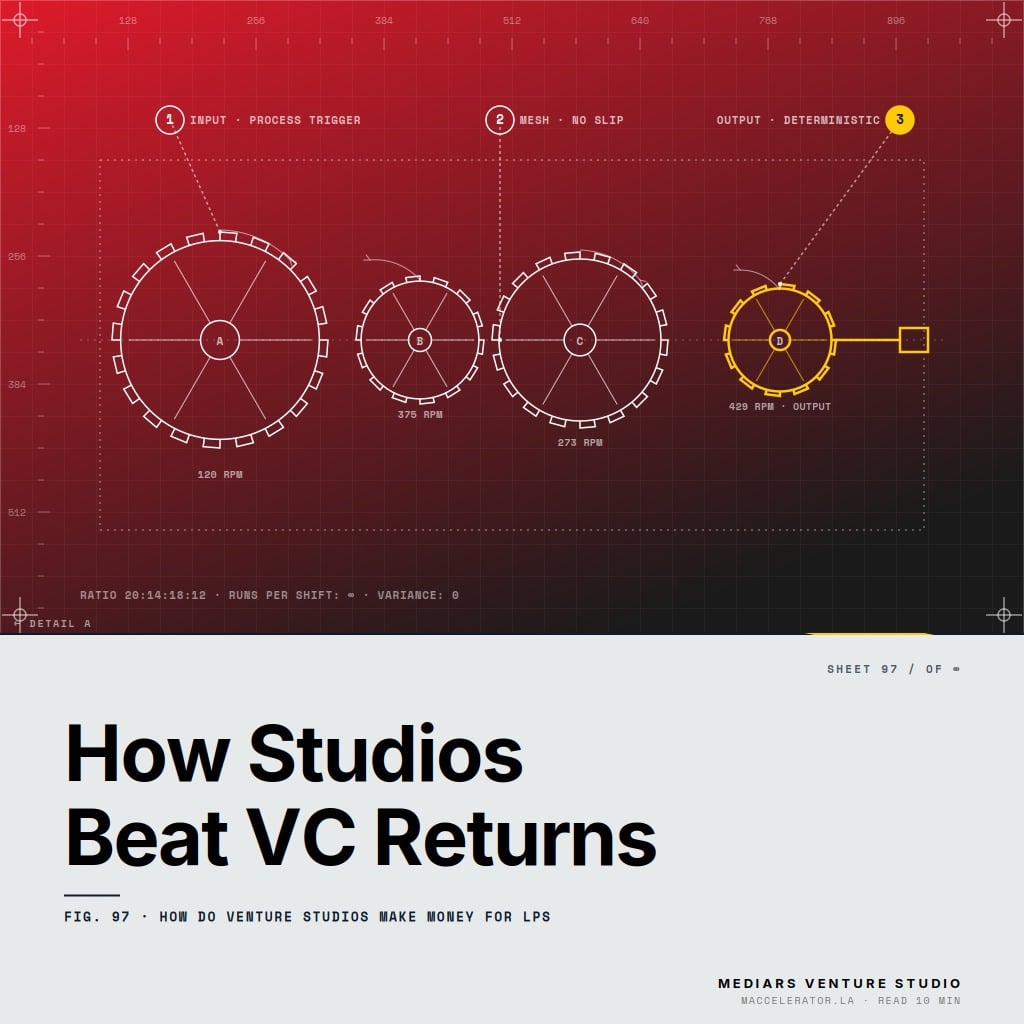
Venture studios make money for LPs through a fundamentally different model than traditional VCs — they build and de-risk companies from inception, typically capturing 20-50% equity stakes while reducing failure rates from 90% to 60-70%. This operational approach generates returns of 3-5x compared to the VC industry average of 2.5x, primarily because studios control more variables in the company-building equation.
Picture an LP reviewing their portfolio performance after ten years. The traditional VC funds delivered their expected 2.5x returns, with one unicorn offsetting eight complete failures. But that venture studio allocation? It returned 4.2x with half the failure rate.
This performance gap exists because studios operate on an entirely different economic model. Where VCs bet on external founders and hope for the best, studios systematically manufacture success through shared infrastructure, validated playbooks, and concentrated expertise.
Why LPs Are Rethinking Their Allocation Strategy
The math behind how venture studios make money for LPs starts with equity ownership. Traditional VCs typically acquire 7-15% stakes in seed rounds. Studios capture 20-50% by being co-founders from day one. A 3x exit on 40% ownership delivers the same returns as a 10x exit on 12% ownership.
But ownership percentage tells only part of the story. Studios fundamentally change the risk equation through operational leverage. When you share legal, accounting, marketing, and technical infrastructure across five portfolio companies, you reduce each company’s burn rate by 30-40%. That same $2M that keeps one traditional startup alive for 18 months can support three studio ventures for the same period.
We’ve worked with over 500 founders and consistently see how operational support transforms success rates. The same principle applies at studio scale — when you remove operational friction, founders focus on what matters: customer acquisition and product-market fit. Studios that master this operational leverage see portfolio company success rates jump from the industry standard 10% to 30-40%.
The concentrated expertise model creates another multiplier effect. Instead of one founder learning expensive lessons alone, studio teams apply battle-tested playbooks across every venture. A B2B SaaS studio that has launched five companies knows exactly which GTM strategies work in their space. They don’t waste six months and $500K discovering what they already know. Smart LPs track these efficiency gains closely through our AI Acceleration newsletter.
The 3-Layer Portfolio Construction That Drives LP Returns
Top-performing venture studios don’t randomly generate ideas. They build portfolios through a systematic three-layer framework that compounds risk reduction at each level.
Layer 1: Validated Problem Spaces
Studios that consistently deliver returns focus on problem spaces with proven demand. Not “wouldn’t it be cool if” ideas, but problems where customers already spend money on inferior solutions. A fintech studio we work with only pursues opportunities where incumbents generate $100M+ in annual revenue with Net Promoter Scores below 20. This validation layer alone eliminates 70% of typical startup failure modes.
Layer 2: Founder-Market Fit Selection
Unlike VCs who evaluate founders after they’ve already started, studios engineer founder-market fit from day one. The best studios maintain networks of experienced operators waiting for the right opportunity. These aren’t first-time founders learning on LP money — they’re proven executives who’ve already built and sold companies in adjacent spaces.
“When we built our third logistics venture, we didn’t recruit a founder with an idea. We identified the specific customer problem first, then brought in an operator who’d spent 12 years running supply chain at Amazon. That venture reached $1M ARR in eight months.” — Alessandro Marianantoni
Layer 3: Built-In Distribution Advantages
The highest-returning studios build ventures with unfair distribution advantages from day one. This might mean launching with three signed enterprise customers, leveraging the studio’s existing user base, or building on top of distribution partnerships negotiated at the studio level. One studio in our network launches every venture with guaranteed access to 50,000 potential customers through portfolio cross-selling agreements.
When you stack these three layers, the math becomes compelling. Start with a validated $100M+ problem space (50% success rate), add an experienced operator (pushes to 65%), then launch with built-in distribution (reaches 80%). Even with conservative exit multiples, the returns dramatically exceed traditional venture investing.
The Performance Metrics That Matter to LPs
LPs evaluating venture studios need different metrics than they use for traditional VC funds. The performance indicators that predict studio returns focus on operational efficiency and velocity rather than pure multiples.
Time to Revenue: The Velocity Advantage
Well-run studios see portfolio companies generating revenue within 6-12 months, compared to 18-24 months for traditional startups. This acceleration happens because studios launch with validated concepts, proven playbooks, and existing infrastructure. An enterprise software studio we work with averages first customer revenue at month seven across their portfolio.
Why this matters for returns: Faster revenue generation means shorter paths to profitability and earlier exit opportunities. Studios often see first exits in years 3-5 while VC portfolios typically wait 7-10 years for liquidity events.
Capital Efficiency Ratios
The best studios achieve similar milestones with 40% less capital than traditionally funded startups. Shared services, economies of scale, and elimination of rookie mistakes compound into dramatic efficiency gains. Where a traditional Series A company might need $5M to reach $1M ARR, studio ventures often get there with $3M.
This efficiency translates directly to LP returns. Lower capital requirements mean less dilution, higher ownership percentages at exit, and the ability to build more companies with the same fund size. Founders who understand these dynamics often become the strongest studio operators.
Portfolio Success Rate Distribution
Unlike VC funds that rely on 1-2 outliers, successful studios show more consistent return distribution. Instead of 90% failures, 8% moderate successes, and 2% home runs, studio portfolios often show 60% failures, 30% moderate successes, and 10% major wins. This distribution creates more predictable returns and reduces fund-level risk.
How Studios De-Risk the Venture Equation
The systematic de-risking that happens in venture studios goes far beyond shared resources. Four specific risk mitigation strategies compound to create the return profiles LPs seek.
Infrastructure Risk Elimination
Every startup faces the same infrastructure challenges: setting up legal entities, building financial systems, implementing HR processes, creating marketing operations. Studios solve these once and replicate across ventures. A mobility studio we work with calculated that shared infrastructure saves each venture 2,000 hours and $400K in their first year alone.
But the real value isn’t just cost savings. It’s risk elimination. When your fifth company uses the same proven financial controls, you don’t face embezzlement risks. When your sales ops playbook has been refined across multiple ventures, you don’t make expensive GTM mistakes.
Execution Risk Reduction Through Validated Playbooks
Studios that generate strong returns don’t let each venture figure out basics from scratch. They maintain living playbooks covering everything from customer discovery to scaling engineering teams. These aren’t theoretical frameworks — they’re battle-tested processes refined through repetition.
“Our B2B sales playbook started as 10 pages of notes. After applying it across six ventures, it’s now 200 pages of validated processes, templates, and scripts. New ventures reach first enterprise deals 75% faster than our initial companies.” — M Studio operator
Strategic Risk Mitigation Through Concentrated Expertise
In traditional venture investing, a first-time founder might take advice from advisors who’ve never operated in their specific market. Studios concentrate deep expertise in chosen verticals. The partners who decide to launch a venture are the same operators who’ll guide its strategy.
This concentration prevents costly strategic errors. A healthcare studio knows exactly which compliance requirements will arise at each stage. A fintech studio understands banking partnership dynamics before writing the first line of code. These aren’t lessons learned through expensive mistakes — they’re known quantities managed from day one.
Portfolio alignment Value Creation
The best studios create portfolio effects that reduce risk and accelerate growth. This goes beyond simple cross-selling. Studios engineer complementary ventures that strengthen each other’s competitive positions. A data infrastructure studio might launch an analytics platform, then a data warehouse solution, then a visualization tool — each venture making the others more valuable.
LPs who understand these compounding risk mitigation strategies recognize why studio returns consistently exceed traditional venture investing. The model doesn’t just reduce downside — it systematically engineers upside through operational excellence.
The Market Forces Driving LPs Toward Studio Models
Three macro trends make venture studios increasingly attractive to sophisticated LPs. Understanding these forces helps explain why studio allocations are growing 3x faster than traditional venture commitments.
The Democratization of Company Building
Ten years ago, starting a technology company required $5M just to build basic infrastructure. Today, cloud services, no-code tools, and AI-powered development reduce that to $50K. This 100x reduction in startup costs makes the studio model dramatically more capital efficient.
Modern studios launch MVPs in weeks, not months. They validate demand with landing pages and waitlists before writing code. They use AI to accelerate everything from market research to content creation. One studio in our network launched and validated five different concepts last quarter with less capital than a single traditional seed round.
This democratization means studios can test more ideas, fail faster, and double down on winners with unprecedented efficiency. LPs see this as portfolio theory applied to company creation — more shots on goal with less capital at risk per shot.
Compression of Startup Timelines
The path from idea to exit keeps shrinking. Companies that once took a decade to reach acquisition readiness now get there in five years. This compression particularly benefits studios, who start with operational advantages that accelerate every phase.
We see this constantly in our work with growth-stage companies. Markets move faster, customers decide quicker, and acquirers act more aggressively. Studios positioned to capitalize on this velocity see dramatically improved IRR compared to traditional 10-year venture funds.
The Shift Toward Operational Value-Add
LPs increasingly recognize that capital alone doesn’t drive returns. The differentiator is operational support — exactly what studios provide at scale. Recent LP surveys show 78% believe operational expertise matters more than network access in driving portfolio company success.
This shift favors the studio model’s hands-on approach. Where VCs might offer quarterly board meetings and occasional introductions, studios provide daily operational support. They don’t just advise on hiring — they provide recruited candidates. They don’t suggest marketing strategies — they execute campaigns through shared resources.
Forward-thinking LPs now evaluate venture opportunities through an operational lens. They ask not just “what’s your investment thesis?” but “what’s your value creation playbook?” Studios answer this question with concrete operational capabilities, not vague promises of mentorship.
Key Takeaways
- Ownership economics: Studios capture 20-50% equity versus VC’s 7-15%, requiring lower exit multiples for equivalent returns
- Risk mitigation: Systematic de-risking through shared infrastructure, validated playbooks, and concentrated expertise reduces failure rates from 90% to 60-70%
- Capital efficiency: Studios achieve similar milestones with 40% less capital through operational leverage and eliminated learning curves
- Return timing: Faster company building cycles enable exits in years 3-5 versus traditional 7-10 year horizons
- Market alignment: Macro trends including democratized building tools, compressed timelines, and demand for operational value-add favor the studio model
FAQ
What’s the typical fund size for a venture studio?
Studios typically raise $10-50M funds, smaller than traditional VC funds, because their capital efficiency is 2-3x higher due to shared resources and operational leverage. A $20M studio fund can launch and scale 8-10 companies, achieving the same portfolio coverage as a $60M traditional seed fund. The smaller fund size also means studios reach meaningful returns faster — a $20M fund returning $80M represents 4x returns, while a $200M VC fund needs to return $800M for the same multiple.
How long before LPs see returns from a venture studio?
Studios often generate first distributions in years 3-5 versus 7-10 for traditional VC funds, driven by faster company building cycles and earlier exit opportunities. The accelerated timeline happens because studios launch companies with validated concepts and operational infrastructure already in place. One studio we analyzed showed first exits at year 3.5 on average, with full fund returns by year 7 — nearly 30% faster than comparable seed-stage VC funds.
What’s the biggest risk for LPs investing in venture studios?
The primary risk is execution dependency — studios require exceptional operators who can build multiple companies simultaneously, making team assessment critical. Unlike VC funds where partners primarily evaluate and advise, studio partners must actively build and operate. This demands a rare combination of strategic vision and executional excellence. LPs should evaluate studio teams based on their operational track records, not just their investment experience. The best studios have partners who’ve previously built and exited companies in their focus verticals.
Understanding how venture studios make money for LPs requires recognizing this fundamental shift from passive investing to active company building. The returns follow operational excellence, not financial engineering.
The studios generating 3-5x returns share common patterns: they focus on specific verticals where they have unfair advantages, they maintain disciplined portfolio construction processes, and they relentlessly optimize their operational playbooks. These aren’t investment firms that happen to provide services. They’re company-building machines that happen to raise outside capital.
For LPs ready to explore this model, the key is identifying studios with genuine operational capabilities, not rebranded incubators or accelerators. Join our next Founders Meeting where we break down what separates high-performing studios from the rest.