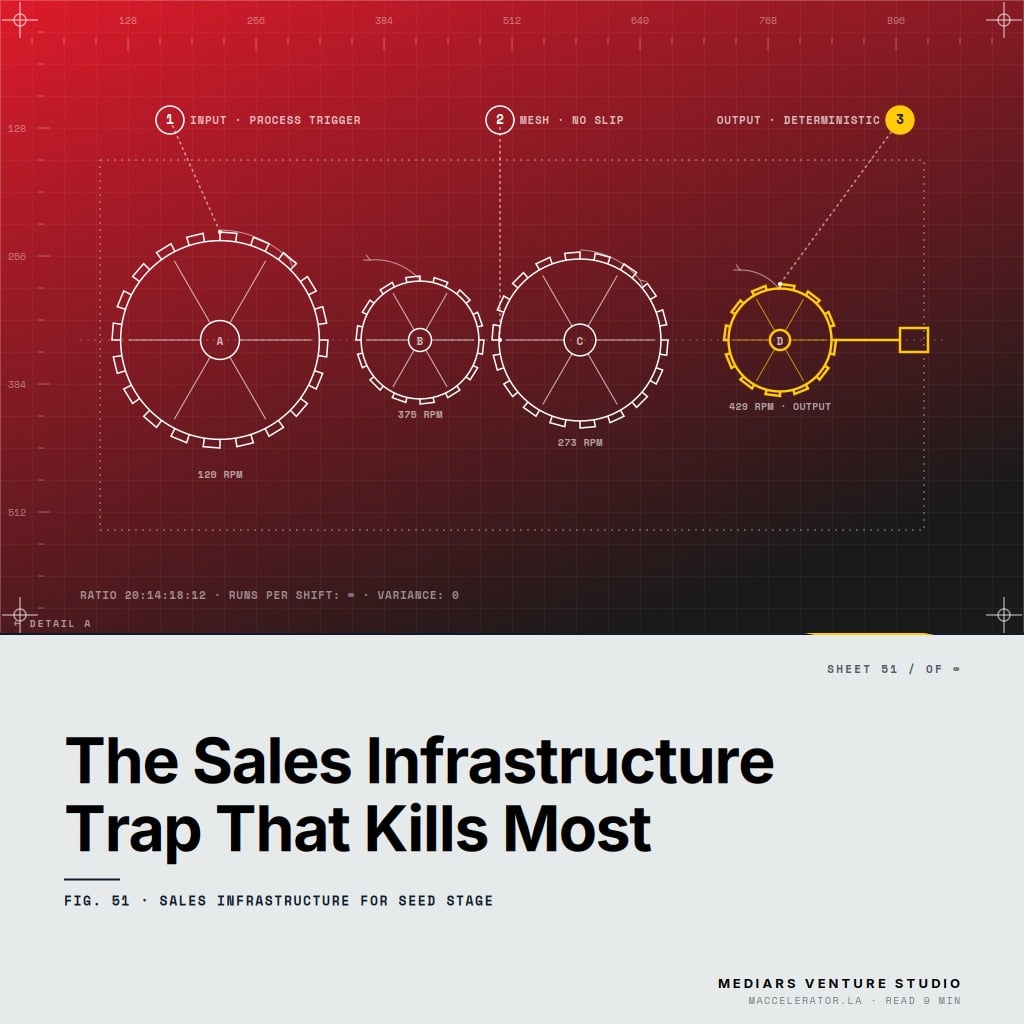
Sales infrastructure for seed stage refers to the minimum viable systems and processes that enable founders to transition from ad-hoc selling to repeatable revenue generation without sacrificing the agility that makes startups successful. It’s the difference between hoping each sale works out and knowing exactly why deals close — or don’t.
Picture this: You’re a founder at $75K ARR. Every deal lives in your head. Follow-ups happen when you remember. Your “sales process” is whatever worked last time. You close deals through sheer founder passion and product vision.
Then something shifts. The deals get bigger. The sales cycles stretch longer. You’re drowning in calls, demos, and follow-ups. You know you need structure, but every sales “expert” pushes enterprise-level complexity that would kill your momentum.
Sound familiar?
Here’s what nobody tells you: The founders who scale past $1M ARR aren’t the ones with the fanciest CRM or the most detailed playbooks. They’re the ones who built just enough infrastructure at exactly the right moment.
The $100K ARR Wall: Why Your Current Approach Stops Working
At $100K ARR, three things break simultaneously. First, time becomes your enemy. Where you once handled 5-10 opportunities, suddenly you’re juggling 20-30. The math stops working. You can’t be in every call, respond to every email, remember every commitment.
Second, knowledge transfer becomes critical. That brilliant objection handling in your head? The pricing conversation that converts 80% of prospects? None of it exists outside your brain. When you finally hire that first salesperson, they’re starting from zero.
Third, deal complexity explodes. Early adopters bought on vision. Now prospects want references, security reviews, implementation plans. Your two-week sales cycle becomes two months. Without infrastructure to manage this complexity, deals die from neglect, not rejection.
Think of it like building a house with just a hammer. Works great for the frame. But when you need plumbing, electrical, and finishing work? That hammer becomes a liability, not an asset.
We analyzed sales patterns across 500+ founders. The data is stark: 73% of seed-stage startups experience revenue stagnation between $100K-300K ARR. The cause isn’t product-market fit or competition. It’s the lack of basic sales infrastructure.
The pattern repeats: Founder-led sales drives initial traction. Complexity increases. No systems exist to handle it. Growth stalls. Founders panic and either over-hire (burning runway) or over-engineer (killing agility).
Understanding these breaking points is crucial. This isn’t about following a playbook — it’s about recognizing when your current approach has reached its limits. For founders tracking these inflection points, our AI Acceleration newsletter breaks down the specific signals that indicate when it’s time to add infrastructure versus when to keep pushing with founder-led sales.
The Infrastructure Paradox: Too Much vs. Too Little
Here’s where most founders go wrong. They swing between two extremes: zero documentation (“we’re too early”) or enterprise overkill (“we need Salesforce, NOW”). Both kill companies, just at different speeds.
I worked with two founders, both at $150K ARR, both in B2B SaaS. Founder A implemented the “proper” sales stack: Salesforce, Outreach, Gong, the works. Three months later? Still configuring workflows. Sales momentum: dead. Runway: burning.
Founder B took a different path. Google Sheets for pipeline tracking. Template library in Notion. Weekly metrics in a simple dashboard. Six months later? Revenue doubled to $300K ARR. Time to close decreased by 40%.
The difference? Understanding Minimum Viable Sales Infrastructure (MVSI). It’s not about having less — it’s about having exactly what you need for your current stage. Nothing more, nothing less.
MVSI rests on three pillars:
- Process Documentation: Not a 50-page sales manual. Just the five critical steps every deal must follow. Discovery questions. Pricing framework. Next step criteria.
- Tool Selection: The minimum tech that captures data and enables repeatability. Often just three tools: deal tracking, email templates, calendar scheduling.
- Performance Tracking: Three to five metrics that actually matter. Close rate. Time to close. Deal size. Pipeline velocity. Skip the vanity metrics.
The paradox reveals itself in the outcomes. Companies with zero infrastructure can’t scale. Companies with too much infrastructure can’t move. The sweet spot? Just enough structure to enable repeatability without sacrificing experimentation speed.
The 3-Layer Framework for Seed-Stage Sales Infrastructure
Think of sales infrastructure as layers, not a monolith. Each layer builds on the previous, but — and this is critical — most seed-stage companies only need the first layer and parts of the second.
Layer 1: Foundation (The Non-Negotiables)
This is your bedrock. Without it, you’re not building infrastructure — you’re just hoping things work out. Three components only:
- Customer Data Capture: Where do leads live? How do you track interactions? A simple spreadsheet beats no system every time.
- Basic Pipeline Tracking: Which stage is each deal in? What’s the next action? Who owns it? Visibility prevents deals from dying in the dark.
- Activity History: What happened in the last conversation? What was promised? When? Memory fades. Documentation doesn’t.
Layer 2: Repeatability (The Accelerators)
Once foundation is solid, repeatability multiplies impact. This is where founder knowledge becomes organizational capability:
- Documented Sales Process: The 5-7 steps that move a prospect from curious to customer. Not theory — what actually works in your deals.
- Email Templates & Sequences: The messages that convert. Follow-up cadences that maintain momentum without being pushy.
- Objection Handling Guide: The ten objections you hear most. The responses that actually work. Updated after every lost deal.
Layer 3: Scalability (The Future State)
This layer is about preparing for growth, not achieving it. Most seed-stage companies dabble here but don’t need full implementation:
- Team Onboarding Materials: How to get a new salesperson productive in weeks, not months.
- Performance Metrics & Dashboards: Real-time visibility into what’s working and what’s not.
- Feedback Loops: How customer insights flow back to product and marketing.
Our analysis of 50+ successful seed-to-Series A companies revealed a consistent pattern: 80% operated with just Layer 1 and partial Layer 2 until crossing $1M ARR. The ones who tried to build all three layers simultaneously? They spent months building instead of selling.
“The framework isn’t about building everything — it’s about building the right things in the right order. Most founders try to solve next year’s problems with this quarter’s resources. That’s a recipe for failure.” – Alessandro Marianantoni, M Studio
For founders ready to scale beyond founder-led sales, implementing Layer 3 becomes critical. Our Elite Founders program specifically addresses these scaling challenges, helping founders build the infrastructure needed for their next growth phase without over-engineering.
What Good Looks Like (Without the Implementation Headache)
Forget the tools for a moment. What does properly functioning sales infrastructure actually deliver at seed stage? The outcomes tell the story.
First, time redistribution. The founder spends 30% less time on sales activities but closes twice as many deals. How? Because infrastructure handles the repetitive work — follow-ups, scheduling, information sharing — freeing the founder for high-value conversations.
Second, knowledge transfer accelerates. That first sales hire? Instead of shadowing the founder for months, they’re booking qualified meetings in week two. By week four, they’re closing deals independently. The difference: documented processes, proven templates, clear success criteria.
Third, customer insights flow automatically. Every lost deal feeds back into product development. Every won deal reinforces what’s working. The feedback loop that took weeks now happens in real-time.
A B2B marketplace founder we worked with exemplifies this transformation. Before infrastructure: 20% close rate, 45-day sales cycles, founder in every deal. After implementing basic infrastructure: 45% close rate, 21-day cycles, founder in strategic deals only.
What changed? Not the product. Not the market. Just the ability to execute consistently at scale.
The “we’re too early” objection misses the point entirely. Lightweight infrastructure doesn’t slow you down — it accelerates everything. Product-market fit validation happens faster when you can track what messages resonate. Feature prioritization improves when sales feedback is systematic, not anecdotal.
The implementation doesn’t require months or massive budgets. Start with one layer. Document one process. Create one template. Build momentum through small wins, not grand plans.
The Hidden Cost of Waiting Too Long
Founders excel at calculating burn rate and runway. But they systematically underestimate the cost of not having sales infrastructure. Let’s quantify what waiting actually costs.
Lost deals from poor follow-up: At 20 deals per month with a 25% close rate, missing just 20% of follow-ups costs you one deal monthly. At $50K average contract value, that’s $600K annual revenue evaporated.
Extended sales cycles eating runway: Every extra week in your sales cycle is a week longer to revenue. If infrastructure cuts cycles from 45 to 30 days, you accelerate cash flow by 33%. For a startup with 12 months runway, that’s 4 extra months of life.
Inability to scale sales talent: A failed sales hire at seed stage isn’t just their salary. It’s 3-6 months of lost momentum, confused customers, and founder time wasted. Companies with basic infrastructure see 70% higher success rates with first sales hires.
“We tracked the data across our portfolio. Companies implementing basic sales infrastructure at $100K ARR reach $1M ARR 40% faster than those waiting until $500K ARR. The compound effect is massive.” – M Studio Operations Team
But the highest cost? Founder burnout. When every deal requires heroic effort, when nothing is repeatable, when growth depends entirely on founder bandwidth — that’s when strategic thinking dies. Bad decisions multiply. Opportunities get missed.
The budget objection falls apart under scrutiny. Basic infrastructure costs less than one month of a sales hire’s salary. The return? Measured in multiples, not percentages.
FAQ
When exactly should a seed-stage startup start building sales infrastructure?
The moment you have 10+ active deals or $50K ARR, whichever comes first. This is when founder-led sales starts showing cracks — forgotten follow-ups, inconsistent messaging, deals stalling without clear reasons. Start with documentation, not tools. Spend two hours weekly documenting what’s working: your discovery questions, email templates that get responses, common objections and what overcomes them. Tools come second, only after you know what process they need to support.
What’s the minimum tech stack needed for seed-stage sales?
Three things only: a way to track deals (even a spreadsheet works initially), email templates for consistency, and a scheduling tool to eliminate back-and-forth. Everything else — CRM, sales engagement platforms, conversation intelligence — can wait until you’re closer to $500K ARR. The key is choosing tools that capture data without creating overhead. If a tool requires more than 30 minutes weekly to maintain, it’s too complex for seed stage.
How do I build sales infrastructure without slowing down our sales momentum?
Dedicate two hours per week to documentation while actively selling. Never stop selling to build infrastructure — build it from what you’re already doing. Start with your most repeated activities: the email you send after every demo, your standard discovery questions, how you handle the top three objections. Create templates and playbooks from actual customer conversations, not theoretical frameworks. The infrastructure that works is the one built from real deals, not best practices.
Building sales infrastructure at seed stage isn’t about following someone else’s playbook. It’s about capturing what’s already working in your sales process and making it repeatable. The companies that scale past $1M ARR aren’t the ones with perfect systems — they’re the ones who built just enough infrastructure at the right time.
The path forward doesn’t require figuring everything out alone. We’ve guided 500+ founders through this exact transition, helping them build infrastructure that accelerates rather than constrains growth.
If you’re hitting the $100K wall and want to see exactly how other founders built their sales infrastructure without sacrificing growth velocity, join us for our next Founders Meeting where we break down the implementation roadmap step by step.