

The Liquid Death marketing strategy is category disruption through identity — it sells canned water not as a product but as a rebellious lifestyle signal, using absurdist branding, product-as-media packaging, and community loyalty to compete against energy drinks and beer rather than other water brands. In plainer terms: they made water dangerous, funny, and worth photographing, and that identity did the selling.
Here is who this article is for. You are post-PMF, somewhere between $50K and $3M ARR. Your product is genuinely better than the competition. And you are watching a water company hit a ~$1.4B valuation on branding alone while your superior thing fights for scraps of attention.
You are wondering what is actually transferable here. What is real mechanics versus survivorship-bias theater.
The water is irrelevant. The mythology is not. Let’s separate the two.
Why the “Dumb Idea” Actually Worked (And Why Copying the Aesthetic Won’t Help You)
Most founders look at Liquid Death and see skulls, profanity, and heavy metal. So they slap that on a landing page and wait for the cult to form.
Nothing happens. Because the aesthetic is the last layer, not the strategy.
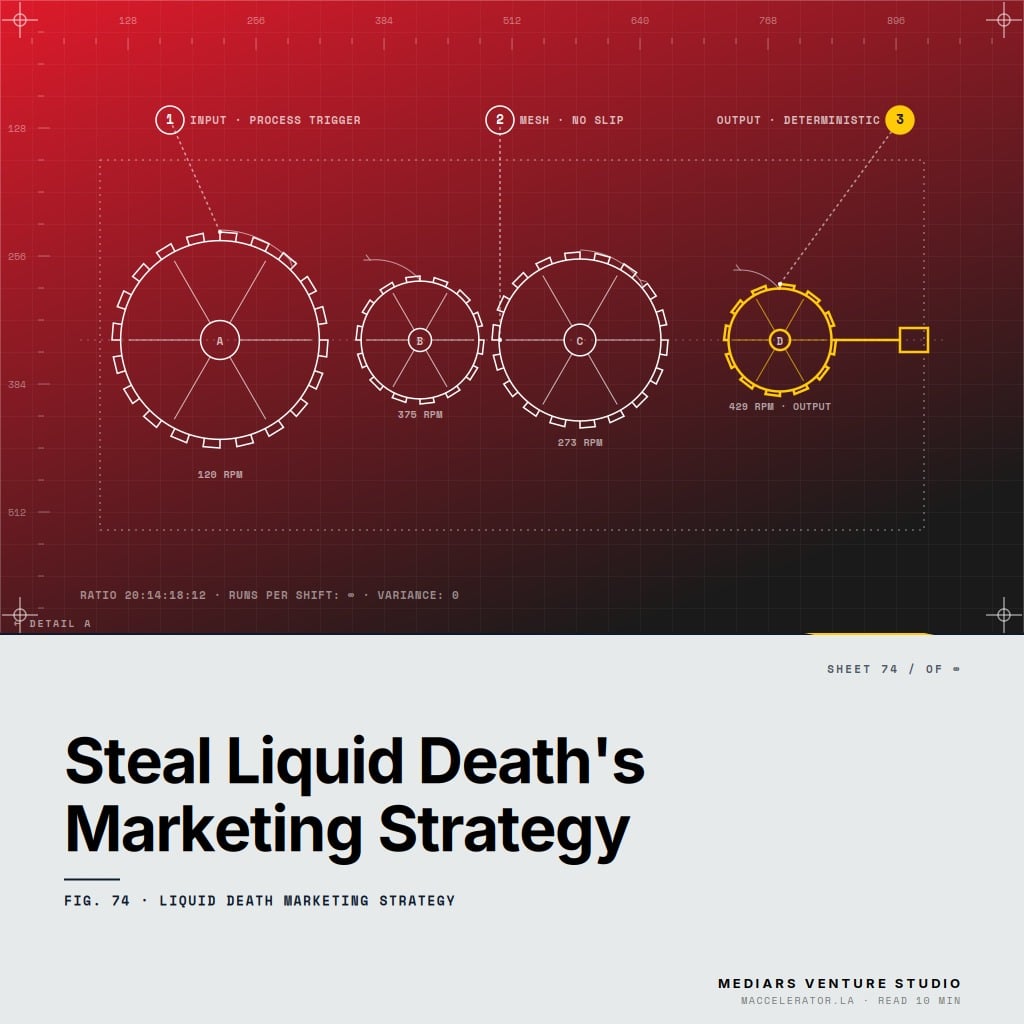
The strategy is a system of three mechanics sitting underneath the paint.
Stale Category Disruption. Bottled water was the most undifferentiated market on earth. Every brand whispered “purity” over pictures of mountains. Liquid Death walked in screaming. When everyone else is quiet, being loud is a moat.
Product-as-Marketing. The can was engineered to be photographed and shared. That tallboy format, that art — it turned packaging into a media channel. The product became the ad budget.
Serious Substance Through Unserious Packaging. There is a real mission buried in the jokes: aluminum over plastic, a genuine environmental argument. But it never preaches. It hides the substance inside irreverence so people share it instead of tuning it out.
“Founders copy the tone because the tone is visible. The mechanics are invisible, and the mechanics are the whole thing. Paint doesn’t build a brand — architecture does.”
The founder’s background matters here. He came from graphic design and advertising, not CPG operations. That produced a product-as-media philosophy most beverage operators never develop.
There is a useful drill behind all of this — the “Dumbest Idea Exercise.” You deliberately brainstorm the most absurd version of your concept to escape your brain’s bias toward proven, safe patterns. “Water that looks like it wants to kill you” is a dumb idea. That is exactly why it broke through.
Key Takeaways
- The Liquid Death marketing strategy is a system of mechanics — category disruption, product-as-media, and hidden substance — not an edgy visual style.
- Copying the aesthetic without the underlying logic is the single most common failure. Founders steal the skulls and skip the strategy.
- The most transferable play is validating the story before the spend — Liquid Death built demand before manufacturing a single unit.
- This works only when your category is genuinely stale, your buyer lives in digital/social channels, and you have real substance to hide inside the humor.
- Brand is a post-PMF positioning problem, not a later-stage luxury.
The Five Transferable Plays — Not the Vibes, the Mechanics
Here is what actually crosses business models, including boring B2B. Five plays. Each with a translation for founders who don’t sell canned water.
- Tribal Demand Creation. Seed the brand where mainstream competitors are irrelevant. Build cult loyalty before chasing mass reach. B2B translation: win a niche of frustrated operators loudly before you try to sell the enterprise.
- Resistance Metabolization. Convert hate and criticism into content fuel. Liquid Death turned negative comments into a literal death metal album. Translation: your loudest critics are free distribution if you answer with confidence instead of defense.
- Cognitive Interrupt. Pattern-breaking design earns seconds of attention competitors pay millions to buy. Translation: in a feed of corporate sameness, being human and funny is the interrupt.
- Pre-launch demand as validation. Liquid Death ran a mock commercial and built viral traction before making a single can. Translation: test the story publicly before you build the roadmap.
- Compete on occasion and identity, not product category. They never competed with Fiji. They competed with beer and energy drinks — the same hand-holding moment. Translation: know what your buyer reaches for instead of you, not who sits next to you on a comparison chart.
The standout is play four. That mock commercial cost almost nothing and became a dual-purpose weapon: an investor pitch that proved demand, and a retail proof-of-concept that reduced buyer risk.
Validate the story before the spend. That single principle saves under-funded founders more money than any growth hack.
We break down plays like this weekly in the AI Acceleration newsletter.
What Makes Liquid Death So Successful? How to Evaluate Whether This Playbook Fits Your Business
The dangerous move is blindly copying a beverage brand into a business that shares none of its conditions. Before you steal anything, run these five diagnostics.
- Is your category genuinely stale? Or are you already the exciting one? If you’re the outlier, being louder just makes noise.
- Can your product or packaging carry its own promotion? Liquid Death’s can markets itself. If your product is invisible or intangible, you need a different vehicle for the interrupt.
- Do you have a counterculture or underserved tribe to seed in? No tribe, no cult loyalty, no engine.
- Is your buyer’s channel actually digital and social? Or does trust live in procurement, referrals, TV, or print? This is where founders get burned.
- Do you have real substance to hide inside the irreverence? Hollow edginess reads as desperation. The humor only works over a genuine mission.
Question four has a hard lesson attached. Liquid Death’s social-media-first entry stumbled in the UK, a market where TV and print remained dominant, trusted channels.
Virality does not translate universally. A strategy tuned for one market’s attention economy fails in another.
There is an even deeper prerequisite most people miss: tap-water trust. Premium bottled water marketing only works where people already distrust the tap. Strategy always depends on market context. Copy the tactic, ignore the context, and you lose.
Liquid Death’s Impact on the Industry — and the Three Roads Founders Take
Liquid Death proved that in commodity categories, identity beats product quality as a purchase driver. That lesson sent thousands of founders down one of three roads. Each one wins in a specific scenario. None is universally right.
Road A: DIY / Self-Taught
Cheapest and fastest to start. You read the case studies, run your own experiments, build your own voice.
The risk: copying aesthetics without the strategic logic underneath. This road wins when the founder has genuine brand and marketing instinct baked in. Some do. Most overestimate it.
Road B: Hiring an Agency or Brand Consultant
You buy craft and execution. Good agencies produce beautiful, shareable work fast.
The risk: agencies often optimize for awards and virality over your actual growth model and unit economics. This road wins when you have budget and a tight brief tied to your business, not just “make us go viral.”
Consider a consumer brand founder at ~$1.2M ARR who hired a virality-focused agency. Impressions spiked. Retention and margin did not move an inch.
The brand play was never connected to the economics. Attention without a business model attached is just an expensive spike.
Road C: Structured Founder-Led Strategic Work
Here the founder builds the strategic muscle to make these calls repeatedly — tying every brand play to the business model and stage. Slower to feel “done.” It compounds.
Over 25+ years across Google, Disney, and Siemens, and after building alongside 500+ founders in 30 countries, one pattern holds: the founders who win don’t rent judgment, they develop it. An agency delivers a campaign. Strategic capability delivers every campaign after that.
This is the kind of work we do inside Elite Founders.
“But We’re Not a Beverage Brand / Too Early / Broke” — Honest Answers
Three objections come up every time. Here are direct answers.
“We don’t have the budget for this right now.”
You have the objection backwards. Liquid Death’s core insight is low budget. The mock commercial and product-as-media approach slash spend. The expensive path is buying attention you could earn through pattern-breaking design.
This playbook favors the under-funded founder, not the well-capitalized one. Constraint forces the creative interrupt.
“We can figure this out ourselves.”
You can figure out the tactics. The tactics are visible. The hard part is the strategic judgment — which plays fit your category and stage, and how to avoid aesthetic-copying.
Here is the litmus test. Take your last three positioning decisions. Can you name the mechanic behind each one, not just the vibe? If yes, run solo. If you’re guessing, you’re decorating, not deciding.
“We’re too early-stage for this.”
Reframe it. Liquid Death built demand before a single unit shipped. Early is the best time to build identity, not the worst.
One condition: do it after PMF. Otherwise you’re marketing a product you’ll pivot away from in ninety days.
Consider a B2B services founder at ~$400K ARR who assumed brand was a later-stage luxury. Their differentiation problem turned out to be a positioning and identity problem all along. The product was never the issue.
“Most founders think they have a marketing problem. They have an identity problem wearing a marketing costume. Fix the identity and the marketing gets cheap.”
A Case Pattern: Making a Boring Category Loud
Here is the shape of the work — an anonymized composite, not the full playbook.
Picture a B2B SaaS founder at ~$800K ARR in an unglamorous, compliance-adjacent category. Every competitor sounded identical: corporate, cautious, interchangeable.
The sequence looked like this.
- Diagnosis: the category was stale. Every rival used the same words, the same tone, the same stock photography.
- Tribe: we identified the underserved buyer — the frustrated operator who privately hated the incumbents’ bloated corporate voice.
- Voice: built a deliberately human, funny, opinionated brand with genuine product depth underneath. Substance under the irreverence.
- Resistance: skeptical comments became content. Objections got answered publicly, with confidence, and that fueled reach.
The outcome pattern: sharper positioning made the product legible for the first time. Inbound conversations shifted from “what do you do?” to “you’re the one that actually gets it.” That is what compounding identity looks like.
The product never changed. The mythology around it did.
This is the same integrated approach — strategy, execution, and communication together — that runs through the Studio approach. Brand is not a coat of paint applied at the end. It’s a strategic decision tied to your economics from the first move.
Where Is Liquid Death Headed — and What That Warns You About Scaling Identity
Liquid Death quietly expanded into sparkling water, flavored water, and iced tea. That shifted its revenue base away from the original plain-water identity that made it famous.
This is the ceiling question every identity-based challenger faces. Counterculture authenticity erodes as you scale. The rebel gets big, and “big” and “rebel” pull against each other.
The lesson for you: identity buys the door. Product depth and expansion economics keep it open. Build both, or the mythology outruns the business.
FAQs
Why is Liquid Death marketing so good?
It works because it runs on mechanics, not vibes: it entered a stale category as the loud outlier, engineered its can to be shared for free, and hid a real environmental mission inside irreverent humor so the message spread instead of getting ignored.
Who is the target market for Liquid Death?
The buyer is the identity-driven consumer choosing a drink as a lifestyle signal — often reaching for it instead of an energy drink or a beer. The competitive set was never other water brands; it was the same occasion and identity moment those categories own.
What made the original low-budget commercial go viral before the product existed?
The mock commercial validated demand and identity before manufacturing. It functioned as both an investor pitch and a retail proof-of-concept, proving people wanted the story — which reduced risk and lowered the spend needed at launch.
Why aluminum cans instead of plastic bottles?
Aluminum carries a genuine environmental argument against plastic, and the tallboy format gave the brand a distinctive, shareable object. Substance and shareability in one decision — the product became the marketing.
How did turning hate comments into a death metal album help rather than hurt?
Resistance metabolization. By converting criticism into content, the brand fed its own publicity engine and signaled confidence. Critics became free distribution instead of a threat.
How is this different from a regular accelerator?
A standard accelerator hands you tactics and a demo day. Structured founder-led work builds the strategic judgment to make brand and positioning calls repeatedly, tied to your model and stage. You develop the capability, not just the campaign.
Where to Take This Next
The Liquid Death marketing strategy is not a costume you put on. It’s a set of strategic decisions you make with intent, matched to your category, your channel, and your stage.
If you’re post-PMF and ready to build the identity your product deserves, join a founders meeting to see whether this fits your stage. Limited to founders ready to do the strategic work, not just borrow the aesthetic.