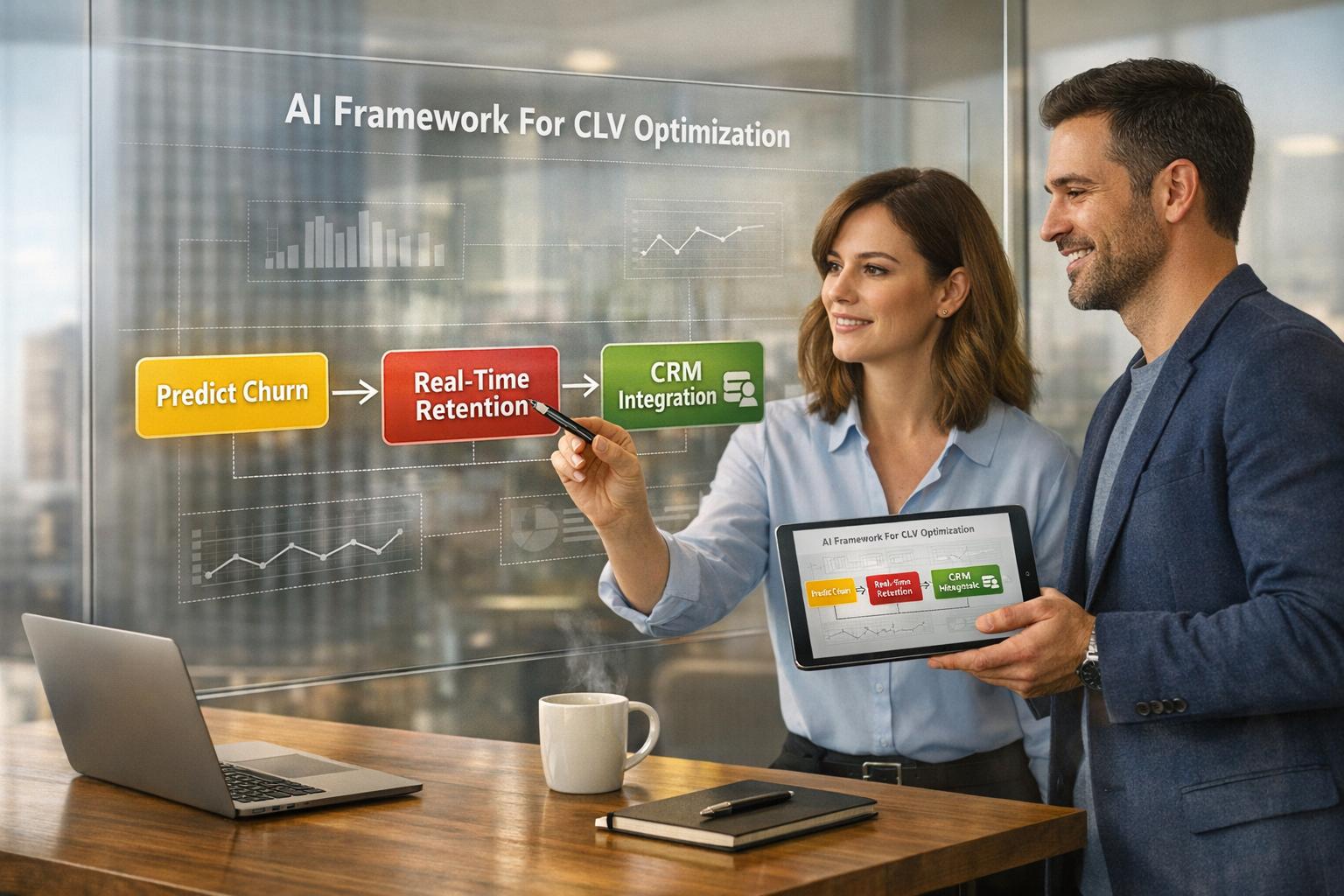
AI-powered Customer Lifetime Value (CLV) optimization transforms how businesses predict, retain, and grow customer relationships. By leveraging predictive models, startups can anticipate churn, identify upsell opportunities, and personalize customer interactions, leading to a 20-35% increase in CLV and 15-25% reduction in churn. Here’s how:
- What is CLV? The total revenue a customer generates over their relationship with your business.
- Traditional vs. AI-driven CLV: Traditional methods rely on static averages and spreadsheets, while AI models predict individual customer behavior with 85-92% accuracy.
- Key benefits: Smarter resource allocation, reduced churn, and improved ROI on marketing campaigns.
- How it works: Combining historical data with behavioral insights (e.g., logins, feature usage) to score customers and trigger real-time actions.
- Scalable for startups: Start with simple models for small datasets and evolve into advanced systems with larger data.
AI frameworks for CLV prediction don’t just analyze; they drive action – like personalized retention strategies and automated workflows. With proper integration into tools like CRMs and billing systems, these models deliver measurable revenue growth.
Ready to dive deeper? Learn how to build and scale predictive CLV systems tailored to your startup’s needs.
What Is Customer Lifetime Value and Why It Matters

Traditional vs AI-Powered CLV: Accuracy and Capabilities Comparison
CLV Basics: Definition and Business Impact
Customer Lifetime Value (CLV) represents the total net profit a customer is expected to bring to your business throughout their entire relationship with you. Instead of focusing on short-term metrics like last month’s spending, CLV shifts the perspective to long-term potential: How much will this customer contribute over the next few years?
For startups operating on lean budgets and limited resources, CLV becomes a critical tool. It helps identify which customers are worth prioritizing. For instance, a customer projected to generate $50,000 in revenue might justify a $5,000 investment in retention, whereas a customer expected to bring in $2,000 may not warrant the same level of effort. The traditional formula – Average Purchase Value × Average Number of Purchases × Average Customer Lifespan – is a good starting point for understanding past trends. However, it only provides a retrospective view, showing what has already happened.
This is where AI comes in. By leveraging advanced frameworks, CLV evolves from a static metric into a predictive tool. AI can identify at-risk customers 30 to 90 days before they churn, enabling businesses to intervene when there’s still a strong chance to retain them.
Traditional vs. AI-Powered CLV Calculation
Traditional CLV calculations rely heavily on spreadsheets, historical averages, and broad segmentation. While these methods can provide a general overview, they often fail to uncover individual customer behaviors or risks. On the other hand, AI-powered models take a much more granular and forward-looking approach. They analyze specific signals – such as reduced logins, unresolved support tickets, or changes in feature usage – to score individual customers.
Here’s a breakdown of how traditional and AI-driven approaches compare:
| Feature | Traditional CLV (Static) | AI-Powered CLV (Predictive) |
|---|---|---|
| Data Perspective | Historical averages (backward-looking) | Probabilistic predictions (forward-looking) |
| Accuracy | Moderate (65–70% churn accuracy) | High (85–92% churn accuracy) |
| Granularity | Broad averages or segment-level | Individual customer scores |
| Response Type | Reactive (post-cancellation) | Proactive (30–90 days before churn) |
| Scalability | Manual spreadsheet updates | Automated, real-time updates |
| Actionability | Shows past valuable customers | Identifies future valuable customers |
"Most businesses know which customers churned last quarter. Few can predict which customers will churn next quarter – and fewer still can quantify how much each customer is worth over their entire relationship."
- Digital Applied
This difference plays out in day-to-day operations. With traditional methods, Customer Success Managers often treat all accounts similarly until a cancellation request occurs. AI-powered tools, however, flag high-value customers showing early warning signs, like decreased engagement or unresolved issues. This allows teams to act before it’s too late.
Forward-thinking startups, including those collaborating with M Studio / M Accelerator, are already adopting AI-driven CLV models to refine their retention strategies and maximize customer value. Up next, we’ll dive into how to build an AI framework that effectively predicts CLV and drives smarter business decisions.
sbb-itb-32a2de3
Building an AI Framework for CLV Prediction
Creating a predictive CLV framework isn’t about chasing the most advanced algorithms – it’s about building a system that turns your data into actionable outcomes. This framework has three main components: data inputs, machine learning models, and integration with your existing tech stack. These work together to transform historical data into predictions that guide retention strategies and revenue growth. Want to learn more about scalable AI systems? Check out our free AI Acceleration Newsletter.
Data Inputs Required for Predictive CLV Models
The reliability of CLV predictions hinges entirely on the quality and variety of your data. Many startups rely solely on basic transaction data, like purchase amounts, dates, and frequency. While this is a good starting point – forming the foundation for an RFM (Recency, Frequency, Monetary) table – it only scratches the surface. To unlock deeper insights, you need to layer in behavioral and engagement metrics.
Metrics like login frequency, browsing history, feature adoption, and product interactions provide a clearer picture of how customers engage with your product. These insights add depth to transactional data, offering a fuller view of customer behavior.
Another layer of insight comes from support and interaction data, which can act as an early warning system for churn. For example, tracking the number of support tickets, average satisfaction scores, and the time between requests can highlight declining customer satisfaction. Derived features, like rolling averages, further enhance the precision of your predictions.
| Category | Raw Field Examples | Engineered Feature (High Predictive Power) |
|---|---|---|
| Engagement | Login count | Login frequency change (30d vs 60d rolling avg) |
| Support | Ticket count | Tickets per 30d + avg resolution satisfaction |
| Product | Features used | Feature adoption breadth + depth score |
| Payment | Payment status | Failed payment attempts + billing inquiry flag |
| Lifecycle | Account age | Days since onboarding completion + time-to-value |
With a robust dataset in place, machine learning models can begin analyzing these behaviors to predict future outcomes.
How Machine Learning Predicts CLV
Machine learning models excel at uncovering patterns in customer behavior, allowing you to address potential churn before it happens. These algorithms don’t assume a one-size-fits-all lifecycle – they analyze hundreds of behavioral signals to predict individual customer value.
For startups with fewer than 10,000 customers, simpler statistical models like BG/NBD and Gamma-Gamma are often sufficient. These models work well with smaller datasets and are ideal for subscription-based businesses, helping differentiate between temporary inactivity and true churn.
As your customer base grows – 10,000+ customers with 12+ months of data – more advanced models like XGBoost and LightGBM become the go-to options. These gradient-boosted tree models handle missing data effectively and provide clear rankings of feature importance. In fact, studies show they outperform deep learning methods for tabular CRM data in 80% of cases. These models can identify key factors like declining logins, unresolved support tickets, or failed payments.
The process involves training the model on historical data to learn correlations between features, then scoring new customers in real time as fresh behavioral data comes in. Companies using these methods often achieve 85-92% accuracy in predicting churn when behavioral signals are included.
"The prediction model alone generates no value – the value comes from acting on predictions." – Digital Applied
This is why integration is crucial. A model that triggers timely interventions, even if it’s not perfect, is far more impactful than a flawless model that goes unused.
Benefits of Predictive CLV Models for Startups
Turning technical insights into actionable strategies is where predictive CLV models shine. They deliver three standout benefits: smarter resource allocation, proactive retention, and higher campaign ROI.
Smarter resource allocation means focusing your efforts where they’re needed most. For example, if your Customer Success team has limited bandwidth, a risk-weighted approach helps prioritize high-risk customers for immediate attention, leaving low-risk customers to automated outreach.
Proactive retention shifts your team from reacting to problems to preventing them. Predictive models help reduce churn and improve campaign ROI. Since acquiring a new customer is 5-7 times more expensive than retaining an existing one, even small retention improvements can have a big financial payoff.
Targeted marketing campaigns also become more effective. Timing offers based on predicted engagement peaks can boost conversion rates by 40-60%, while suppressing campaigns for customers at risk of churn avoids sending messages that might backfire.
At M Studio / M Accelerator, we’ve helped startups at all stages – from pre-seed to Series A – build predictive CLV systems that integrate seamlessly into their CRM workflows. If you’re ready to move beyond reactive customer management, our Elite Founders program offers hands-on sessions to create these automations together – no prior data science expertise needed.
Next, we’ll dive into integrating these predictive components into your tech stack.
Using AI for Real-Time CLV Optimization
Once you’ve set up a solid predictive framework, the next step is acting on those insights in real time. A predictive model is only as useful as the actions it drives. Companies using AI-powered Customer Lifetime Value (CLV) models often see revenue increases of 20–35% when predictions lead to personalized actions across their customer systems. Want to learn more? Join our free AI Acceleration Newsletter for weekly tips on boosting CLV with AI.
The move from static segmentation to dynamic optimization transforms how your CRM, marketing automation, and customer success tools operate. These systems can now automatically respond to shifts in customer behavior. For example, if a high-value customer starts showing signs of disengagement, AI can flag the risk 30–90 days before potential churn. This gives your team a critical window to step in and turn things around.
Real-Time Personalization With AI
Real-time personalization takes AI predictions and connects them to workflows that adjust customer experiences instantly. Instead of sending a one-size-fits-all email campaign, your system tailors messages and offers based on each customer’s value and risk level.
The most effective systems use a risk-tier framework to guide responses:
- Critical-risk customers (80–100% churn probability): Immediate action, such as a call within 24 hours and alerts for top-tier accounts.
- High-risk customers (60–80%): Personalized emails, a review within 48 hours, and enrollment in re-engagement campaigns.
- Moderate-risk customers (40–60%): Automated nurture sequences and feature adoption prompts.
- Low-risk customers (0–40%): Standard engagement flows, including cross-sell and upsell opportunities.
Providing context is just as important as predicting risk. For instance, if a CRM flags a churn risk, it should also highlight the main driver, such as "declining logins: 40%." This helps your team focus on the root issue. Automated workflows based on these insights can cut churn by 15–25%. Additionally, timing upsell offers during peak engagement can boost conversion rates by 40–60%.
AI-Powered Customer Journey Mapping
Personalization enhances individual interactions, but mapping the entire customer journey uncovers larger patterns that refine your retention strategy. AI doesn’t just predict what might happen – it pinpoints friction points and opportunities across the journey. By analyzing customer behavior at scale, machine learning can reveal where users struggle, what keeps them engaged, and when they’re most likely to take action.
This ongoing analysis tracks how customers navigate onboarding, adopt features, interact with support, and handle billing. Comparing individual journeys against broader trends helps refine your approach. For instance, if data shows that completing onboarding within seven days improves retention, you can automate check-ins and send helpful resources to customers who are falling behind. Similarly, if reaching a certain usage level signals an upsell moment, your sales team can act right on time. Acting on these insights can deliver 3–5× higher ROI compared to rigid, calendar-based campaigns.
Connecting AI With Your Current Tech Stack
To make these insights actionable, integrating AI with your existing tech stack is essential. This typically involves a three-layer setup: a data warehouse to collect information, a prediction pipeline to generate scores, and a write-back mechanism to feed those scores into your CRM. Many startups accomplish this with tools like BigQuery or Snowflake for storage, Python scripts running XGBoost or LightGBM for predictions, and APIs to connect with platforms like HubSpot, Salesforce, or Zoho.
Here’s how it works:
- Data aggregation: Combine CRM, product analytics, support, and billing data in a central warehouse.
- Prediction pipeline: Run regular scoring to assess each customer and identify key risk factors.
- CRM integration: Write scores and insights back into your CRM to trigger tailored workflows, such as personalized email sequences or alerts for your team.
For faster action, you can implement a real-time scoring API. This recalculates predictions immediately after specific events, like a failed payment or a sudden drop in logins. This ensures your team gets instant alerts when a high-value customer’s risk score changes, allowing for quick intervention.
At M Studio / M Accelerator, we’ve built these integrated systems for startups at various stages. Using tools like N8N, Make, and custom APIs, we connect AI predictions to CRM workflows seamlessly. Through our GTM Engineering service, we handle everything – from data pipelines to automated actions – so your AI solutions start delivering measurable results right away.
Implementation Roadmap for Startups
Turning predictive insights into a fully functional AI-driven CLV system takes careful planning. A strong data foundation is the backbone of this process. Did you know that achieving 85-92% accuracy in churn prediction relies more on well-prepared data than on advanced algorithms? Jumping straight into machine learning without setting up the right infrastructure can waste time and lead to skewed results.
The upside? You don’t need to go big right away. You can start small and grow gradually. For example, statistical models like BG/NBD work with as few as 1,000 customers, while machine learning methods typically require 10,000+ customers and at least 12 months of data. This roadmap breaks down the process into three key phases: establishing your data foundation, running pilot tests to validate your approach, and scaling the system as your business grows. Want to dig deeper into AI-driven CLV strategies? Subscribe to our AI Acceleration Newsletter for weekly insights.
Building Your Data Foundation
Start by consolidating all your customer data into one central repository. Pull data from systems like your CRM (e.g., HubSpot, Salesforce, or Zoho), billing platforms, support ticket tools, and product usage metrics. A three-layer architecture works best for this setup:
- A data warehouse (e.g., BigQuery, Snowflake, or Redshift) to store all your data.
- A prediction pipeline to generate actionable scores.
- An integration layer to feed these scores back into your CRM.
Feature engineering is critical here. Instead of just tracking basic metrics like the "last login date", focus on dynamic behaviors. For instance, calculate engagement changes over different time periods – 7, 14, 30, 60, and 90 days. A customer whose 7-day engagement is 40% below their 90-day average signals a higher churn risk than someone who simply hasn’t logged in recently. This level of detail can push your model’s accuracy from 65-70% to 85-92%.
When writing predictions back into your CRM, include the top three risk factors (e.g., "declining logins: 40%"). This added context helps your team take targeted retention actions, turning predictions into measurable revenue outcomes.
With your data foundation set, the next step is to test your model’s performance in a controlled environment.
Running Pilot Tests for Predictive Models
Before diving into advanced machine learning, start with a basic benchmark model. The Python library "lifetimes" (or "btyd") lets you build a production-ready CLV model using just transaction history – date, amount, and customer ID – in less than a day. This initial model serves as a baseline to measure against more sophisticated methods.
The key to any pilot is setting up a controlled holdout group. Randomly divide at-risk customers into two groups: one gets interventions based on your predictions, while the other doesn’t. This is the only way to measure the true impact of your model.
"The prediction model alone generates no value – the value comes from acting on predictions." – Digital Applied
Focus on making your model actionable, not just accurate. A model with 90% precision that sits idle is worthless. On the other hand, a model with 80% precision that triggers automated workflows – like personalized emails, alerts for high-risk accounts, or real-time adjustments to customer journeys – can reduce churn by 15-25%. For most startups, tools like XGBoost or LightGBM are great options. They’re quick to train, handle missing data, and offer interpretable results without the complexity of deep learning.
During your pilot, track these key metrics to evaluate performance:
| Metric | Target | Alert Threshold | What It Measures |
|---|---|---|---|
| AUC-ROC | 0.88+ | < 0.83 | Ability to distinguish churners from non-churners |
| Precision @ top 10% | 0.70+ | < 0.60 | Accuracy of predictions for the highest-risk group |
| Recall @ 80% threshold | 0.75+ | < 0.65 | Percentage of churners correctly identified |
| Calibration error | < 0.05 | > 0.10 | How well the predicted scores match actual outcomes |
Run predictions nightly for batch use cases, like helping customer success teams prioritize accounts. For high-value customers (e.g., CLV over $100,000), consider setting up alerts to notify your team of significant changes in risk scores. This structured approach lays the groundwork for scaling your AI system effectively.
Scaling and Refining Your AI System
Once your pilot delivers measurable results, it’s time to expand. This involves rolling out the system to your entire customer base, adding more data sources, and fine-tuning your features. Monitor performance on a rolling 30-day basis to catch "concept drift" – when customer behavior changes and your model’s accuracy starts to drop.
Set up a monthly retraining pipeline to keep your predictions aligned with current trends. Customer behavior evolves – whether due to product updates, pricing changes, or market shifts. A model trained six months ago might no longer be relevant, so automating retraining ensures your system stays sharp without constant manual adjustments.
As you scale, experiment with different interventions for various risk tiers. For instance, test if a 20% discount works better than premium support for customers with a 60-80% churn probability. These tests can yield 3-5× higher ROI compared to static, one-size-fits-all campaigns. Also, recalculate CLV at least quarterly or after major changes in pricing or product to ensure your predictions stay aligned with your business’s current realities.
At M Studio / M Accelerator, we’ve helped startups at every stage – from pre-seed to Series A – build and implement these systems. Through our Elite Founders program, we work directly with founders to create these automations, ensuring they’re up and running in your business right away. Our GTM Engineering service takes care of the entire tech stack, so you can focus on acting on insights instead of building infrastructure.
Conclusion
AI takes the guesswork out of manual CLV calculations by offering real-time predictive models. The framework shared here – from establishing a solid data foundation to scaling advanced systems – shows that you don’t need a massive budget to get started. Begin with pilot projects using your existing CRM data, test your approach with controlled experiments, and scale once you see measurable results. Want to learn more about how AI can enhance your CLV strategy? Join our free AI Acceleration Newsletter for weekly insights and actionable advice.
By leveraging this predictive framework, AI can deliver real-time actions that translate into measurable business outcomes. Start small with focused pilots, prioritize clean, high-quality data over unnecessary complexity, and integrate AI into your existing tools – whether that’s Stripe, HubSpot, or Google Analytics. This method reduces risk while driving revenue through automated upselling, churn prevention, and smarter customer prioritization. These strategies, as outlined in this guide, can help your startup achieve real revenue growth.
At M Studio / M Accelerator, we’ve helped over 500 founders build AI-powered systems that have generated more than $75M in funding, reduced sales cycles by 50%, and boosted conversion rates by 40%. We don’t just consult – we work alongside you in live sessions to implement these systems directly into your business. Our expertise spans tools like N8N, OpenAI, CRM integrations, and custom AI solutions, all designed to create unified revenue systems.
Ready to use AI to grow your CLV? Join our Elite Founders program for hands-on AI and go-to-market implementation. We collaborate with startups from pre-seed to Series A, building automations that drive revenue from day one.
FAQs
What data do I need to predict CLV with AI?
To estimate Customer Lifetime Value (CLV) with AI, you’ll need a variety of customer data. This includes details like transaction history, behavioral patterns, and engagement signals. For example, factors such as how often customers log in, their purchasing habits, interactions with customer support, and how they use your product are all crucial. These data points play a key role in feature engineering, which helps refine the AI model for better accuracy.
Which CLV model fits my startup stage?
The Customer Lifetime Value (CLV) model you choose should align with your startup’s growth phase and the data you have on hand. For early-stage startups, simpler predictive methods like regression can provide valuable insights even with limited data. As your business grows and you collect more data, advanced options – such as AI-powered models like neural networks – can help you dive deeper into retention and revenue opportunities. Begin with straightforward models, and as your data pool and business needs expand, shift to more sophisticated, AI-driven approaches.
How can I turn CLV scores into real-time actions?
AI frameworks simplify and streamline how businesses optimize Customer Lifetime Value (CLV). By pulling together customer data from multiple sources, these systems use machine learning to analyze behavior and deliver real-time CLV updates. This means startups can make smarter decisions when it comes to marketing strategies, retention plans, and upselling opportunities.
With AI-powered tools, you can even automate personalized actions – like launching targeted campaigns or sending timely support prompts. The result? Every decision is backed by data, helping you get the most out of your customer relationships.
Related Blog Posts
- AI Tools for Freemium Retention
- How AI Cuts Churn To Grow MRR
- Scaling Subscription Revenue with AI
- CLV Prediction Tools for SaaS Startups