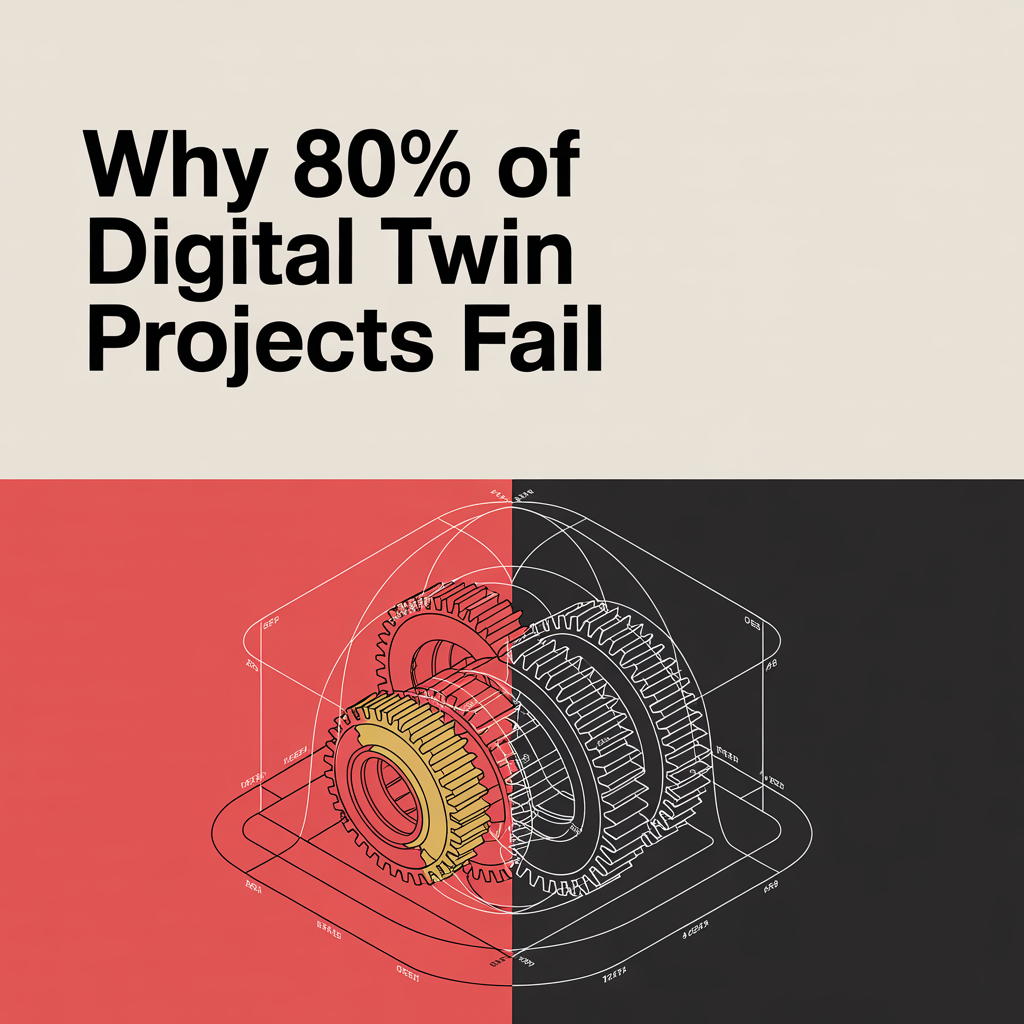
Picture this: You’re standing in front of your board explaining why the $1.5M digital twin project you championed six months ago still hasn’t delivered meaningful results. Digital twin implementation for industrial companies is a complex undertaking that promises to transform operations through real-time virtual replicas of physical assets, yet 80% of these projects fail to reach full deployment despite investments ranging from $500K to $2M with projected payback periods of 18-24 months.
The vendor promised “revolutionary insights.” The consultants guaranteed “transformative visibility.” Your engineering team was excited about the modern technology. Yet here you are, with expensive sensors collecting dust and dashboards nobody uses.
Sound familiar?
Gartner predicts that 50% of large industrial companies will use digital twins by 2025. But here’s what they don’t tell you: most pilots die in the proof-of-concept phase, burning through budgets while delivering PowerPoint presentations instead of operational improvements.
After working with 500+ founders across 30 countries, we’ve seen this pattern repeat itself. The companies that succeed don’t have better technology. They have a better framework for thinking about the problem.
The $50M Question Nobody’s Asking
Last month, a B2B industrial IoT founder at $2M ARR shared something that stopped me cold: “We spent six months building the most sophisticated digital twin platform our client had ever seen. Real-time 3D visualization, predictive analytics, the works. Know what they actually use? The Excel export function.”
This captures the fundamental disconnect in digital twin implementations. Vendors sell visualization and dashboards. They demo spinning 3D models and real-time data streams that make executives lean forward in their chairs. But operational teams need something entirely different.
They need to know which pump will fail next Thursday. They need to optimize production schedules based on actual equipment performance, not theoretical capacity. They need to reduce downtime by 15%, not watch it happen in high definition.
“The most successful digital twin implementations we’ve seen start by ignoring the visualization entirely. They focus on one question: What decision will this help us make differently tomorrow morning?” – Alessandro Marianantoni
Here’s the pattern we’ve observed with industrial technology founders: technical sophistication inversely correlates with business value delivered. The more impressive the demo, the less likely it is to survive contact with reality.
A mobility startup founder we worked with learned this the hard way. They built a digital twin solution for fleet management that could track every vehicle component in real-time. Beautiful dashboards. Comprehensive analytics. Zero adoption.
Why? Because fleet managers don’t make decisions based on component temperatures. They make decisions based on route optimization and maintenance windows. The technical team built what was possible. They should have built what was useful.
This mismatch isn’t accidental. It’s structural. Digital twin vendors come from the simulation and CAD world, where accuracy and fidelity matter above all else. But industrial operations live in a world of constraints, trade-offs, and good-enough solutions that work at scale.
The founders navigating these waters successfully are the ones who learn to translate between these worlds. They’re sharing their war stories and frameworks in communities like the AI Acceleration newsletter, where the focus stays on what actually drives results.
The Three-Layer Reality Check
Before you spend a single dollar on digital twin technology, you need to assess your readiness across three critical layers. Companies scoring below 7/10 on all three have a 90% project failure rate. No exceptions.
Layer 1: Data Maturity
Do you have clean, real-time data? Not in theory. In practice. A manufacturing founder we worked with spent 6 months deploying sensors before discovering their legacy PLCs were outputting timestamps in different formats. Some used local time. Some used UTC. Some didn’t timestamp at all.
The test is simple: Can you pull last Tuesday’s production data and trust every number? If you’re still reconciling spreadsheets and arguing about which system has the “real” numbers, you’re not ready for a digital twin. Fix your data foundation first.
Layer 2: Process Maturity
Are your operations standardized enough to model? This is where reality bites hardest. That same manufacturing founder discovered their processes varied significantly between shifts. The night crew had developed workarounds for equipment quirks. The day shift followed official procedures. Weekend teams had their own approaches entirely.
You can’t model chaos. If your standard operating procedures exist only on paper while reality operates on tribal knowledge, a digital twin will simply digitize your dysfunction.
Layer 3: Value Clarity
Can you quantify the impact in dollars, not just percentages? “20% efficiency improvement” sounds impressive until you realize it translates to $50K annually on a $1.5M investment. A chemicals company founder we worked with had beautiful KPIs showing improvement across every metric. Annual savings? Less than the software license cost.
“If you can’t draw a straight line from your digital twin to a P&L impact of at least 5x your investment, stop. You’re building a science project, not a business tool.” – M Studio Operations Team
Here’s the uncomfortable truth: Most companies fail at least one layer. The successful ones acknowledge this and address the gaps before moving forward. The failures convince themselves that technology will somehow paper over operational weaknesses.
Run your own assessment. Score each layer honestly. Below 7/10 on any dimension? That’s your real project — fix the foundation before building the house.
What Actually Moves the Needle
McKinsey data shows focused digital twin implementations deliver 3x better ROI than comprehensive approaches. Yet every vendor pitch starts with “complete digital transformation” and “end-to-end visibility.” They’re selling you the wrong dream.
The highest returns come from modeling 20% of your operations that drive 80% of costs. Not the entire facility. Not every asset. Just the critical few that actually matter.
A B2B industrial SaaS founder at $1.2M ARR discovered this through painful trial and error. Their client, a mid-size manufacturer, wanted to digitize their entire production line. Price tag: $2.2M. Timeline: 18 months. The founder pushed back with a different approach.
Instead of 200 assets, they focused on three critical machines that caused 75% of unplanned downtime. Instead of real-time everything, they focused on predicting failure modes 72 hours out. Instead of comprehensive dashboards, they built SMS alerts for maintenance crews.
Results? 22% reduction in maintenance costs within 6 months. ROI positive by month 8. Total investment: $180K.
The client’s CEO later admitted: “We almost spent 10x more for maybe 20% additional value. The focused approach forced us to think about what actually mattered.”
This is the framework that works:
- Identify your constraint assets (usually 3-5 in any operation)
- Model only the failure modes that cost real money
- Build only the alerts and insights that change behavior
- Measure everything in dollars saved or earned
A water treatment facility we studied tried to model their entire plant. Two years and $3M later, they had a beautiful digital replica that nobody used. Down the road, a competitor focused solely on pump efficiency in their highest-cost treatment process. Six months, $400K investment, 18% operating cost reduction.
One built a monument to technical possibility. The other built a profit center.
The Elite Founders we work with are seeing this same pattern in their industrial customer bases. The winners resist the temptation to boil the ocean. They pick their battles based on economic impact, not technical elegance.
The Integration Trap (And How to Avoid It)
Here’s what no vendor will tell you upfront: The average industrial company runs 15+ disparate systems. Your shiny new digital twin needs to talk to all of them. That beautiful demo running on clean sample data? It’s about to meet your 20-year-old SCADA system running on Windows XP.
Industry data shows companies spending more than $200K on integration in year one have 70% lower success rates than those starting simple. Yet every implementation plan shows real-time integration with everything from day one.
An industrial automation founder we worked with learned this lesson at a cost of $400K. They architected the perfect real-time data pipeline. APIs for everything. Automated data cleansing. Machine learning for anomaly detection. It was beautiful.
It was also useless.
The legacy PLC controllers could only push data every 15 minutes. The ERP system batch processed overnight. The maintenance management system required manual exports. By the time they built workarounds for every system quirk, they’d burned through budget and patience.
The crawl-walk-run approach that actually works:
Start with CSV exports. Yes, seriously. A metals processing company built their entire pilot on daily manual exports. Ugly? Yes. Functional? Absolutely. They proved value first, then automated.
Build integration only after proving value. That same company now has real-time feeds, but only for the three data sources that actually impact daily decisions. Everything else? Still batch processed, because real-time historical data is an oxymoron.
Plan for 30% of your budget to go to integration. Not the 10% vendors suggest. Not the 50% that kills projects. Right around 30% lets you build something functional without gold-plating.
A founder in the energy sector shared their integration reality check: “Every vendor said their platform had ‘native connectors’ for our systems. True. What they didn’t say was those connectors expected data formats from 2015. We spent three months just mapping fields.”
The companies that succeed treat integration as a core project risk, not a technical detail. They prototype with manual processes. They pilot with basic automation. They only build the full symphony after the business value is proven and budgeted.
The Build vs. Buy Decision Framework
65% of industrial companies regret their initial build/buy decision within 18 months. The pattern is predictable: Builders underestimate complexity. Buyers overestimate flexibility. Both learn expensive lessons.
We’ve developed a four-quadrant framework based on two factors: Technical Complexity and Industry Specificity. Plot your use case and the answer becomes clear.
High Specificity, Low Complexity: BUILD
Your processes are unique but technically straightforward. A specialty chemicals manufacturer with proprietary processes but standard equipment profiles. Building lets you capture your secret sauce without overpaying for features you don’t need.
Low Specificity, High Complexity: BUY
Your processes are industry-standard but technically sophisticated. A automotive parts manufacturer doing predictive maintenance. The physics models already exist. The machine learning is proven. Buy it and configure.
High Specificity, High Complexity: HYBRID
Your processes are unique AND technically complex. Start with a platform that handles the complex foundation (3D visualization, physics engines) but build your specific logic on top. Most pharmaceutical and semiconductor companies land here.
Low Specificity, Low Complexity: NEITHER
Your processes are standard and simple. You don’t need a digital twin. You need better Excel dashboards and maybe some IoT sensors. Save your money.
An industrial automation founder burned $400K learning this lesson. They had standard equipment doing standard processes but convinced themselves their situation was unique. Six months into building their own platform, they discovered three off-the-shelf solutions that did everything they needed for $50K/year.
“We confused ‘configured differently’ with ‘fundamentally different,'” they told us. “Our pumps weren’t special. Our unnecessary pride was expensive.”
The opposite mistake is equally costly. A food processing company bought an off-the-shelf solution despite having genuinely unique processes. The customization costs exceeded the platform price by 400%. They essentially paid to rebuild the vendor’s product.
Use this framework before any vendor calls. Know your quadrant. It will save you hundreds of thousands in mistakes.
Key Takeaways
- 80% of digital twin projects fail because they solve the wrong problem — focus on operational decisions, not technical sophistication
- Assess your readiness across three layers (Data, Process, Value) — scoring below 7/10 on any layer predicts failure
- Model the 20% of operations driving 80% of costs — comprehensive approaches deliver 3x worse ROI than focused ones
- Start integration simple with CSV exports — companies spending >$200K on integration in year one have 70% lower success rates
- Use the Build vs. Buy framework based on Technical Complexity and Industry Specificity to avoid the 18-month regret cycle
FAQ
How much should we budget for a digital twin implementation?
Follow the 40/30/30 rule: 40% for software/platform costs, 30% for integration work, and 30% for change management. Typical ranges run from $200K for focused pilot programs to $2M for facility-wide implementations. Companies consistently underbudget for integration and change management, leading to project failures despite good technology choices.
When are we ready to start a digital twin project?
Three prerequisites must be in place: First, you need 6+ months of clean historical data from your target assets. Second, identify a specific use case worth minimum $500K annually in measurable impact. Third, assign a dedicated technical owner with both operational knowledge and political capital. Missing any of these elements predicts project failure.
What’s the typical timeline to see ROI?
Expect 3-6 months for pilot development and validation, 12-18 months for full deployment across target assets, with ROI typically starting between months 15-18. Vendors promising faster returns are usually hiding complexity. The successful implementations front-load the hard work of integration and change management rather than rushing to go live.
Digital twin implementation for industrial companies isn’t about the technology — it’s about transforming how industrial companies operate. The founders who succeed treat it as a business transformation with a technical component, not the other way around.
The difference between the 20% who succeed and the 80% who fail isn’t technical sophistication or bigger budgets. It’s the discipline to focus on what matters, the courage to start simple, and the wisdom to measure everything in business impact.
If you’re wrestling with these decisions and want to learn from founders who’ve already walked this path, join our next Founders Meeting. Limited to 20 founders ready to move beyond vendor promises to real operational results.