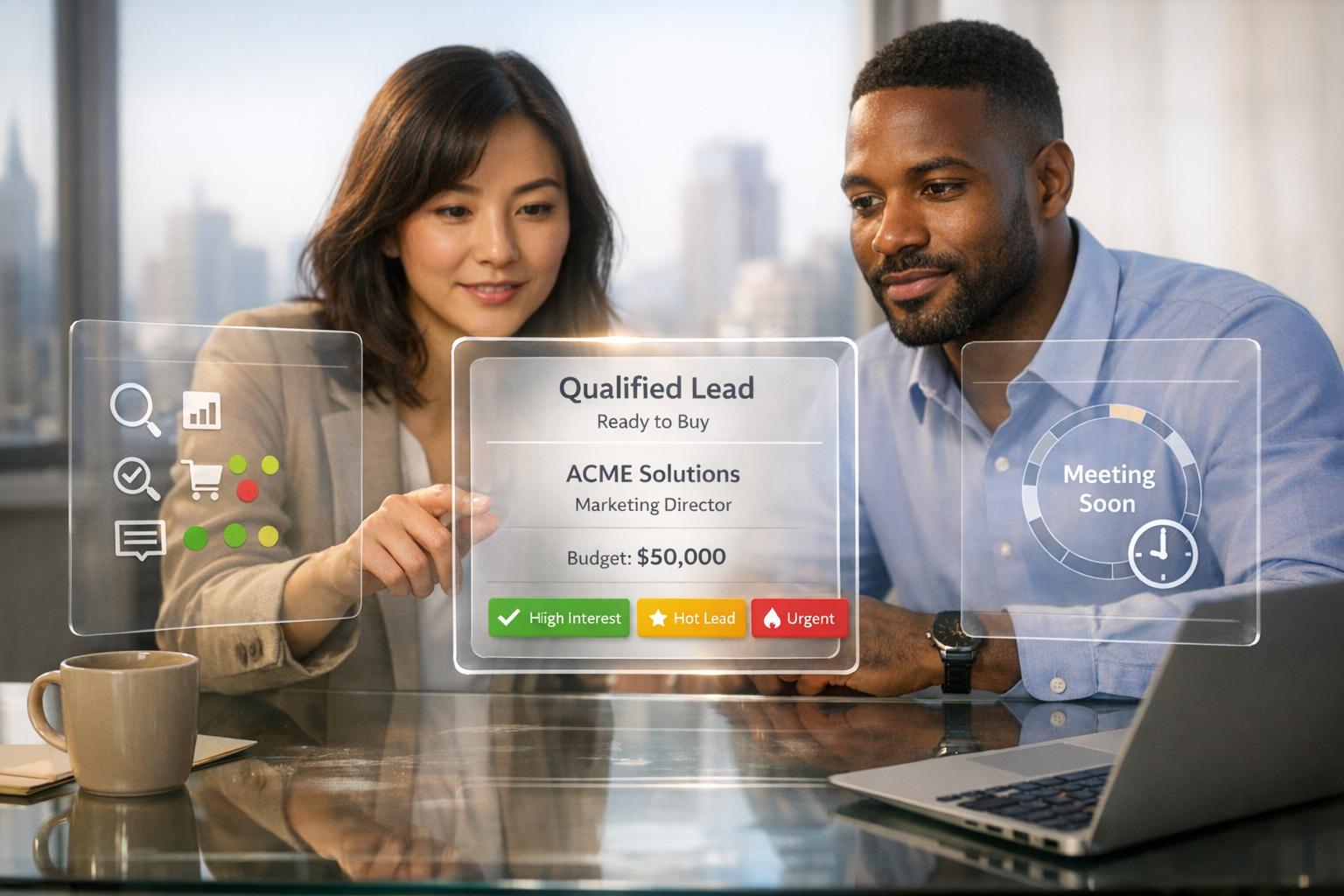
AI helps businesses know exactly when prospects are ready to buy. By analyzing behavioral patterns, timing, and engagement, AI pinpoints high-intent leads and flags them for immediate action. Traditional lead scoring methods fall short because they rely on outdated data and manual processes. With AI, businesses can prioritize leads based on real-time actions like visiting pricing pages, downloading case studies, or revisiting key resources.
Key Takeaways:
- Behavioral tracking: AI identifies high-intent actions like repeated visits to pricing pages or case study downloads.
- Timing insights: Recent, clustered activities (e.g., multiple actions in 48 hours) signal readiness.
- Firmographic data: AI adds context by analyzing company size, industry, and leadership changes.
- Automated responses: AI triggers immediate outreach to capitalize on high-intent signals, reducing delays.
- Improved results: Businesses using AI see conversion rates rise from 15% to over 40% and sales cycles cut by 50%.
AI-powered systems integrate with CRMs and marketing tools to ensure every lead is tracked and prioritized effectively. If you’re not acting on purchase readiness signals, you’re likely missing out on key opportunities.
How AI Detects Purchase Readiness at Each Buyer Stage

AI Purchase Readiness Detection Across Buyer Stages
AI categorizes prospects into different buyer stages – from recognizing a problem to signing a contract. It identifies four key types of signals: intent (research behaviors), engagement (direct interactions like email clicks), fit/change (contextual shifts like leadership changes), and timing (recency and urgency). By combining these signals, AI creates a dynamic, up-to-date profile of a prospect’s readiness. This real-time tracking allows businesses to act quickly and strategically. Interested in learning more? Subscribe to our AI Acceleration Newsletter for weekly insights and strategies. Let’s dive into how AI picks up on readiness signals at each stage.
Unlike traditional scoring methods, AI places a higher value on recent and clustered activities. For instance, a visit to the pricing page yesterday carries more weight than downloading a whitepaper a month ago. When multiple actions occur in quick succession – like checking case studies, exploring integration options, and visiting the pricing page within 48 hours – AI identifies this as a high-priority lead. Members of Elite Founders leverage automations that enable immediate outreach based on these patterns. Below, we explore how AI hones in on signals during the Awareness, Consideration, and Decision stages.
Awareness Stage: Spotting Early Interest Signals
At the awareness stage, prospects are just starting to identify a problem. They’re not yet comparing solutions but are researching the issue itself. Here, AI tracks subtle behaviors like content views, newsletter sign-ups, social media interactions, keyword searches, and repeated visits to educational pages or blog posts. These early signals often go unnoticed by traditional methods.
For example, AI uses natural language processing to analyze anonymous website traffic, identifying trends like technology adoption or hiring patterns that suggest potential needs. Tools like Dreamdata Signals analyze go-to-market data to connect these hidden intent signals with pipeline revenue, often identifying opportunities months before they become obvious. By focusing on indirect indicators – such as a company hiring for roles that align with your product – AI uncovers opportunities that might otherwise remain hidden.
Consideration Stage: Identifying Active Solution Evaluation
When prospects enter the consideration stage, their behavior shifts as they start actively evaluating solutions. AI picks up on actions like visits to pricing pages, time spent on comparison pages, case study downloads, and demo video views. It pulls data from multiple sources, including first-party engagement (like email opens and website interactions), anonymous research intent, and public signals like news events or funding announcements.
Platforms like 6sense use algorithms to create dynamic buyer profiles, tracking how prospects move from awareness to consideration. AI-based scoring integrates directly with tools like your CRM, flagging when a prospect’s activity indicates they’re transitioning from passive research to actively comparing options.
Decision Stage: Recognizing High-Intent Actions
The decision stage is where AI’s capabilities shine the most. It detects high-intent actions like proposal reopens, meeting bookings, pricing inquiries, and involvement from senior decision-makers. These signals strongly correlate with conversions. For instance, Acme Software increased their conversion rates by 30% by acting quickly on repeated visits to product pages and pricing inquiries.
AI tools enable immediate responses through features like conversation intelligence, critical signal alerts (e.g., inactivity on a deal or sudden pricing requests), and predictive scoring powered by machine learning. Platforms like Momentum send Slack alerts after key calls and update Salesforce automatically, while tools like Outreach analyze the fact that 80% of B2B interactions now happen digitally among 6–10 decision-makers per deal. If AI detects a reopened proposal late at night or notices a CFO joining an email thread, it triggers workflows to ensure your team engages with the prospect within minutes, not days.
sbb-itb-32a2de3
Data Sources and AI Analysis Methods
Once buyer stages are outlined, the next step is to explore how AI refines purchase readiness detection using various data sources. By analyzing specific datasets, AI identifies readiness signals and informs immediate actions. These datasets – behavioral, firmographic, and timing data – fuel predictive models that distinguish serious buyers from casual browsers. Want to learn more about leveraging AI for precise purchase readiness detection? Sign up for our AI Acceleration Newsletter for weekly strategies. At M Studio / M Accelerator, we specialize in helping founders create AI-driven go-to-market systems that deliver fast revenue results.
Behavioral Data: Tracking Engagement Across Channels
Behavioral data reveals how prospects interact with your business by tracking key digital activities like website visits, email interactions, content downloads, webinar attendance, and social media engagement. AI analyzes details such as which pages are visited, how long prospects stay, and whether they return. For instance, repeated visits to a pricing page within a short timeframe often indicate stronger buying intent.
AI also evaluates engagement velocity, which measures how concentrated these actions are over a specific period. When multiple actions occur in quick succession, the system flags this as high-intent behavior rather than a coincidence. Additionally, AI identifies multi-threaded engagement, where multiple individuals from the same organization interact simultaneously. This distinction helps founders focus on deals driven by active buying teams rather than isolated researchers.
Firmographic Data: Adding Context with Company and Role Insights
Firmographic data provides deeper context by analyzing details like company size, industry, revenue, technology stack, funding status, and organizational changes. For example, a newly hired VP of Sales might signal upcoming evaluations of sales tools, while a recent funding round or executive leadership change could indicate a new buying opportunity.
AI also tracks technographic timing, such as monitoring when a competitor’s contract is nearing renewal, creating a "displacement window." Since CRM contact data typically degrades by 25% to 30% annually, keeping firmographic intelligence current is crucial. Interestingly, nearly 70% of buyer intent categories in major datasets now relate to AI and automation, reflecting a growing focus on time-sensitive technology assessments. By combining firmographic data with behavioral signals, AI pinpoints whether a prospect has both the need and the authority to make a purchase. Timing is key – understanding when to act ensures teams can capitalize on high-intent opportunities.
Timing Data: Prioritizing Leads with Activity Patterns
Timing data helps determine when to engage with prospects. Using decay logic, AI prioritizes recent interactions over older ones. For example, a signal from 48 hours ago carries far more weight than one from six weeks ago.
"A signal from six weeks ago is not equivalent to one from 48 hours ago. Build decay logic into your scoring: reduce behavioral signal value each week without new activity." – Pintel.ai
Modern AI platforms shift from periodic updates to real-time activation. When a lead reaches a specific score threshold, the system immediately routes it to sales. By analyzing historical data from closed-won deals, AI identifies the sequence and timing of actions that typically lead to a purchase. This allows teams to engage at the most opportune moment. In fast-moving buying cycles, even a delay of a few hours can result in missed opportunities.
How to Implement AI for Purchase Readiness Detection
Turning data insights into action requires a clear and focused approach. While having the right data sources is essential, the real challenge lies in implementation. Many founders fall into the trap of designing overly complex AI systems that fail to deliver results. The solution? Start by identifying the business outcomes you want and work backward to pinpoint manual processes that can be automated. Generic tech stacks won’t cut it – successful AI systems need to align with your specific goals. Want to stay ahead with actionable AI strategies? Join our AI Acceleration Newsletter for weekly tips on seamless AI integration.
At M Studio / M Accelerator, we work directly with founders to build and implement these systems in real time. Through live sessions, we create automations using tools like N8N, Make, and CRM integrations, ensuring that AI works hand-in-hand with your sales process from the start.
Building AI-Powered Lead Scoring Models
A strong lead scoring model starts with examining patterns in your historical closed-won deals. AI can analyze behavioral, firmographic, and timing signals, assigning weighted values to actions based on their likelihood to predict a purchase. For example, visiting your pricing page might carry more weight than reading a blog post, and engagement from multiple stakeholders adds even more value.
Real-time activation is critical. Once a lead hits your threshold score, your system should immediately alert sales or trigger personalized outreach. To keep scoring accurate, include decay factors so older signals lose weight over time. During our Elite Founders sessions, we work alongside you to build these scoring models and integrate them seamlessly into your CRM, ensuring they deliver actionable insights.
Automating Outreach for Each Buyer Stage

Automation tailored to each stage of the buyer’s journey can dramatically improve conversion rates. Early-stage prospects respond well to educational content and nurture sequences, while decision-stage leads need prompt, personalized sales engagement. Timing is everything – especially in the 48 hours after a demo. Optimized post-demo sequences can achieve conversion rates of over 40%, compared to the industry average of 15%.
AI helps craft messaging that aligns with each prospect’s behavior. For instance, if someone downloads your pricing guide and explores your integrations page, the follow-up should address implementation specifics rather than general product features. Through our GTM Engineering service, we create these multi-stage workflows, connecting every interaction to measurable outcomes. By automating outreach, you can set the stage for AI to further streamline your sales cycle.
Shortening Sales Cycles with AI-Driven Insights
When your scoring and outreach systems are fine-tuned, AI can take things a step further by identifying peak buying moments. By spotting clusters of high-intent behaviors – like multiple page visits and downloads within a short timeframe – AI alerts your sales team to act immediately. This targeted approach can cut sales cycles by up to 50%, focusing your team’s efforts on leads that are ready to close.
This approach ensures your resources are spent where they matter most, helping your team prioritize high-intent prospects and drive faster results. Clients who’ve adopted this system have seen their sales cycles shrink significantly, allowing them to achieve greater impact with less effort.
Conclusion
AI-powered purchase readiness detection is changing the way founders drive revenue. By implementing systems that pinpoint high-intent prospects with accuracy, businesses can unlock opportunities that might otherwise go unnoticed. Combining behavioral tracking, firmographic data, and timing cues creates a system that works tirelessly to identify sales opportunities.
The numbers back it up. AI-driven tools have been shown to increase conversion rates from 15% to over 40% while cutting sales cycles in half. At M Studio / M Accelerator, we’ve supported over 500 founders who’ve collectively raised more than $75 million by automating their go-to-market processes. With 12 successful exits and 1 IPO under our belt, our results demonstrate the power of systematic AI integration. Want practical frameworks to help you catch purchase readiness signals? Join the AI Acceleration Newsletter for weekly insights you can apply immediately.
Our approach is all about hands-on results. Through the Elite Founders program, you’ll build real, functional automations during live sessions – no waiting, no fluff, just systems that start working in your business right away. From creating lead scoring models to designing multi-stage outreach strategies and syncing your tech stack, we help you build a unified, efficient revenue engine.
The gap between strategy and execution is bridged when you work with experts who’ve done it before. Don’t let poor follow-up cost you deals. Start building smarter systems today.
FAQs
What signals best predict someone is ready to buy?
When it comes to spotting purchase readiness, some behaviors stand out as clear indicators. These include frequent visits to pricing pages, requests for demos, engagement with emails (like clicks or replies), and interactions on social media (such as comments or shares). These actions show genuine interest and suggest that a potential buyer is moving closer to making a decision.
By using AI to monitor and rank these signals, startups can sharpen their outreach efforts, tailor their messaging to individual prospects, and ultimately speed up the sales process.
How do you weight recency versus older activity in scoring?
When evaluating purchase readiness signals, recent behaviors – like checking out pricing pages or requesting a demo – tend to be more influential since they indicate a stronger, immediate interest. Meanwhile, older activities, such as prior visits to the website, are assigned less importance but aren’t ignored entirely. To balance this, a decay function is often applied. This approach prioritizes recent actions while still factoring in historical behaviors, helping lead scoring stay aligned with current intent and boosting the chances of closing deals.
How do you trigger real-time outreach without spamming leads?
AI takes outreach to the next level by focusing on real-time, meaningful interactions. How? It analyzes high-intent actions like website visits, content engagement, and demo requests. Instead of sending generic messages to everyone, it pinpoints prospects who are actively exploring a purchase.
This smarter approach automates outreach that’s tailored to where the buyer is in their journey, cutting down on spam and irrelevant messaging. By scoring and routing leads effectively, sales teams can zero in on genuine opportunities. The result? Stronger trust, higher conversions, and communication that feels respectful and personalized.
Related Blog Posts
- AI-Powered Lead Scoring for Startups
- Intent Signal Hierarchy: Which Page Visits Actually Matter for B2B Sales
- Intent-Based Qualification: Reading Purchase Signals from Page Visits
- 10 AI Workflows for B2B Networking