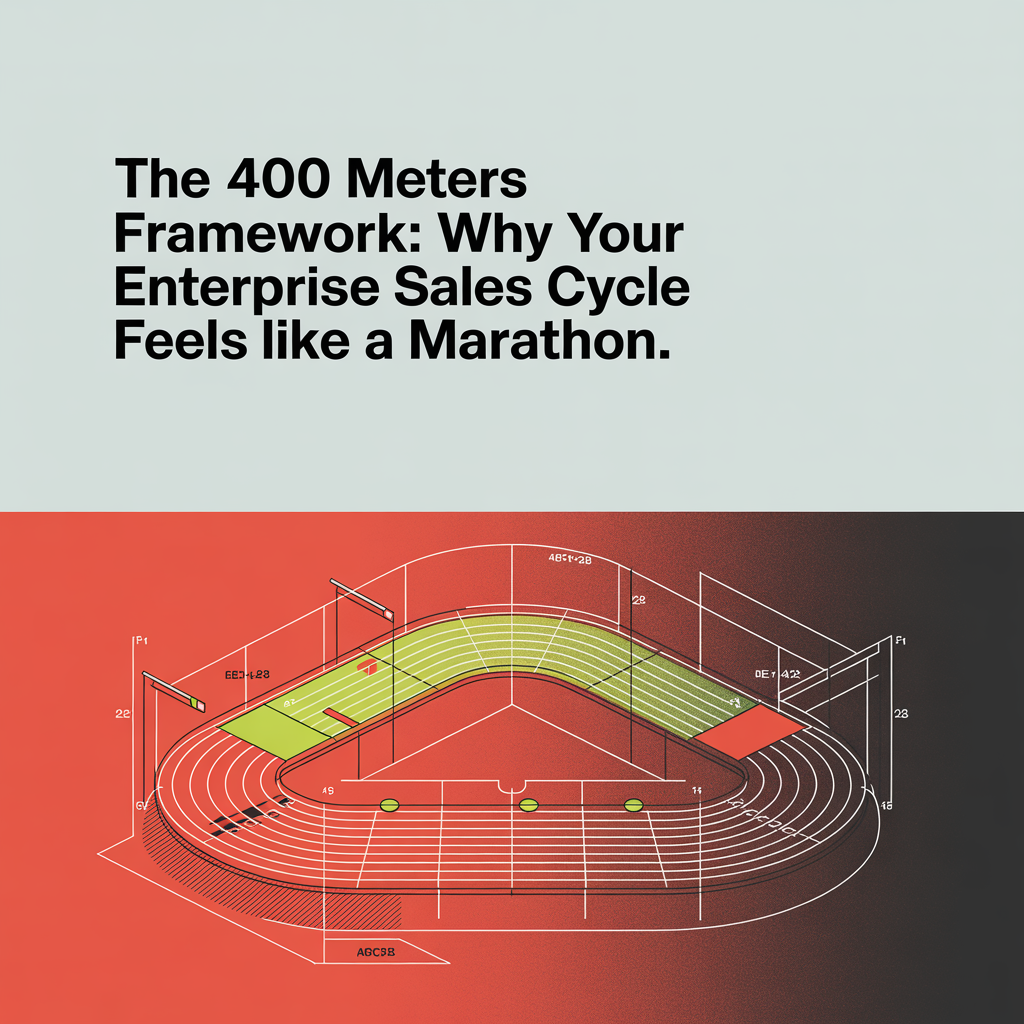
The 400 meters framework transforms enterprise sales from a grinding marathon into a strategic sprint with clear checkpoints, helping B2B founders cut their sales cycles by 40% while actually increasing close rates. It’s a speed-based approach that treats each enterprise deal like a 400-meter race—explosive qualification, technical stakeholder navigation, value acceleration, and a powerful closing sprint—rather than the traditional “slow and steady” marathon that loses 65% of deals to indecision.
Picture this: A B2B SaaS founder at $800K ARR sits across from their head of sales. The whiteboard shows their average enterprise deal cycle: 8 months. The close rate: 15%. The pipeline: stalled.
“This is just how enterprise sales works,” the head of sales explains. “Big companies move slowly. We need patience.”
Six months later, that same founder’s metrics tell a different story. Average cycle: 4.5 months. Close rate: 38%. The difference? They stopped running a marathon and started sprinting the 400 meters.
Here’s what most founders get wrong about enterprise sales speed: They confuse “enterprise” with “slow.” They treat every deal like a marathon, pacing themselves for a long haul that kills momentum, exhausts resources, and—worst of all—loses deals to the most dangerous competitor of all: no decision.
The Enterprise Sales Speed Paradox: Why “Slow and Steady” Is Actually Losing You Deals
The conventional wisdom sounds logical: Enterprise deals are complex. Multiple stakeholders. Large budgets. Compliance requirements. Therefore, they must take time. Six months minimum. Often nine. Sometimes a year.
This thinking is killing your close rates.
A Series A founder we worked with discovered something shocking when they analyzed their lost deals. Of the 85% of enterprise opportunities that didn’t close, only 20% went to competitors. The other 65%? They died from “no decision.” The deals didn’t lose—they dissolved.
The data pattern is consistent across B2B SaaS companies between $500K and $3M ARR: Deal velocity correlates directly with close rates. Deals that maintain momentum close at 2.3x the rate of those that stall. Yet most sales teams are trained to expect—even plan for—long cycles.
“We were so focused on not rushing the buyer that we forgot buyers hate waiting too. Our 8-month average wasn’t professional—it was painful for everyone involved.”
The paradox reveals itself in the numbers. When this founder’s team compressed their average cycle from 8 months to 4.5 months, they didn’t just save time. Their close rate jumped from 15% to 38%. Customer satisfaction scores increased. Deal sizes grew by 22%.
Why? Because enterprise buyers aren’t actually asking for slow processes. They’re asking for thorough ones. There’s a difference. When you understand how markets are shifting and buyers are evolving, you realize the old playbook is broken. Smart founders stay ahead of these shifts by challenging conventional assumptions.
The real insight: Enterprise buyers prefer speed when it comes with clarity, structure, and confidence. They’ve sat through enough meandering sales processes. What they want is a guide who knows exactly where they’re going and how to get there efficiently.
Breaking Down the 400 Meters Framework: Sprint Mechanics for Enterprise Deals
The 400 meters is track’s most brutal race. It demands the speed of a sprinter with just enough endurance to maintain that speed through four distinct phases. Each phase requires different techniques, different energy management, different focus.
Sound familiar?
Enterprise sales follows the same pattern. It’s not a marathon where you pace yourself for 26 miles. It’s not a 100-meter dash where raw speed wins. It’s exactly 400 meters—a controlled sprint with four critical phases:
Phase 1: The Explosive Start (Days 1-14)
Like a sprinter bursting from the blocks, your qualification phase must be explosive and precise. This isn’t discovery—it’s rapid diagnosis. You’re confirming fit, identifying the true problem, and establishing velocity expectations from day one.
Phase 2: The Curve (Days 15-45)
The curve is technical. Maintaining speed while navigating the turn requires perfect form. In enterprise sales, this is stakeholder mapping and initial value demonstration. You’re building coalition while maintaining momentum from the explosive start.
Phase 3: The Back Straight (Days 46-75)
This is where races are won. The back straight demands acceleration when every instinct says coast. For enterprise deals, this is deep value proof, ROI modeling, and security reviews. Most teams slow down here. Winners accelerate.
Phase 4: The Home Stretch (Days 76-100)
The final 100 meters separates sprinters from joggers. Everything hurts, but champions find another gear. In sales, this is negotiation, legal review, and closing. With momentum from the previous phases, this becomes a powerful sprint to signature rather than a painful crawl.
The data supports this approach. Deals with clear 100-day targets close at 2.3x the rate of open-ended timelines. But the framework isn’t about arbitrary deadlines. It’s about maintaining competitive tension—with yourself, with the market, with the buyer’s other priorities.
A mobility startup founder put it perfectly after implementing this approach:
“We stopped asking ‘How long will this take?’ and started asking ‘How fast can we deliver value?’ That shift changed everything—for us and our buyers.”
How to Evaluate Enterprise Sales Frameworks: 5 Criteria That Actually Matter
Before adopting any sales acceleration approach, you need objective evaluation criteria. Most founders evaluate based on features or price. Elite performers evaluate based on measurable impact.
Here are the five criteria that actually predict framework success:
1. Time-to-First-Value Metrics
Not time to close—time to first value. How quickly can the framework deliver measurable improvement? Look for approaches that show impact within 30 days. If you’re not seeing movement in the first month, the framework lacks precision.
2. Stakeholder Compression Ability
Enterprise deals average 6.8 stakeholders. Can the framework help you engage multiple stakeholders simultaneously rather than sequentially? This is where most acceleration happens. Measure this by tracking parallel versus serial conversations.
3. Buyer Experience Scores
Speed without buyer satisfaction is just pushy selling. The right framework accelerates while improving buyer experience. Track this through post-sales surveys. Scores should increase with speed, not decrease.
4. Rep Adoption Rates
The best framework fails if your team won’t use it. Measure adoption at 30, 60, and 90 days. Look for 80%+ consistent usage by day 60. Lower adoption indicates either complexity or misalignment with your sales culture.
5. Revenue Velocity Impact
The ultimate measure: Revenue per rep per month. This compound metric captures cycle time, close rate, and deal size. A 20% improvement here translates to significant growth. Anything less might not justify the change management cost.
A B2B founder at $1.2M ARR used these criteria to evaluate three different approaches:
- Option A scored high on features but showed 45% rep adoption
- Option B promised fast results but had no buyer experience data
- Option C showed moderate scores across all five criteria
They chose Option C. Six months later, their revenue velocity had increased 34%. The lesson? Consistent improvement across all criteria beats excellence in one or two.
400 Meters vs Traditional Approaches: An Honest Comparison
Let’s compare the 400 meters framework to three established methodologies. Each has merit. The question is which fits your current stage and goals.
400 Meters vs MEDDIC
MEDDIC excels at qualification depth. It prevents bad deals from entering your pipeline. But it can create analysis paralysis in the critical early days. The 400 meters framework assumes basic qualification competence and focuses on maintaining velocity post-qualification. For teams struggling with deal quality, start with MEDDIC. For teams struggling with deal velocity, the 400 meters framework fits better.
400 Meters vs Challenger Sale
Challenger methodology revolutionized enterprise selling by leading with insight. It works brilliantly when you have true market expertise and patient buyers. The 400 meters framework incorporates insight-led selling but compresses the education timeline. A fintech founder described the difference: “Challenger gave us the what, 400 meters gave us the when.”
400 Meters vs Solution Selling
Solution Selling’s consultative approach builds deep buyer relationships. In complex, multi-year engagements, this depth matters. The 400 meters framework sacrifices some depth for speed. It’s optimized for deals between $50K-$500K annual value where velocity matters more than perfect customization.
The honest assessment: The 400 meters framework works best for B2B SaaS companies between $500K-$5M ARR selling to mid-market or enterprise with deal sizes of $50K-$500K annually. Outside these parameters, other approaches might serve you better.
Three founders’ experiences illustrate this:
- A cybersecurity startup selling $1M+ deals found Challenger methodology more appropriate
- An HR tech company at $400K ARR found the 400 meters framework “transformative”
- A data infrastructure company pivoted from 400 meters to MEDDIC when deal complexity increased
The key is matching methodology to market moment.
“But We’re Different”: Addressing the Real Concerns About Sales Acceleration
Every founder thinks their situation is unique. Sometimes they’re right. Here are the three most common objections to sales acceleration frameworks, with honest responses backed by pattern recognition across hundreds of implementations.
Objection 1: “We don’t have budget for this right now”
The math usually surprises founders. A SaaS company at $800K ARR with a 6-month average sales cycle has $400K tied up in their pipeline at any moment. Compress that cycle by just 60 days, and you free up $133K in working capital—not to mention the compound effect on growth.
One founder’s finance team ran the numbers: “We thought we couldn’t afford it. Turns out we couldn’t afford not to do it. The acceleration paid for itself in 73 days through faster cash collection alone.”
That said, timing matters. Below $50K ARR, you’re still finding product-market fit. Framework investments rarely make sense. The sweet spot starts around $300K ARR when you have enough volume to measure and improve velocity.
Objection 2: “We can figure this out ourselves”
You absolutely can. Many successful companies build their own sales acceleration approaches through trial and error. The question is opportunity cost.
A founder who tried the self-directed route shared this data: “We spent 8 months iterating on our own. Made progress—cycle time dropped 20%. Then we implemented a proven framework and dropped another 40% in 10 weeks. Those 8 months of slower learning cost us about $1.8M in delayed revenue.”
Self-directed learning works when you have time. In competitive markets with funding runways, time is precisely what you lack.
Objection 3: “We’re too early-stage for this”
This objection is often correct. There’s an inflection point around $50K ARR where sales patterns become predictable enough to optimize. Before that, you’re still in pure discovery mode.
The indicators you’re ready:
- You’ve closed at least 10 enterprise deals
- Your sales cycle varies by less than 100% deal to deal
- You have at least one dedicated salesperson
- Deals stall in predictable places
A wellness tech founder ignored these indicators: “We tried implementing acceleration at $30K ARR. Total waste. Came back at $400K ARR and it clicked immediately. Timing is everything.”
What Actually Happens: Week-by-Week Patterns from Real Implementations
Understanding implementation patterns helps set realistic expectations. Here’s a composite timeline from multiple B2B SaaS implementations, showing what typically happens when founders commit to sales acceleration.
Weeks 1-2: Diagnostic Reality Check
The first fortnight is always humbling. Teams discover their “4-month average cycle” is actually 5.7 months. Their “pretty good close rate” is 18%. One founder called this phase “productive discomfort—painful but necessary.”
Weeks 3-4: First Experiments
Small changes begin. Qualification calls get structured differently. Follow-up cadence tightens. Nothing revolutionary yet, but the team starts speaking a common language about velocity. Early indicators appear—calls feel different, prospects engage more actively.
Weeks 5-8: Systematic Changes
This is where frameworks earn their value. Systematic changes to deal structure, stakeholder engagement, and value demonstration. The messy middle where old habits fight new methods. Strong teams push through. Weak teams revert.
A Series A founder described week 6: “Half my team was energized, half was exhausted. I realized this was exactly like changing your running form—it feels wrong before it feels right.”
Weeks 9-12: Measuring Impact
Results become undeniable. Cycles compress. Close rates climb. More importantly, the team internalizes velocity thinking. It’s no longer forced—it’s natural. Deals that would have stalled navigate obstacles smoothly.
Common obstacles in this timeline:
- Week 3: Sales team pushback on changing “what works”
- Week 6: Founder impatience with gradual progress
- Week 9: Tendency to declare victory too early
The pattern is consistent: 12 weeks to meaningful change, provided leadership stays committed through the messy middle.
Key Takeaways
- Enterprise sales velocity directly correlates with close rates—deals that maintain momentum close at 2.3x the rate of those that stall
- The 400 meters framework treats enterprise sales as a strategic sprint with four phases: explosive qualification, technical navigation, value acceleration, and closing sprint
- Evaluation criteria matter more than features—focus on time-to-first-value, stakeholder compression, buyer experience, rep adoption, and revenue velocity impact
- Implementation takes 12 weeks with predictable phases: diagnostic reality check, first experiments, systematic changes, and measurable impact
- The framework works best for B2B SaaS at $500K-$5M ARR with deals between $50K-$500K annual value
FAQ
How is the 400 meters framework different from just “selling faster”?
Selling faster usually means rushing buyers and skipping steps—which actually lengthens cycles through increased objections and mistrust. The 400 meters framework is about structured acceleration. Each phase has specific objectives, techniques, and exit criteria. It’s the difference between a panicked sprint and a professionally executed race. You move faster by being more precise, not by being pushier.
What size deals work best with this framework?
The sweet spot is $50K-$500K annual contract value. Below $50K, the framework’s structure can feel heavy relative to deal size. Above $500K, deals typically require deeper customization than the sprint methodology allows. That said, we’ve seen successful adaptations both higher and lower—it depends more on your buyer’s process than pure deal size.
Can this work for complex, regulated industries?
Yes, with adaptations. A healthcare SaaS company we worked with modified the framework to include parallel compliance tracks. They maintained the four-phase structure but extended the timeline to 150 days to accommodate regulatory requirements. The key insight: Even in regulated industries, you can compress the business evaluation while compliance runs in parallel. Their cycle dropped from 11 months to 5 months while maintaining 100% compliance.
What is the 2 2 2 rule in sales?
The 2-2-2 rule suggests making 2 attempts to connect, using 2 different channels, within 2 days of initial contact. While this rule helps with initial outreach discipline, it’s tactical rather than strategic. The 400 meters framework operates at a higher level—orchestrating the entire sales cycle rather than optimizing individual touches. Think of 2-2-2 as a useful tool within a broader velocity strategy, not a complete system.
The difference between good and great enterprise sales isn’t effort—it’s approach. Most teams are running marathons when they should be sprinting 400 meters. The exhaustion is the same. The results are not.
If you’re a founder between $500K and $5M ARR watching deals drag on for months, losing opportunities to “no decision,” and feeling like enterprise sales has to be slow, let’s map the 400 meters framework to your specific situation. Limited to founders ready to challenge conventional sales wisdom and accelerate intelligently.