

Picture this: Your two-person customer success team manages 150+ accounts. Your CS manager responds to Slack messages at 11pm while churn silently creeps above 15%. AI customer success for small teams is the systematic use of artificial intelligence to help resource-constrained CS teams deliver personalized support at scale, typically reducing response times by 80% while improving retention metrics. This isn’t about replacing humans with chatbots — it’s about amplifying what your small team can accomplish.
We’ve worked with over 500 founders who hit this exact wall between $500K and $1M ARR. The pattern is predictable: rapid growth creates more accounts than your CS team can handle, quality drops, churn spikes, and suddenly your unit economics look broken. The conventional wisdom says hire more CSMs.
That conventional wisdom is wrong.
The founders who win this stage don’t throw bodies at the problem. They build AI-powered systems that turn their 2-person team into what feels like a 10-person operation. They maintain response times under 2 hours while their competitors’ customers wait days. They predict churn before it happens instead of reacting after the damage is done.
If you’re drowning in CS tickets while watching MRR leak out the bottom of your funnel, join our AI Acceleration newsletter where we share weekly frameworks for solving exactly these operational challenges.
The $1M ARR CS Crisis Nobody Talks About
At $500K ARR, your customer success playbook works beautifully. Your CS manager knows every customer by name. Response times stay under an hour. Quarterly business reviews happen like clockwork. Then you double your customer count in six months.
Here’s what breaks: The jump from 50 to 150 accounts doesn’t create 3x more work — it creates 10x more complexity. Each new customer adds not just their own support needs but exponential communication pathways. Slack channels multiply. Email threads fork into parallel universes. That personal touch that drove your early growth becomes impossible to maintain.
The math tells the story. Industry data shows 67% of SaaS companies experience their highest churn spike between $750K and $1.5M ARR. Not because the product gets worse. Not because competitors get better. Because customer success breaks under its own weight.
A B2B SaaS founder we worked with described it perfectly: “We went from knowing when each customer logged in to not even knowing when they churned until the failed payment notification.” Their response time went from 45 minutes to 3 days. Their NPS dropped 20 points in a quarter. Monthly churn jumped from 3% to 7%.
“The scariest part wasn’t the churn number. It was realizing we had no idea which customers were at risk until they were already gone.” – B2B SaaS founder at $1.2M ARR
This is death by a thousand cuts. No single customer leaves for dramatic reasons. They leave because response times stretch. Because their success manager changes three times in six months. Because that proactive check-in call gets pushed to next quarter, then never happens.
Traditional CS wisdom says double your team size. Add more coverage. Hire senior CSMs who can handle larger books of business.
That wisdom comes from companies at $10M+ ARR who can afford the unit economics. At your stage, it’s a trap.
Why “Hire More CSMs” Is The Wrong Answer
Let’s run the numbers every founder should calculate before posting that CSM job listing. A mid-level CSM costs $70-90K base salary. Add benefits, tools, and overhead — you’re at $100-120K fully loaded. That person manages maybe 50-70 accounts well. Your CAC payback just extended by 3-6 months.
But the real cost isn’t salary. It’s time.
Onboarding a new CSM takes 60-90 days minimum. During that period, your existing team carries extra load while training the new hire. Service quality drops further. More customers slip through cracks. By the time your new CSM is productive, you’ve leaked another 5-10% of your customer base.
Even worse: you’ve now created a management layer. Your founding CS manager spends less time with customers and more time in one-on-ones. The direct customer feedback loop that helped you iterate quickly gets filtered through multiple layers. You’ve solved a capacity problem by creating a communication problem.
“We hired CSM #3 and #4 in the same month. Six months later, our churn was higher than before we hired them. We had more coverage but worse outcomes.” – SaaS founder who learned this lesson at $1.5M ARR
The founders who break through this wall think differently. They ask: “How can technology give my existing team 10x leverage?” instead of “How many more people do I need?”
A mobility startup we worked with kept their CS team at 2 people while scaling from $400K to $2.1M ARR. Response times actually improved from 3 hours to under 45 minutes. Churn dropped from 5.5% to 2.8%. The difference? They built AI-powered workflows that handled 80% of routine interactions, freeing their team to focus on high-value customer strategy.
This isn’t about replacing humans. It’s about amplifying them. Your CSMs stop drowning in password reset tickets and start identifying expansion opportunities. They stop writing the same response for the hundredth time and start building deeper customer relationships.
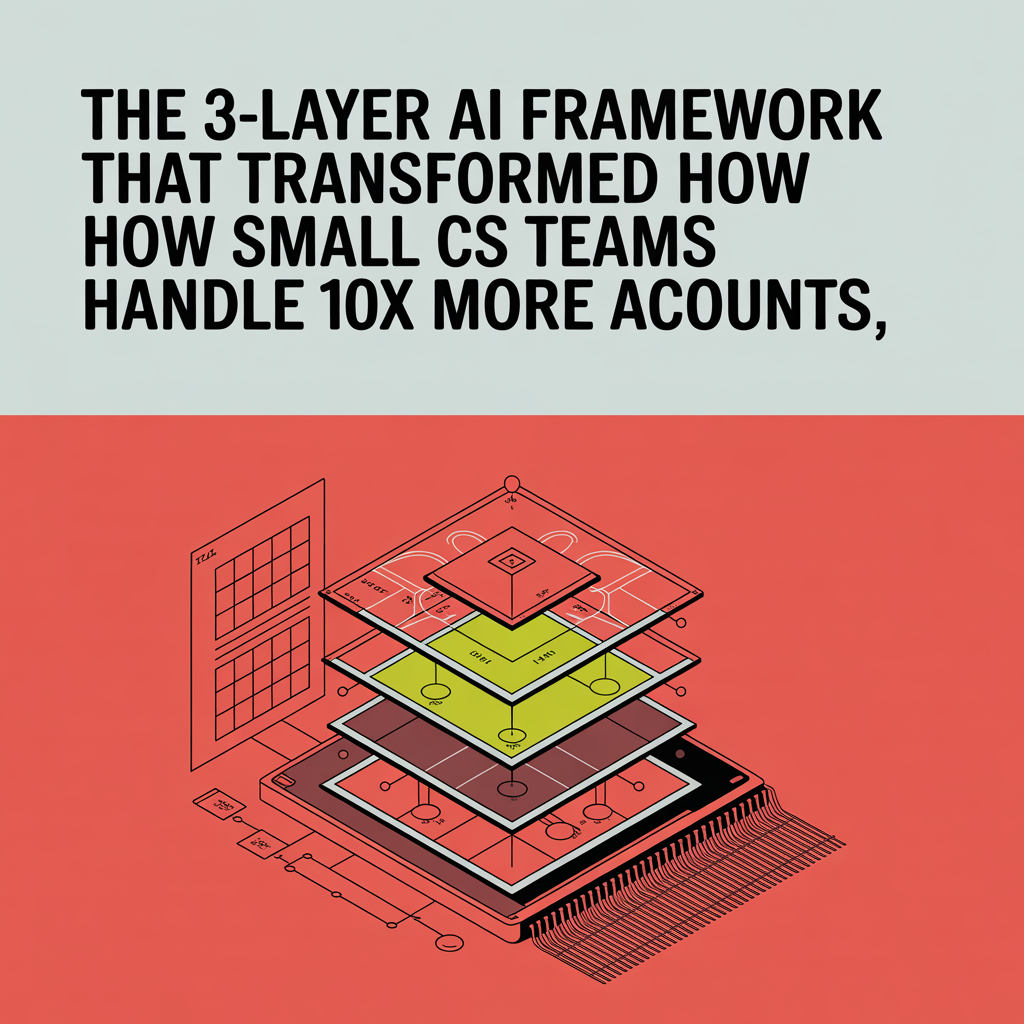
The 3-Layer AI Customer Success Framework
Most founders approach AI in customer success backwards. They start with tools, not strategy. They buy a chatbot, plug it in, and wonder why customers hate it. The teams that succeed build in layers, each one amplifying the next.
Layer 1: Reactive Automation
This is where 90% of small teams should start. Simple, high-impact automations that eliminate repetitive work. Ticket routing based on keywords. Suggested responses for common questions. Automated data gathering before human intervention. One founder reduced ticket handling time by 65% just by implementing smart routing that sent technical issues directly to engineering with full context pre-loaded.
Layer 2: Proactive Monitoring
Once reactive workflows run smoothly, shift to prediction. AI monitors usage patterns, flags anomalies, and surfaces at-risk accounts before they churn. A wellness platform we worked with built models that predicted churn risk 45 days out with 89% accuracy. Their CSMs went from fighting fires to preventing them.
Layer 3: Strategic Augmentation
The final layer transforms CSMs into strategic advisors. AI identifies expansion opportunities, suggests optimal outreach timing, and even drafts personalized growth plans based on usage data. Your 2-person team operates like a consulting firm, each CSM managing 100+ accounts while delivering more value than ever.
The key insight: each layer must work perfectly before adding the next. Too many teams jump straight to Layer 3, implementing complex predictive models while their CSMs still manually route tickets. The foundation crumbles.
Elite founders understand this progression. They build methodically, measuring impact at each stage. If you’re ready to explore how this framework applies to your specific situation, Elite Founders membership includes access to our AI implementation tools and strategic guidance from operators who’ve built this at scale.
The timeline matters too. Layer 1 takes 30-60 days to implement well. Layer 2 needs 3-6 months of data to train properly. Layer 3 requires both previous layers running smoothly plus deep customer understanding. Rush this progression and you’ll join the graveyard of “AI-powered” tools that customers avoid.
The 4 Signals That Separate AI Winners From Losers
After analyzing hundreds of CS teams implementing AI, clear patterns emerge. The winners share four measurable signals that separate them from teams still drowning in tickets. These aren’t vanity metrics — they’re leading indicators of sustainable growth.
Signal 1: Response Time Drops Below 2 Hours Without Adding Headcount
Winners maintain sub-2-hour first response times even as ticket volume doubles. Not through heroics or overtime, but through intelligent automation. One team handles 400% more tickets today than 18 months ago with the same headcount. Their secret: AI handles initial triage and data gathering, so when humans engage, they have full context immediately.
Signal 2: CSMs Spend 70%+ Time on Strategic Work
Track where your CSMs spend their time. Winners see 70% or more going to strategic account planning, relationship building, and growth initiatives. Losers see CSMs stuck in reactive support, regardless of how many AI tools they buy. The difference? Winners automate entire workflows, not just individual tasks.
Signal 3: Churn Prediction Accuracy Above 85%
Every team claims they can predict churn. Winners prove it with numbers. Their AI models identify at-risk accounts 30-45 days before churn with 85%+ accuracy. More importantly, they act on these predictions. A fintech startup we worked with saves 6 accounts monthly that would have silently churned pre-AI.
Signal 4: Net Revenue Retention Improves Without Increasing CS Spend
The ultimate proof: NRR goes up while CS cost per customer goes down. Winners see 110-130% NRR while spending less than 10% of revenue on customer success. Their AI surfaces expansion opportunities human CSMs miss. One B2B platform discovered $200K in expansion revenue hiding in usage data their team never had time to analyze.
“We obsessed over these four signals every week. When all four turned green, our entire business transformed. Churn became predictable and preventable.” – B2B SaaS founder who achieved 125% NRR
These signals compound. Better response times improve satisfaction. Satisfied customers provide cleaner data. Better data improves predictions. Better predictions prevent churn. Less churn means CSMs focus on growth. It’s a flywheel, but only if all four signals align.
The teams that fail show inverse patterns: response times creeping up despite new tools, CSMs still drowning in tickets, prediction models with 60% accuracy that no one trusts, and flat or declining NRR despite AI investment.
The Hidden Cost of Waiting
Every founder thinks they’ll implement AI “next quarter.” Let me show you what waiting actually costs. Not in abstract terms, but in real dollars leaving your bank account.
Take a typical $1M ARR SaaS company with 5% monthly churn. That’s $50K in MRR walking out the door every month. Industry data shows AI-powered CS reduces churn by 35-40% on average. Conservative estimate: you could save $15-20K monthly. Over six months, that’s $90-120K in prevented churn alone.
But churn is just the start. Add these hidden costs:
CSM burnout and turnover: The average CSM at a high-growth startup lasts 14 months. When they leave, you lose relationships, context, and momentum. Replacement costs hit $30-50K between recruiting, training, and lost productivity. AI-augmented CSMs report 60% higher job satisfaction and stay 2x longer.
Competitive disadvantage: While you wait, competitors implement AI and deliver experiences you can’t match. Their response times beat yours. Their CSMs build deeper relationships. Their NPS climbs while yours stagnates. Six months from now, they’ve pulled ahead by 18 months.
Compound effect on growth: Poor CS doesn’t just increase churn — it kills expansion revenue. Unhappy customers don’t buy more seats. They don’t refer friends. They leave cautionary reviews. A 2% improvement in churn translates to 20-30% higher valuation at your next round.
A portfolio company we work with modeled their six-month delay. Total cost: $280K in preventable churn, two CSM replacements, and 15 points of NPS decline. Their competitor who moved fast? Raised Series A at a 40% higher valuation.
The brutal truth: AI implementation takes 3-6 months to show full results. Every month you delay means you’re 4-7 months behind competitors who start today. By the time you feel the pain acutely enough to act, recovery takes even longer.
One founder told us: “I thought we were being prudent by waiting. Turns out we were being penny-wise and pound-foolish. That six-month delay cost us more than two years of AI platform fees.”
What Your CS Tech Stack Should Look Like (Conceptually)
Forget vendor comparisons and feature lists. Let’s map out how information should flow through an AI-powered CS operation. Think architecture, not applications.
The Ingestion Layer: Every customer interaction creates data — support tickets, product usage, communication patterns, payment history. Your stack needs unified ingestion that normalizes these signals into a single stream. Without this, AI operates half-blind.
The Intelligence Layer: Raw data flows into models that identify patterns humans miss. Usage anomalies that predict churn. Communication sentiment that flags frustration. Behavioral clusters that suggest upsell readiness. This layer turns noise into signal.
The Orchestration Layer: Intelligence without action is worthless. This layer triggers workflows based on AI insights. At-risk account? Automatically schedule a check-in call with context pre-loaded. Feature adoption low? Queue targeted education content. Expansion opportunity detected? Alert the CSM with a talk track.
The Amplification Layer: Your CSMs interface here. Instead of raw dashboards, they see prioritized actions with full context. Draft responses appear based on similar past issues. Call notes auto-populate from system data. Every human decision gets amplified by machine intelligence.
A before-and-after comparison makes this concrete:
Before: Customer submits ticket → Goes to general queue → CSM manually checks account history → Drafts response → Sends → Logs activity → Hopes they caught any red flags
After: Customer submits ticket → AI routes based on urgency/topic/account value → Suggests response with personalized context → Flags account risks → CSM reviews and enhances → Sends → AI monitors response and suggests follow-up → Proactive retention workflows trigger if needed
The time difference: 45 minutes versus 5 minutes. The quality difference: reactive support versus strategic partnership.
Notice what’s missing from this architecture: specific vendor names. The best teams stay platform-agnostic, focusing on capabilities over brands. They ask “What must this layer accomplish?” not “Which tool has the most features?”
Your existing tools probably handle 60-70% of what you need. The gap isn’t usually technology — it’s integration and workflow design. Winners spend 80% of their effort on process, 20% on platform selection.
FAQ
How much should a small team budget for AI-powered CS tools?
The sweet spot for teams under 10 people sits between $500-2000 monthly for core AI capabilities. This typically includes ticket intelligence, basic automation, and health scoring. The ROI math is straightforward: preventing one enterprise customer churn pays for an entire year. Teams spending over $3K monthly rarely see proportional returns until they pass $3M ARR. Start lean, measure impact, then scale investment based on proven ROI.
Can AI really understand context like our human CSMs?
AI doesn’t replace human understanding — it amplifies it. Think of AI as a brilliant assistant with perfect memory but no wisdom. It remembers every customer interaction, spots patterns across thousands of data points, and surfaces relevant context instantly. But it can’t read between the lines of a frustrated email or sense when a customer needs empathy over efficiency. The magic happens when AI handles context gathering so humans can focus on connection.
What if our customers hate talking to bots?
This question reveals a fundamental misunderstanding. AI-powered customer success isn’t about customer-facing bots — it’s about backend intelligence that makes your human CSMs superhuman. Your customers still talk to real people. Those people just happen to have AI-powered insights, automated workflows, and predictive alerts working behind the scenes. The best AI implementations are invisible to customers. They just experience faster, more personalized service.
The path forward is clear. Small CS teams can’t win by adding headcount. They win by building systems that multiply human capability. The framework exists. The technology is accessible. The ROI is proven.
The only question is timing. Will you move while the advantage is yours to take, or wait until AI-powered CS becomes table stakes?
If you’re seeing these patterns in your CS metrics — response times stretching, churn creeping up, CSMs drowning in reactive work — join our next Founders Meeting where we dive deeper into implementation strategies that actually work for small teams. Limited to founders ready to transform their customer success operations.