

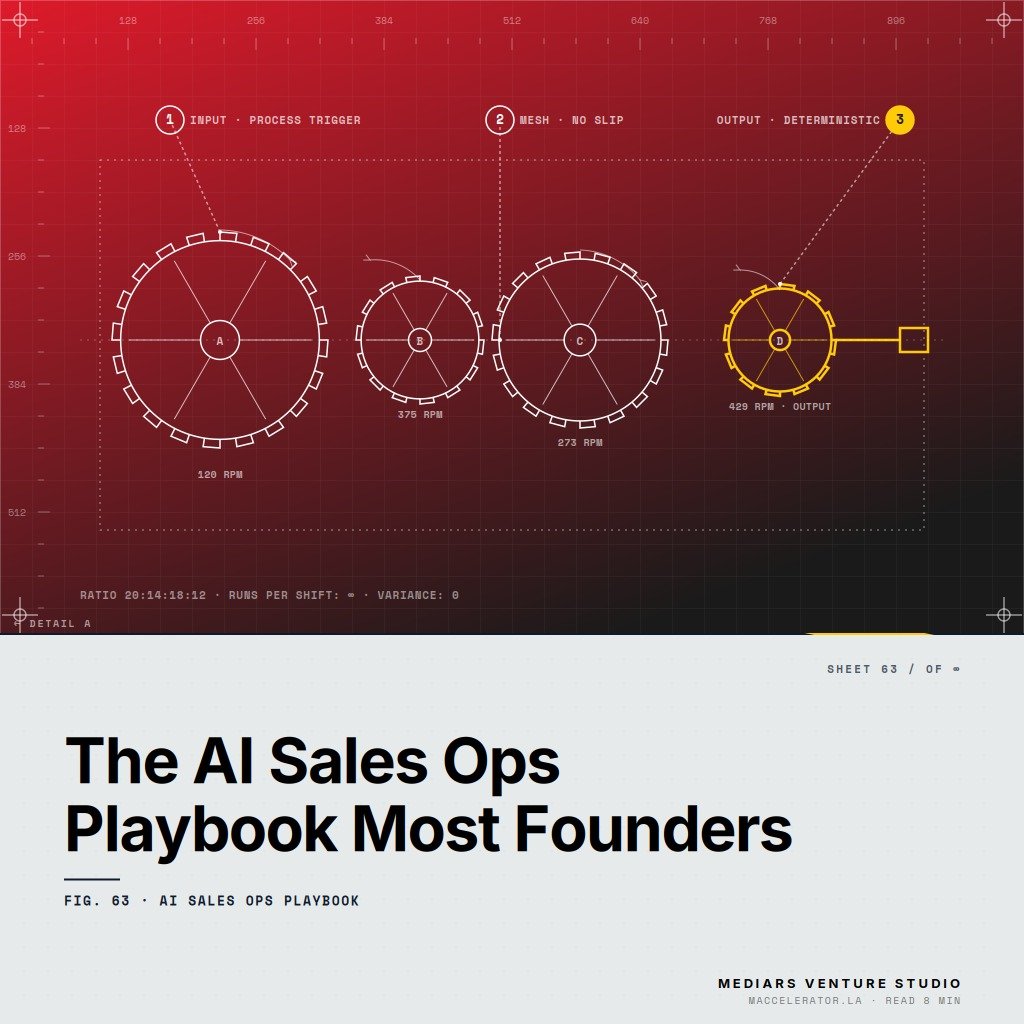
An AI sales ops playbook is the systematic framework for using artificial intelligence to optimize your sales operations—from lead scoring to pipeline velocity. Most founders think it’s about automating emails or using ChatGPT for outreach, but that’s exactly why their close rates stay stuck at 15% while watching competitors scale past them.
Here’s what nobody tells you: The founders crushing it with AI sales ops aren’t the ones with the fanciest tools. They’re the ones who understand that AI amplifies whatever system you already have. Good system? AI makes it great. Broken system? AI makes it fail faster.
After working with 500+ founders across 30 countries, we’ve seen the same pattern repeatedly. The companies that 2.5x their close rates within 90 days don’t start with tool selection. They start with a playbook—a clear framework for how AI fits into their existing sales motion.
Want the AI frameworks that actually move the needle? Join 3,000+ founders getting weekly insights → AI Acceleration newsletter.
The $2M ARR Ceiling Nobody Talks About
Every founder hits the same wall between $1-2M ARR. You can feel it coming: deals take longer to close, your team can’t replicate your founder-led close rate, and suddenly you’re drowning in “follow-ups” that never convert.
The numbers tell the story. According to recent industry data, 73% of founders between $1-3M ARR report sales efficiency as their #1 bottleneck. Not product-market fit. Not funding. Sales efficiency.
Here’s why: At this stage, your manual processes break. You can’t scale hiring fast enough. Quality drops when you delegate. Your personal 40% close rate becomes your team’s 15% close rate. Sound familiar?
“We thought hiring more reps would solve our pipeline problem. Instead, our close rate dropped from 35% to 12% in three months. That’s when we realized we needed systems, not bodies.” – B2B SaaS founder we worked with at $1.8M ARR
This is where AI sales ops becomes critical. Not as a nice-to-have, but as the difference between breaking through to $5M or staying stuck in the $2M purgatory.
Companies using structured AI sales ops maintain 80% of founder close rates even with new reps. Read that again. They maintain 80% of founder effectiveness at scale.
The difference? They build their AI sales ops playbook before they need it, not after things break.
The Three-Layer AI Sales Ops Framework
Most founders approach AI sales ops backwards. They buy a tool, automate some emails, then wonder why nothing improves. That’s like buying a Ferrari engine for a car with square wheels.
The framework that actually works has three distinct layers:
Layer 1: Intelligence (The Foundation)
This is about data enrichment, lead scoring, and intent signals. Before AI can help you sell, it needs to understand who’s actually worth selling to. This means:
- Enriching every lead with 20+ data points automatically
- Scoring based on actual buyer behavior, not demographics
- Tracking intent signals across multiple channels
- Building dynamic ideal customer profiles that evolve with your market
Without this layer, you’re feeding garbage data into your AI. Garbage in, garbage amplified out.
Layer 2: Automation (The Engine)
Only after Layer 1 works should you automate. This layer handles:
- Follow-up sequences that adapt to prospect behavior
- Pipeline management that surfaces deals needing attention
- Task prioritization based on revenue impact
- Meeting scheduling and prep automation
Notice what’s missing? Generic email blasts. Mass outreach. Spray and pray. Real automation is intelligent, not just efficient.
Layer 3: Augmentation (The Multiplier)
This is where AI becomes your sales team’s superpower:
- Real-time call working based on what actually works
- Objection handling suggestions pulled from won deals
- Deal intelligence that spots risks before they kill deals
- Next-best-action recommendations based on similar wins
Here’s the crucial insight: Most founders jump straight to Layer 2 without building Layer 1. That’s why their automation feels robotic and their close rates tank.
A B2B marketplace founder at $1.2M ARR learned this the hard way. They spent four months automating outreach (Layer 2) with terrible results. We rebuilt their approach layer by layer. First, they fixed their data and scoring (Layer 1). Then they automated intelligently (Layer 2). Finally, they augmented their reps’ capabilities (Layer 3).
Results? Their qualified-lead-to-close rate jumped from 18% to 45% in under 90 days.
See how Elite Founders are implementing this framework → Elite Founders membership.
The Signal-to-Noise Problem in Your Pipeline
Here’s a truth that will sting: 60-80% of your pipeline is noise. Dead deals marked as “negotiating.” Unqualified leads labeled “hot.” Stages that haven’t been updated in months.
AI doesn’t fix bad data. It amplifies it.
Think about what happens when you feed noisy data to AI. It learns that dead deals are worth pursuing. It prioritizes leads that will never close. It suggests actions based on false patterns. You’re training your AI to fail.
The solution isn’t cleaning your CRM (though you should do that too). It’s identifying the 3-5 signals that actually predict deal outcomes for YOUR specific business. We call this “signal extraction.”
A fintech founder at $2.3M ARR discovered this when their AI-powered lead scoring kept failing. They were tracking 47 different metrics. Turns out, only 3 actually correlated with closed deals:
- Time from first website visit to demo request (under 7 days = 3x higher close rate)
- Number of stakeholders engaged in first two weeks (4+ = 2.5x higher close rate)
- Specific product pages viewed in sequence (pricing → integrations → security = 4x higher close rate)
After focusing their AI on just those signals, their sales cycle shortened by 40%. Not because they added more data, but because they found the right data.
“We went from drowning in metrics to obsessing over three numbers. Our entire sales motion transformed when we stopped trying to track everything and started tracking what mattered.” – Fintech founder we partnered with
Key Takeaways
- AI sales ops isn’t about tools—it’s about amplifying good systems and exposing broken ones
- The $1-2M ARR ceiling happens when manual processes break and founder close rates can’t be replicated
- Build your AI sales ops in three layers: Intelligence first, then Automation, then Augmentation
- 60-80% of most pipelines is noise—AI amplifies whatever data you feed it
- Focus on the 3-5 signals that predict YOUR deals, not generic best practices
What Good Looks Like (The 4 Benchmarks)
Forget the AI sales ops playbooks that promise overnight transformation. Real success has specific, measurable benchmarks. Here’s what separates the companies that scale from those that stall:
Benchmark 1: Response Time Under 5 Minutes
Not for every lead—for qualified leads. Your AI should identify high-intent prospects and trigger immediate, personalized responses. Not templates. Not “Thanks for your interest.” Real responses that reference their specific situation.
When you nail this, conversion rates jump 35-50%. Every time.
Benchmark 2: Reps Spending 70%+ Time on High-Intent Activities
Track where your sales team actually spends time. Most reps waste 60% of their day on admin, data entry, and chasing ghosts. AI should flip this ratio.
High-intent activities: Discovery calls with qualified prospects. Solution design. Objection handling. Closing.
Everything else? Automated or eliminated.
Benchmark 3: Deal Velocity Improving 20% Quarter-Over-Quarter
Not close rate. Not pipeline size. Velocity. How fast qualified deals move through your pipeline. This is the compound interest of sales.
AI accelerates velocity by surfacing stuck deals, suggesting next actions, and preventing the “check in next month” death spiral.
Benchmark 4: New Rep Ramp Time Cut by 50%
Your AI becomes your best sales trainer. It captures what works from top performers and transfers it to new reps. Call recordings become working. Won deals become playbooks. Tribal knowledge becomes system knowledge.
Companies hitting these benchmarks show consistent patterns. Average ARR growth of 3.2x within 12 months. Sales team satisfaction up 40%. Founder time in sales down 60%.
That last one matters most. When your AI sales ops playbook works, you get your time back to focus on strategy, not pipeline reviews.
The AI Tools Trap (And Why Integration Beats Innovation)
Here’s how most founders waste 6-12 months: They buy Gong. Then Outreach. Then Apollo. Then Clay. Then 10 more tools that promise to “revolutionize” their sales process.
Six months later? Their team uses 20% of the features across 15 tools that barely talk to each other.
This is tool debt. Each new tool adds complexity that compounds. Your sales team becomes IT support instead of revenue generators.
The best AI sales ops playbooks use 3-4 deeply integrated tools. That’s it. They prioritize:
- Deep integration over feature breadth
- Workflow automation over point solutions
- Data flow over data silos
- Team adoption over technical capabilities
An e-commerce founder at $800K ARR learned this after their sales stack ballooned to 12 tools. Reps spent more time switching between systems than selling. They consolidated to 4 core tools with deep integrations.
Results? Deal visibility improved 300%. Sales team adoption hit 95%. Most importantly, their reps started selling again instead of fighting with software.
The innovation isn’t in having more tools. It’s in making fewer tools work together intelligently.
FAQ
Q: “We’re at $200K ARR – isn’t AI sales ops premature for us?”
The best time to implement AI sales ops is before you need it. Founders who wait until $1M+ ARR face 6-9 months of painful migration. Starting early means growing into the system rather than retrofitting it.
Q: “How much should we budget for AI sales ops tools?”
The tools matter less than the thinking. Most founders at $50K-$3M ARR can build effective AI sales ops with $200-500/month in tools. The real investment is the time to design the right workflows.
Q: “Can AI really replicate founder-led sales?”
AI doesn’t replicate founder sales—it amplifies what makes founder sales work: deep market knowledge, quick pattern recognition, and authentic problem-solving. The goal is augmentation, not replacement.
The difference between founders who scale past $3M ARR and those who plateau isn’t the AI tools they choose—it’s how they think about sales operations as a system. The playbook isn’t a document. It’s a living framework that evolves with your business.
If you’re ready to see how this framework applies to your specific situation, join us for a Founders Meeting where we break down real examples from your industry. Limited to 20 founders ready to move past the tool trap and build systems that scale. Reserve your spot at the next Founders Meeting.