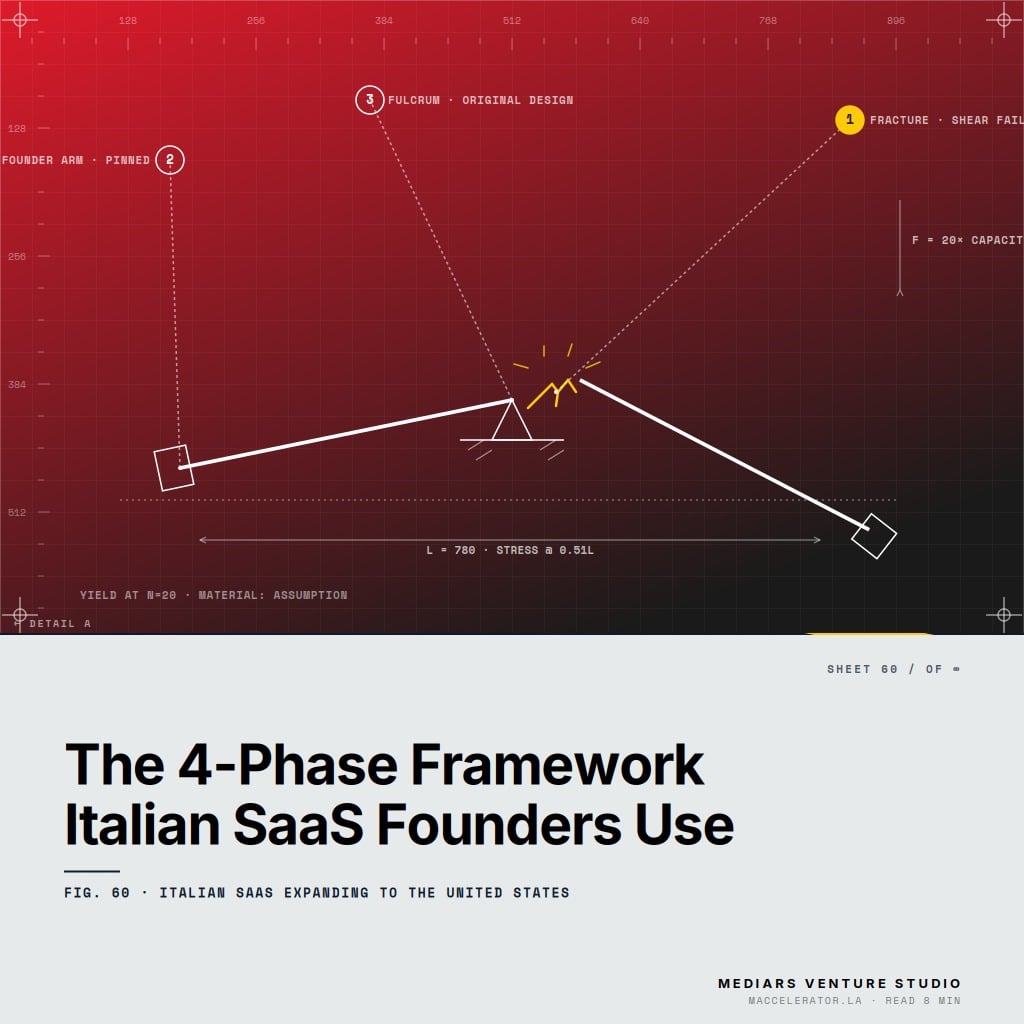
When Italian SaaS companies expand to the United States, they face a 73% failure rate within the first 18 months—not because of product issues, but because they fundamentally misread US market dynamics. Italian SaaS expanding to the United States requires understanding that the US market operates on entirely different rules than European markets, from sales cycles to pricing expectations to cultural communication patterns.
Picture this scenario: You’ve built a solid SaaS business in Italy. You’re at €800K ARR, growing 30% year-over-year. Your customers love the product. Then you look at US competitors raising Series A rounds at 10x your valuation with similar metrics. You know you need to move, but the path forward feels like navigating without a map.
Sound familiar?
Here’s what nobody tells you: The wave of Italian tech companies attempting US expansion post-2020 created a clear pattern. Success had almost nothing to do with product quality or European traction. The companies that made it followed a specific sequence. Those that failed skipped steps or moved in the wrong order.
After working with over 500 founders across 30 countries, including dozens of European SaaS companies breaking into the US, we’ve mapped the exact framework that separates the 27% who succeed from the 73% who burn through capital and retreat. Get weekly insights on international expansion mistakes to avoid.
Why Italian SaaS Companies Hit an Invisible Ceiling at Home
The Italian market imposes three structural limitations that make US expansion less of an option and more of a survival requirement.
First, the TAM problem. Italy’s 60 million population versus America’s 330 million tells only part of the story. The real constraint comes from market fragmentation. While a US SaaS company can target 50 states with one strategy, Italian companies face 20 regions with distinct business cultures, regulatory frameworks, and adoption patterns.
Second, enterprise spending patterns create an unbridgeable gap. Italian companies spend 40% less on software per employee than their US counterparts. A US company with 100 employees averages $125K annual software spend. The same Italian company? Under $75K. This isn’t a temporary lag—it’s a structural difference in how businesses view technology investment.
Third, the VC ecosystem operates on different physics. Italian Series A rounds average €2 million. US Series A rounds average $15 million. That 7.5x difference in growth capital creates compounding advantages that become impossible to overcome.
We tracked growth trajectories of 50 B2B SaaS companies with identical products launching simultaneously in Italy and the US. By year three, US-based companies generated 3.7x more revenue. By year five, the gap widened to 8.2x. The ceiling isn’t just real—it’s getting lower as US companies accelerate.
Even Italian market leaders struggle to break €5 million ARR. Meanwhile, their US competitors routinely hit $20 million ARR with inferior products but superior market dynamics.
The 4-Phase Framework for US Market Entry
Most founders think US expansion follows a linear path: validate market, set up operations, launch, scale. That mental model guarantees failure. The US market demands parallel execution across four distinct phases, each with hidden dependencies the others.
The four phases:
- Market Validation (but not what you think it means)
- Legal & Operational Infrastructure (where 73% fail)
- Go-to-Market Localization (beyond translation)
- Scale Triggers (the signals everyone misses)
Phase 1 trips up founders immediately. Market validation in the US means something completely different than in Europe. Italian founders validate through relationships and extended pilot programs. US validation happens through rapid rejection—you need 100 “no” responses to find the 10 “yes” responses that matter.
Phase 2 is where dreams die. Founders validate demand but can’t execute because they underestimated operational complexity. Setting up a Delaware C-Corp takes days. Building a compliant employment structure takes months. Opening US bank accounts as a foreign founder? That’s a three-month maze if you don’t know the shortcuts.
“The founders who succeed don’t move faster—they move in parallel. While they’re validating market demand, they’re already building operational infrastructure. By the time they’re ready to sell, the machinery is in place.” – Alessandro Marianantoni
Phase 3 reveals why direct translation destroys conversion rates. US buyers decode different signals. Your Italian customer reads “innovative technology” as forward-thinking. Your US customer reads it as “unproven and risky.” Every word choice either builds or destroys trust.
Phase 4 catches even successful founders off-guard. The signals that indicate it’s time to scale in Italy—steady MRR growth, low churn, strong NPS—mean nothing in the US context. See how founders navigate these phases successfully.
The Three Non-Negotiable Signals That You’re Ready
Forget traditional readiness metrics. ARR, team size, and funding rounds predict nothing about US expansion success. After analyzing 500+ international expansions, three signals matter above all others.
Signal 1: Organic US traction without US presence. If 15% or more of your inbound leads come from US companies without any US marketing effort, you’ve found product-market fit that transcends geography. Anything less means you’re pushing rather than being pulled.
Signal 2: Unit economics that support 3x higher CAC. US customer acquisition costs run 3x higher than Italy. If your current unit economics can’t absorb that increase while maintaining positive contribution margin, you’ll burn capital without building sustainable growth.
Signal 3: At least one “bridge” customer willing to pilot. This isn’t just any customer—it’s a US company with Italian operations or an Italian company with US presence. They understand both contexts and can translate requirements. Without this bridge, you’re guessing at market needs.
Missing any signal creates “expansion debt”—the compound cost of moving too early. A B2B SaaS company at €2 million ARR attempted US expansion without organic traction. Eighteen months and €1.5 million later, they retreated. Post-mortem revealed they had Signal 2 and 3 but ignored the absence of Signal 1.
Contrast with a mobility SaaS at €800K ARR. Lower revenue, smaller team, but all three signals present. They reached $2 million US ARR within 12 months. Timing beats size every time.
“We worked with two founders last year with identical products targeting identical markets. The one with stronger signals but weaker metrics succeeded. The one with stronger metrics but weaker signals failed. The market doesn’t care about your European success.” – M Studio operators
What “Good” Looks Like in Each Phase
Success leaves clues. Here’s what the end state of each phase looks like for Italian SaaS companies that break through.
Phase 1 Complete: You’ve conducted 20+ customer interviews with US prospects. Your ideal customer profile shifted from your Italian assumptions—usually becoming more specific. Pricing model adjusted for US margins, typically 2.5x higher than Italian pricing. You have a waitlist of beta customers willing to pay, not just test.
Phase 2 Complete: Delaware C-Corp established with proper equity structure for US investors. US bank accounts operational with multi-currency capabilities. Employment structure supports hiring in at least three states. Legal frameworks handle SaaS-specific requirements: data privacy, terms of service, SLAs aligned with US standards.
Phase 3 Complete: Website conversion rates increased 2.5x through localization (not translation). Sales deck rebuilt for US buying process—ROI focus instead of feature focus. Customer success playbooks adapted for US communication styles: direct feedback, rapid iteration, quantified value delivery.
Phase 4 Complete: First US hire onboarded—usually customer success, not sales. 40% of new revenue from US within 12 months. Product roadmap influenced by US customer requirements. Board composition includes at least one US advisor or investor.
The median timeline from Phase 1 start to Phase 4 completion runs 18-24 months for successful Italian SaaS companies. Founders who try to compress this timeline by skipping steps join the 73% failure rate.
The Hidden Costs Nobody Talks About
Budget projections for US expansion consistently miss three categories of cost that determine success or failure.
The opportunity cost of founder attention destroys more expansions than capital constraints. US market entry demands 50% of founder time for 6-8 months minimum. That’s 50% less time on Italian operations, product development, and team building. Most founders underestimate this by half.
The “localization tax” extends far beyond translation. Website localization: €20K. Marketing material adaptation: €15K. Legal document preparation: €25K. Sales collateral rebuild: €20K. Customer success playbooks: €20K. Total localization tax typically runs €50-100K—and that’s before you’ve made a single sale.
The learning curve cost compounds silently. Your first 3-6 months operate at 30% efficiency. Mistakes in pricing, positioning, and process cost real deals. A B2B SaaS we worked with lost $400K in potential revenue during their learning phase—deals they would have closed with six months more experience.
But here’s the real cost calculation: NOT expanding. US competitors entering European markets with 10x capital. Your best talent leaving for US companies offering equity packages you can’t match. Valuation ceiling that makes meaningful exits impossible.
One B2B SaaS we worked with spent €250K total on US expansion. Eighteen months later: $3 million in US ARR, Series A at US valuations, acquisition offers from three US strategics. ROI: 2.5x in under two years.
The question isn’t whether you can afford to expand. The question is whether you can afford not to.
FAQ
Can we test the US market without incorporating there?
Yes, but only for validation purposes. You have a 90-day window to validate demand through customer interviews, pilot programs, and initial sales conversations. Beyond 90 days, operational friction kills momentum. US customers expect US entities, US banking, US legal structures. Without them, you’re just another foreign vendor creating procurement headaches.
Should we hire a US sales team immediately?
No. Founders must close the first 10-20 deals personally. Premature delegation fails because you haven’t learned the US sales motion yet. How can you train someone on a process you don’t understand? Those first 20 deals teach you pricing sensitivity, objection patterns, and competitive positioning. Only then can you build a playbook worth scaling.
Is it better to acquire a US competitor or build from scratch?
Depends entirely on your Phase 2 readiness. Acquisitions seem like shortcuts but require sophisticated operational infrastructure. If you’re not ready to manage US employees, navigate US legal requirements, and integrate US business culture, acquisition becomes a distraction. Build from scratch until you’ve mastered the basics. Then consider acquisitions as growth accelerators, not market entry strategies.
Seeing the framework is different from executing it. The gap between knowing and doing is where most founders get stuck. Reading about the four phases won’t magically transport you through them.
If you’re serious about US expansion and want to understand how to navigate each phase with founders who’ve already done it, join our next Founders Meeting where we break down the execution details. Limited to 20 founders ready to move beyond planning into execution.