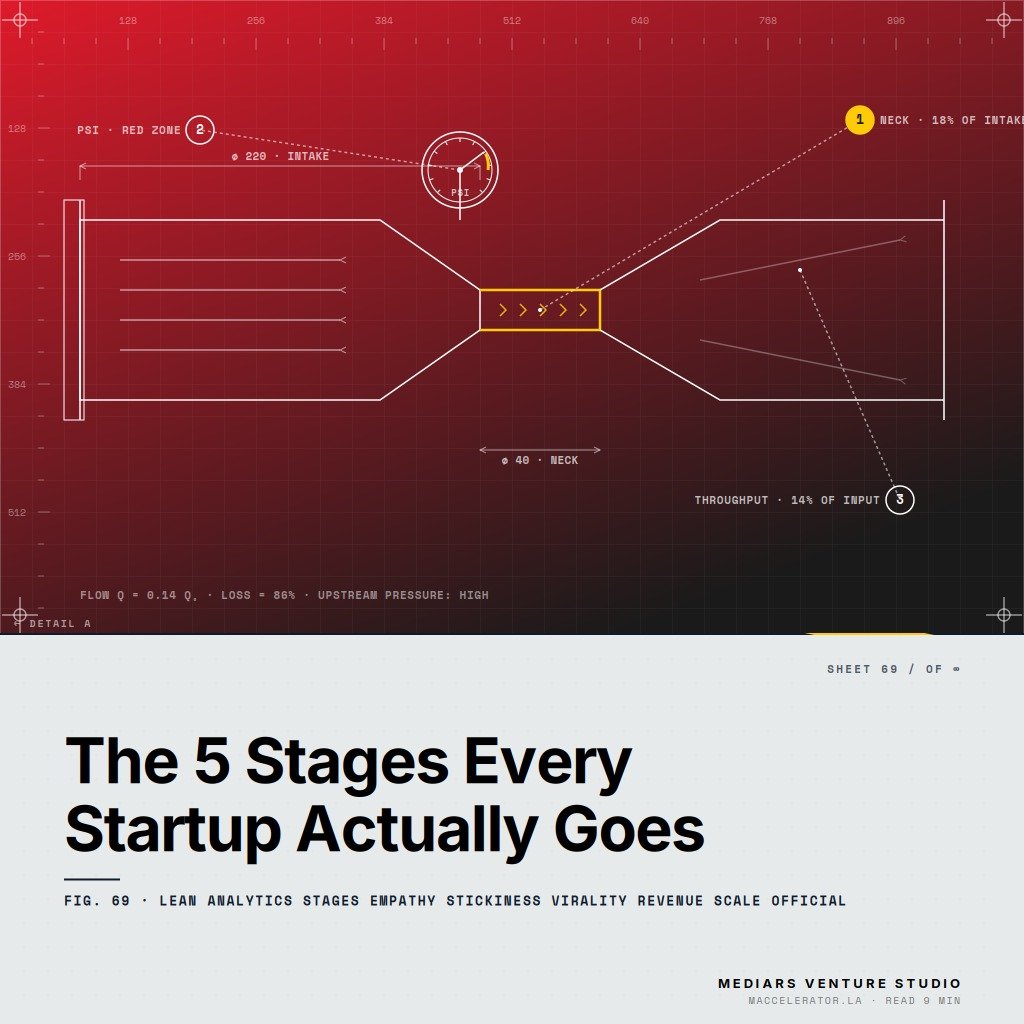
The official lean analytics stages—empathy, stickiness, virality, revenue, and scale—represent the five sequential milestones every data-driven startup must navigate, yet 73% of founders get permanently stuck at stage two because they misdiagnose their actual position. These stages aren’t just academic concepts from the Lean Analytics playbook; they’re the difference between a founder at $300K ARR adding features frantically with zero traction and one who understands exactly why growth has flatlined.
Picture this: A B2B SaaS founder celebrating their first $500K in annual recurring revenue. Twenty customers, growing pipeline, team of eight. They’re convinced they’ve reached the revenue stage—after all, they have revenue. But their 65% annual churn tells a different story. They never actually mastered stickiness. Now they’re burning cash on sales and marketing for a product that bleeds customers faster than they can acquire them.
This pattern repeats across 500+ founders we’ve worked with. Most believe they’re further along the lean analytics progression than they actually are. The consequences are predictable: premature scaling attempts, misallocated resources, and eventual failure that could have been prevented by simply understanding which stage they were actually in.
Why Most Founders Misdiagnose Their Current Stage
The cognitive bias is universal. Founders see revenue and assume they’re at the revenue stage. They see users signing up and think they’ve achieved virality. They confuse motion with progress, activity with advancement through the stages.
A mobility startup we worked with had 10,000 registered users. The founder was already planning their Series A, talking about their viral growth. The data told a different story: 80% of users never completed a second transaction. They had traffic, not stickiness. They had signups, not product-market fit. They were still in the empathy stage, desperately needing to understand why users abandoned after one use.
The misdiagnosis happens because vanity metrics lie. Download numbers, registered users, even revenue—these can all mask fundamental weaknesses in your business model. A marketplace with $1M in gross merchandise value but 90% customer churn isn’t at the revenue stage. They’re failing at stickiness while pretending otherwise.
“Companies that correctly identify their actual stage grow 2.3x faster than those who don’t. The first step isn’t moving forward—it’s knowing where you actually stand.” – Alessandro Marianantoni
The framework exists for a reason. Each stage builds on the previous one. Skip a stage, and the foundation crumbles. Try to scale before achieving stickiness, and you’re amplifying a broken model. Chase virality before understanding what makes users stay, and you’re filling a leaky bucket.
Get weekly insights on startup metrics that actually matter delivered to your inbox, including stage-specific benchmarks most founders miss.
The Empathy Stage: Finding Problem-Solution Fit (Not Product-Market Fit)
Empathy stage has nothing to do with building products. It has everything to do with understanding problems so deeply that the solution becomes obvious. Most founders get this backwards, starting with a solution and searching for a problem to solve.
We tracked two founders in the same space. Founder A spent six months building their MVP before talking to a single customer. Founder B spent six weeks conducting 50 customer interviews before writing a line of code. Eighteen months later, Founder B had reached $1M ARR. Founder A had pivoted twice and was still under $100K.
The difference wasn’t talent or resources. The difference was that Founder B discovered through interviews that customers already had budget allocated for solving this specific problem—they just hadn’t found the right solution yet.
True problem validation reveals three critical signals:
- Urgency: Customers are actively trying to solve this problem today, not someday
- Frequency: The problem occurs daily or weekly, not quarterly
- Budget: Money is already being spent on inferior solutions
An HR tech founder we worked with discovered through 40+ interviews that companies were spending $50K annually on consultants to solve what his software could automate. That’s empathy stage success—finding a problem so painful that customers are already paying for band-aid solutions.
The trap is building too early. Every line of code written before achieving true empathy is technical debt. Every feature built on assumptions rather than evidence is future failure embodied in the present product.
The Stickiness Trap: Why 73% of Startups Get Stuck Here
Stickiness is where dreams go to die. It’s the stage that separates real businesses from science projects. It’s also where 73% of startups get permanently stuck, adding features frantically while core retention metrics slowly deteriorate.
A marketplace startup celebrated reaching 10,000 users in their first year. Press coverage, investor interest, team growth—all the external validation that masks internal metrics. But when we examined cohort retention, the truth emerged: 80% of users churned after their first transaction. They had achieved growth without stickiness. The business was already dead; it just didn’t know it yet.
The confusion comes from measuring the wrong metrics. Activation metrics feel good: signups climbing, first-time usage growing, total user count increasing. But stickiness lives in retention metrics: D7/D30 retention for consumer apps, monthly churn for B2B SaaS, repeat rate for marketplaces.
The benchmarks are unforgiving:
- B2B SaaS needs 90%+ monthly retention to build a real business
- Marketplaces need 20%+ repeat transaction rate within 90 days
- Consumer apps need 40%+ D7 retention or they’re already dying
A fintech app we analyzed had 50,000 downloads but only 8% D30 retention. They were spending $50K monthly on user acquisition, filling a bucket with no bottom. Six months later, they were gone. The killer wasn’t competition or market timing. It was ignoring stickiness while chasing growth.
“Most founders think stickiness is about features. It’s actually about delivering consistent value that becomes habit-forming. Features are just the vehicle.” – M Studio team
The stickiness trap deepens because solutions seem obvious: add more features, improve onboarding, enhance UI. But these are symptoms, not causes. True stickiness comes from product-market fit at the atomic level—solving one problem so well that users can’t imagine going back to their old solution.
See how elite founders measure what matters and break through the stickiness trap with the right metrics framework.
Virality vs. Revenue: The Strategic Choice That Defines Your Business Model
After achieving stickiness, founders face a critical fork: pursue virality or pursue revenue. The choice isn’t just tactical. It’s existential. Each path demands different DNA, different teams, different metrics, different funding strategies.
Consider two startups that reached stickiness at the same time. Company A, a B2B SaaS platform, went straight to the revenue stage. They built an inside sales team, focused on enterprise deals, optimized for ACV over user count. In 18 months, they grew from $50K to $2M ARR with just 200 customers.
Company B, a consumer app, chose virality. They removed all friction, made sharing core to the experience, optimized for viral coefficient over monetization. They reached 1M users with exactly $0 in revenue. Both succeeded by committing fully to their chosen path.
The mistake is trying to do both simultaneously.
A social commerce startup we encountered wanted viral growth AND immediate revenue. They added paywalls that killed sharing. They prioritized monetization features over viral mechanics. Result: K-factor of 0.3 (you need >1.0 for true virality) and revenue per user too low to support paid acquisition. They achieved neither virality nor sustainable revenue.
The metrics tell the story:
- Virality path: K-factor >1.0, time to share <24 hours, zero friction to value
- Revenue path: LTV:CAC >3:1, payback period <12 months, ACV growing quarter over quarter
These aren’t just different metrics. They’re different religions. Virality worships growth at all costs. Revenue worships unit economics. Try to worship both, and you’ll be cast out of both churches.
The Scale Stage: When Systems Matter More Than Hustle
Scale is the most misunderstood stage. Most companies claiming to be “scaling” are just growing linearly—adding revenue at the same pace they’re adding costs. That’s not scale. That’s just getting bigger.
A founder at $2.5M ARR still approved every deal over $10K. Still reviewed every hire. Still wrote product requirements. The business had grown, but it hadn’t scaled. Revenue increased 3x, but so did the team. Margins stayed flat. The founder worked 80-hour weeks, convinced this was what scaling looked like.
True scale means revenue grows faster than headcount. It means CAC decreases with volume. It means the founder works ON the business, not IN it. Scale is when systems replace hustle.
Three systems enable true scale:
- Repeatable sales process: New reps productive in 30 days, not 90
- Predictable product development: Shipping on schedule, not constantly firefighting
- Autonomous teams: Decisions happen without the founder in the room
An edtech company we worked with grew revenue 3x while growing headcount only 1.5x. Their secret wasn’t working harder. It was building systems that made each person 2x more effective. Sales automation that qualified leads before human touch. Product processes that shipped features on two-week cycles. Team structures where directors owned outcomes, not just activities.
The scale stage never truly ends. It’s the ongoing process of finding leverage, building systems, removing bottlenecks. But you can’t scale what doesn’t work. Which brings us back to the fundamental truth: stages can’t be skipped.
The Stage Progression Framework: Knowing When to Advance
Knowing when to advance between stages is as critical as understanding the stages themselves. Move too early, and you’re building on quicksand. Move too late, and competitors pass you by. The signals are specific and measurable.
Empathy → Stickiness: You have 3+ customers paying for an ugly MVP that solves their problem. Not interested customers. Not pilot customers. Paying customers using a barely functional solution because the problem is that painful.
Stickiness → Virality/Revenue: Your retention curves have flattened above benchmark for your category. B2B SaaS showing <10% monthly churn for 3+ months. Marketplaces seeing 20%+ repeat rate stabilizing. The product works. Users stay. Time to grow.
Virality/Revenue → Scale: Unit economics are proven at current size. For viral products: organic growth sustains without paid acquisition. For revenue products: LTV:CAC exceeds 3:1 and payback period is under 12 months. The model works. Time to amplify.
An edtech startup tried to jump from empathy to scale. They raised $2M, hired 20 people, launched in 5 markets simultaneously. Burned through the entire raise in 8 months with nothing to show for it. They had skipped stickiness entirely—building elaborate distribution for a product nobody wanted to use twice.
Contrast that with a mobility startup that methodically progressed through each stage over 18 months. Three months validating the problem through driver interviews. Six months achieving stickiness with 100 beta users. Nine months building viral mechanics that drove organic growth. Only then did they raise capital to scale what was already working.
The framework punishes impatience and rewards discipline. Each stage has entrance criteria and exit criteria. Meet them or face the consequences.
Key Takeaways
- The five lean analytics stages—empathy, stickiness, virality, revenue, and scale—must be completed sequentially
- 73% of startups get stuck at the stickiness stage by focusing on vanity metrics instead of retention
- Virality and revenue are mutually exclusive paths requiring different strategies and metrics
- True scale means revenue grows faster than costs through systems, not just hustle
- Each stage has specific, measurable criteria for advancement—skip at your peril
FAQ
What if we’re between stages?
Being between stages means you haven’t completed the previous one. Most companies live in transition, telling themselves they’re progressing when they’re actually stuck. If retention is declining while you’re trying to scale, you never mastered stickiness. If you have revenue but 60% churn, you’re not at revenue stage—you’re failing at stickiness with revenue as a distraction. Success requires completing each stage’s core metric before advancing.
Can B2C companies skip the revenue stage?
B2C companies often follow the path empathy→stickiness→virality→revenue, prioritizing user growth over early monetization. But skipping revenue entirely means building on quicksand. Even Instagram, the poster child for virality-first strategy, eventually needed revenue. The question isn’t whether to monetize, but when. Build virality first if your model demands it, but remember: businesses without business models aren’t businesses.
How long should each stage take?
Rough timelines: empathy (2-6 months), stickiness (6-12 months), virality/revenue (12-24 months), scale (ongoing). These vary dramatically by model, market, and execution. A B2B SaaS targeting enterprise might spend 6 months in empathy doing deep customer development. A consumer app might complete empathy in 8 weeks through rapid prototyping. The danger isn’t moving too slowly—it’s moving too quickly. Rushing guarantees failure.
Knowing your stage is just the first step—executing the right strategies for that stage is where real growth happens. If you’ve recognized your company in these patterns and want to understand the specific playbooks that work at your current stage, join our next Founders Meeting where we break down the execution frameworks that help founders progress through each stage systematically.