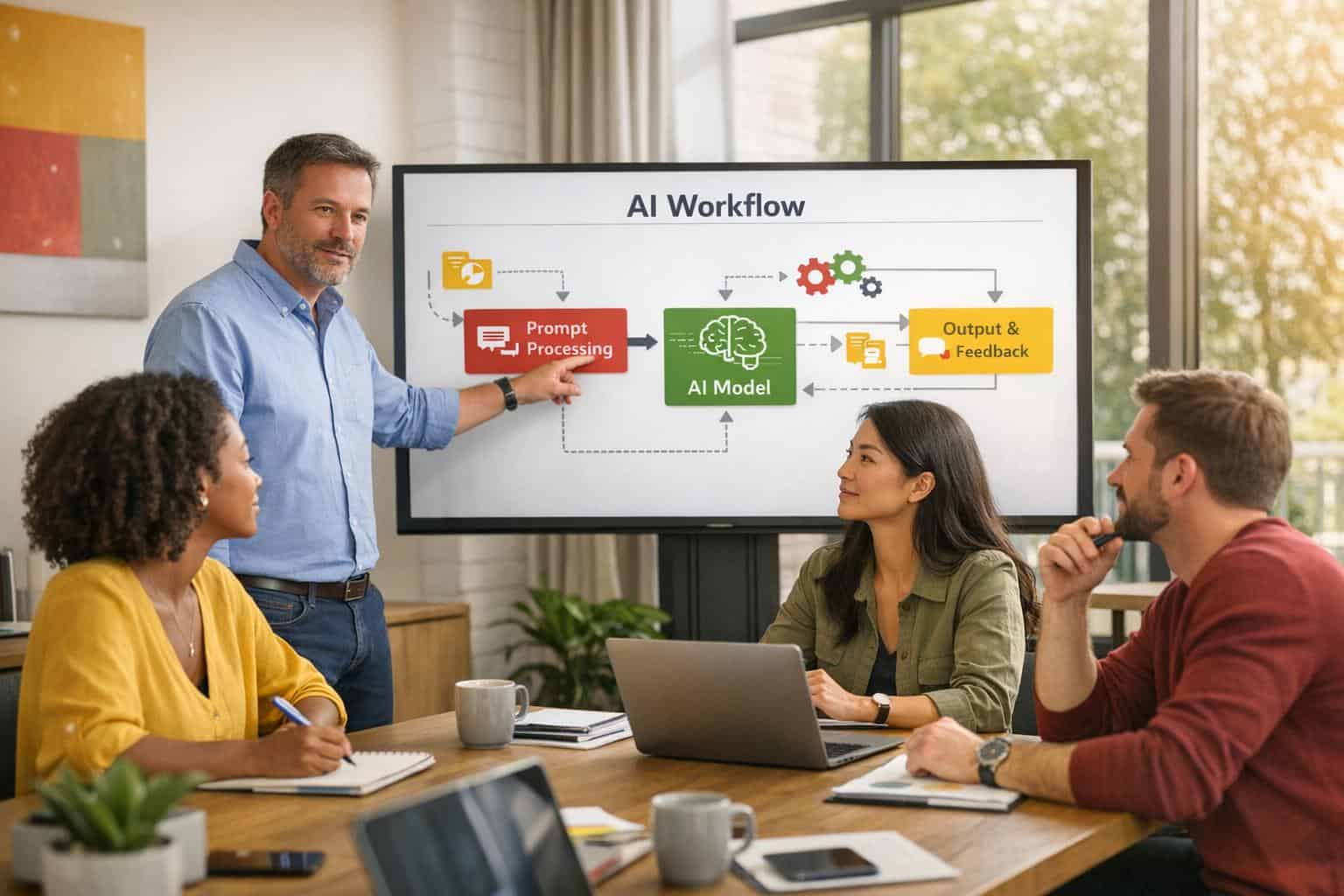
Flow engineers design multi-step workflows that make AI systems more reliable and effective for complex tasks. Unlike traditional prompt engineering, which relies on single-shot solutions, flow engineering breaks problems into smaller steps, incorporates feedback loops, and ensures quality through validation mechanisms. This approach aligns with "System 2" thinking, enabling AI to handle intricate challenges with greater accuracy and consistency.
Key Takeaways:
- Multi-step workflows: Tasks are divided into smaller, manageable steps.
- Chaining: Outputs from one step feed into the next for continuity.
- Validation: Built-in checks ensure quality at every stage.
- Iteration: Feedback loops allow refinement and error correction.
- Integration: Systems are connected with business tools like CRMs and databases.
Flow engineering is transforming how businesses use AI, making it a reliable tool for tasks like coding, financial analysis, and automation of operational workflows. For example, GPT-4’s coding accuracy improved from 19% to 44% when researchers adopted a multi-step process instead of single prompts.
This role bridges the gap between AI automation and practical business needs, offering structured solutions to complex problems.
What is Flow Engineering?

Flow Engineering vs Prompt Engineering: Key Differences and Performance Improvements
Flow engineering is a method that breaks down complex tasks into a series of interconnected steps. Instead of aiming for a one-and-done solution, it focuses on creating a sequence where each step’s output becomes the input for the next. Along the way, it incorporates checks and refinements to ensure quality and accuracy.
Think of it like building a house: you start with a blueprint, lay the foundation, construct the walls, and finish with inspections. Each phase builds upon the last, with adjustments made as needed.
How Flow Engineering Works
Flow engineering is built on five key components that work together to create dependable AI systems:
- Multi-step workflows: Break large, high-level goals into smaller, manageable tasks.
- Chaining: Link steps together by using the output of one as the input for the next, ensuring continuity throughout the process.
- Logic gates: These enable decision-making within the workflow. The system can branch out or change direction based on real-time feedback. For example, if one approach doesn’t work, it can automatically pivot to an alternative.
- Validation mechanisms: These checkpoints evaluate the output against predefined criteria before moving forward, acting as quality control.
- Iteration cycles: Feedback loops allow the system to refine its output repeatedly until the desired result is achieved.
In October 2024, researchers Jan-Samuel Wagner and Dave DeCaprio introduced the Controller-Embedded Language Model Interactions (CELI) framework. This framework embeds control logic directly into prompts, making it possible to manage multi-stage tasks more effectively. A case study on multi-stage content generation showed that 94.4% of CELI-produced Wikipedia-style articles met or exceeded first-draft quality, with 44.4% rated as high quality[1].
This structured approach highlights the clear differences between flow engineering and traditional prompt engineering.
Flow Engineering vs Prompt Engineering
The primary difference between these two methods lies in their structure and flexibility. Prompt engineering is a single-shot method: you craft an instruction, send it to the model, and receive a response. Flow engineering, on the other hand, creates a modular, multi-stage system where each step focuses on a specific part of the task.
| Feature | Prompt Engineering | Flow Engineering |
|---|---|---|
| Structure | Single-prompt, one-shot | Modular, multi-stage, iterative |
| Logic | Fixed, linear, rule-based | Dynamic, real-time reasoning |
| Adaptability | Struggles with unexpected input | Adjusts strategy using feedback |
| Error Handling | Requires human intervention | Self-correcting with feedback loops |
| Cognitive Mode | System 1 (Fast/Automatic) | System 2 (Slow/Deliberate) |
Prompt engineering is suitable for simple, predictable tasks. However, flow engineering shines when dealing with complex challenges, where adaptability, error recovery, and consistency are crucial. Its modular design also makes it easier to tweak individual components without reworking the entire system, making it especially useful for enterprise-level applications where reliability is a top priority.
System 1 vs System 2 Thinking in AI
Grasping these cognitive models is key to understanding how flow engineering overcomes the limits of single-prompt systems.
System 1 and System 2 Explained
Psychologist Daniel Kahneman’s framework for human cognition provides a helpful way to think about AI workflows. System 1 thinking is quick, automatic, and intuitive – similar to how a single-prompt AI response relies on recognizing patterns.
On the other hand, System 2 thinking is deliberate and logical, mirroring the structured, iterative process of flow engineering. This approach plans, evaluates, and adjusts to refine outcomes. As Rohan Balkondekar, an AI developer, explains:
"The simple associative token-level choices of LMs are also reminiscent of ‘System 1’, and thus might benefit from augmentation by a more deliberate ‘System 2’ planning process."
This distinction makes it clear why multi-step workflows are crucial for tackling complex tasks.
When dealing with intricate problems, System 2 reasoning shines. A single prompt relies on intuition and pattern-matching, which can fall short for more complicated challenges. Flow engineering breaks these tasks into smaller, manageable steps, ensuring each stage builds on the previous one. Validation checkpoints along the way catch errors before they snowball, making the process more reliable and effective.
Single-Prompt vs Flow Engineering: A Comparison
The advantages of flow engineering become even clearer when looking at real-world examples. In November 2023, J.P. Morgan AI Research tested the FlowMind workflow on financial question-answering tasks. For complex queries requiring data aggregation across multiple funds, the workflow achieved 89.5% accuracy compared to just 8.5% for the single-prompt baseline. The single-prompt method struggled with issues like context truncation and calculation errors – problems effectively addressed by the iterative feedback loops built into flow engineering.
Another example comes from the Language Agent Tree Search (LATS) framework. When paired with GPT-4, LATS achieved a 94.4% success rate on the HumanEval benchmark, significantly outperforming GPT-4’s standalone performance of 67.0%. This leap demonstrates how deliberate planning and exploring diverse alternatives can transform AI systems from basic assistants into reliable, enterprise-ready tools.
What a Flow Engineer Does
Flow engineers play a key role in connecting AI capabilities with business logic. They design multi-step processes that transform reactive tools into proactive systems, focusing on three main areas: crafting workflows, creating validation mechanisms, and integrating various systems into cohesive operations. Let’s dive into how flow engineers approach these tasks to build smarter, more efficient systems.
Curious to see flow engineering in action? Check out our Founders Meetings.
Designing AI Workflows
Flow engineers start by breaking down complex business objectives into clear, sequential steps that AI models can follow. This involves mapping out processes with defined decision points, inputs, and outputs. Essentially, they create the "logic engine" that determines when and how specific AI actions are triggered, moving beyond simple, one-off responses.
A great example of this approach comes from January 2024, when researchers Tal Ridnik, Dedy Kredo, and Itamar Friedman showcased their work with AlphaCodium. By dividing the task of code generation into distinct phases like "problem reflection" and "test generation", they boosted GPT-4’s accuracy on the CodeContests dataset from 19% to 44%. The improvement wasn’t due to a better prompt – it was the result of a smarter, staged process.
Creating Validation and Feedback Loops
Designing workflows is just the beginning. Ensuring reliability through validation and feedback is just as critical. Flow engineers build iterative refinement cycles, where AI models can self-correct based on test results or feedback. This often involves creating "test anchors" – automated testing tools that verify outputs before moving to the next step.
This concept aligns with what Rohan Balkondekar at Lyzr describes as "process supervision." Instead of only checking final outcomes, feedback is provided at every intermediate step. In November 2024, BDO Israel applied this method through the BlinkOps platform to automate over 50% of their monthly security alerts. The result? A 50% faster response time for their Managed Detection Response service. The system didn’t just complete tasks – it validated each step along the way, ensuring accuracy and reliability.
Connecting Tools and Systems
Another critical responsibility of flow engineers is ensuring that AI workflows seamlessly integrate with business operations. This involves orchestrating APIs to connect AI models with essential tools like CRMs, databases, and communication platforms. They also handle data transformation – cleaning, normalizing, and structuring information to ensure high-quality inputs for AI models. To streamline communication between systems, they create Interface Control Documents (ICDs), which define how data flows and interacts across components.
A practical example of this comes from Fungible Labs in 2025. They built an AI workflow that synchronized user group access across Okta and Google Workspace. This eliminated the need for manual identity management tasks, saving hours of work each week while ensuring consistent access across platforms.
For those ready to take the leap from chatbots to fully autonomous AI agents, Elite Founders offers weekly sessions to help turn flow engineering concepts into real-world systems tailored to your business needs.
sbb-itb-32a2de3
How to Implement Flow Engineering
Getting Started with Flow Engineering
To kick off flow engineering, start by designing and testing modular workflows. Moving toward autonomous AI agents requires a clear structure. Begin by gathering stakeholders to identify which processes need automation. Focus on tasks that involve multi-step reasoning rather than simple, quick responses. Solving sample inputs manually can help refine your understanding of how AI should handle specific scenarios. For more tips on building smarter AI workflows, consider signing up for our AI Acceleration Newsletter.
The next step is creating modular prototypes. Break down complex goals into smaller, independent nodes with defined inputs, actions, and outputs. Set up a shared data store that all nodes can access – this eliminates redundancy and makes workflows easier to maintain. The AlphaCodium case study is a great example of how this approach works in practice.
Before full deployment, test your workflows with real data. Include retries and self-evaluation loops within nodes to handle errors effectively. For instance, using the Language Agent Tree Search (LATS) framework alongside GPT-4 resulted in a 94.4% success rate on the HumanEval benchmark, compared to 67.0% for GPT-4 alone. This shows how structured feedback loops can significantly improve performance over single-pass attempts.
When deploying at scale, keep your workflow logic separate from external integrations. This makes it easier to maintain and expand your system as new capabilities are added. Want to see flow engineering in action? Check out our AI Acceleration Newsletter for real-world examples.
Business Applications of Flow Engineering
Once your workflows are fully tested and validated, you can apply these principles to transform key business processes. The same iterative approach that enhances AI accuracy can also streamline go-to-market (GTM) automation tasks. For example, companies use multi-step workflows to qualify leads, tailor outreach, and schedule follow-ups based on customer behavior. AI agents can analyze engagement patterns and adjust messaging in real time, speeding up sales cycles while keeping interactions personalized.
In revenue operations, flow engineering automates routine tasks while ensuring complex cases are escalated to human oversight when needed. This allows small teams to function with the efficiency of much larger organizations without compromising on quality. Interested in building these systems for your business? Elite Founders offers weekly sessions where you can create these automations together – no technical background required.
Conclusion: Flow Engineering as the Future of AI Automation
Using single prompts taps into System 1 thinking – quick and intuitive but often unreliable for tackling complex problems. Flow engineering takes AI to the next level by engaging System 2 thinking: deliberate, structured, and iterative. This shift isn’t just theoretical – real-world results back it up. For instance, GPT-4’s coding accuracy surged from 19% to 44% when researchers replaced direct prompts with multi-step workflows. Similarly, the Language Agent Tree Search framework boosted success rates on the HumanEval benchmark from 67.0% to an impressive 94.4%[1].
The secret to AI success isn’t about crafting better prompts – it’s about designing smarter processes. Flow engineering brings fault tolerance, modular control, and iterative improvements into play. If one path doesn’t work, the system adjusts; if accuracy falters, feedback mechanisms catch and correct errors before they escalate. This isn’t just about improving performance – it’s about making AI reliable enough for real-world applications where mistakes can be costly. Curious how flow engineering could transform your go-to-market strategies? Subscribe to our AI Acceleration Newsletter for weekly insights into actionable AI workflows.
This shift in process design isn’t just shaping high-performing AI systems – it’s also central to how we approach automation.
M Studio‘s Approach to Flow Engineering

At M Studio, we’ve been crafting multi-step AI workflows for founders long before the term "flow engineering" even existed. Back then, we called it GTM engineering. The idea is simple: break big, complex goals into manageable steps, build feedback loops into the system, and design for safe failure.
Through our work with Elite Founders, we help founders create these systems during weekly sessions. By the end, they walk away with functional automations – whether it’s lead scoring algorithms that adapt to user behavior, post-demo sequences that evolve based on engagement, or customer journey flows that escalate to human intervention when necessary. No technical expertise is required – just a willingness to move from manual workflows to scalable, dependable System 2 automation.
[1] Based on recent research and benchmarking studies.FAQs
How does flow engineering enhance AI accuracy compared to traditional prompt engineering?
Flow engineering enhances AI accuracy by creating multi-step workflows that incorporate structured logic, validation, and iterative processes. Unlike single prompts, which often depend on quick, intuitive responses, this method allows AI to engage in more thoughtful and organized reasoning. For example, applying flow engineering has increased GPT-4’s success rate on coding challenges from roughly 19% with single prompts to about 44% – a significant leap.
This approach works by breaking down complex tasks into smaller, more manageable steps, while validating results at each stage. By doing so, it ensures outputs are more consistent and precise. It’s especially useful for businesses looking to go beyond basic chatbot functions and develop autonomous AI systems capable of managing more intricate workflows.
What are the key elements of a flow engineering process?
A flow engineering process takes a single prompt and turns it into a well-structured, multi-step AI workflow by combining several key elements. It starts with breaking the problem into smaller, manageable tasks. These tasks can either run in sequence or independently, but they’re always connected by clear dependencies that outline how the workflow progresses. Each task is then carried out by agents – these could be AI models or specialized tools designed to process inputs, perform specific actions, and deliver outputs.
The process doesn’t stop there. To ensure accuracy and reliability, validation and verification loops are built into the workflow. These loops check intermediate results, enforce business rules, and retry steps when something goes wrong, creating a more reliable system. Overseeing all of this is a flow engine, which manages the workflow’s progress, handles errors, and ensures tasks are orchestrated smoothly.
By combining task decomposition, agent execution, validation, and orchestration, this approach allows businesses to create scalable, end-to-end AI solutions that go far beyond simple, one-off prompts.
How can businesses start using flow engineering to enhance their AI systems?
Businesses can embrace flow engineering by treating AI solutions as multi-step workflows instead of relying solely on single prompts. The first step is to identify tasks where a single AI call falls short – think of scenarios like complex coding, data validation, or decision-making that requires several intermediate steps. Once identified, outline a high-level workflow where each step builds on the previous one. For example, a workflow might involve generating code, performing static analysis, refining the results, and testing for accuracy.
From there, create a prototype using modular components or agents that are easy to assemble, debug, and reuse. Start with a manageable and impactful use case, iterating quickly. Focus on building validation loops – such as unit tests or schema checks – to ensure the process is reliable at every stage.
Finally, integrate the workflow into your existing systems, keeping an eye on performance and cost through monitoring tools. As you fine-tune and expand these workflows, you’ll transition from one-off prompting to robust AI processes that can handle complex, real-world challenges efficiently.