


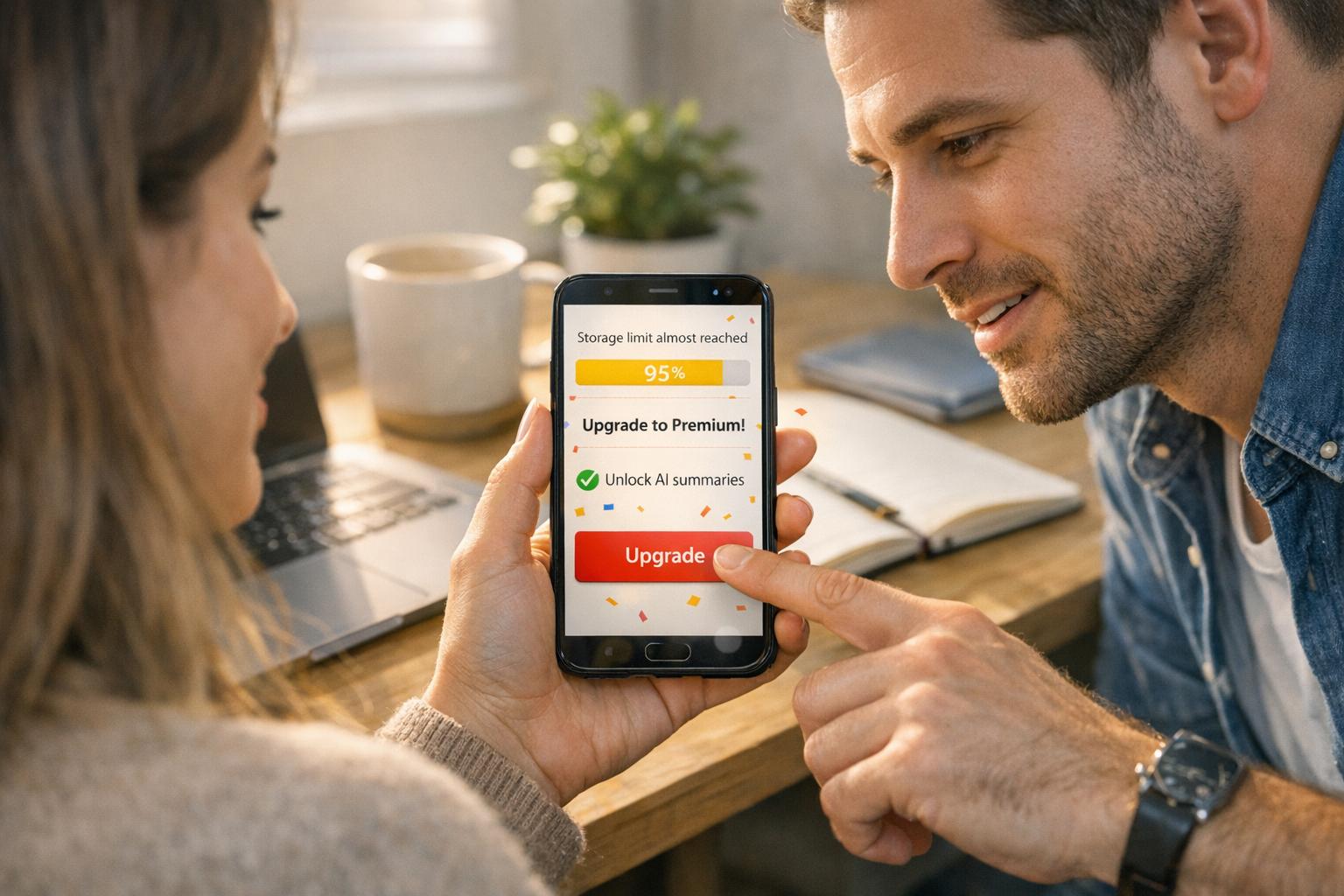
Freemium models are a popular strategy for SaaS companies, offering free access to basic features while reserving advanced tools for paying users. The challenge? Converting free users into paying customers. While average conversion rates hover around 3–5%, top-performing companies push these numbers to 5–15% by leveraging timely, personalized upgrade prompts and behavioral triggers.
Key strategies include:
- Usage Limits: Users are more likely to upgrade when they hit storage caps, message history limits, or API thresholds (e.g., Slack’s 3x higher conversions when users hit the 10,000-message cap).
- Psychological Triggers: Loss aversion (fear of losing access) and value recognition (realizing premium features amplify success) drive decisions.
- Timing: Prompts tied to milestones, like completing a task or reaching a usage threshold, convert better than arbitrary time-based offers.
- Personalization: Tailored messages, like highlighting specific achievements, can boost conversions by up to 350%.
Freemium success requires aligning upgrade prompts with moments of high engagement and clear user value. Companies like Slack, Dropbox, and Spotify demonstrate how thoughtful triggers can significantly improve conversion rates.

Freemium Conversion Triggers: Key Statistics and Upgrade Drivers
Psychological Triggers That Drive Upgrades
Upgrade decisions aren’t just about pricing – they’re deeply influenced by psychological factors. To fine-tune your upgrade funnel, consider subscribing to our free AI Acceleration Newsletter for weekly tips. At M Accelerator, we specialize in helping founders turn freemium users into loyal paying customers with AI-powered strategies.
Value Recognition and Perceived ROI
Users are more likely to upgrade when they see clear, measurable value in premium features. This is often referred to as the "pennies-to-dollars" effect – users need to feel the leap from free to paid is worth it. The focus should be on showcasing tangible benefits, not just hypothetical ones.
Take Zoom, for example. In June 2025, they analyzed their freemium users and found that those hosting meetings with three or more participants at least twice a week converted at rates four times higher than the average. By tailoring upgrade journeys for this group, Zoom boosted conversion rates by 22%. These users already experienced productivity gains, making it easier to connect premium features to their daily workflows.
Personalized upgrade prompts can also make a huge difference. Instead of generic messages like "Unlock advanced features", a targeted message that highlights a user’s specific achievements can increase conversions by up to 350%.
Loss Aversion as a Conversion Driver
Behavioral economics teaches us that people fear losing something more than they enjoy gaining something of equal value. This principle, known as loss aversion, is a powerful motivator for freemium users to upgrade.
When users invest time and effort into a platform – customizing settings, building databases, or accumulating data – they develop a sense of ownership. Slack tapped into this in May 2025 by capping searchable message history for free users at 10,000 messages. Teams that hit this limit converted to paid plans at three times the average rate – not because they wanted new features, but because they didn’t want to lose access to their conversation history.
Data shows that 67% of upgrades happen when users hit a limit, not because they’re seeking new capabilities. The key is to frame these upgrade prompts as opportunities to enhance what’s already working, rather than as penalties. As SaaS expert David Skok puts it:
"The most successful freemium companies don’t sell to their free users; they make their free users want to buy."
However, poorly executed strategies can backfire. For example, when Evernote restricted its free plan without proper messaging, its app store rankings dropped by 40% in just six months. Users who saw more than two upgrade prompts per session were also three times more likely to abandon the app altogether. The takeaway? Use loss aversion wisely and avoid overwhelming users with excessive prompts.
Timing and Milestone Alignment
Even the best upgrade offer can fail if it’s poorly timed. The most effective prompts appear during moments of high engagement or right after a user achieves something meaningful. This approach taps into the "peak-end rule", where users remember a product based on its most impactful and final moments.
For instance, triggering an upgrade prompt after a user completes a design, launches a project, or finishes a key task can make the offer feel like a natural progression rather than an interruption. Timing is critical – products with a "time-to-value" (TTV) under 24 hours see a 23% higher conversion rate with trials, while those requiring two weeks or more of engagement see a 31% boost with freemium models. Aligning upgrade prompts with moments when premium features provide immediate value – what some call "contextual gating" – is essential for driving conversions.
| Trigger Type | Psychological Driver | Real-World Example |
|---|---|---|
| Value Realization | Positive Reinforcement | Prompting after 10 tasks completed |
| Limit Hit | Loss Aversion | Reaching storage or message caps |
| Team Expansion | Social Proof | Inviting a third teammate to a project |
| Workflow Completion | Peak-End Experience | Finishing a design or launching a campaign |
sbb-itb-32a2de3
Behavioral Signals and Usage Patterns
Freemium models thrive on understanding user behavior. By identifying the moments when users are most likely to upgrade, companies can strategically nudge them toward paid plans. These moments aren’t random – they’re rooted in predictable patterns that align with natural points of growth in a user’s workflow. By tracking these signals, businesses can pinpoint when users are ready to pay. For insights on leveraging these techniques, check out our free AI Acceleration Newsletter. If you’re curious about integrating AI-driven strategies into your business, take a look at how M Studio / M Accelerator creates systems designed to maximize conversions. Let’s dive into the specific usage patterns and feature interactions that often signal a readiness to upgrade.
Usage Thresholds That Trigger Upgrades
Interestingly, 67% of freemium-to-paid upgrades occur when users reach usage limits – not because they’re chasing new features. The desire for more of what’s already working often drives these decisions.
Take Amplitude as an example. When they implemented a freemium model capped at 10,000 events per month, their overall conversion rate landed at 4%. However, users who hit this threshold converted at a much higher rate – 14%, more than triple the average. These users had clearly integrated the product into their routines and needed additional capacity to sustain their success.
Dropbox shows a similar trend. Users who stored at least 500MB of data were 20% more likely to switch to a paid plan compared to those with minimal storage usage. These thresholds highlight a growing dependence on the product, making them prime opportunities for conversion.
This behavior ties into the concept of loss aversion. When users approach or exceed a limit, they’re naturally inclined to upgrade to avoid disruptions. SaaS growth expert Lincoln Murphy sums it up well:
"The best freemium conversions happen when the user achieves their desired outcome and immediately sees how the premium version can amplify that success."
Feature Engagement as a Predictor
Beyond hitting usage caps, how users interact with your product can reveal their upgrade potential. Engagement with advanced features – whether locked or partially accessible – often signals a strong intent to convert. These users are already exploring solutions that premium features can deliver.
Zoom provides a great case study here. Free users who hosted meetings with three or more participants at least twice a week converted at rates 4x higher than the average. This wasn’t just about reaching a limit; it reflected deeper product adoption and growing collaboration needs.
Contextual prompts can also play a key role. Grammarly, for instance, highlights advanced grammar issues for free users but doesn’t correct them, subtly showcasing the value of its premium tier. These targeted cues are 3–4x more effective at driving upgrades compared to generic notifications.
Another telltale sign? Users who find creative ways around restrictions, like exporting data manually or creating multiple free accounts. These behaviors indicate a strong demand for expanded capabilities or automation, making them ideal candidates for premium plans.
| User Behavior Signal | Conversion Impact | Real-World Example |
|---|---|---|
| Hitting Usage Limits | 3x higher conversion | Slack’s message history cap |
| Multi-User Meetings | 4x higher conversion | Zoom’s collaboration patterns |
| Team Expansion | 4–5x higher conversion | Figma’s collaborator invites |
| Power User Activity | 5–8x higher conversion | Airtable’s advanced view usage |
Designing Effective Upgrade Strategies
Understanding behavioral signals is just one piece of the puzzle. The real challenge is turning those insights into upgrade strategies that feel seamless and natural, fitting effortlessly into users’ workflows. Companies that get this right often see conversion rates between 2% and 5%. On the flip side, those that miss the mark struggle to reach even 1%. To see how AI-driven insights can deliver immediate revenue gains, check out our free AI Acceleration Newsletter. Founders can also explore how M Accelerator, an innovation studio in Los Angeles, builds AI-powered systems that drive measurable revenue results.
Strategic Feature Gating
Feature gating is all about balance: offering enough value in the free tier while showcasing the premium tier’s advantages. A great tactic is horizontal feature slicing, where core functions remain fully accessible for free, but advanced tools – like enhanced security or scalability – are reserved for premium users. Soft paywalls can help here, using grayed-out "Pro" features to educate users without disrupting their workflow. Upgrade prompts that emphasize the value users have already experienced can outperform generic messages by up to 350%.
Usage-based triggers are another effective method. By setting limits tied to meaningful metrics – like storage capacity, message history, or team size – you allow users to see the value of the product before nudging them to upgrade. For example, Spotify’s subtle prompts played a key role in helping the platform reach 100 million paid users by April 2019.
One critical rule: never block access to ongoing work. If users hit a free-tier limit, let them finish their current projects and only require upgrades for new ones. As Kris Carter, Founder of Segment8, puts it:
"Good freemium feels like expansion… Bad freemium feels like extortion."
Personalized and Contextual Prompts
The timing of upgrade prompts can make or break your strategy. Prompts tied to meaningful moments – like completing a task or hitting a milestone – convert at rates 2–3x higher than those based on limits.
Segmenting users into groups such as Evaluators, Power Users, and Tire-Kickers allows for more targeted messaging. For instance, educational nudges that explain how a premium feature solves a specific problem can drive 3–4x higher conversions than generic prompts. Even something as simple as a "3 days remaining" trial notification converts at 2.3x the rate of more generic "unlock access" messages. But there’s a catch: overdoing it can backfire. Users who encounter more than two upgrade prompts in one session are three times more likely to abandon the product altogether. Lincoln Murphy, Growth Consultant, sums it up well:
"The best freemium conversions happen when the user achieves their desired outcome and immediately sees how the premium version can amplify that success."
Frictionless Upgrade Processes
Even the most well-timed prompts can fall flat if the upgrade process is clunky. A smooth, one-click upgrade flow is ideal, as every extra field in a payment form decreases conversion rates by 6%. Overly complicated checkout processes can push away up to 17% of potential buyers. To avoid this, integrate upgrade options directly into the user’s workflow, making premium features accessible exactly when they’re needed.
The transition from free to paid should be as seamless as possible. A one-click upgrade with clear pricing warnings helps reduce friction, and subscribers who experience this ease are 38% more likely to stay after six months. Behavioral economist Dan Ariely refers to the jump from free to paid as the "Pennies-to-Dollars" effect, emphasizing how significant that shift can feel. To soften the leap, some companies offer smaller commitments, like one-time purchases or temporary boosts, before asking for a full subscription.
Ibrahim Bashir, Former VP of Product at Amplitude, suggests tailoring upgrade strategies to price points. For example:
- At $10/month, users often upgrade independently.
- At $100/month, manager approval might be necessary.
- At $1,000/month or higher, decisions usually involve senior leadership like Directors or VPs.
Designing your upgrade flow with these price thresholds in mind can make a big difference in conversion success.
Case Studies: Freemium Models in Action
The following examples showcase how three companies – Slack, Dropbox, and Spotify – have successfully implemented strategic triggers to encourage users to upgrade from free to paid plans. Each company uses a unique approach to balance user satisfaction with conversion goals, demonstrating how well-designed freemium models can drive growth. If you’re curious about using AI to refine upgrade strategies, much like M Studio / M Accelerator, these case studies offer valuable insights.
Slack: Usage Caps That Encourage Upgrades

Slack limits searchable message history to 10,000 messages, but the real magic happens when teams approach around 2,000 messages. At this point, conversion rates jump to three times higher than average. Why? As teams grow and conversations pile up, accessing older messages becomes essential. Slack introduces its upgrade prompt at just the right moment – when users naturally feel the need for expanded access. This strategy shows how usage-based limits can nudge users toward paid plans without disrupting their workflow.
Dropbox: Storage Limits That Prompt Premium Plans

Dropbox takes a capacity-driven approach, using storage thresholds to encourage upgrades. Rather than cutting users off when they hit their limit, Dropbox offers subtle reminders about their storage usage. For example, users who store at least 500MB of data are 20% more likely to upgrade. By keeping users informed about their storage consumption, Dropbox creates a seamless transition to premium plans, presenting the upgrade as a natural solution to their growing needs.
Spotify: Highlighting Premium with Experience-Based Triggers

Spotify uses experience-based limitations to encourage upgrades, framing its premium tier as a way to enhance the listening experience. This strategy has helped Spotify reach 100 million paid subscribers. Free users encounter occasional friction, like limited skips, with messages such as "You have 3 skips remaining." These warnings prepare users for the limit, reducing frustration and making the premium option more appealing. Interestingly, research shows that 67% of freemium upgrades are driven by hitting usage limits rather than by a desire for added features. As Venture Capitalist David Skok wisely puts it:
"The most successful freemium companies don’t sell to their free users; they make their free users want to buy."
These case studies highlight how thoughtful triggers can turn free users into paying customers while maintaining a positive user experience.
Turning Insights Into Action
Understanding psychology is a good start, but what really moves the needle on conversions beyond 2% is execution. If you’re looking for strategies to use AI for boosting freemium upgrades, consider subscribing to our AI Acceleration Newsletter for weekly tips on automating revenue systems. As Kris Carter, Founder of Segment8, explains:
"If your freemium-to-paid conversion rate is below 2%, you almost certainly don’t have a product problem. You have an upgrade trigger problem."
The key to improving freemium model success lies in pairing users’ moments of value realization with smart, automated upgrade prompts. Use analytics tools to track behaviors that predict conversions – like hitting 90% of a usage limit, inviting more team members, or storing 500MB of data. Then, set up billing triggers that align with these value realization moments, rather than relying on arbitrary time limits. Prompts tied to user success tend to convert 40% better than those based on time.
To bridge the gap between insights and execution, combine automated upgrade triggers with personalized human interactions. For instance, when analytics flag a high-intent user – someone adding multiple team members or repeatedly hitting feature limits – trigger a tailored outreach, such as a demo offer or a personalized email. This hybrid approach can push conversion rates from the typical 6–8% range to 10–15%.
At M Studio, we specialize in helping founders implement these systems through our Elite Founders program. We’ve worked with over 500 founders, building automations that have increased conversion rates by 40% and halved sales cycles. With the right setup, your upgrade triggers can work 24/7, turning user behavior into revenue seamlessly.
FAQs
Which user behaviors best predict an upgrade?
Users are more likely to upgrade when they see the value in premium features or feel the pinch of limitations on free options – this taps into a sense of loss aversion. Well-timed and effective upgrade prompts can nudge them further. Psychological factors like the perceived benefits of upgrading and a sense of urgency often play a big role in influencing their decision to make the leap.
How do I use limits without frustrating users?
To make limits work well, it’s all about finding the right balance. You want to give users enough value upfront while introducing subtle scarcity that nudges them toward upgrading. Be upfront about the limits – whether it’s on features or usage – and clearly explain the benefits they’re getting within those boundaries. When prompting upgrades, keep it smooth and natural, so it doesn’t feel forced.
Psychological triggers like value recognition (showing users what they gain) and loss aversion (highlighting what they might miss out on) can encourage upgrades without making users feel boxed in. However, steer clear of sudden or vague restrictions. These can break trust and hurt your chances of converting users in the long run.
What’s the best timing for upgrade prompts?
The ideal moment to introduce upgrade prompts is when users are fully aware of the benefits of premium features, feel the fear of missing out, or are deeply immersed in the product. These opportunities often arise during times of heavy usage or when users are nearing the limits of free features. These situations not only highlight the value of upgrading but also strike a balance between encouraging conversions and avoiding user frustration.