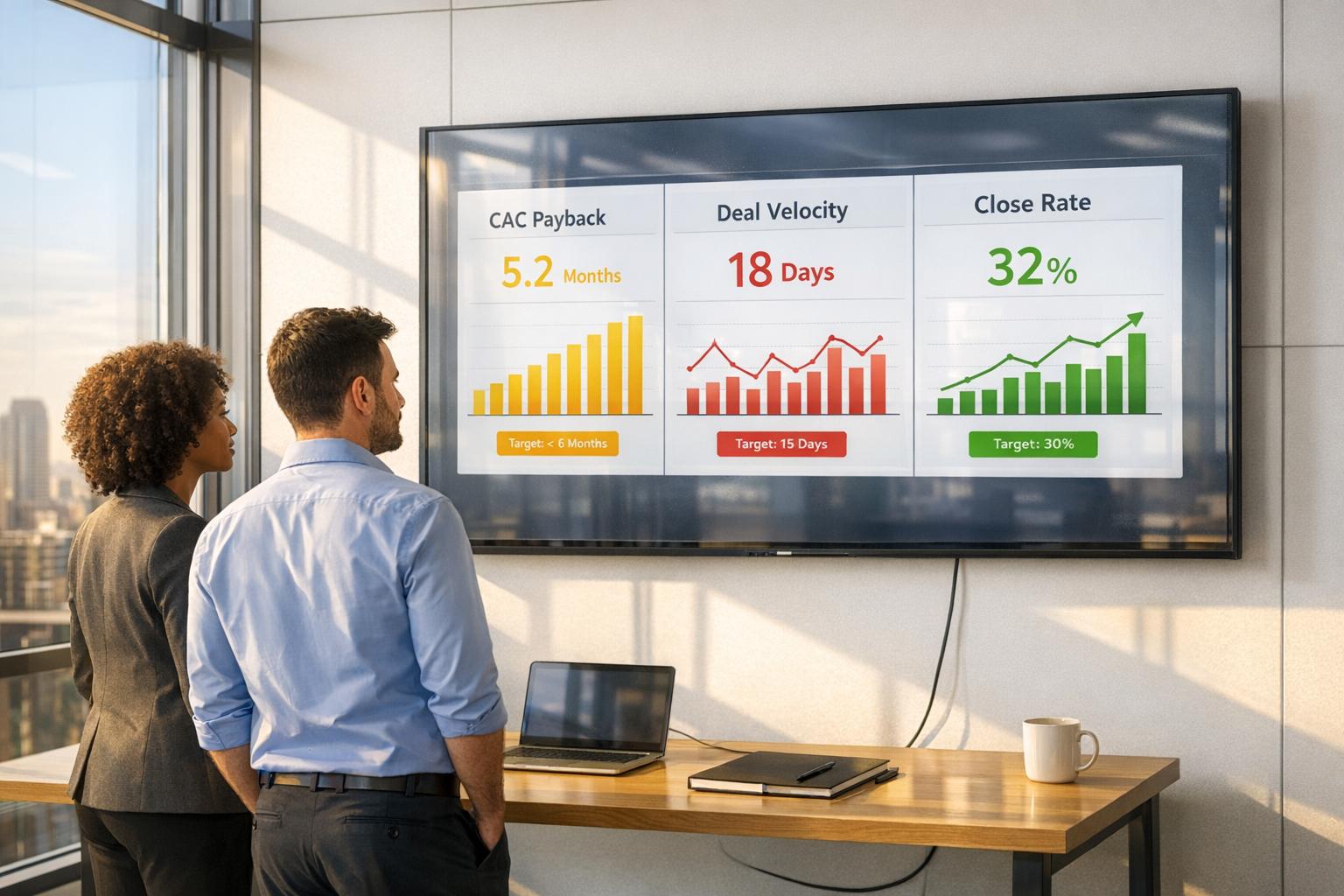
Want to grow your SaaS business? Focus on these five metrics:
- CAC Payback Period: How long it takes to recover your customer acquisition costs.
- Deal Velocity: The time from first contact to closing a deal.
- Demo-to-Close Rate: The percentage of demos that convert into paying customers.
- LTV:CAC Ratio: Lifetime value of a customer compared to their acquisition cost.
- Pipeline Coverage: The ratio of pipeline value to sales targets.
These metrics reveal the efficiency of your revenue engine, helping you identify what’s working – and what’s not. For example, if your CAC payback period exceeds 12 months or your demo-to-close rate is below 20%, you might be overspending on acquisition or targeting the wrong leads.
Key benchmarks include:
- Seed Stage: CAC payback under 12 months, 30–45 day deal velocity, and 20–30% demo-to-close rate.
- Series A: CAC payback of 9–12 months, 45–60 day deal velocity, and 30–40% demo-to-close rate.
Investors prioritize efficiency over activity metrics like demo counts or pipeline size. By tracking these benchmarks and improving weak areas, you can optimize growth and make your business more attractive to investors.
Quick tip: Start by calculating your CAC payback and demo-to-close rate. If either falls short of benchmarks, focus on improving lead quality or shortening your sales cycle. Small adjustments can lead to big improvements in efficiency and profitability.

SaaS Revenue Metrics Benchmarks by Funding Stage
The 5 Metrics Investors Actually Check
When it comes to impressing investors, demo counts won’t cut it. What they really care about is how efficiently you can turn your acquisition spending into cash flow. The five metrics below are the ones that investors scrutinize to decide whether to fund you, how to value your company, and how to gauge whether you’re running a tight ship or burning through resources recklessly.
These aren’t just surface-level numbers – they’re diagnostic tools for understanding your unit economics. Each one sheds light on critical aspects of your revenue engine: how much you’re spending to acquire customers, how fast deals close, conversion rates, and whether your long-term economics are sustainable. By tracking these metrics diligently, you’ll have the answers ready for any investor question. Let’s break them down with benchmarks and formulas.
CAC Payback Period: How Long to Recover Customer Acquisition Costs
The CAC Payback Period measures how many months it takes to earn back what you spent acquiring a customer. It’s one of the clearest indicators of your go-to-market efficiency, showing how quickly you can reinvest capital into growth.
Here’s the formula:
CAC ÷ (Monthly ARPU × Gross Margin)
Start by calculating your Customer Acquisition Cost (CAC) – divide your total sales and marketing spend by the number of new customers acquired during a specific period. Then, divide that number by your Monthly ARPU (Average Revenue Per User) multiplied by your Gross Margin. This gives you an accurate view of profitability.
For early-stage companies, the benchmarks are clear. Seed and Series A companies should aim for a payback period under 12 months. By Series B, investors expect this to stretch to 12–15 months. If it takes over 24 months to recoup your acquisition costs, it’s a red flag – your unit economics likely don’t add up. But remember, payback only works if your customers stick around long enough. For instance, if your average customer churns after 10 months but your payback period is 12 months, you’re losing money on every deal. Retention, in this case, becomes the ultimate sanity check.
| Stage | CAC Payback Benchmark | Key Characteristics |
|---|---|---|
| Seed | 6–12 months | Often relies on organic or viral growth |
| Series A | 9–12 months | Healthy SaaS economics |
| Series B | 12–15 months | Scaling with a controlled burn rate |
| Series C+ | 15–18 months | Mature growth with expansion revenue strategies |
Deal Velocity: How Quickly Deals Close
Deal Velocity tracks the time it takes from the first interaction with a prospect to closing the deal. Long sales cycles don’t just delay revenue – they can also tie up your sales team’s capacity, slowing overall growth.
At the Seed stage, aim for a sales cycle of 30–45 days. By Series A, this typically extends to 45–60 days. As you scale further, Series B deals usually close in 60–90 days, and Series C deals can take 90–120 days due to increased complexity.
Why does this matter? Sales reps can only handle so many deals at once. If each deal takes longer, they’ll close fewer deals per quarter, effectively driving up your CAC – even if your marketing budget stays the same. Keeping an eye on deal velocity by segment is also essential. For example, enterprise deals naturally take longer than SMB deals, but if your SMB cycles are stretching beyond 45 days, it could signal issues like unclear messaging or poor lead quality. Speeding up deal velocity not only boosts efficiency but also improves your CAC payback.
Demo-to-Close Rate: How Many Demos Turn Into Customers
The Demo-to-Close Rate measures the percentage of product demos that convert into paying customers. This metric is a direct reflection of your lead quality and sales effectiveness. A low conversion rate suggests you might be targeting the wrong prospects – or failing to close the right ones.
For Seed-stage companies, a healthy conversion rate is 20–30%. By Series A, aim for 30–40%. For example, if you run 100 demos a month but only convert 12%, that means 88% of your efforts are yielding no revenue. Improving your close rate to 25% could nearly double your results without increasing spending, effectively lowering your CAC.
It’s worth noting that inbound demos – leads who come to you – typically convert at two to three times the rate of outbound cold outreach. If your outbound close rate is below 10%, it might be time to refine your targeting or focus more on higher-converting channels.
LTV:CAC Ratio and Pipeline Coverage: The Long-Term View
Long-term profitability hinges on how well your customer value compares to your acquisition costs. Two key metrics, the LTV:CAC Ratio and Pipeline Coverage, provide a snapshot of your financial health and growth potential.
LTV:CAC Ratio
This ratio measures the return on investment from acquiring customers. The goal is a ratio of 3:1, meaning every dollar spent on acquisition should generate at least three dollars in profit over the customer’s lifetime. Seed-stage companies aim for this 3:1 benchmark, but Series A and beyond should target 4:1 or higher. Calculate LTV using this formula:
(Monthly ARPU × Gross Margin) ÷ Monthly Churn Rate
If your ratio is under 3:1, you’re likely overspending on acquisition or undercharging customers. On the flip side, a ratio above 5:1 might indicate you’re not investing enough in growth.
Pipeline Coverage
This metric ensures you have enough deals in progress to hit your revenue targets. It’s calculated as the ratio of your total pipeline value to your sales quota. A benchmark of 3–4× is typical. For instance, if your team’s quarterly quota is $1M, you should aim for a pipeline worth $3–4M. Too low, and you risk missing targets. Too high, and it might mean your pipeline is full of unqualified leads or that your close rates need improvement.
| Metric | Seed Benchmark | Series A Benchmark | What It Tells You |
|---|---|---|---|
| CAC Payback | 6–12 months | 9–12 months | How quickly cash is recycled |
| Deal Velocity | 30–45 days | 45–60 days | Sales team productivity |
| Demo-to-Close | 20–30% | 30–40% | Lead quality and sales success |
| LTV:CAC Ratio | 3:1 | 4:1 | Long-term profitability |
| Pipeline Coverage | 3–4× | 3–4× | Revenue predictability |
How to Calculate Each Metric: Formulas and Spreadsheet Logic
Now that we’ve gone over the key revenue metrics, let’s dive into the exact formulas and practical spreadsheet setups you can use to monitor your progress effectively.
Formulas for CAC, Payback, Velocity, Close Rate, and LTV:CAC
Customer Acquisition Cost (CAC) is the cornerstone of your metrics. Calculating it is straightforward: divide your total Sales & Marketing expenses by the number of new customers acquired during the same period. Be thorough – include all related costs like salaries, commissions, advertising, CRM tools, and even office rent allocated to these teams. For example, if you spent $50,000 on S&M and brought in 25 new customers, your CAC is $2,000.
CAC Payback Period requires precision. The formula is:
Sales & Marketing Expenses for the Period ÷ (Net New MRR × Gross Margin).
Net New MRR factors in revenue from new customers, expansion revenue, and subtracts churned MRR. Gross Margin (usually 75–90% for SaaS) accounts for the cost of servicing customers, ensuring you’re measuring profit recovery, not just revenue. For instance, if your CAC is $2,000, ARPU is $250, and Gross Margin is 80%, the payback period is:
$2,000 ÷ ($250 × 0.80) = 10 months.
Deal Velocity measures how quickly deals close. For each customer, subtract the first contact date from the close date, then average these durations. In your spreadsheet, use columns for "First Contact Date" (e.g., A2) and "Close Date" (e.g., B2), and calculate "Days to Close" in column C with the formula:
=B2-A2.
Average the values in column C to determine your overall deal velocity.
Demo-to-Close Rate shows how efficiently demos convert into deals. Divide the number of closed deals by the number of demos conducted, then multiply by 100 to get a percentage. For instance, if you ran 80 demos in February and closed 20 deals, your demo-to-close rate is:
(20 ÷ 80) × 100 = 25%.
Tracking this weekly can help flag conversion issues early.
LTV:CAC Ratio evaluates long-term profitability. The formula is:
[(ARPU × Gross Margin) ÷ Churn Rate] ÷ CAC.
For example, if ARPU is $250, Gross Margin is 80%, monthly churn is 3%, and CAC is $2,000, the ratio is about 3.3:1. Be cautious with this metric in early stages, as churn rates and pricing can be unstable. Jay Po, Co-founder of Stage 2 Capital, emphasizes this point:
"At the early-stage, almost nothing is fixed… the notion of quantifying ‘lifetime value of a customer’ at a single point in time just doesn’t make sense."
For early-stage companies, Cumulative Cohort Revenue (CCR) – revenue generated by a cohort over 12 or 24 months divided by its CAC – offers a more grounded perspective.
Building Your Metrics Dashboard
Once you have the formulas, organize them into a structured dashboard with three tabs: Data Entry, Cohort Analysis, and Executive Summary.
- Data Entry: Include columns for Month, S&M Spend, New Customers, New MRR, Expansion MRR, Churned MRR, Gross Margin %, First Contact Date, Close Date, and Demos Conducted. Each row should represent one month of data.
- Cohort Analysis: List monthly cohorts (e.g., January 2026, February 2026) with columns for "Month 0" through "Month 24." Populate each cell with cumulative gross profit for that cohort at each point in time. For example, if a January 2026 cohort had a CAC of $2,000 per customer and generated $1,800 in cumulative gross profit by Month 9 and $2,100 by Month 10, payback occurred in Month 10.
- Sales Cycle Adjustment: For longer sales cycles, align S&M expenses with the cohort they produced. For example, with a 60-day sales cycle, compare Q1 S&M spend to Q2 new customers.
- Segmentation: Break down data by customer type (e.g., SMB, Mid-Market, Enterprise). Blended averages can mask insights – your SMB segment might have an 8-month payback, while Enterprise could take 20 months.
- Executive Summary: Summarize key metrics (CAC, Payback Period, Deal Velocity, Demo-to-Close Rate, and LTV:CAC Ratio) for each segment. Use conditional formatting (green for good, yellow for caution, red for critical) and update weekly to spot trends quickly.
Finally, always validate your CAC Payback against actual retention. As Sean Fanning, Vice President at OpenView, puts it:
"Retention is the best and only check on whether your implied CAC payback will ever be realized CAC payback."
If your payback period is 12 months but customers churn after 10 months, you’re losing money on every deal – no matter what your spreadsheet says.
Case Study: From 100 Demos Per Month to 25% Close Rate
In March 2025, the founder of a 19-person MarTech SaaS company approached M Studio with what seemed like promising activity metrics: 100 demos per month. But when we dug deeper into the numbers, a different story emerged. The demo-to-close rate was just 12%, the deal velocity stretched to 90 days, and the CAC (Customer Acquisition Cost) payback period was 18 months. Each customer acquisition cost the founder $4,200, and it was taking a year and a half to recover that investment. This highlighted a critical issue: activity metrics alone don’t tell the full story. Metrics like close rate and CAC payback are essential for understanding whether revenue is truly efficient.
While the demo volume was high, poor conversion rates revealed inefficiencies that were dragging down the business. The math was clear: if the close rate could be improved to 25%, the same 100 demos would result in 25 deals – more than doubling revenue without increasing sales or marketing expenses. This was a smarter and faster solution than trying to cut CAC, which often involves reducing spend on effective channels and risking pipeline constriction.
To address these challenges, we implemented three focused process changes in just 60 days. These changes were designed to improve the demo-to-close rate, which directly impacts CAC payback and revenue growth:
- Faster Lead Qualification: Using intent signals, we prioritized high-interest prospects. For example, leads who visited the pricing page twice within 24 hours were contacted immediately, while less-engaged leads were placed into automated nurture sequences.
- Tailored Sales Playbooks: We revamped the sales process with vertical-specific demos, customizing presentations for each prospect’s industry. This eliminated generic pitches that failed to connect with potential customers.
- Quick Response Times: A 15-minute response SLA (Service Level Agreement) was introduced for high-intent leads. Automated Slack notifications alerted reps the moment a prospect took a key action, ensuring timely follow-ups.
By May 2025, the results were clear. The demo-to-close rate jumped to 25%, deal velocity improved to 67 days, and the CAC payback period dropped to 10 months. With a CAC of $4,200 generating $420 in monthly recurring revenue at an 80% margin, the payback period was reduced significantly – from 18 months to just 10 months. All of this was achieved without increasing headcount or advertising spend.
"Retention is the best and only check on whether your implied CAC payback will ever be realized CAC payback."
- Sean Fanning, Vice President at OpenView
This case drives home an important lesson: focusing on activity metrics like demo volume can be misleading. While 100 demos per month might seem like a win, a 12% close rate translates to 88 wasted sales conversations every month. By shifting the focus to conversion efficiency instead of simply chasing more meetings, the same pipeline was transformed into a powerful revenue engine.
sbb-itb-32a2de3
3 Mistakes That Hide Revenue Problems
Founders often get caught up in metrics that look impressive at first glance but fail to reveal underlying revenue inefficiencies. These three common mistakes can create blind spots, making it harder to identify problems until they’ve already affected cash flow and growth.
Tracking Activity Instead of Outcomes
Metrics like demos booked, calls made, or website traffic reflect effort – not profitability. While it’s tempting to celebrate activity, it only matters if it leads to actual customer acquisition. Overemphasizing activity metrics can give a false sense of progress, focusing on quantity over quality. Instead, prioritize outcome-based measures like CAC Payback, which encourage your team to focus on acquiring customers who genuinely recover their acquisition costs.
Another pitfall is relying too heavily on Lifetime Value (LTV) as a key metric. LTV is a projection – it assumes future revenue based on churn and expansion rates – but it can obscure immediate inefficiencies. To ensure sustainable growth, pay closer attention to input metrics like CAC (Customer Acquisition Cost) and retention. After all, if customers churn before you recoup their acquisition costs, your business never truly breaks even.
Not Segmenting by Cohort
Looking beyond overall outcomes, segmenting your data can uncover inefficiencies that blended metrics often hide. Averages combine good and bad performance, masking the true picture of your revenue engine. For example, while a company might report an average CAC payback of 10 months, a closer look at individual cohorts might reveal significant differences between customer segments. Without this granular view, you risk missing key trends.
"Cohort-based analysis wins every time. There are too many things that can get skewed when you analyze things using aggregates or averages."
- Blake Bartlett, Partner, OpenView
Here’s an example: The median SaaS CAC payback is 6.8 months, but this number only becomes meaningful when broken down by customer type, acquisition channel, or time period. As companies scale, payback periods often lengthen. Early-stage companies ($1,000–$10,000 MRR) typically see payback in about 4.8 months, while growth-stage companies ($200,000+ MRR) might stretch to 8.8 months as they move beyond early adopters. Cohort analysis helps pinpoint these variations, giving you a clearer picture of where to focus.
Ignoring Deal Velocity
Even with decent close rates, long sales cycles can drain cash flow and slow growth. When deals take longer to close, revenue recognition is delayed, putting pressure on cash flow. A faster, more efficient sales cycle improves both CAC payback and overall revenue performance. While revenue itself is a lagging indicator, revenue velocity offers a forward-looking view of your cash position.
Data shows that companies tracking revenue velocity weekly grow 34% annually, compared to just 11% with sporadic tracking. The median B2B SaaS sales cycle is 67 days, but between 2022 and 2024, average cycle lengths increased by 24% (from 65 to 75 days) due to tighter budgets. Since sales cycle length is a key factor in the revenue velocity formula, even small improvements can make a big difference. For instance, a 10% improvement in all four velocity elements – opportunities, win rate, average contract value, and sales cycle – can lead to a 49% boost in overall velocity.
Take this example: Between January and September 2024, a 23-person MarTech SaaS company shortened its sales cycle from 97 days to 79 days while also improving win rates and average contract value. By addressing all four velocity elements, the company increased its daily revenue from $1,240 to $3,553 – a 186% jump in quarterly revenue – without adding more staff. Recognizing and addressing these mistakes can help you refine your dashboard and drive meaningful improvements.
Implementation: 3 Steps to Start Tracking Today
To build a system that tracks what really matters, focus on creating a baseline and improving one metric at a time. Forget perfection – this is about progress. If you’re interested in simplifying your revenue tracking with AI-driven tools, check out our AI Acceleration Newsletter for weekly insights and actionable strategies.
Start by examining your recent closed deals to establish a clear baseline.
Step 1: Measure Your Current Baseline
Pull data from the last 90 days of closed deals in your CRM. Use these formulas to calculate your current performance across five key metrics:
CAC Payback Period:
The formula is: (Sales & Marketing Expenses) / (Net New MRR × Gross Margin). Adjust your sales and marketing (S&M) expenses based on your average sales cycle. For example, if you spent $50,000 on S&M, added $10,000 in MRR, and have an 80% gross margin, your payback period comes out to 6.25 months.
Revenue Velocity:
This is calculated as (Opportunities × Win Rate × ACV) / Sales Cycle Length. It tells you how much revenue you’re generating daily. For instance, with 40 opportunities, a 20% win rate, an ACV of $15,000, and a 75-day sales cycle, your revenue velocity is $1,600 per day.
Demo-to-Close Rate:
Use this formula: (Closed Won Deals / Total Demos) × 100. For example, if 100 demos resulted in 18 closed deals, your close rate is 18%.
Compare your numbers to industry benchmarks. For many B2B SaaS companies, typical benchmarks include a median CAC payback of 8.6 months, a 67-day sales cycle, and a 22% win rate. Identify the metric where you’re furthest behind – this is your biggest opportunity for improvement.
Once you’ve established your baseline, pick the metric that deviates most from these benchmarks.
Step 2: Pick One Metric to Improve
Focus on the metric with the largest gap between your performance and the benchmark. Often, improving your close rate or shortening the sales cycle delivers faster results than trying to reduce CAC, which can require more extensive marketing adjustments.
For instance, a 23-person MarTech SaaS company in 2024 revamped its revenue process over nine months. From January to September, they achieved a 45% increase in opportunities, raised their win rate from 14% to 21%, grew ACV by 19%, and shortened their sales cycle from 97 to 79 days. This effort boosted their daily revenue velocity from $1,240 to $3,553 – all without adding new staff.
When prioritizing, consider both the impact and how quickly you can implement changes. Small adjustments can make a big difference. For example, improving your win rate from 20% to 21% could increase overall revenue velocity by about 5%. Similarly, running processes like legal reviews or proofs of concept in parallel can cut sales cycle times by over 50%. Choose the metric where you can achieve the fastest, most measurable gains in the next 90 days.
Once you’ve chosen your focus, track your progress consistently.
Step 3: Track Weekly and Iterate
Set up a dashboard with these four key components:
- A trend chart showing Opportunities, Win Rate, ACV, and Sales Cycle Length.
- A daily revenue velocity line chart.
- A bottleneck alert list for deals stalled longer than 14 days.
- A forecast-versus-actual comparison.
Weekly tracking is crucial. Companies that monitor revenue velocity weekly tend to grow about 34% annually, compared to just 11% for those using ad-hoc tracking. Take this example: In Q2 2024, a 67-person Enterprise Security SaaS company began tracking revenue velocity weekly. Within six months, their forecast accuracy improved from 48% to 87%, deal slippage dropped from 38% to 12%, and annual revenue growth jumped from 16% to 34%.
Quarterly tracking leaves you 12 weeks behind on spotting issues, but weekly tracking catches bottlenecks by Week 2. Schedule a recurring Monday morning meeting to review your dashboard, flag stalled deals, and adjust your approach.
Conclusion: Build Your Metrics Dashboard This Week
When it comes to impressing investors, five metrics stand out: CAC Payback, Deal Velocity, Demo-to-Close Rate, LTV:CAC Ratio, and Pipeline Coverage. These numbers separate companies that can effectively manage their unit economics from those that can’t. For Seed stage businesses with $100,000–$500,000 in ARR, the benchmarks include a 12-month payback period, 45–60 day deal velocity, and a 20–30% close rate. Meanwhile, Series A companies ($500,000–$3,000,000 ARR) should aim for a 6–12 month payback, 30–45 day velocity, and a 30–40% close rate.
Focusing on raw activity without considering outcomes can lead to funding challenges. For example, booking 100 demos in a month might sound impressive, but investors prioritize efficiency over volume. Want more tips on turning these metrics into a strong revenue engine? Subscribe to our AI Acceleration Newsletter for actionable insights.
FAQs
What can I do to improve my CAC payback period if it’s longer than 12 months?
To bring your CAC payback period under control, especially if it’s stretching beyond 12 months, focus on these three areas:
- Speed up deal velocity: Simplify and refine your sales process to close deals faster. The quicker you close, the sooner you start recovering your costs.
- Improve conversion rates: Work on moving prospects from demo to deal more effectively. This could mean sharpening your sales pitch, targeting better leads, or addressing common objections head-on.
- Lower acquisition costs: Take a closer look at your marketing and sales spend. Invest in channels that deliver the best ROI and cut back on efforts that aren’t pulling their weight.
Tackling these areas can help you recover revenue faster and bring your CAC payback period closer to industry benchmarks for your growth stage.
How can I improve my demo-to-close rate?
To improve your demo-to-close rate, focus on creating demos that resonate with your prospects and refining your overall sales approach. Start by tailoring each demo to tackle the specific challenges and priorities of your audience. This personalized approach not only makes the presentation more engaging but also highlights how your product or service can directly meet their needs.
Equip your sales team with the tools they need to succeed – clear messaging, strong objection-handling techniques, and thorough product knowledge. These elements help them navigate conversations confidently and build trust with prospects.
Dive into your data to pinpoint which customer segments are most likely to convert. Once identified, fine-tune your strategy to cater to those groups. Consistent and timely follow-ups after demos are also key – they reinforce the value of your solution, address any remaining questions, and nudge prospects toward making a decision.
By focusing on delivering high-quality demos and refining your sales process, you can boost conversions without relying on cutting costs or simply increasing sales activity.
Why does deal velocity matter for SaaS companies, and how can it be improved?
Deal velocity plays a critical role for SaaS companies because it directly impacts cash flow, revenue growth, and sales team efficiency. When deals close faster, leads turn into paying customers more quickly, allowing the business to generate recurring revenue sooner. This not only boosts cash flow but also minimizes the chances of deals stalling or falling apart, saving valuable time and resources. Plus, faster deal velocity improves forecasting accuracy by providing clearer insights into the sales pipeline.
To speed up deal velocity, start by simplifying the sales process. Eliminate unnecessary steps, refine how leads are qualified, and leverage automation tools to streamline workflows. Equipping sales teams with the skills to handle objections effectively and personalize their messaging to match customer needs can also make a big difference. Another useful approach is segmenting prospects into groups to pinpoint specific bottlenecks within each segment. This targeted focus allows for tailored adjustments that help shorten deal timelines. By improving deal velocity, SaaS companies can recognize revenue faster and optimize their overall sales operations.