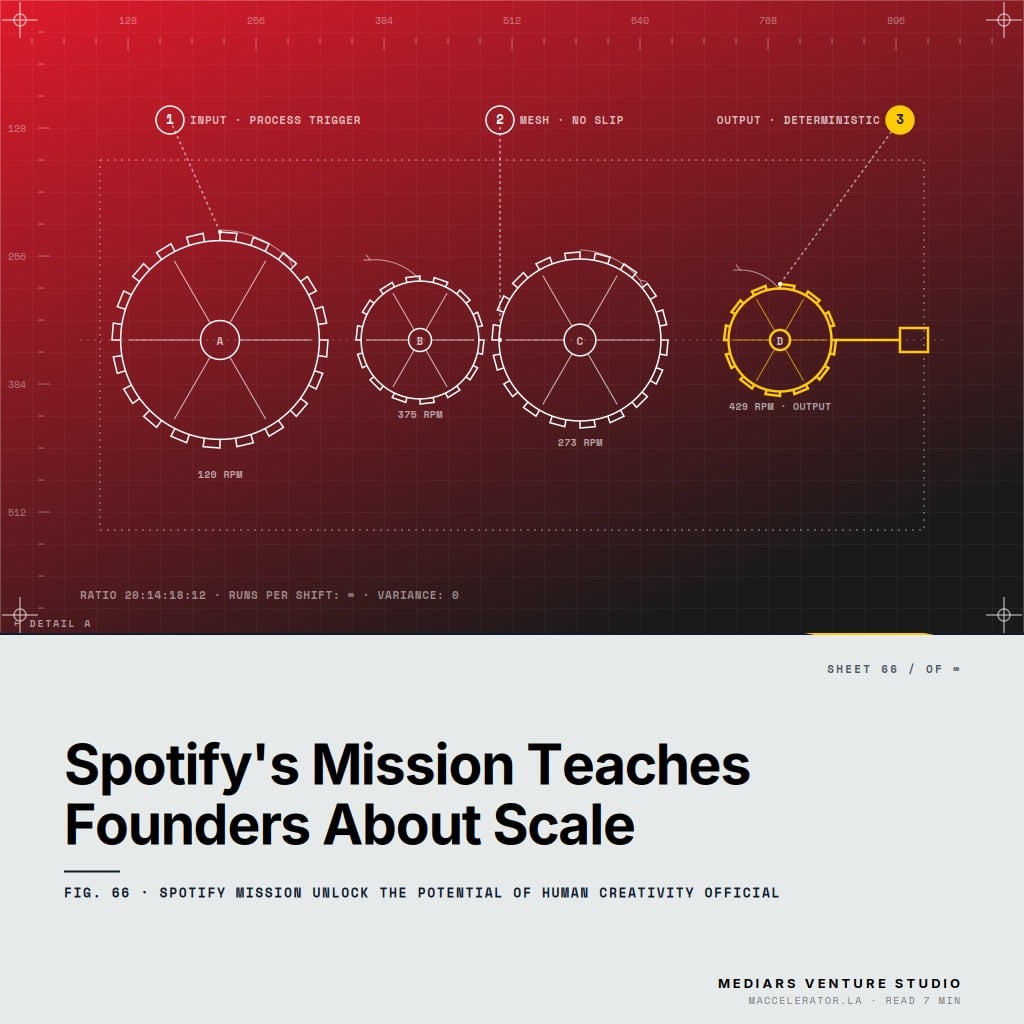
Spotify’s official mission is “to unlock the potential of human creativity — by giving a million creative artists the opportunity to live off their art and billions of fans the opportunity to enjoy and be inspired by it.” That’s the spotify mission unlock the potential of human creativity official statement, and it does something most mission statements never do: it names who it serves, what it gives them, and how you’d know it worked.
This isn’t a piece about admiring Spotify. It’s about a question every founder hits somewhere between $50K and $3M ARR.
Does your mission do any work? Or is it a poster on the wall?
You probably wrote yours in a hurry. Nobody on the team can recite it. It has zero influence on how decisions actually get made. Meanwhile most founders default to something like “we help businesses grow” — no who, no outcome, no trade-off forced. Spotify gave us a clear who, what, and why. You gave yourself a tagline.
Why Your Mission Becomes a Bottleneck the Moment You Scale
Before product-market fit, you make every decision. The mission lives in your head. It’s implicit, and that’s fine — you’re the filter.
After PMF, everything changes. You’re hiring people. You’re delegating roadmap calls. You’re saying no to opportunities you don’t have time to evaluate yourself.
Without a sharp mission, every one of those decisions routes back to you. The bottleneck isn’t strategy. It’s the absence of a shared decision filter.
“The founders who stall between $1M and $3M almost always have a mission that can’t be used to make a single decision. That’s not a branding problem. That’s an operating problem.”
Watch how Spotify’s mission works as a filter. Every feature, every artist tool, every content bet maps back to one test: does this help unlock creativity and help artists live off their art? If it doesn’t, it’s easier to kill.
We worked with a consumer subscription founder at $1.2M ARR who couldn’t get her team to prioritize anything. Her mission was “improve people’s lives.” The problem? That applied to literally every feature request in the backlog. Everything qualified, so nothing was ranked.
Founders confuse a marketing tagline with an operating mission. They are not the same tool.
Key Takeaways
- A working mission has three parts: a direction (the verb), a defined who, and a falsifiable outcome.
- Post-PMF, mission ambiguity becomes an operational tax — every decision routes back to the founder.
- Spotify’s mission works because it forces trade-offs: artists and fans, not “everyone.”
- If your team can’t use the mission to prioritize their own backlog, it isn’t load-bearing.
- Clarity is cheaper to install at 5 hires than to retrofit at 20.
The Anatomy of a Mission That Does Work: Lessons From Spotify
Strip the brand away and look at the structure. Spotify’s mission breaks into three functional parts.
- The core promise: “unlock the potential of human creativity.” This is the verb. It gives direction.
- The named beneficiaries with quantified ambition: “a million creative artists… billions of fans.” This forces trade-off clarity. You can’t serve everyone, so you name who.
- The concrete outcome: “live off their art.” This is measurable. You can ask whether it’s happening.
Each part carries weight. The verb points the team. The named who lets you say no. The outcome makes the mission falsifiable — you can be wrong about whether you’re achieving it.
Now compare the empty version most founders write: “empower creators everywhere.” No who. No outcome. No trade-off forced. “Everywhere” is the tell — it serves no one because it serves everyone.
“A mission you can’t fail at isn’t a mission. It’s a feeling. Spotify’s version can be measured against reality. ‘Empower creators everywhere’ can’t.”
Here’s the nuance. Even Spotify’s execution has been messy — designers have publicly critiqued the inconsistency in its brand expression over the years. That proves something important. Clarity of mission and consistency of execution are two different muscles. A sharp mission doesn’t guarantee clean execution. But a vague one guarantees the opposite.
We unpack patterns like this every week for operators. The AI Acceleration newsletter is where we share the frameworks we see working across hundreds of founders.
What a High-Functioning Mission Actually Looks Like in Practice
Forget the wording for a second. Look at behavior.
A working mission lets a new hire prioritize their own backlog in week one. It lets you turn down a profitable-but-off-mission deal without an hour-long debate. It shows up in how you talk to customers — not just on the careers page.
Now the common reality. The mission never comes up in a planning meeting. Ask the cofounders to write it down separately, and you’d get two different statements. That gap is the problem.
Run your own diagnostic. Be honest with each answer.
- Can your team recite the gist without looking it up?
- Has the mission ever caused you to turn something down?
- Would both cofounders phrase it the same way independently?
- Does a new hire use it to make a real call in their first month?
- Does it name who you serve — and, by omission, who you don’t?
We’ve seen across 500+ founders that the ones with a usable mission delegate faster and burn far less time in alignment meetings.
One services founder at $700K ARR kept saying yes to misaligned clients. Every new deal sparked a debate. The root cause wasn’t sales discipline — there was no shared “what we’re here to do.” Once that existed, the no’s got fast.
Why This Matters More in 2024-2025 Than It Did Five Years Ago
Three trends make mission clarity urgent right now.
First, AI is collapsing the cost of building product. When anyone can ship features fast, differentiation shifts from “what you build” to “why and for whom.” Mission becomes a moat that code can’t copy.
Second, distributed teams kill osmosis. You can’t rely on hallway absorption when your team is in six time zones. The mission has to be explicit and load-bearing, or alignment simply doesn’t happen.
Third, senior talent screens by clarity of purpose. At the early stage, your comp can’t beat big tech. Operators increasingly choose where to work based on whether the mission is real. A fuzzy one costs you the hires you most need.
Spotify’s framing of “human creativity” reads as a deliberate bet in an AI-saturated world. The company itself is navigating the tension between human artistry and AI-generated content in its own catalog — a live example of a mission being tested in real time.
This is exactly the clarity work we dig into with operators in Elite Founders — founders past PMF who are scaling without losing the thread.
“We Can Sort This Out Internally” — and Why Most Teams Don’t
You can do this internally. Many founders intend to. That’s exactly the trap.
Mission clarity is urgent-but-not-on-fire. It gets deferred until a bad hire, a stalled raise, or a team conflict forces the issue. By then it’s expensive.
“Too early”? Spotify’s mission predates most of its scale. Clarity is cheaper to install early than to retrofit after you’ve hired 20 people who each interpreted the vague version differently.
“No budget”? This is a thinking problem, not a spending problem. The cost is attention, not dollars.
“The cost of retrofitting a mission after 20 hires is far higher than getting it right at 5. You’re not writing a sentence. You’re aligning a system.”
We worked with a DTC founder who kept deferring this. The real problem surfaced as a cofounder dispute over which market to serve. They’d never actually agreed on who they were building for. The mission wasn’t a writing exercise — it was the unspoken disagreement they’d been avoiding.
Drawing on 25+ years across enterprise environments and 500+ founders, the pattern is consistent: the thinking that feels optional today becomes the constraint tomorrow.
FAQ
What is Spotify’s official mission statement?
Spotify’s official mission is “to unlock the potential of human creativity — by giving a million creative artists the opportunity to live off their art and billions of fans the opportunity to enjoy and be inspired by it.” It names two beneficiaries: artists and fans.
Why does a mission statement matter for a small or early-stage company?
It functions as a decision filter and alignment tool the moment you start delegating. The absence costs you in slow decisions and misaligned hires — not just branding. A sharp mission lets a new hire prioritize without asking you.
How is a mission different from a vision or a tagline?
The mission is the work you do and for whom — an operating tool. The vision is the future you’re betting on. The tagline is your market-facing message. Spotify’s mission (“unlock human creativity, help artists live off their art”) is operational; a tagline would be the line in the ad.
Why is Spotify verifying human artists?
It maps directly back to the mission. If the goal is helping human artists live off their art, distinguishing them from AI-generated content protects the outcome the mission is built to deliver.
If your mission can’t make a decision yet, the fix starts with thinking it through alongside people facing the same problem. Come explore it with peers at one of our Founders Meetings — where post-PMF operators pressure-test the thinking that actually scales.