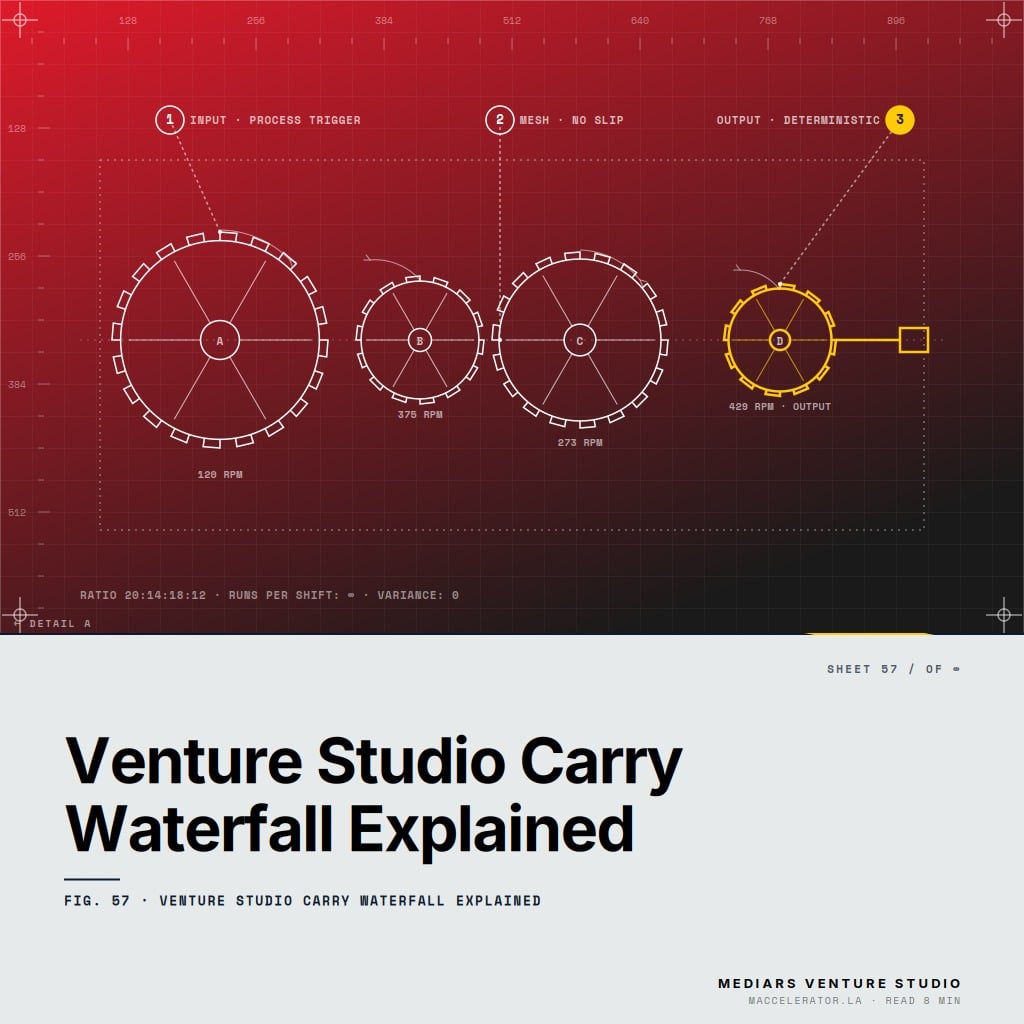
A venture studio carry waterfall, explained in one line, is the ordered set of rules that decides how exit proceeds get split between the studio, its investors, and you — the founding team — typically returning invested capital first, paying a preferred return, then dividing the profits known as “carry.” It refers to the sequence money flows through before anyone sees a personal payout, and that sequence — not your headline equity percentage — determines what you actually walk away with.
Here is the moment this matters. You’ve been offered equity or a co-build deal with a venture studio. The term sheet says “waterfall” and “carry.” You’re nodding along in the meeting, quietly unsure how much you take home at exit.
That gap is the most expensive thing in the room.
Across the 500+ founders we’ve worked with in 30 countries, the people most blindsided at exit were not the ones who picked the wrong market. They were the ones who never modeled the distribution order. They knew their equity number. They had no idea where it sat in the line.
Why Venture Studios Changed the Equity Math
The venture studio model has moved from niche to mainstream. A studio supplies capital, operators, and shared infrastructure in exchange for outsized early equity — often 30-50% of the company, not the smaller check a traditional VC writes.
That single fact rewires the math you’ve been trained on.
Most founders study dilution. How much do I give up across rounds? That instinct is correct but incomplete. The studio deal forces a second question almost nobody rehearses: distribution math — who gets paid, in what order, when the company exits.
Two deals can carry identical headline equity and produce wildly different founder payouts. The difference lives entirely in the waterfall.
The model is growing fast. Industry reporting from the Global Startup Studio Network and related sources shows studios expanding from roughly 200 in 2017 to 700+ today. Studio-founded companies show higher early survival rates than the broader startup average — but they carry distinctly different cap-table dynamics underneath that survival.
“Founders walk in fluent in dilution and illiterate in distribution. The studio is fluent in both. That asymmetry is the whole game.” — Alessandro Marianantoni, M Studio
This is why the question is urgent now in a way it wasn’t five years ago. More founders are signing studio deals. Most are signing them with a mental model built for VC term sheets. The structures don’t match.
Key Takeaways
- A carry waterfall is the order proceeds flow at exit — order, not equity percentage, decides your payout.
- Studios take larger early equity (often 30-50%) and layer carry on top, compounding the complexity versus a standard VC deal.
- The four standard tiers: return of capital, preferred return/hurdle, catch-up, then carry split.
- American (deal-by-deal) versus European (whole-fund) waterfalls decide when — and whether — your specific win pays you.
- The cheapest moment to understand the waterfall is before you sign. By exit, the terms are locked.
The Four Layers Every Carry Waterfall Moves Through
Think of the waterfall as four tiers. Money fills the top tier completely before a dollar spills to the next. The order is the entire point.
1. Return of Capital
Invested capital comes back first. Before anyone earns a profit, the dollars that went in come out. In a studio deal, this includes the capital the studio and its investors deployed to build the company.
2. Preferred Return (The Hurdle)
Next, investors earn a minimum return — often 6-8% — before profit-sharing begins. This is the hurdle. It’s a floor the deal must clear before carry holders participate in the upside.
3. Catch-Up
Once the hurdle is cleared, the carry holder “catches up” to their agreed share of profits. This tier exists so the carry holder isn’t penalized for the hurdle existing. It can move a large slice of early profit toward the studio quickly.
4. Carry Split
Remaining profits divide per the carry percentage — frequently 20%, though studios vary widely. This is where the studio earns its share of the value it helped create.
This four-tier structure mirrors private equity and VC fund waterfalls. It is industry-standard, not exotic. The complication in studios is that this fund-style waterfall sits on top of operating equity the studio already holds — so you’re stacked twice.
We break down one of these dynamics each week for operators in the AI Acceleration newsletter. It’s the kind of mechanic worth understanding slowly, before it’s binding.
American vs. European Waterfalls: Why Your Payout Timing Differs
This is the single most consequential structural choice in any waterfall. It also gets the least founder attention.
An American waterfall pays carry deal-by-deal. As each company exits, the carry on that deal gets distributed. Winners pay out as they win.
A European waterfall pays carry only after the whole portfolio is made whole. Investors recover their capital plus the hurdle across every bet the studio made — and only then does carry flow.
Translate that into your situation. In a studio context, the model decides whether your specific company’s success pays out on its own, or gets pooled against the studio’s other companies.
Picture building the breakout winner in a portfolio of ten. Under an American structure, your exit stands alone. Under a European structure, your win can be absorbed covering losses elsewhere before any carry math reaches you.
This is the most contested term in fund formation. The mechanics get covered everywhere. The founder-side implication almost never does.
“In our sessions, the question that changes the room is simple: which model governs my upside? Most founders have never asked it. The studio always knows the answer.” — M Studio operator note
Ask which model governs your deal before you sign. The answer reshapes your entire timing and risk picture.
What a Founder-Fair Waterfall Actually Looks Like
You can benchmark a deal without knowing the negotiation playbook. Here is what “good” looks like.
A healthy structure has four traits:
- Transparency on the order of distributions — you can see every tier and where your equity sits in the line.
- A hurdle that aligns rather than penalizes — the preferred return motivates shared upside, not a structure that quietly buries the founder.
- Carry that vests with continued contribution — value accrues to people still building, not to a name on an early document.
- Clarity on what happens to your equity if the studio’s involvement ends — no ambiguity about your stake when the relationship changes.
Here is the feel test. In a good deal, you can model your take-home across three exit scenarios — modest, strong, breakout — on a single page. If you can’t, the structure is hiding something.
This article shows you what good looks like. It is not the negotiation playbook to get there.
A consumer-product founder at $1.2M ARR we worked with had signed a co-build deal on headline equity alone. Only after modeling did the picture sharpen. An 8% hurdle plus a catch-up tier left them with far less than the equity percentage implied. They renegotiated — but they caught it only because they finally ran the distribution math.
That is the pattern. The equity number looked generous. The waterfall told a different story.
Founders working through deals like this often want peers who’ve sat on the other side of the table. That’s the kind of room Elite Founders is built for — operators comparing real structures, not theory.
“We’re Too Early / We Can Figure This Out Ourselves”
Three objections come up every time. Each one is a reason to understand the waterfall sooner, not later.
“We don’t have budget for this.” Understanding a waterfall costs nothing but attention. The expensive mistake is signing blind. The line of money is already written down — you just have to read it before it’s binding.
“We can figure this out ourselves.” You can. But the asymmetry is real. The studio has structured dozens of these deals. You’re doing your first. They know exactly which tier moves the most value and where founders stop reading. That experience gap is the whole negotiation.
“We’re too early-stage for this to matter.” The waterfall is decided at the deal — which is early. By the time it matters at exit, the terms are locked and unchangeable. Early is precisely when it’s live.
Across 500+ founders, the regret clusters at exit, never at signing. By then nothing can move.
The cheapest moment to understand this is before your signature is on the page.
How Studio Carry Structures Are Evolving
The economics are shifting, and the direction favors informed founders.
Competition for builder-founders is intensifying. Studios that want the strongest operators are moving toward more founder-aligned carry — better hurdles, cleaner vesting, clearer terms when involvement ends.
Hybrid models are rising. Studios increasingly blend operating equity with smaller, fund-style carry rather than stacking maximum claims on both. The result is structures that read more like partnerships than capture.
Standardization is following founder awareness. As more founders ask the right questions, terms converge toward legibility. The studios that resist transparency lose the deals.
And the model is broadening beyond software. Studios now build in commerce, marketplaces, and hardware — sectors where capital intensity changes the return-of-capital tier dramatically. The waterfall question grows more important, not less, as studios diversify.
You’re entering this moment with leverage available to you. Understanding the structure is what converts a take-it-or-leave-it term sheet into a real conversation.
FAQ
How does a carried interest waterfall work?
A carried interest waterfall distributes exit proceeds in a fixed order: invested capital returns first, then a preferred return clears the hurdle, then a catch-up tier brings the carry holder to their agreed share, and finally remaining profits split per the carry percentage. The order is what governs every payout — money fills each tier before spilling to the next.
What is a waterfall in venture capital?
In venture capital, a waterfall is the rulebook for how returns flow back to investors and stakeholders when a company or fund exits. It defines who gets paid, how much, and in what sequence — separating return of capital from preferred returns from profit-sharing carry.
What is carry in a venture studio deal?
Carry is the share of profits the studio and its investors earn after invested capital and the preferred return are paid. It’s commonly around 20%, but studio terms vary widely — and critically, it sits on top of the operating equity the studio already holds in your company.
Does the waterfall affect founders or only investors?
Both. In a studio model the founder’s payout is downstream of the distribution order, so the waterfall directly determines your take-home at exit. Your equity percentage is only meaningful once you know where it sits in the line.
The waterfall is one of several deal dynamics founders only understand fully when they walk through it with people who’ve already done it. The mechanics are learnable. The judgment about your specific deal is sharper in a room of operators.
If you want to pressure-test how a structure like this plays out for your situation, come explore it with peers at one of our Founders Meetings. Bring the term you’re unsure about. Leave knowing what to ask before you sign.