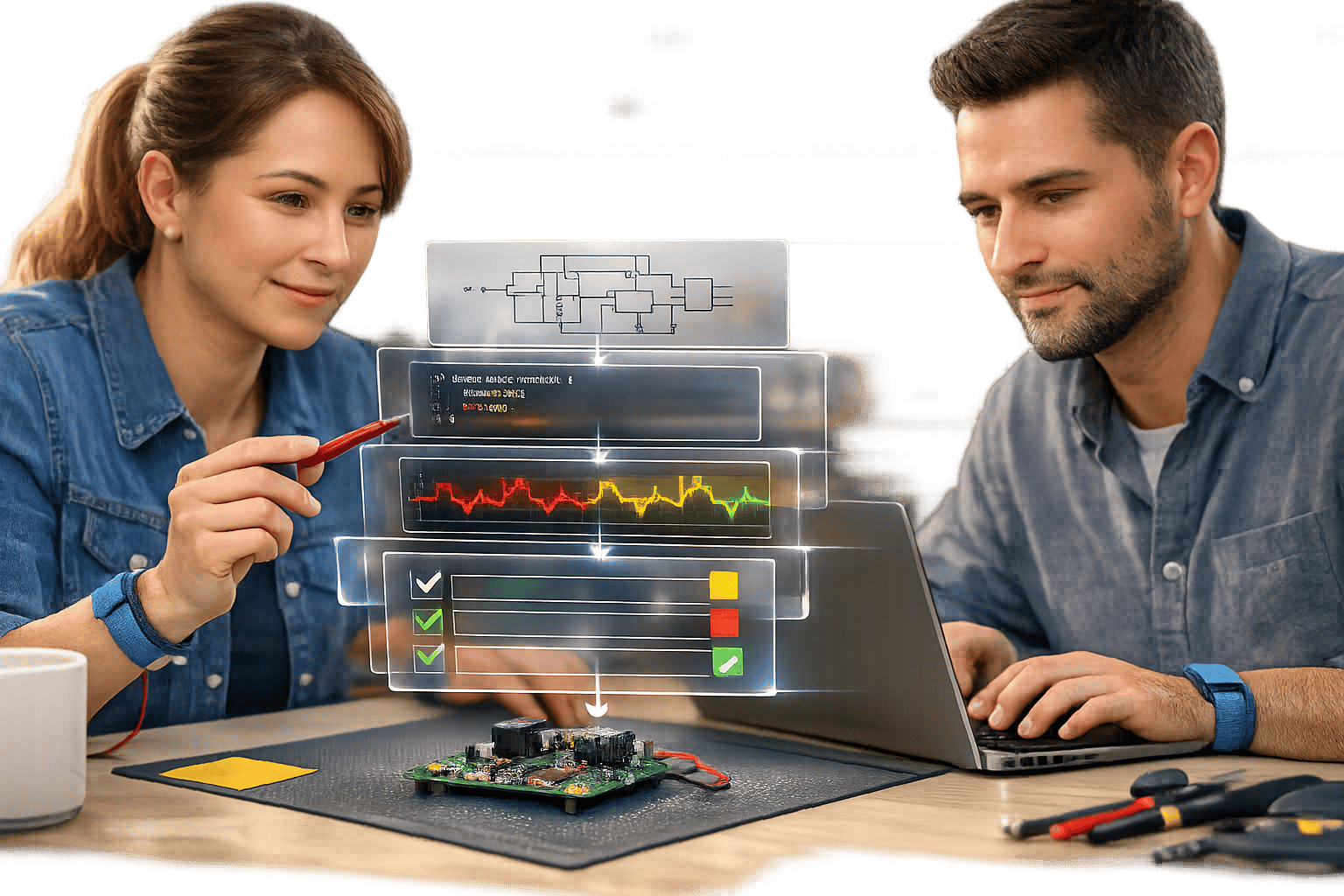
AI is transforming embedded system prototyping by slashing development time, automating tedious tasks, and improving design workflows. Here’s what you need to know:
- Faster Prototyping: AI tools like Kiro CLI have reduced development cycles from 6 weeks to just 8 days. Debugging, once 40% of the process, now takes only 15%.
- Smarter Circuit Design: AI-driven EDA tools automate component placement and optimize layouts, reducing errors and improving power efficiency.
- Streamlined Firmware Development: Platforms like Embedder generate precise, production-ready code for over 300 microcontroller models, saving hours of manual work.
- Efficient Testing: Digital twins and AI-powered simulations cut prototype validation from weeks to days, saving up to $50,000 per iteration.
- Collaborative Workflows: AI simplifies team coordination by consolidating data and automating documentation.
Engineers now focus on validating AI-generated options rather than building everything from scratch. The result? Faster, more efficient prototyping with fewer errors. Let’s dive into the details.

AI Impact on Embedded System Prototyping: Time and Cost Savings
AI for Circuit Design and Layout Optimization
Circuit design has always been a painstaking process. Engineers manually place components, route traces, and sift through datasheets to avoid conflicts. Now, AI is stepping in to automate these time-consuming tasks, offering smarter layouts that reduce interference, cut power consumption, and catch errors early in the process. This is especially useful for compact, high-density devices like IoT gadgets and wearables, where every millimeter and milliwatt counts. Let’s dive into how AI is reshaping design workflows and optimizing component placement with impressive precision.
Automating Design Tasks with AI
AI-powered Electronic Design Automation (EDA) tools are changing the game for circuit designers. Tasks that used to involve tedious manual effort – like configuring hardware registers or setting up interfaces such as SPI, I2C, and USART – are now handled by AI. These tools can generate boilerplate code for hardware initialization, reducing the risk of common errors.
A particularly exciting development is "Specs Driven Development", where AI takes rough requirements and turns them into detailed design documents, architecture diagrams, and component specs. What does this mean for engineers? They can evaluate 200 design variations in just a week – a process that would have taken months by hand. This fast iteration allows teams to weigh trade-offs in areas like thermal performance, weight, and cost before committing to physical prototypes.
Another standout feature is Retrieval-Augmented Generation (RAG), which simplifies navigating massive datasheets. Instead of flipping through 1,500-page reference manuals, AI can pinpoint specific register settings or hardware constraints in seconds. This capability is a lifesaver for resolving tricky issues like timing mismatches or I2C clock problems.
How AI Improves Component Selection and Placement
Once design tasks are streamlined, AI takes optimization to the next level by fine-tuning component placement. By analyzing signal paths, power distribution, and thermal dynamics, AI suggests layouts that reduce electromagnetic interference and enhance signal integrity. For IoT devices, where battery life is critical, these improvements can mean the difference between a product that lasts months and one that needs recharging in weeks.
AI also integrates Hardware-in-the-Loop (HIL) testing early in the design phase. This allows engineers to detect issues like sensor drift or timing violations long before production begins. Tools like Fusion Studio make it possible to benchmark execution time, memory usage, and power consumption on target silicon early on. This means engineers can tweak layouts and component choices without risking a costly $50,000 fabrication cycle that takes eight weeks to complete.
"AI compresses hardware prototyping from an expensive, slow process into rapid iteration that rivals software development speeds." – Figr.design
AI thrives when engineers provide clear objectives – like weight limits, strength requirements, or thermal thresholds. Using these constraints, the system proposes designs that meet the criteria. However, it’s critical for experienced engineers to validate these AI-generated designs. While they may look perfect on paper, they must be checked to ensure they’re practical and manufacturable in the real world.
sbb-itb-32a2de3
AI-Assisted Code Generation and Firmware Testing
Writing firmware for embedded systems has historically been a repetitive and time-consuming process. Tasks like configuring registers, setting up peripheral interfaces (e.g., SPI and UART), and defining RTOS tasks often require painstaking manual effort. But now, AI tools such as GitHub Copilot and ChatGPT can handle these tasks in seconds, allowing engineers to focus on solving the more complex challenges that make their products stand out. For instance, <a href="https://maccelerator.com">M Studio</a>, an innovation hub in Los Angeles, showcases how AI-driven prototyping has transformed development timelines.
These tools don’t just churn out generic code – they analyze the specific context of your project and generate functions tailored to your hardware’s needs. Say you need an SPI initialization function for an STM32 microcontroller. Simply describe your requirements in plain English, and the AI will deliver functional code complete with error handling and comments. AI models like RAG take things further by pulling precise register details from massive technical documentation libraries, saving engineers from hours of tedious searching.
AI isn’t just changing how hardware is designed – it’s reshaping firmware workflows too. By building on AI’s success in circuit design, these tools now dramatically accelerate firmware creation and debugging.
Faster Firmware Development
AI’s impact extends beyond generating code – it also speeds up the testing phase. The time savings are impressive. In December 2025, developer Shsrams adopted a systematic AI workflow using Kiro CLI, breaking development into four distinct phases: Requirements Elaboration (1–2 days), Research and Design (1–2 days), Implementation Planning (1 day), and Build/Test (5–6 days). This approach allowed AI to handle code and test generation, while the developer concentrated on validation and quality assurance.
Platforms like Embedder support over 300 microcontroller models, enabling automated, production-ready code generation. When engineers provide detailed context – such as register values, datasheet excerpts, and expected behavior – these platforms produce precise, usable driver code instead of generic suggestions.
Once the firmware is generated, AI tools continue to streamline the process by accelerating debugging and performance optimization.
AI for Debugging and Optimization
Debugging has traditionally consumed a massive chunk of the embedded development process – about 20% to 40% of the cycle, or roughly 2.5 to 5 months each year. AI tools like Claude Code can reduce this to just 15% of the total development time. Instead of juggling multiple resources, engineers can now paste register dumps, code snippets, and hardware observations directly into AI tools for quick, targeted analysis.
"AI solves this by collapsing context. Instead of managing 50 tabs, you paste your register dump, code snippet, and datasheet reference into Claude, and get targeted analysis in seconds." – Ashraf Said, CEO & Educator
The key is to treat AI as a hypothesis generator rather than an all-in-one solution. For example, AI-driven validation processes have achieved a 92.4% success rate in fixing vulnerabilities – an improvement of 37.3% compared to traditional methods. However, engineers must still verify AI suggestions against physical hardware using tools like oscilloscopes or debuggers. Virtualized testing platforms like QEMU further enhance this process, delivering real-time performance metrics. These include execution times as low as 8.6ms and jitter reduced to 195μs, ensuring high reliability before committing to costly fabrication.
Digital Twins and Simulation for Prototyping
Building physical prototypes can be both expensive and time-consuming – costing up to $50,000 and taking eight weeks to complete. Enter AI-powered digital twins, which allow engineers to test embedded system designs virtually before committing to fabrication. These virtual replicas simulate real-world conditions like memory load, thermal changes, and power fluctuations under interrupt-heavy scenarios. This level of precision helps engineers identify design flaws early, saving both time and money by avoiding costly rework.
Curious about the AI tools driving this change? Subscribe to our free <a href="#eluid160000aa">AI Acceleration Newsletter</a> for weekly tips on optimizing your embedded system development.
With AI-accelerated workflows, the traditional 14-week development process can shrink to just 5 weeks. Simulation phases, which once took two weeks, now wrap up in as little as three days. This shift not only slashes costs but also speeds up the critical design validation stage. Engineers now act more as curators than creators – AI generates multiple design options, leaving them to evaluate and refine the most promising ones.
Virtual Testing with Digital Twins
Digital twins revolutionize testing by simulating real-world dynamics with remarkable accuracy. Unlike traditional methods, these AI-driven models dive deep into scenarios like memory pressure, temperature fluctuations, and power consumption during interrupt-heavy operations. They even allow for early-stage hardware-in-the-loop (HIL) testing, helping teams catch issues such as ADC quantization noise, sensor drift, or timing violations long before physical hardware is built.
Surrogate machine learning models, trained on initial simulation data, provide quick performance estimates – often in minutes rather than hours. Full, high-compute simulations are reserved for final validation, making the iteration cycle faster and more efficient. Additionally, AI tools analyze real-time system logs to detect potential issues like anomalies or priority inversions in RTOS-based systems. Impressively, these anomaly detection models can run on devices as resource-limited as a Cortex-M4 with under 20 KB of RAM.
AI-Powered FPGA Prototyping
AI-powered FPGA prototyping takes things a step further, offering a way to explore high-performance designs rapidly and in parallel. Platforms such as AMD Vitis and Intel OpenVINO utilize AI to speed up FPGA design and prototyping, enabling engineers to optimize performance, power efficiency, and resource allocation all at once. These tools allow hypotheses to be tested in minutes using AI-driven FEA (finite element analysis) and CFD (computational fluid dynamics), catching thermal or structural issues early in the process. However, while AI simulations provide a powerful starting point, physical tests remain essential to confirm practical feasibility.
AI for Team Collaboration and Workflow Efficiency
Managing dispersed teams is one of the biggest challenges in embedded system prototyping, alongside the technical hurdles. Traditional workflows often leave engineers juggling multiple browser tabs, poring over endless datasheets, and manually syncing updates between hardware, firmware, and software teams. AI platforms are stepping in to simplify this chaos by consolidating information into a unified, easily accessible source. This shift not only improves design and debugging but also helps create a smoother, more connected workflow across teams.
Want to make embedded system teamwork easier with AI? Sign up for our free <a href="#eluid160000aa">AI Acceleration Newsletter</a> to get weekly tips on AI-driven collaboration.
Platforms like Embedder, which support over 300 MCU variants, help large teams avoid the headaches of toolchain fragmentation. Instead of losing hours combing through technical manuals, engineers can use Retrieval-Augmented Generation to quickly locate specific details. This approach has been shown to cut debugging time in embedded systems from 40% of the development cycle to just 15%.
Cloud-Based Collaboration Platforms
Cloud-based platforms are transforming how teams share and manage their work. They allow real-time sharing of schematics, BOMs, and layouts, eliminating delays caused by version control issues or endless email chains. These platforms also automate the documentation process, recording design assumptions, architectural decisions, and test results. AI agents further enhance this by analyzing real-time hardware traces and providing actionable feedback. This is especially useful during Hardware-in-the-Loop (HIL) testing, where identifying issues early can save teams from costly fixes later in the process.
Blending AI with Manual Expertise
While cloud platforms streamline collaboration, combining AI with human judgment takes system development to the next level. The best workflows integrate AI-generated prototypes with human oversight and physical testing. Techniques like Specs-Driven Development condense phases like requirements gathering, research, design, and implementation from months into just days. Structured "gates" ensure engineers validate AI outputs at every step, maintaining quality and minimizing technical debt. Steering files or Agentic Standard Operating Procedures (agent-SOPs) are often used to enforce coding standards and conventions.
"The human developer is the weakest link in the whole process… the developer is the one who determines whether the output produced is AI slop with a bunch of tech debt OR production quality code." – Shsrams, Full-stack Prototype Developer
To further safeguard the process, engineers should frequently commit changes when using AI-driven tools for code generation. Clearing the AI’s context window between different phases also helps avoid errors caused by irrelevant data. While AI excels at generating hypotheses, physical verification with tools like oscilloscopes or logic analyzers remains crucial in ensuring the final product meets the required standards.
Conclusion
AI is reshaping how embedded systems evolve from initial concepts to functional prototypes. Processes that once took months now unfold in weeks. For instance, traditional hardware prototyping cycles that used to span 14 weeks have been shortened to just 5 weeks, while individual prototype deliveries now take only 8–10 days instead of 6 weeks, thanks to AI tools. Debugging, which previously consumed a significant portion of the cycle, now requires just 15% of the time, making development smoother and faster. Want to transform your prototyping workflow? Subscribe to our free <a href="#eluid160000aa">AI Acceleration Newsletter</a> for weekly insights into AI systems.
Generative design tools have also revolutionized optimization, automatically balancing factors like weight, strength, and cost. This eliminates the need for costly physical iteration cycles, which previously cost $50,000 and took 8 weeks per round. By enabling the simultaneous development of hardware, software, and UI/UX, AI tools expose integration issues early – when they’re less expensive to address – while speeding up time-to-market.
For startups and engineering teams, this streamlined approach offers a real edge. Faster market entry with thoroughly tested, inventive products becomes a reality. Engineers now act more as curators, defining constraints and evaluating AI-generated options rather than manually drafting every possibility. This shift frees up mental bandwidth for solving complex, high-level challenges. While physical verification is still crucial, AI takes care of tedious groundwork like datasheet cross-referencing and hypothesis generation.
If you’re working on hardware products and want to adopt AI-driven workflows effectively, <a href="https://maccelerator.la/en/elite-founders/">Elite Founders</a> offers weekly implementation sessions. You’ll build real automations alongside seasoned experts. With over 500 founders already benefiting from M Studio’s guidance – raising over $75M collectively – this program provides not just strategies but working systems to accelerate your development process.
FAQs
Which embedded prototyping tasks should I automate with AI first?
Start by automating tasks that consume the most time and energy. For instance, debugging is an excellent place to begin – AI tools can pinpoint and address issues much faster than manual methods, cutting down development time significantly. Another smart move is automating code generation for routine functions and repetitive work. This frees up engineers to concentrate on more intricate design challenges, accelerates prototyping, and boosts efficiency across the board.
How do I verify AI-generated circuits and firmware are manufacturable and safe?
To create circuits and firmware that are both manufacturable and safe, it’s crucial to use AI tools for early-stage analysis. These tools can predict manufacturability by examining design parameters and flagging potential issues before they become costly problems. Additionally, AI-driven simulations play a key role in validating safety and ensuring compatibility with manufacturing processes.
By integrating AI with traditional testing methods, you can automate much of the verification process. This not only boosts accuracy but also ensures compliance with safety standards. Pairing AI’s analytical power with expert reviews further strengthens the reliability of designs, helping to minimize errors and defects while maintaining a focus on quality and manufacturability.
What do I need to build a useful digital twin for my embedded prototype?
To develop a digital twin for your embedded prototype, start by creating a virtual model that closely reflects how the physical system operates. Gather comprehensive data about the hardware, software, sensor inputs, and system states to ensure accuracy. AI tools can simplify this process by supporting tasks like simulation, debugging, and refining system performance. Additionally, generative AI can assist in generating code snippets and implementing real-time updates, which helps improve the twin’s precision and adaptability.
Related Blog Posts
- The AI Efficiency Paradox: How Automation Creates Sustainable Startups
- Wireframing vs. Prototyping: Key Differences
- AI Tools for Faster, Cheaper Prototyping
- How AI Cuts Sales Cycle Length By 50%