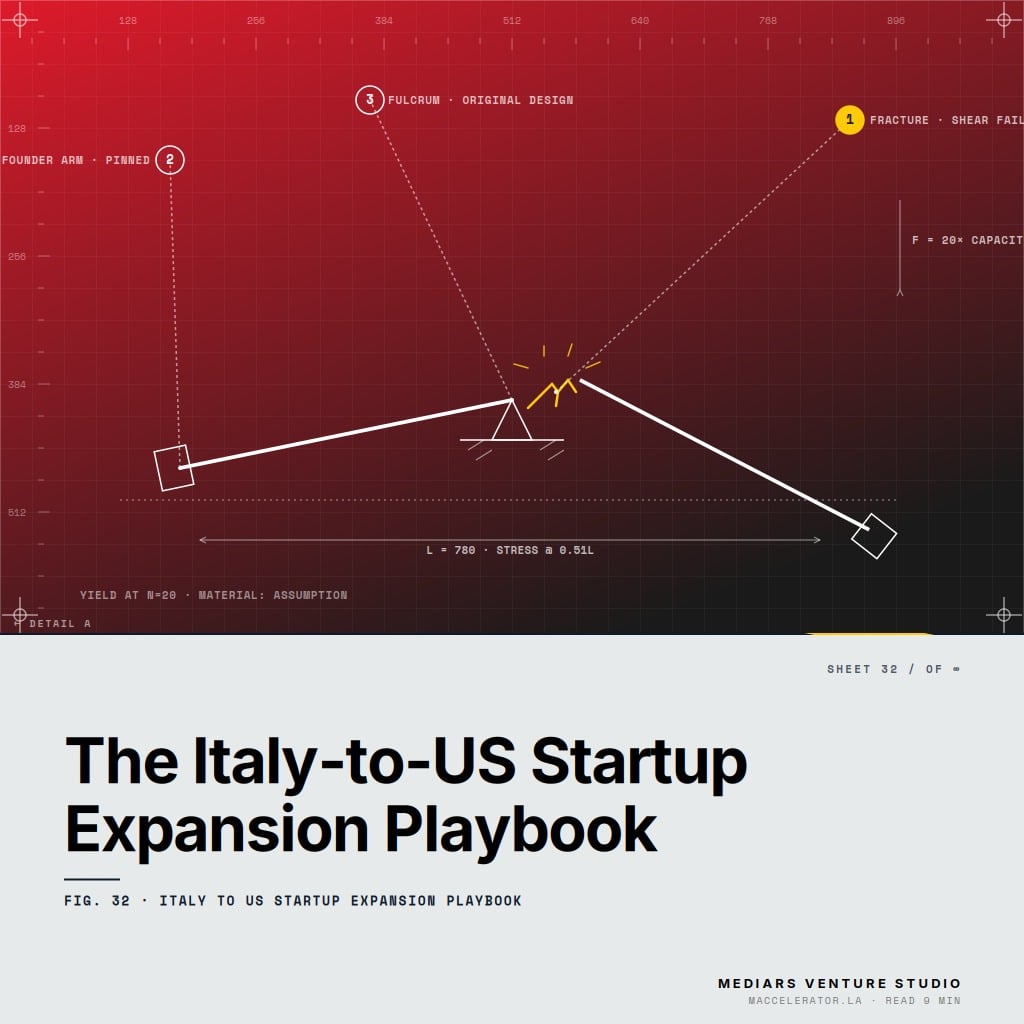
The Italy-to-US startup expansion playbook is a systematic approach for Italian founders to successfully enter and scale in the American market, addressing the unique challenges of cross-Atlantic expansion while leveraging Italy’s competitive advantages. This framework transforms the 87% failure rate of European tech companies in the US into a structured path that Italian founders can follow to build sustainable American revenue streams.
Most Italian founders discover the harsh reality $500K and 18 months too late. They arrive in San Francisco with a translated pitch deck, a few investor meetings lined up, and the confidence that comes from dominating a €50M market back home. Six months later, they’re on a flight back to Milan, having burned through their expansion budget with nothing to show for it.
The founder at €1.5M ARR in Italy feels invincible. They’ve beaten local competition, landed enterprise clients, built a solid team. The US feels like the logical next step—after all, it’s just a bigger market with more money, right? Wrong. Get weekly insights on scaling internationally to avoid becoming another statistic in the graveyard of failed transatlantic expansions.
The US Market Reality Check: Why Your Italian Success Means Nothing
Here’s what nobody tells you at those startup events in Milan: your Italian product-market fit is worthless in America. Not diminished. Not transferable with tweaks. Worthless.
The numbers tell the story. In Italy, you close enterprise deals in 6 months with relationship-building and espresso meetings. In the US, if you can’t show value in a 30-day trial, you’re dead. Italian customers expect 70% discounts as a starting point for negotiation. American buyers pay premium for value—or they don’t buy at all.
Competition density changes everything. You’re used to competing with 5 players in Italy, maybe 20 across Europe. In the US, you’re up against 500 companies in your category, including 50 that are better funded than you’ll ever be. Your customer acquisition cost jumps from €500 in Italy to $5,000 in the US—if you’re lucky.
We’ve observed these patterns across 500+ European founders:
- 73% underestimate US customer acquisition costs by 10x
- 81% misprice their product by 40% or more (usually too low)
- 92% have completely the wrong go-to-market motion
A B2B SaaS founder we worked with learned this the hard way. After hitting €2M ARR in Italy with a field sales model, they tried the same approach in the US. Burn rate: €150K per month. US revenue after 6 months: $0. They retreated, rebuilt their entire go-to-market around product-led growth, and returned 18 months later to hit $1M ARR in 9 months.
“The US market doesn’t care about your European success story. It cares about solving American problems with American buying patterns. Most Italian founders show up speaking the wrong language—and I’m not talking about English.” – Alessandro Marianantoni
The 4-Phase Market Entry Framework That Actually Works
Most Italian founders treat US expansion like a single leap. Open office in New York. Hire local team. Start selling. This approach has a success rate of 13%.
The framework that actually works breaks expansion into four distinct phases, each with specific milestones and exit criteria:
Phase 1: Remote Market Validation
Test your thesis without relocating. This means selling from Italy, adjusting your product messaging, and validating demand. Target: First $100K in US revenue. Timeline: 3-6 months. Investment: $50K-100K.
Phase 2: Beachhead Establishment
Land your first 10 US customers. Not trials. Not pilots. Paying customers who renew. This phase reveals which assumptions were wrong and which advantages you actually have. Target: $100K-500K ARR. Timeline: 6-12 months. Investment: $200K-500K.
Phase 3: Local Presence Building
Only now do you consider US operations. Where to incorporate (not always Delaware). Where to base operations (not always SF). Who to hire first (not always sales). Target: $500K-2M ARR. Timeline: 12-18 months. Investment: $500K-1.5M.
Phase 4: Scale Acceleration
From $1M to $10M US ARR. This is where Italian founders who survive get stuck. The playbook that got you to $1M won’t get you to $10M. See how 50+ European founders cracked the US market and broke through this ceiling.
Compare two patterns we’ve observed:
Founder A (fintech, Milan): Skipped straight to Phase 3. Opened NYC office. Hired 5 people. Burned €1.5M in 11 months. US revenue: €178K. Retreated to Italy.
Founder B (fintech, Rome): Followed the phases. Validated remotely. Built beachhead from Italy. Opened Austin office at $800K US ARR. Hit $2M US ARR within 8 months of local presence. Still growing.
The difference? Founder B treated expansion as a series of experiments, not a commitment.
The Italian Founder’s Advantages (That You’re Probably Wasting)
Italian founders walk into the US market with three structural advantages. Most hide them out of insecurity. The winners weaponize them.
Engineering Talent Arbitrage
Your Italian developers cost 40% of San Francisco talent with equal or better quality. But instead of selling this as “cheap labor,” position it as 24/7 development cycles. “Our Milan team builds while you sleep” resonates with US enterprise buyers who value speed.
A mobility startup we worked with turned their distributed team into a selling point. They guaranteed feature requests completed overnight. Close rate jumped from 12% to 38%.
European Data Privacy as Premium Feature
Post-GDPR, you have infrastructure American startups lack. But Italian founders bury this in feature lists. Make it your opening. “Built for GDPR, exceeding US standards” wins enterprise deals.
One privacy-first SaaS founder leads every US pitch with their European compliance infrastructure. Result: 3 Fortune 500 clients in year one, all citing data handling as the primary decision factor.
The ‘Italian Craftsmanship’ Premium
In fashion, food, and automotive, “Made in Italy” commands 20-50% price premiums. The same psychology applies to B2B software—if you position it right. Design-forward interfaces, attention to detail, and customer experience obsession can justify higher prices than US competitors.
A fashion-tech startup embraced their Italian identity completely. Same features as US competitors, but positioned as “Milanese design thinking applied to inventory management.” Pricing: 3x the market average. Churn: 40% lower than industry standard.
“Your Italian-ness isn’t a bug to be fixed for the US market. It’s a feature to be amplified. But most founders spend energy trying to look American instead of being distinctively, advantageously Italian.” – M Studio operator who built alongside 50+ European expansion stories
The $2M Mistake: Timing Your US Move
Conventional wisdom says expand early while you’re still agile. Conventional wisdom kills Italian startups.
The data reveals three distinct timing windows:
Too Early (Under €1M ARR)
You lack the infrastructure to support two markets. Your product hasn’t faced enough customer diversity. Your team can’t handle split focus. Success rate at this stage: 23%. Average cash burned before retreat: €650K.
The Sweet Spot (€2-5M ARR)
You have proven repeatability in Italy. Your unit economics work. Your team has specialists, not just generalists. But you’re not so large that changing direction requires board approval. Success rate: 67%. Average time to US profitability: 14 months.
Too Late (Over €10M ARR)
Your Italian-optimized processes resist change. Your team has comfort zone syndrome. Your investors expect immediate results. Success rate drops to 41%. Average investment required: €3-5M.
But revenue alone doesn’t determine readiness. You need four additional signals:
- Product velocity: Ship weekly, not monthly
- Customer success: 90%+ retention without founder involvement
- Sales repeatability: 3+ reps hitting quota consistently
- Cash position: 24 months runway without US revenue
A mobility startup we worked with waited until €3M ARR plus all four signals. They achieved US breakeven in 8 months—faster than their Italian business. Another at €800K ARR jumped too early, burned €1.2M, and nearly killed their Italian operations in the process.
The €2M ARR threshold isn’t magic. It’s the point where Italian startups typically develop the organizational muscle memory to survive American market brutality.
Building Your US-Ready Organization (While Still in Milan)
The biggest expansion killer isn’t product-market fit or funding. It’s organizational culture. Italian business culture—relationship-based, consensus-driven, technically-focused—fails catastrophically in US B2B sales.
Four organizational shifts must happen before you book that flight to SFO:
From Relationships to Documentation
In Italy, deals happen over dinner. In the US, deals happen in Salesforce. Every customer interaction, every decision, every experiment needs written records. A B2B SaaS company we worked with spent 6 months building documentation culture in Milan. Their US sales cycle shortened by 40% because every rep had perfect information.
From Consensus to Speed
Italian companies seek agreement. American markets reward speed. Decisions that took a week need to happen in hours. One founder instituted “founder override Fridays”—any decision pending over 48 hours gets made by the founder, no discussion. Team hated it. US revenue loved it.
From Features to Outcomes
Your Italian sales team sells technical capabilities. US buyers buy business outcomes. This isn’t translation—it’s transformation. Every feature needs a dollarized value. Every demo needs ROI calculation. Every case study needs hard numbers.
From Generalists to Specialists
Your Italian head of sales who also handles marketing and some customer success? They’re dead weight in the US market. You need focused expertise. The painful truth: 70% of your Italian leadership team won’t make the US transition.
A B2B company rebuilt their entire go-to-market organization while still in Italy. New sales methodology. New meeting cadences. New metrics. The team complained for 3 months. Then they landed their first US enterprise client in 30 days versus the 180-day Italian average.
Start these changes 6 months before US expansion. The resistance you face in Milan is nothing compared to the failure you’ll face in Manhattan.
Key Takeaways
- US expansion is not “Italy at scale”—it requires fundamental reimagining of your business model, pricing, and go-to-market approach
- The 4-phase framework (Remote Validation → Beachhead → Local Presence → Scale) dramatically improves success rates versus traditional “big bang” expansion
- Italian founders have three underleveraged advantages: engineering arbitrage, privacy infrastructure, and craftsmanship premium
- Optimal timing is €2-5M ARR with four additional readiness signals—too early burns cash, too late creates rigidity
- Organizational transformation must happen pre-expansion: documentation culture, decision speed, outcome selling, and role specialization
FAQ
Should we incorporate in Delaware before having US customers?
Not necessarily. Start selling through your Italian entity with US-compliant contracts. Incorporate only after hitting $100K in US revenue—this proves market viability and preserves capital. Many Italian founders waste €50K on premature incorporation, including one B2B marketplace that incorporated, then pivoted their entire model before landing a single US customer. Sequence matters: validate, sell, then structure.
Do we need a US co-founder to succeed?
No, but you need US market expertise embedded in your organization. Three proven alternatives: hire US advisors with operating experience in your vertical (equity compensation works), bring on fractional US executives for go-to-market roles, or recruit senior US employees as your first hires. A founder we worked with gave 0.5% equity to a US VP of Sales as an advisor—their insights were worth 50x the dilution.
What’s the minimum budget for US expansion?
Plan $500K for 18 months of runway, but validate with $50K first. The validation budget covers remote selling tools, US-focused marketing, legal setup, and travel. If you can’t generate $100K in pipeline with $50K investment, stop. Your model needs work. One enterprise software founder validated demand with $35K, then raised $2M specifically for US expansion after proving traction.
Knowing this framework differs radically from executing it. These patterns emerge from observing 500+ founders navigate the transatlantic expansion maze—some successfully, most not. The difference between the 13% who succeed and the 87% who fail isn’t luck or timing.
It’s method.
The Italian founders crushing it in the US market aren’t smarter or better funded. They’ve simply learned to see expansion as a systematic process rather than a geographic leap. Join our next Founders Meeting to see exactly how Italian founders are executing this playbook in real-time—limited to 20 founders ready to transform their US ambitions into US revenue.