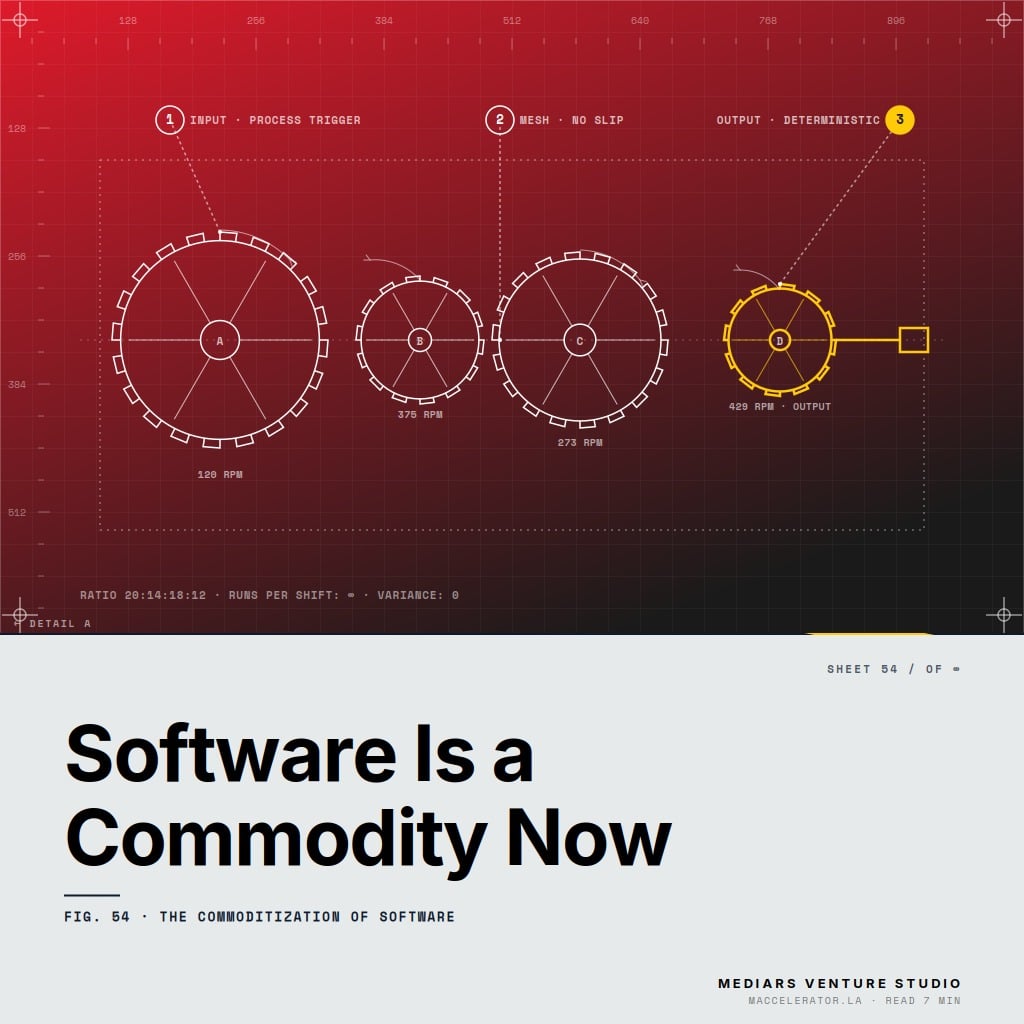
A feature that took your team two quarters to ship just got replicated by a competitor in a weekend. Then a customer asked the question that keeps post-PMF founders awake: “Why am I paying you when an AI can just build this?” The commoditization of software is the process by which software capabilities become cheap, abundant, and undifferentiated, so the code itself no longer commands a price premium. It matters right now because AI code generation has collapsed the cost of building features that used to take months down to days.
Across the 500+ founders we’ve worked with in 30 countries, the recurring question has shifted. It used to be “how do we build it?” Now it’s “why would anyone pay for it?”
That shift is not a mood. It is structural. And if your pricing and differentiation rest on the product roadmap, the ground is already moving under you. This piece gives you a lens to see where value is migrating — and where it is not.
Why Software Commoditization Hit a Tipping Point in 2024-2025
This is not a five-year-out problem. Three forces compounded at once, and the result is permanent.
First, AI code generation pushed the marginal cost of a feature toward zero. What required a senior engineer and a quarter now takes a prompt and an afternoon. The build moat — the thing many founders quietly relied on — evaporated.
Second, open-source and API-first infrastructure mean nobody builds from scratch anymore. Authentication, payments, search, vector storage, model access — all assembled, not invented. When everyone starts from the same Lego set, the structures look the same.
Third, buyers have more substitutes than ever. Funded competitors per category have multiplied. Switching costs dropped. Software buyer churn pressure is well-documented across SaaS benchmarks, and it gets worse as parity products flood every niche.
Here is the part most founders miss. When the layer below you gets cheap, value does not disappear — it migrates up. It moves toward distribution, trust, outcomes, and relationships.
“Commoditization is not the death of value. It is the relocation of value. The founders who panic are the ones still standing on the layer that’s becoming free.” — Alessandro Marianantoni
This applies far beyond SaaS. A services business whose deliverables are now AI-assisted. A marketplace whose matching logic is replicable. A consumer app whose features are copyable in a sprint. Same migration, different surface.
Key Takeaways
- Software capabilities are now cheap and abundant — code no longer commands a premium on its own.
- AI is the accelerant, not the cause. Open-source and APIs started the shift years ago.
- Competing on feature velocity is a margin-losing race when build cost collapses.
- Durable value lives in four layers: distribution, trust, outcome ownership, and network effects.
- Positioning is cheapest to change pre-scale — fixing it post-PMF beats fixing it after churn forces you.
The Trap: Competing on the Layer That’s Becoming Free
Most founders respond to commoditization by doing more of what broke. They double down on feature velocity. They race to out-build the competitor who just copied them. They treat the roadmap as the moat.
It is a losing race. When build cost collapses for you, it collapses for everyone. You win the feature and lose the margin.
Consider a B2B SaaS founder we worked with at roughly $900K ARR. They shipped 40 features in a single year. Impressive output. Yet gross margin slid and win rate declined across the same period.
The features were not the problem. The strategy was built on the value of building, not the value of being chosen. Those are different games entirely.
Defensibility is moving away from what you make toward why you’re trusted and how you reach the customer. The moat is no longer in the codebase. It is in the relationship, the channel, and the result you own.
We break down shifts like this every week in the AI Acceleration newsletter — a useful place to keep tracking where value is actually moving.
The Value Migration Framework: 4 Layers That Survive Commoditization
When software gets cheap, value migrates to four layers. Use this as a diagnostic. Ask which layer your moat is actually built on — and be honest if the answer is “features.”
1. Distribution — owning the channel to the customer
Whoever controls attention controls margin. In SaaS, that’s a category-defining audience or a partner channel competitors can’t access. In services, a referral engine. In a marketplace, a supply side that won’t churn. In consumer, organic reach that doesn’t reset to zero with every ad budget cut.
2. Trust and brand — being the default safe choice
Buyers pay a premium to not get fired for choosing wrong. A SaaS brand that’s the obvious answer in its category. A services firm whose name de-risks the decision. That trust takes years to build and cannot be cloned in a weekend.
3. Outcome ownership — being measured on the customer’s result
Stop selling a feature list. Sell the result you’re accountable for. A SaaS product priced on revenue lifted, not seats. A services business paid on outcomes delivered. When you own the outcome, parity features become irrelevant.
4. Ecosystem and network — value that compounds per user
Each new user makes the product more valuable to every other user. A marketplace with liquidity. A platform with integrations. A community with data that improves the product. This compounds in a way code never does.
Across the 500+ founders we’ve worked with, the ones who held pricing power through commoditization were anchored on layers 1 through 4. The ones who lost it were anchored on the feature layer — the layer going free.
What Defensibility Looks Like When Code Is Free
You don’t need to guess whether you’ve escaped the commodity trap. There are observable markers.
- Customers describe you by outcome, not feature. “They got us to X,” not “they have integration Y.”
- Pricing conversations are about value, not parity. Nobody opens with “your competitor charges less.”
- Churn comes from the customer’s situation changing — not from a competitor shipping a feature.
- Referrals outpace paid acquisition.
- The team spends more time on distribution and relationships than on shipping parity features.
Contrast two founders at similar ARR. One is locked in feature parity with falling margins, discounting to close, churning when copied. The other is anchored on outcome and distribution, holding price, growing on referrals.
Same revenue today. Radically different futures.
“The question is never how many features you shipped. It’s whether the customer would feel the loss if you disappeared tomorrow. That feeling is the moat.” — M Studio operator
This is the kind of strategic repositioning founders work through together in Elite Founders — alongside peers facing the exact same shift.
“But We’re Too Early / Too Lean / Can Figure This Out Ourselves”
“No budget right now.” Commoditization erodes margin precisely when you can least afford it. This is a thinking shift, not a spend. The cost of ignoring it is the margin you’re already losing.
“We can figure this out ourselves.” You’re smart enough to. The trap is that you’re inside the feature race and can’t see the value migration from within it. Outside perspective and pattern recognition compress the timeline from years to weeks.
“We’re too early-stage.” The opposite is true. Positioning is cheapest to change before you scale. Founders who fix it post-PMF — before raising — avoid building a growth engine on a commodity foundation.
The most painful repositioning we see is among founders who waited until churn forced it. By then you’re rebuilding the plane mid-flight, with less runway and a frustrated cap table.
FAQ
What does the commoditization of software actually mean?
It means software capabilities have become cheap, abundant, and undifferentiated, so the code no longer commands a premium. Value shifts upward to distribution, trust, and the outcomes you deliver.
Is AI causing software commoditization?
AI is the accelerant, not the sole cause. It collapses build cost, but open-source and API ecosystems started the shift years earlier. The net effect is that features are no longer a moat.
How do I make my software product defensible now?
Stop competing on the layer that’s getting cheaper. Anchor on distribution, trust and brand, outcome ownership, or network effects — the four layers in the value migration framework above.
Does this apply if I’m not a SaaS company?
Yes. Services firms, marketplaces, and consumer products face the same migration as their core mechanics become replicable. AI-assisted deliverables and copyable features hit every model.
Is software becoming commoditized?
It already is. Drawing on 25+ years across Fortune 500 environments and 500+ founders, the pattern is clear: the code layer is commoditizing, and pricing power is relocating to distribution, trust, and outcomes.
Recognizing the value migration is the first move. Acting on it before churn forces your hand is what separates the founders who keep pricing power from the ones who discount their way to a slow exit.
If you want to think through where your real moat lives, come explore it with other founders facing the same shift. Not a pitch — a conversation about the layer your value actually sits on, and whether it’ll still be there next quarter.