

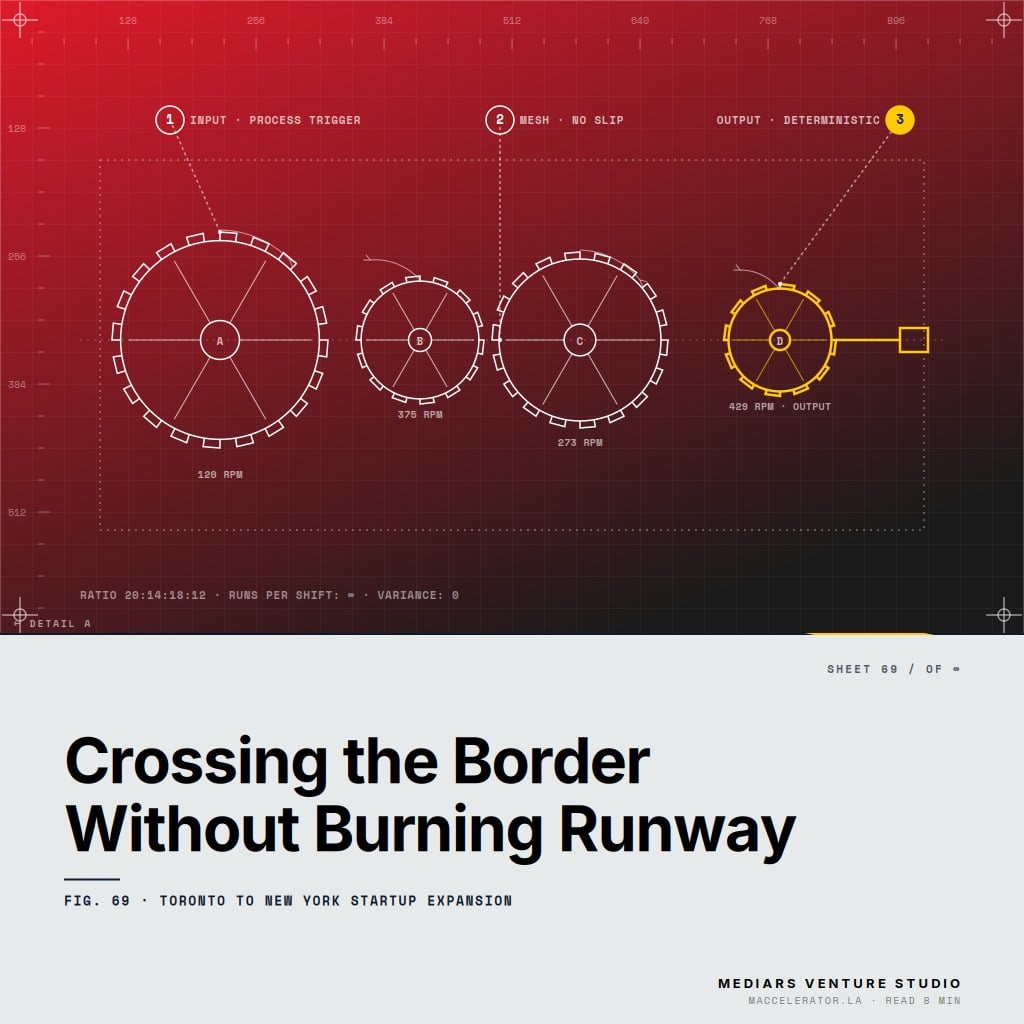
Toronto to New York startup expansion means deliberately re-validating your market, pricing, and go-to-market motion in a deeper, more competitive, higher-cost ecosystem — not simply opening a second office. It is the process of treating the U.S. market as a fresh experiment, not a copy-paste of your Canadian playbook.
Here is the founder this article is for. You hit product-market fit in Canada. Revenue sits somewhere between $50K and $3M ARR. Investors, customers, or your own ambition keep pulling you toward New York.
And you are not sure whether crossing the border is a growth lever or a runway trap.
That tension is real. Across 500+ founders in 30 countries, one pattern repeats: the metrics that signal “ready to scale” inside Canada often mislead founders about their readiness for the United States. Domestic traction does not automatically transfer across the border.
Why the Toronto-to-NYC Move Looks Easy (And Why That’s the Trap)
On paper, this looks like the lowest-friction international expansion a Canadian founder can run. Same language. Same time zone. A flight under 90 minutes.
Shared business norms. A border you can cross before lunch.
So founders treat it as a logistics problem. Find office space, book some meetings, hire a salesperson. Done.
That assumption is exactly what burns runway.
New York is the second-largest startup ecosystem in the world by capital and company density. The customer expectations are different. Sales velocity is faster. Talent costs more. Competitive saturation is brutal.
We have seen founders repeatedly underestimate the cost delta. NYC engineering and sales compensation runs materially higher than Toronto benchmarks. Office and operating costs follow. The “soft landing” you imagined is a deeper, faster, more expensive pool.
“The proximity is the danger. Founders treat New York as a logistics move when it is a re-validation move. Those are two completely different budgets.”
Geographic closeness creates false confidence, and false confidence is what makes founders under-resource the entry. A market that feels familiar is the one you study least. That is precisely why it costs you.
Why 2025 Is a Different Moment for Cross-Border Expansion
The expansion decision carries more weight today than it did three years ago. Capital is tighter. Runway is precious. There is no forgiving funding environment to catch a mistimed move.
At the same time, U.S. investors increasingly expect a U.S. presence before they write a check. The Delaware C-corp question — whether and when to flip your entity — now shows up earlier in founder conversations than it used to.
This creates a dual risk that defines the moment.
- Move too early and you burn months of runway validating demand that was never there.
- Move too late and a better-capitalized U.S. competitor owns the market before you arrive.
The decision is timing-sensitive, not just strategy-sensitive. The post-2023 funding tightening punishes both forms of error. You cannot raise your way out of a premature expansion the way founders did in 2021.
If you are tracking how shifts like AI-driven go-to-market are reshaping cross-border expansion economics, the AI Acceleration newsletter breaks these signals down weekly.
Key Takeaways
- Toronto to New York startup expansion is a re-validation problem, not a relocation problem. Treat the U.S. as a new market experiment.
- Proximity creates false confidence. NYC has different customer expectations, faster sales velocity, and significantly higher talent costs.
- The modern playbook is early, lightweight validation — not late, all-in relocation.
- You need enough runway to fund 12-18 months of dual-market operation without a forced raise.
- The recurring founder regret is “we moved before we validated,” not “we thought about it too long.”
The Three Questions That Determine If You’re Actually Ready
Before you commit a dollar to New York, pressure-test three filters. These apply whether you run SaaS, a marketplace, a services firm, or a commerce brand.
1. Market Pull: Inbound demand or outbound ambition?
Is there evidence of U.S. customers reaching toward you? Inbound traffic, unsolicited demos, referral requests from American buyers?
Or is the pull coming entirely from your own ambition?
One marketplace founder at $1.2M ARR had genuine U.S. inbound traffic but no U.S. payment infrastructure to convert it. The demand was real. The ability to capture it was not. Pull without the rails to monetize is still a gap.
2. Model Portability: Does your economics survive a higher-cost environment?
Your pricing, sales motion, and unit economics were tuned for Canada. New York charges more for everything.
A B2B services founder learned this the hard way. The Canadian pricing collapsed against NYC labor costs the moment they tried to staff a U.S. delivery team. The model worked in Toronto. It did not survive the cost transfer.
If your margins only work at Canadian input costs, you do not have a business in New York — you have a discount nobody asked for.
3. Runway Resilience: Can you fund the experiment without a forced raise?
Dual-market operation costs more than a single market. You are funding two go-to-market motions at once.
Can you carry 12-18 months of that without being forced into a bad raise at a bad time? If the answer depends on a round that has not closed, you are not ready. You are gambling.
Across 500+ founders, the ones who cleared all three filters before committing rarely regretted the move. The ones who skipped them almost always did.
What a Healthy Toronto-to-NYC Expansion Actually Looks Like
A well-executed expansion has visible markers. You can spot it before the office lease is signed.
- A beachhead segment validated before relocation. Not a guess — a named segment with proof of demand.
- A sales motion adapted to U.S. velocity. American buyers move and expect differently than Canadian ones.
- A clear entity and legal posture. You know your C-corp answer and why.
- A hiring plan built on real NYC comp benchmarks. No Toronto-priced fantasies.
- A dashboard that separates Canada baseline from U.S. experiment. You can see what is actually working.
Now contrast two founders.
The first flies to New York every week, takes meetings, feels productive, and validates nothing. Activity masquerading as progress. Runway draining with each round trip.
The second lands a referenceable U.S. anchor customer before signing anything. One commerce founder validated three U.S. retail accounts before committing to a lease. That anchor de-risked everything downstream.
“The healthiest expansions we have built alongside founders share one trait: they earned a real U.S. customer before they spent on U.S. infrastructure. Optimism is not a beachhead.”
The difference between the two founders is not budget. It is sequence. Validation before commitment beats commitment before validation every time.
Founders navigating this rarely solve it in isolation. Many pressure-test the move alongside peers further down the same path, like those in the Elite Founders community.
The Data Behind Cross-Border Startup Expansion
New York consistently ranks among the top two U.S. startup ecosystems by venture funding volume and deal density. The capital concentration is the draw — and the competitive pressure.
Three trends shape how smart founders enter today.
- Remote-first beachhead strategies are now standard. Founders validate U.S. demand before relocating, slashing the upfront cost of entry.
- Delaware C-corp flips are rising among Canadian startups. U.S. fundraising and customer trust increasingly favor a U.S. entity.
- Expansion happens earlier in the lifecycle. A decade ago, founders relocated after scaling. Now they validate early and lightly.
This directly addresses the “we’re too early-stage” worry. Early validation is the modern playbook. Late relocation is the legacy one.
Across 500+ founders, the most expensive mistakes came from late, all-in moves — not from early, lightweight tests. The cost curve rewards founders who probe before they plant.
“We Can Figure This Out Ourselves” — And Other Things Founders Tell Themselves
Three objections come up every time. Each deserves a straight answer, operator to operator.
“We don’t have the budget to think this through.”
The cost of a wrong expansion dwarfs the cost of thinking it through first. A burned year and depleted runway is the expensive outcome.
Early validation is cheap. Premature relocation is not. You are choosing between a small deliberate cost now and a large forced one later.
“We can figure it out ourselves.”
You can. Founders are capable of learning anything.
The real question is the cost of the learning curve. When each cross-border experiment burns months of runway, the tuition gets steep fast. Self-reliance is not free when the classroom charges by the quarter.
“We’re too early-stage for this.”
Early-stage is exactly when lightweight validation is most valuable and least expensive. You have not yet committed the resources that make a mistake costly.
The recurring regret across 500+ founders is “we moved before we validated” — never “we thought about it too carefully.”
FAQ
Do I need to relocate to New York to expand my startup there?
No. The modern beachhead approach favors validating U.S. demand remotely first. Relocation is a later-stage commitment, justified only once unit economics and genuine market pull are proven. Plenty of founders run an NYC experiment for months before anyone books a one-way flight.
Should I flip to a Delaware C-corp before expanding to the U.S.?
A Delaware C-corp is often relevant for U.S. fundraising and customer trust. But it is a decision tied to your capital strategy and timing, not a reflex. Weigh it against your raise plans and tax posture before flipping. Do it because your funding path requires it — not because it feels like the expected move.
How much runway do I need before expanding from Toronto to NYC?
Enough to fund 12-18 months of dual-market operation without a forced raise. Expanding while runway-constrained is the single most common failure pattern. If the math only works after a round that has not closed, you are not funding an expansion — you are funding a gamble.
Why are tech startups moving to New York?
Capital density and customer concentration. New York ranks among the top U.S. ecosystems by venture funding, and many U.S. investors expect a domestic presence. For Canadian founders, it is the closest deep U.S. market — proximity plus scale.
The Move Is a Question Before It Is a Decision
Toronto to New York startup expansion rewards founders who treat it as an experiment to validate, not a destination to reach. The clarity you build before you commit determines whether the move extends your runway or eats it.
The founders who get this right ask the hard questions first. They earn a U.S. customer before they sign a U.S. lease. They know their C-corp answer and their runway math cold.
If you want to think this through alongside founders facing the same border, come explore the questions with peers in our Founders Meetings. Limited to founders ready to pressure-test the move before they make it.