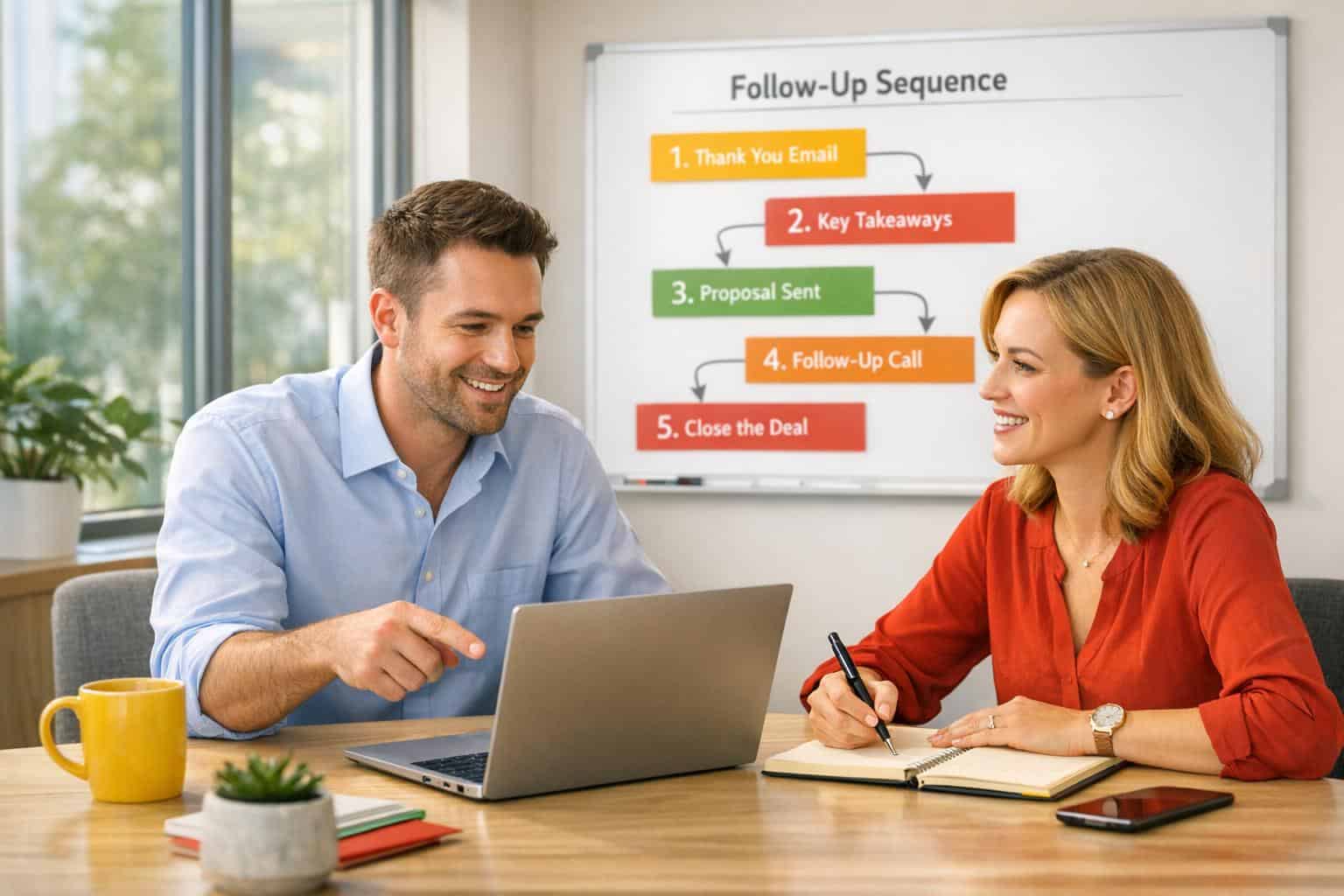
You’re losing deals after the demo, not during it. The real problem? A lack of effective follow-up in the critical 48 hours after your presentation. Without timely, personalized outreach, prospects forget your key points, and deals stall.
Here’s the solution: a 5-touch follow-up sequence over 14 days that keeps your solution top of mind, addresses objections, and empowers your prospect to sell internally. The steps:
- 2-hour recap: Send a personalized email with key takeaways, a demo recording, and next steps.
- 24-hour objection response: Address concerns raised during the demo with tailored solutions.
- 48-hour champion enablement: Equip your internal advocate with shareable resources like a summary or slide deck.
- Day 5–7 case study: Re-engage with relevant social proof to highlight your solution’s impact.
- Day 10–14 final ask: Send a respectful "close your file?" email to prompt a response or clean your pipeline.
This system works because it combines speed, relevance, and persistence. Track metrics like reply rates and demo-to-close conversions to refine your process. Want to stop losing deals? Build a consistent follow-up system that turns demos into revenue.

5-Touch Post-Demo Follow-Up Sequence Timeline for Sales Success
The 5-Touch Post-Demo Follow-Up Sequence
A well-executed five-touch follow-up sequence over 14 days can address key post-demo challenges and keep the momentum alive. This isn’t about bombarding your prospect with emails – it’s about delivering the right message at the right time. Each touch builds on the last, ensuring you stay relevant and helpful while guiding your prospect toward a decision – or getting a clear "no" so you can focus your efforts elsewhere.
Here’s how to structure these five touches, with timing, content, and examples to help you close deals effectively.
Touch 1: 2-Hour Personalized Recap
Timing is critical here – send this email within two hours of wrapping up the demo.
Keep it simple: recap the key pain points they shared and explain how your solution addresses them. Include the demo recording and a single link to a resource hub with everything they might need, like pricing, slides, and technical documentation. Avoid cluttering their inbox with multiple attachments.
Make it personal by referencing something specific they mentioned:
"You mentioned your team spends 15 hours a week on manual data entry. Here’s how we streamline that process significantly."
Use tools like Dock or Flowla to create a Digital Sales Room (DSR) instead of sending multiple files. A trackable link makes it easier for them to access and share information. End with a clear next step and a proposed date:
"Can we schedule 20 minutes on Thursday, January 16th at 2:00 PM to discuss implementation?"
Touch 2: 24-Hour Objection Response
Within 24 hours, address any concerns or objections raised during the demo. Whether it’s about budget, integration, or compliance, proactively tackle these issues with tailored solutions.
For example:
"You asked about GDPR compliance during our call. Here’s our certification and a concise FAQ that many of our European clients use when discussing this with their legal teams."
This step shows you were listening and are serious about removing any barriers to moving forward.
Touch 3: 48-Hour Champion Enablement Package
At the 48-hour mark, shift your focus to empowering your prospect’s internal advocate – your "champion." They’ll need the right tools to pitch your solution internally, especially when you’re not in the room.
Send a "Champion Package" with forwardable resources like a one-page summary, a short slide deck (5–7 slides), or a quick video (under 3 minutes) explaining the business case. Include a mutual action plan (MAP) that outlines next steps, responsibilities, and deadlines.
As Flowla puts it:
"Your champion is an extension of your sales effort. By making their job easier, you increase the likelihood of securing internal buy-in."
A great example comes from Nectar, a B2B HR platform. In 2023, they switched to using Dock’s digital workspaces for centralized post-demo resources. The result? A 31% year-over-year increase in win rates. By giving champions the right information at the right time, you make it easier for them to sell your solution internally.
Touch 4: 5–7 Day Case Study or Proof
By day 5–7, if you haven’t heard back, it’s time to re-engage with social proof. Share a case study or testimonial from a company in their industry or with a similar challenge.
The key here is relevance. Avoid generic success stories. Instead, tailor the example to their specific situation:
"You mentioned challenges with onboarding speed. Here’s how a logistics company reduced their onboarding time from 3 weeks to 5 days using our system."
Include concrete data – like percentage improvements or time saved – to make your case stronger. This keeps you on their radar while continuing to provide value.
Touch 5: 10–14 Day Final Ask or Walk Away
If there’s still no movement by day 10–14, it’s time for a respectful breakup email. This gives them an easy way to bow out while leaving the door open for future conversations.
A subject line like:
"Should I close your file?"
can grab attention. And the body might say:
"I haven’t heard back, so I’m assuming this isn’t a priority right now. Should I close your file, or is there something I can clarify to help move things forward?"
This approach removes pressure while prompting a response. Busy prospects often reply quickly, while uninterested ones appreciate the respectful exit. Either way, you gain clarity and can clean up your pipeline.
As Steli Efti, CEO of Close, puts it:
"I keep following up until I get a response. I don’t care what the response is as long as I get one."
What to Put in Each Follow-Up Touch
Every follow-up should provide value, address concerns, and encourage action. Here’s a breakdown of how to structure each touchpoint with practical templates and examples to keep your prospects engaged.
Struggling to create follow-up systems that convert? Join our AI Acceleration Newsletter for weekly tips on automating your sales process while keeping it personal.
How to Write Recap Emails and Videos
Send your recap within two hours of the demo. Keep emails under 200 words and videos under two minutes. Start by highlighting 1–2 key pain points the prospect mentioned and tie those directly to how your product solves them. Focus on outcomes, not features.
Include a single link to a Digital Sales Room containing everything they need – demo recordings, slides, pricing, and supporting documents. End with a clear next step and a specific time, like:
"Can we schedule 20 minutes on Thursday, January 16th at 2:00 PM to discuss implementation?"
Avoid vague phrases like "Let me know when you’re ready to chat."
Make it personal. Reference something specific from your conversation to show you were paying attention. For example:
"You mentioned your team spends 15 hours a week on manual data entry. Here’s the exact workflow that eliminates that."
This shows you’re not just sending a generic email.
How to Address Objections Directly
Within 24 hours, tackle the main objection raised during the demo. Stick to one objection per email to avoid overwhelming the recipient. For example, if they asked about GDPR compliance, share your certification along with a short FAQ their legal team can use. If budget is the issue, break down pricing and show ROI based on their numbers.
Use supporting materials like security documents, implementation timelines, technical reports, or customer references. Keep the tone collaborative, not pushy. For instance:
"Does this address your concern, or should we schedule a quick call to go over the details?"
This keeps the conversation moving without adding pressure.
Maria Akhter, Editor at Outreach’s Revenue Best Practices Group, highlights the importance of persistence:
"90% of buyers respond within two days of their most recent message, yet only 8% of sales reps follow up more than five times. That gap is your opportunity."
How to Build Champion Enablement Materials
By the 48-hour mark, provide your prospect with tools to advocate for your solution internally. Create content they can easily share – like a one-page executive summary, a five-slide deck, or a 90-second Loom video explaining the business case. Make sure these materials answer key questions decision-makers will ask: What problem does this solve? What’s the ROI? How long will implementation take?
Include a Mutual Action Plan to give your champion a clear roadmap for presenting to stakeholders. As Flowla explains:
"Your champion is an extension of your sales effort. By making their job easier, you increase the likelihood of securing internal buy-in and driving the deal forward."
For example, Nectar – a B2B HR platform – streamlined follow-ups by centralizing post-demo materials in Dock workspaces. This approach helped them boost year-over-year win rates by 31% (Source: Dock Team, 2026).
Once your champion is equipped, shift your focus to reinforcing your solution’s value with tailored social proof.
How to Use Social Proof That Matches Their Situation
After empowering your internal advocate, re-engage decision-makers by day 5–7 with relevant case studies or testimonials. Match the proof to their industry, company size, or specific challenges. For instance, if they mentioned issues with onboarding, share a story about a similar company that reduced onboarding time from three weeks to five days using your product.
Use concrete data – like percentage gains, time saved, or cost reductions – to give your champion compelling evidence they can share internally.
If these success stories don’t elicit a response, wrap up your sequence with a respectful final email.
How to Write a Respectful Final Email
On day 10–14, send a polite breakup email. Use a subject line like "Should I close your file?" to grab attention. In the email, offer a clear choice: either schedule a final call or close the file. For example:
"I haven’t heard back, so I’m assuming this isn’t a priority right now. Should we schedule a call to address any remaining questions, or close the loop for now?"
This approach prompts a quick decision while allowing you to clean up your pipeline instead of chasing unresponsive prospects.
How to Track and Improve Your Follow-Up
You can’t improve what you don’t measure. Solo founders often miss out on deals because they fail to track how effective their follow-ups are. By keeping an eye on key metrics, you can identify where your process falters and make adjustments based on actual data.
Looking to simplify your follow-up process and ensure no opportunity slips away? Join our AI Acceleration Newsletter for weekly AI tools designed to help founders save time and close more deals.
4 Metrics That Matter
Start with the reply rate per touch. For example, if your 2-hour recap email gets a 25% response rate but your 24-hour objection email underperforms, it’s time to tweak the latter. A good benchmark for post-demo follow-ups is a reply rate between 20% and 30%. Tracking this for each touchpoint can reveal where prospects lose interest.
Next, measure meetings booked from follow-ups. If you’re getting replies but not converting them into meetings, your calls-to-action or objection handling might need work. Keep a close eye on how many demos lead to follow-up meetings. A strong conversion rate here signals that your messaging is connecting with your audience.
Another key metric is your demo-to-close conversion rate, calculated by dividing the number of closed deals by the total number of demos over a specific period. B2B deals often require 5–8 touchpoints to close, so cutting your follow-up short could mean leaving potential revenue untapped.
Finally, track your average time to close. Your follow-up sequence should align with your typical sales cycle. If your sequence ends too early compared to how long it usually takes to close deals, you might be missing chances to further engage and nurture prospects.
Peter Emad, GTM Expert at SalesCaptain, says it best: "Follow-up is no longer just follow-through. It’s infrastructure. Automation turns you from a rep into a system builder."
Additionally, keep your bounce rate below 2% and spam complaints under 0.1% to maintain strong email deliverability. These metrics are essential for building a reliable, data-driven follow-up system.
Simple Tools for Solo Founders
Once you’ve identified the metrics that matter, use straightforward tools to track them consistently.
- For fewer than 20 demos a month, a simple spreadsheet works perfectly. Track demo dates, prospect names, follow-up touches, replies, and bookings. Spend just 15 minutes a week updating it to spot trends.
- For higher volumes, lightweight CRMs like HubSpot (free tier) or Close can be game-changers. These tools allow you to create custom pipeline stages for each follow-up touch and can automate tasks for prospects who haven’t responded yet. Automated reminders ensure you never miss a critical follow-up.
- Digital Sales Rooms like Flowla or Dock help you see how stakeholders engage with your materials, giving you valuable insights into their interest levels.
- For email sequencing, platforms like Instantly offer flat-fee models with unlimited sending accounts. They handle warmup, email rotation, and reply detection, so you can focus on crafting the right message. You can even integrate Instantly with your CRM via Zapier to sync follow-up data automatically, saving time and effort.
Lastly, monitor the time to first response after each touchpoint. Faster responses usually signal higher engagement. Use this data to prioritize quick follow-ups instead of overanalyzing every word in your emails.
sbb-itb-32a2de3
When to Stop Following Up
Knowing when to stop following up is just as important as having a solid follow-up strategy. This section dives into the signs that indicate it’s time to shift your efforts elsewhere and how to stay on a prospect’s radar without wasting resources.
Chasing unresponsive prospects can drain your time and energy. If you’ve reached out five times without any engagement, it’s time to change your approach. This doesn’t mean giving up entirely – it means stepping back from active pursuit and transitioning the prospect to a low-maintenance system that keeps you visible without constant effort.
Want to streamline your follow-up process and know exactly when to pivot? Join our AI Acceleration Newsletter for weekly tips on creating systems that separate delayed interest from dead-end deals.
3 Signs It’s Time to Move On
1. No engagement after five touches.
If you’ve sent a series of thoughtful follow-ups – such as a personalized recap within 2 hours, an objection response at 24 hours, an enablement package at 48 hours, a case study after 5–7 days, and a final ask at 10–14 days – and received zero replies, views, or clicks, it’s safe to say the deal has gone cold. Research indicates that while 80% of sales require at least five touches to close, only 8% of sales reps follow through beyond that point. If you’ve already done the work, it’s time to move on.
2. Clear disinterest.
When a prospect explicitly states they’re not interested or the timing isn’t right, respect their response and close the file. Avoid bombarding them with additional emails. Instead, use a professional and polite response like this:
"I’m going to assume you’re all set for now and will close your file. If anything changes down the road or you’d like to revisit this conversation, just reply to this email."
– Outreach.io
3. Complete digital silence.
If you’re using tools like a Digital Sales Room or tracking links, check whether anyone has interacted with your materials. If there’s no activity – no views on your demo, pricing, or case studies within 48 hours – it’s a clear sign the deal has stalled. Send one final email, similar to the breakup template above, and move the prospect to a passive nurture system.
Once you’ve identified a deal as inactive, focus on transitioning the prospect into a long-term strategy that keeps you in their periphery.
How to Stay on Their Radar Without Extra Effort
When a prospect goes cold, shift to a low-effort strategy that maintains occasional contact without becoming intrusive.
- Quarterly updates: Add inactive prospects to a list for quarterly emails featuring product updates, case studies, or useful industry insights. Keep it simple – use a subject line like "Q2 Product Updates" and include three quick bullet points. This approach takes about 30 minutes to set up each quarter and can run on autopilot.
- Signal-based re-engagement: Tools like HubSpot or Instantly can notify you when a prospect reopens your Digital Sales Room or clicks a link in your email. Treat this as a signal to reach out with a personal message, such as, "Noticed you checked out our pricing page again – has anything changed on your end?"
- Feature-specific follow-ups: If a prospect showed interest in a particular feature during a demo, follow up when that feature is ready. A straightforward email like, "You asked about [Feature] back in March – it’s live now. Here’s a 2-minute demo", gives you a relevant and timely reason to reconnect.
- Monitor LinkedIn for updates: Keep an eye on job changes or company news. If a previously cold prospect gets promoted or their company secures funding, send a quick congratulations message – without a sales pitch. A simple note like this can keep you top-of-mind and potentially reignite the conversation.
Conclusion: Systems Beat Sporadic Effort
Your product delivers results – but your follow-up process doesn’t. Deals slip through the cracks during the crucial 48 hours after a demo because your approach isn’t consistent or repeatable. Many founders fall into the trap of giving up after a few scattered attempts, leaving potential revenue on the table.
What makes the difference? A systematic approach outperforms sporadic efforts every time. Are you using an AI framework to automate your post-demo follow-up? If not, it might be time to rethink your strategy. Subscribe to our AI Acceleration Newsletter to discover weekly systems that transform manual follow-up into automated revenue drivers.
Scaling from $100K to $1M ARR isn’t about grinding harder – it’s about creating a solid infrastructure. When your process is efficient and repeatable, every demo becomes an opportunity to build momentum. Take Nectar, for example. In 2023, they adopted a systematic digital follow-up approach and saw measurable growth. They didn’t work longer hours – they built a system that empowered their internal champions to advocate for their product without constant intervention.
By focusing on speed, personalization, and tools that enable your champions, you can turn demos into paying customers. The five-touch sequence described in this article works because it delivers consistent, targeted value while respecting the buyer’s decision-making process. Set it up once, fine-tune it based on your results, and let it run.
Stop letting deals slip away. Turn your follow-up process into a well-oiled revenue engine. Time is too valuable to waste. Get the frameworks you need to stop losing deals and start scaling effectively. Join our next Founders Meeting. Spots are limited – don’t miss out.
FAQs
What should I include in my follow-up email two hours after a demo?
Your 2-hour follow-up email should be brief, personal, and easy to act on. Use a subject line that references the demo to immediately catch their eye, such as: "Quick recap of our demo – [Prospect Name]." Start by thanking them for their time and include a specific detail from your conversation to show you were paying attention. Highlight 2-3 key points from the demo in bullet form, connecting your product’s features to the challenges they mentioned. Add a link to a short recap video or the demo recording so it’s simple for them to revisit or share. Wrap up with a clear call to action – whether it’s scheduling a follow-up call via a calendar link or asking them to reply with a convenient time. Sending this email within two hours keeps the conversation fresh and shows you’re attentive to their needs.
How can I handle objections from prospects during or after a demo?
Handling objections well is crucial for keeping deals on track. Start by acknowledging the concern and thanking the prospect for sharing it. This simple gesture shows respect and helps build trust. Then, dig deeper by asking clarifying questions, such as, “Can you explain more about why that’s a concern?” This helps you uncover the real issue behind their hesitation.
Once you’ve identified the core concern, offer a solution that directly addresses it. Here are a few examples:
- For price concerns: Share a quick example of how another client achieved measurable ROI, like saving money or boosting revenue.
- For timing issues: Suggest a phased implementation plan that minimizes risk and makes the process feel more manageable.
- For fit concerns: Highlight a specific feature that meets their needs or share a case study that demonstrates a similar success story.
Wrap up by confirming the next steps. You could ask, “Does this resolve your concern, and can we move forward with [specific action]?” Afterward, send a short follow-up email summarizing the objection, your response, and the agreed-upon next step. This keeps everything clear and ensures momentum during the critical post-demo phase.
How do I know when to stop following up with a prospect?
When you’ve completed a structured outreach sequence – usually about 5-8 touches over 3-4 weeks – and the prospect still hasn’t responded, it’s time to stop following up. Their silence likely means they’re either not interested or unable to proceed at the moment.
Shift your energy toward prospects who show genuine interest or engagement. Having a clear process helps you avoid wasting time on unresponsive leads and keeps your pipeline active and productive.