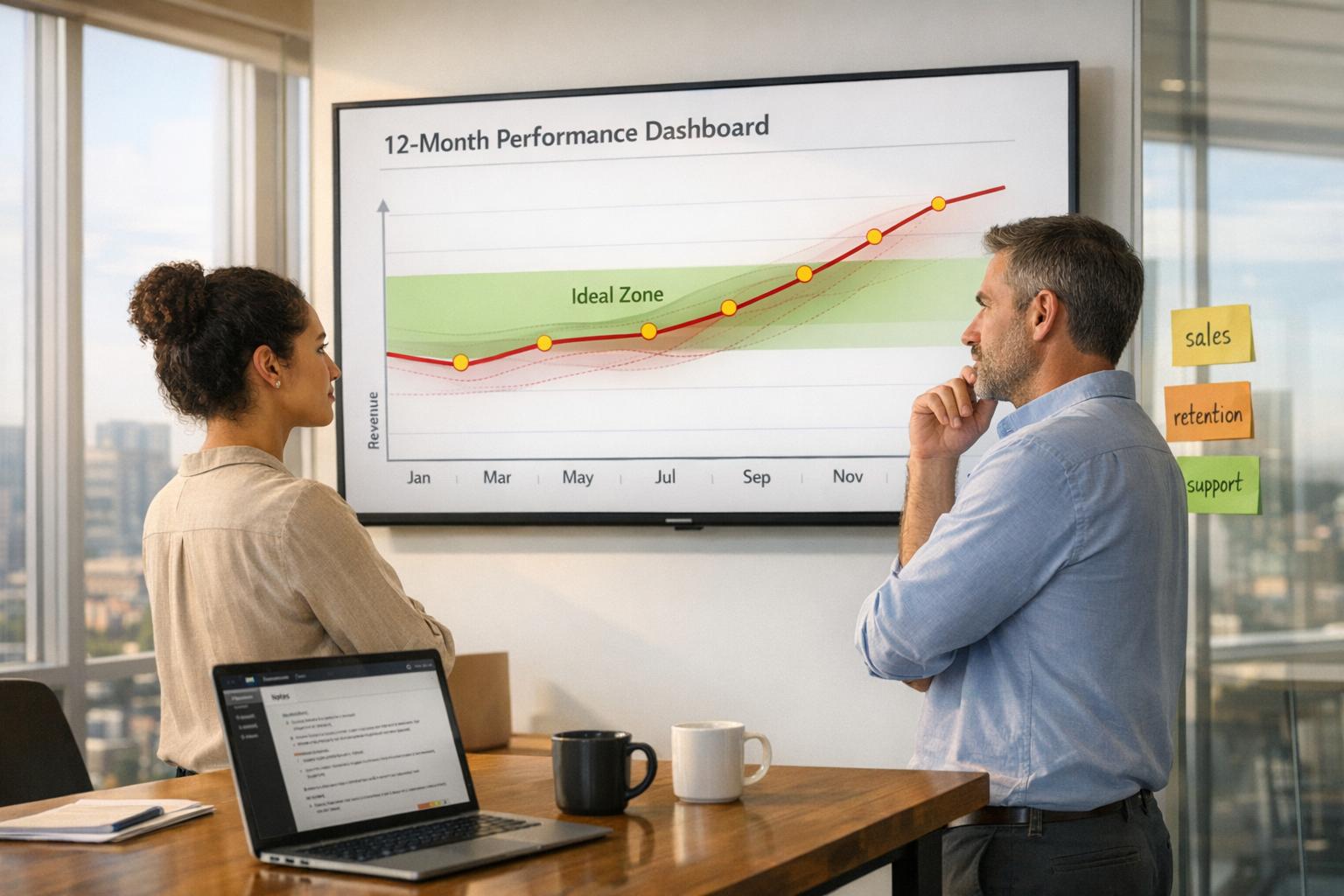
Hitting $1M ARR feels like success, but subtle problems can quietly derail your growth. Longer sales cycles, low-fit customers, and rising support costs are often symptoms of ICP drift – when your Ideal Customer Profile no longer aligns with your product or strategy. This misalignment can lead to 2.3x higher acquisition costs and 40% lower customer lifetime value.
Here’s what’s happening:
- Your $200K ICP doesn’t scale to $1M. New acquisition channels and product features attract misaligned customers.
- Messaging dilutes as your team grows, pulling in low-fit leads.
- ICP drift creeps in through longer sales cycles, shrinking expansion revenue, and spiking support tickets.
The fix? Treat ICP as a living system. Regularly monitor sales, retention, and support data to detect drift early. Refine messaging, product focus, and acquisition channels to realign with high-value customers.
Want to catch ICP drift before it costs you millions? Learn how to build a proactive detection system to protect your growth.

ICP Drift Impact: Key Metrics and Warning Signals for SaaS Founders
Why Your $200K ARR ICP Fails at $1M
The customer profile (ICP) that worked wonders when you hit $200K ARR was built on focused outreach, a simple product offering, and precise messaging. But as your business grows toward $1M, subtle shifts in strategy start pulling you away from that original ICP. These changes aren’t mistakes – they’re often logical decisions made along the way. The problem is that these small shifts snowball into a bigger issue you might not notice until it’s already costing you time and money. Let’s break down how acquisition strategies and product growth contribute to this drift.
This ICP misalignment can creep in through multiple areas: how you acquire customers, the features you add to your product, and the way your messaging evolves. For example, landing just one deal outside your ideal customer profile – maybe a big enterprise contract worth three times your usual deal size – can trigger a chain reaction. Sales starts chasing similar deals, marketing adjusts messaging to attract more of these buyers, and product teams begin prioritizing features for outlier customers. While each of these steps seems reasonable on its own, together they dilute your focus.
Here’s the result: companies serving customers outside their ICP often see customer acquisition costs (CAC) more than double and lifetime value (LTV) drop by 40%. And while markets shift every quarter, 64% of companies only revisit their ICP once a year. By the time you realize the drift, you’ve likely wasted months – and a significant chunk of your budget – pursuing the wrong audience.
Acquisition Channels Change Your Customer Mix
At $200K ARR, your growth likely came from founder-led outreach. You were sending personal emails, connecting on LinkedIn, and leveraging warm introductions. You knew your ideal customer inside and out because you were directly involved in every conversation. This hands-on approach gave you a crystal-clear understanding of who converted best.
As you scale toward $1M, though, you need to expand your acquisition efforts. You might start running LinkedIn or Google ads, partnering with other companies to drive traffic, or hiring sales development reps (SDRs) to generate leads. But these new channels come with trade-offs. Paid ads focus on clicks and form fills, not necessarily customer fit. Partnerships bring in leads from their audience, which may not align with your ICP. And new sales reps, lacking your deep understanding of the customer, will often chase anyone who shows interest.
The result? Your pipeline fills with prospects who don’t match your ideal profile. Trial-to-paid conversion rates drop – while healthy ICPs convert at 15-25%, misaligned prospects often convert at 10-15% or lower. Demo no-show rates climb to 20-40%, as these leads were never truly engaged in the first place. Suddenly, you’re working harder to close deals that used to come naturally. And just as these acquisition shifts alter your customer base, product changes amplify the drift.
Product Expansion Attracts New Segments
At $200K ARR, your product was laser-focused on solving one specific problem for one specific audience. Maybe you offered simple analytics for small marketing teams. But as you grow, you start adding features – AI forecasting, advanced integrations, custom reporting. Each addition feels like a logical step, especially when customers ask for it.
What often gets overlooked is how these new features attract different types of customers. For instance, AI-driven forecasting might catch the attention of enterprise buyers, who have entirely different needs than your original small business customers. Advanced integrations might pull in technical users who evaluate products based on criteria you never designed for.
Take Okta, for example. They initially targeted SMBs managing three or more SaaS apps. Over time, they expanded into serving larger enterprises, which required more complex solutions. While this kind of growth can be strategic, it also fundamentally alters your ICP. Every new feature, every tweak to your offering, subtly shifts your audience – and your messaging often struggles to keep up.
Messaging Dilutes as Your Team Expands
When you were the sole person driving sales, your messaging was sharp and focused. You spoke directly to the problem your product solved, using language that resonated with your ideal customers. Your website, emails, and demos all reinforced a clear and specific value proposition.
But as your team grows, consistency often takes a hit. Marketing teams might broaden the messaging to attract more leads. Sales reps push for flexibility to close deals outside the core ICP. Customer success teams advocate for features that reduce churn across a wider range of users.
This leads to diluted messaging. Instead of saying, "We help Series A SaaS companies automate their sales forecasting", you end up with something generic like, "We provide powerful analytics solutions for growing businesses." That sharp, specific pitch that made your original customers think, "This was built for me," disappears.
As one industry expert puts it:
"Your ICP is not anyone with a budget. It’s people who see your product and think, ‘This was made for me.’"
When your messaging loses focus, it attracts low-fit customers. These prospects take up demo slots, consume sales resources, and often don’t convert – or worse, they convert and become high-maintenance clients who demand features you never planned to build. This cycle drains your resources and pulls you further away from your original ICP.
sbb-itb-32a2de3
3 Data Signals That Reveal ICP Drift
ICP drift often creeps in quietly: sales cycles stretch out, expansion revenue shrinks, and support tickets pile up. These subtle changes point to a misalignment between your product and your Ideal Customer Profile (ICP). The good news? Three specific data signals can help you spot this drift early – often within 30–40 days – if you know where to look.
These signals are powerful because they reflect different stages of the customer journey. Sales cycle length reveals if your messaging still resonates with the right buyers. Expansion revenue highlights whether your product continues to deliver value to the customers you’re acquiring. And support ticket volume shows whether new customers align with the use cases your product was designed to solve. Together, these metrics act as an early warning system. Let’s break them down, starting with sales cycle delays.
Signal 1: Sales Cycles Get Longer
The first sign of ICP drift often shows up in days-to-close. For example, one company found that deals with core ICP customers closed in 12 days, while deals with drift accounts stretched to 47 days – nearly four times longer. This happens because your sales team is no longer following a proven playbook. Instead, they’re navigating uncharted territory with new buyer personas.
Longer sales cycles mean your reps lack the reference customers and proof points needed to build trust with these prospects. Objections become scattered and inconsistent. One prospect might say your product is "too complex", while another claims it’s "missing critical features." In a stable ICP, objections tend to cluster around predictable trade-offs, like price versus advanced features. When drift occurs, these objections stop aligning.
"Misfit prospects take longer to lose than good-fit prospects take to win." – SkoutLab
This mismatch creates a clogged pipeline filled with deals that linger, draining your sales team’s capacity. Companies serving multiple ICPs – often a result of drift – see sales cycles stretch 35–60% longer than those with a focused approach. To stay ahead, segment your sales data every 30–40 conversations. If certain segments are taking significantly longer to close, that’s your first red flag.
Signal 2: Expansion Revenue Drops
ICP drift doesn’t just slow down deals – it also hits your bottom line. Metrics like win rates and velocity can tell you about Message-Market Fit – whether your pitch resonates. But Net Revenue Retention (NRR) is the ultimate measure of Product-Market Fit, showing if your product delivers lasting, expanding value.
When NRR drops in newer customer cohorts, it’s a sign you’ve moved away from your core ICP into less ideal segments. These customers might be easy to acquire, with high win rates masking the issue, but they fail to expand or renew. Why? Your product addresses only surface-level problems for them, rather than becoming deeply integrated into their workflows.
For example, core ICP customers in one study showed a 35% expansion rate over three years, while outlier customers expanded by just 12%. That’s a huge gap in long-term value. Drift accounts also bring higher costs, with 40% lower lifetime value and requiring 3–5× more resources.
To identify drift, segment your NRR data by customer profile. Healthy ICP segments typically achieve 110%+ NRR, so if newer cohorts fall below that, it’s time to analyze which profiles are expanding and which are stagnating.
Signal 3: Support Tickets Increase
Another clear sign of ICP drift is a spike in support tickets. When new customers generate far more tickets than your historical average, it’s a sign they’re using your product in ways you didn’t anticipate. A study found that outlier customers submitted 7.8 support tickets per user annually, compared to just 2.3 for core ICP customers – a 3.4× increase.
"Support costs escalate because edge-case customers generate edge-case tickets. They use your product in ways you didn’t anticipate, integrate with systems you haven’t tested against, and encounter scenarios your documentation doesn’t address." – User Intuition
These mismatched customers often require custom configurations and extensive onboarding. For example, they might need 32 hours of implementation support to reach value, compared to just 8 hours for core accounts. This isn’t just a support issue – it’s a sign that your product wasn’t built for their needs, and no amount of training will fix that.
To pinpoint the problem, track support ticket volume and resolution time by customer segment. If certain cohorts require 4.1× more support hours, you’re likely serving customers outside your ICP. Tag each account’s primary use case in your CRM to correlate high ticket volume with specific misaligned use cases. This data will help you identify exactly where your ICP has drifted and which segments are draining your resources.
Treating ICP as a Living System
Many founders treat their Ideal Customer Profile (ICP) as if it’s set in stone – created during a strategy session, added to a pitch deck, and then forgotten. The problem? 64% of companies update their ICP only once a year, even though market conditions can change every few months. This creates a dangerous gap where your ICP quietly drifts out of relevance while you’re busy executing your plans.
Here’s the truth: your ICP isn’t a one-and-done document. It’s a living hypothesis that should evolve with your business. As your product grows, your customer base expands, and new acquisition channels emerge, the profile of your "ideal" customer will shift. The question isn’t whether your ICP will change – it’s how quickly you can adapt. For insights on detecting ICP drift in real time, check out our AI Acceleration Newsletter: https://maccelerator.la/en/live-presentation/#eluid160000aa.
"A static ICP is a dead ICP. Market conditions shift. Your product evolves. What once was ‘ideal’ may slowly become outdated, and if you don’t catch it, your pipeline suffers." – Peter Emad, GTM Expert, SalesCaptain
The best way to keep your ICP relevant is to treat it as a dynamic system. By continuously pulling data from your CRM, enrichment tools, and team feedback, you can monitor for changes in real time. Instead of waiting for quarterly reviews to identify issues, this system alerts you to shifts early, helping you protect your bottom line.
What a Living ICP System Looks Like
A living ICP system follows a simple but ongoing process: Define, Test, Refine, Realign. Start with your current understanding of your ideal customer, test it through real-world interactions, refine it based on outcomes, and realign your team around the updated profile.
This isn’t a one-time exercise – it’s a continuous cycle. Monthly reviews of customer data can confirm whether your ICP assumptions are still on track. Comparing newer customer cohorts to your most successful accounts helps you spot trends. Quarterly deep dives uncover shifts that might not show up in weekly metrics. The key is to make this process part of your daily workflows, not a separate project.
For example, win–loss interviews can reveal early signs of ICP drift, long before it affects your revenue. Analyzing product adoption data can show which customer segments are gaining the most value, while reviewing support tickets can flag misaligned customers early. These feedback loops keep your ICP sharp and allow for quick adjustments. This approach also lays the groundwork for automated detection systems – covered in the next section – that can identify drift in weeks instead of months.
Setting Up Feedback Loops for Monitoring
To effectively monitor your ICP, you need to connect data from five core areas: Sales, Product, Support, Marketing, and Customer Success. Each team generates signals that help identify ICP drift:
- Sales: Tracks when decision-making priorities shift.
- Product: Highlights which segments achieve "time to value" fastest.
- Support: Flags customers requiring excessive resources.
- Marketing: Reveals which campaigns draw the right leads.
- Retention Data: Confirms which segments renew and expand over time.
Top-performing sellers understand the value of continuous monitoring. In fact, 62% of them rely on ongoing industry research to refine their understanding of ideal customers. Rather than waiting for annual updates, they embed monitoring into their daily routines by tagging deals with firmographic and behavioral attributes. Automated alerts flag significant shifts, and escalation paths ensure "out-of-ICP" deals are reviewed by leadership, preventing long-term misalignment.
At M Studio, we take this a step further by integrating these feedback loops directly into your Revenue Operating System. Our system automates the entire process – tracking CRM data, cross-referencing it with enrichment tools, and alerting you when key metrics like sales cycle length or support ticket volume deviate from your ICP baseline. This allows you to identify drift within weeks, compared to the 3+ months it takes most companies. By embedding these loops into your workflows, you ensure every team stays aligned with the evolving ICP, keeping your strategy agile and effective.
The goal isn’t perfection – it’s progress. Your ICP will never be flawless, and that’s okay. What matters is having a system that catches misalignment early, long before it costs you millions in wasted resources and missed opportunities. In the next section, we’ll dive into how you can set up this proactive detection system for your business.
How to Set Up ICP Drift Detection
You’ve recognized that your Ideal Customer Profile (ICP) needs to adapt over time. Now, it’s crucial to create a system that spots misalignment before it impacts your revenue. The good news? You don’t need a data science team or pricey software. All it takes is a three-part approach: baseline metrics, automated alerts, and monthly reviews.
Skipping the baseline step is a common mistake. Without it, tracking progress is like navigating without a map. To build a solid baseline, gather data from at least 50 historical wins spanning the last 12–18 months. Segment these into three groups: Core ICP (your best customers), Adjacent (close but not ideal), and Outliers (deals that don’t fit your ICP). For each group, calculate key metrics: sales cycle length, win rate, customer acquisition cost (CAC), lifetime value (LTV), 12-month retention rate, and support ticket volume per user. This data becomes your guide for detecting shifts. Here’s how to set up this system step by step.
Step 1: Set Your Baseline Metrics
Start by analyzing your top 20 customers – the ones with the fastest sales cycles, greatest expansion, and lowest churn. Look for patterns in their firmographic and technographic attributes. This isn’t about creating an idealized profile; it’s about identifying what’s already working.
Focus on six core metrics across your three cohorts:
- Sales cycle length: How quickly deals close.
- Win rate: Your ability to convert opportunities.
- CAC and LTV: Indicators of economic health.
- 12-month retention rate: Helps catch churn early.
- Support ticket volume per user: Tracks post-sale friction.
Create a simple spreadsheet or dashboard to display these metrics side by side for all three cohorts. This setup makes it easy to spot deviations. For example, if Outliers show much longer sales cycles than Core ICP accounts, it’s a sign your targeting may need adjustment.
Step 2: Build Automated Signal Detection
Manual tracking has its limits, and letting metrics go unchecked allows drift to creep in. Automation bridges this gap. By integrating your CRM (e.g., HubSpot or Salesforce) with tools like Apollo, ZoomInfo, or Clearbit, you can continuously compare new wins against your baseline.
Set up alerts for specific thresholds. For instance:
- A 15% drop in win rates over two consecutive quarters.
- A noticeable increase in sales cycle length for Core ICP deals.
- A sudden spike in wins from an industry you weren’t targeting six months ago.
These aren’t vanity metrics – they’re early warning signs. Without automation, companies often take three months or more to detect ICP drift. Automated tools can cut that down to 4–6 weeks, giving you a head start in addressing issues.
Assign every CRM account an ICP score that weighs factors like industry fit, tech compatibility, and growth signals. If a prospect’s score falls below expectations, your sales team can reroute them through a different qualification process, avoiding deals that historically underperform.
Step 3: Run Monthly ICP Reviews
Automation helps identify potential issues, but human input is essential for interpreting the data. Schedule monthly review sessions with key team members from Sales, Marketing, Product, and Customer Success. These reviews ensure your ICP stays aligned with market realities.
During these sessions, analyze closed deals from the previous month and tackle tough questions:
- Are buyers citing new decision drivers that weren’t part of your original ICP?
- Are lost deals raising objections that don’t match historical patterns?
- Is your pipeline shifting toward lower-fit accounts (Tier 3) instead of high-fit accounts (Tier 1)?
Use a RACI model to assign roles – who’s Responsible, Accountable, Consulted, and Informed – for updating your ICP. This ensures the reviews lead to actionable changes rather than endless discussions.
Also, keep an eye on what’s known as "roadmap fracture." This measures how much of your engineering resources are being spent on features requested by outlier customers versus their revenue contribution. If outlier demands are consuming a disproportionate amount of resources, it’s a clear sign to refocus on your Core ICP.
At M Studio, we’ve integrated this framework into our Revenue Operating System. Our system automates data collection, runs detailed cohort analyses, and sends alerts when metrics deviate from your baseline. This lets you catch drift in weeks, not months. Interested in automating ICP drift detection without starting from scratch? Subscribe to our AI Acceleration Newsletter to learn how AI is reshaping how founders monitor customer cohorts. The goal isn’t to craft a flawless ICP document – it’s to build a system that spots misalignment early, saving you from wasted CAC and missed opportunities.
Fixing ICP Misalignment When You Spot It
Once you’ve identified misalignment in your Ideal Customer Profile (ICP), the next step is to act quickly and recalibrate. Fixing ICP drift doesn’t usually require a complete overhaul. Instead, it often comes down to making targeted adjustments in three areas: messaging, product priorities, and channel strategies. Companies that recover the fastest treat this as a team effort, involving marketing, product, and sales, rather than siloed fixes.
Take Vymo as an example. In 2024, their MQL-to-SQL conversion rate was just 4.5%. By introducing a "Pain Intensity Matrix" and narrowing their ICP to 50 high-value accounts in India’s banking and insurance sectors, they boosted their conversion rate to 18% in just three months, generating a $41.5M pipeline sourced from marketing.
Curious how AI can help you identify and fix ICP misalignment faster? Join our AI Acceleration Newsletter to learn about automation frameworks top founders are using to track customer trends in real-time.
Refine Messaging to Attract Better Fits
Sometimes, your messaging is aimed at the wrong audience. Founders often write for the user (the person interacting with the product daily) instead of the buyer (the one who controls the budget). This disconnect can hurt your win rates. For instance, RevOps teams might care about data integrity, but a Chief Revenue Officer (CRO) is more focused on accurate forecasts. If your website speaks only to the end-user while the decision-maker holds the purse strings, you’re likely to lose deals.
Start by reviewing lost opportunities and churned customers. Look for patterns in objections – these can reveal your "anti-ICP", or the types of customers you should avoid. Use these insights to refine your messaging to actively exclude low-fit prospects. Shopify did this successfully when they realized their true ICP was "scrappy entrepreneurs", not large retailers. They shifted their messaging to appeal to small business owners, which unlocked significant growth as these entrepreneurs felt the platform was tailored for them.
"Until your ICP aligns around the buyer (not just the user), your go-to-market motion will stall." – Patrick Thompson, Co-Founder, Clarify
Focus on identifying segments with high lifetime value, short sales cycles, and strong retention. Then, implement "Message House Discipline", ensuring all sales and marketing content addresses the challenges and goals of your refined ICP. Avoid vague statements like "we serve enterprise" and opt for specifics such as "we serve mid-market SaaS companies with 50–200 employees who just raised Series A." Clear messaging helps the right customers self-select and discourages low-fit prospects from engaging.
Once your messaging is sharp, it’s time to align your product with these high-value segments.
Realign Product with High-Value Segments
Your product roadmap can get off track if you’re catering to outlier demands. If too many resources are being spent on features requested by a small subset of customers, you might be experiencing "roadmap fracture." Instead, base your development efforts on usage data from your best customers – not just the loudest ones.
Consider implementing a tiered service model. High-value segments, like enterprise clients, could receive high-touch support and custom integrations. Meanwhile, smaller customers might transition to self-service or low-touch models. For example, one mid-market company found that while enterprise clients made up just 12% of their customer base, they generated 60% of total revenue. This insight allowed them to focus their resources where it mattered most.
Use frameworks like MoSCoW to prioritize features – categorizing them as "Must have", "Should have", "Could have", or "Won’t have" – based on the needs of high-value customers. SoluteLabs, a product engineering firm, used an "Operational Readiness" checklist to qualify leads by assessing their technical infrastructure and internal champions. This approach reduced implementation time by 60% and improved lead quality by focusing only on customers who were set up for success.
Once your product is aligned with your top segments, focus on optimizing how you reach these customers.
Optimize Acquisition Channels
Not all acquisition channels deliver the same quality of customers. If your best clients come through referrals and partnerships, but you’re pouring money into channels that attract low-fit leads, you’re wasting resources. Start by setting up a Traffic Light System for lead scoring:
- Green (80%+ ICP match): Immediate attention.
- Yellow (60–79%): Nurture over time.
- Red (below 60%): Disqualify right away.
Analyze your last 20 high-value wins. Where did they come from? What content resonated with them? Were there specific triggers – like new funding, executive hires, or competitor activity – that prompted them to act? Use this data to create lookalike profiles of your top 500 potential customers and focus your outbound efforts there. Test new channels with small batches (50–100 prospects over a week) to measure response rates before committing significant budgets.
Finally, align incentives to prioritize deals that fit your ICP. This ensures your team isn’t chasing low-fit customers just to hit quotas.
At M Studio, we’ve built ICP drift detection and correction into our Revenue Operating System. By catching early signs of misalignment, our system helps you make coordinated adjustments across messaging, product, and channels. The goal? To address ICP drift before it leads to higher acquisition costs and lost opportunities.
Conclusion: Catch ICP Drift Before It Costs You
ICP drift doesn’t come with flashing warning signs. Revenue might even grow while your unit economics quietly deteriorate. By the time you notice retention issues or rising support costs, the drift has often been happening for six months or more. According to data, the average mid-market company loses $12.9 million annually due to misaligned targeting, which eats away at margins through poorly matched customer acquisition[1]. This slow but steady erosion highlights the need for proactive oversight.
Smart companies don’t wait for these issues to spiral. They treat their ICP as a dynamic system – constantly monitoring for changes, reviewing performance quarterly, and adjusting before small shifts turn into big problems. Curious how AI can help you stay ahead of ICP drift? Subscribe to our AI Acceleration Newsletter to learn how top founders use automation to track customer trends in real time.
As mentioned earlier, a static ICP won’t sustain growth beyond $200K ARR. The three key signals – longer sales cycles, falling expansion revenue, and rising support tickets – demand immediate action. At M Studio, we’ve integrated drift detection into our Revenue Operating System. Our diagnostic tool identifies misaligned segments, calculates the financial impact, and suggests corrective steps. With these monitoring systems, you can detect drift in weeks instead of quarters, keeping your growth on track.
Don’t let ICP drift go unnoticed. Join our next Founders Meeting to see the diagnostic in action: https://maccelerator.la/en/live-presentation/
[1] RAG Data: Key insights on ICP drift.FAQs
How do I know if my ICP has drifted?
You can spot ICP drift by keeping an eye on a few telltale signs: sales cycles taking longer in segments that used to close quickly, a drop in expansion revenue from your current customers, and an increase in support tickets from newer customers. These patterns indicate that your ideal customer profile might not match your current customer base anymore. Staying on top of these trends regularly can help you identify and tackle drift before it becomes a bigger problem.
What data should I track to catch drift early?
To spot ICP drift early, keep an eye on key metrics like sales cycles getting longer (deals that used to close quickly now dragging on), drops in expansion revenue (fewer successful upsells), and a rise in support tickets (new customers needing extra assistance). Additionally, tracking changes in win rates, churn rates, and lead quality can provide valuable insights. Leverage systems that compare current customer data against your baseline ICP and set up alerts to flag any major shifts.
How do I fix ICP drift without slowing growth?
To address ICP drift without hindering growth, think of your ICP (Ideal Customer Profile) as a living system that needs constant attention and fine-tuning. Watch for red flags like extended sales cycles in crucial segments, drops in expansion revenue, or an uptick in support requests from newer customers. Leverage tools that can track patterns in real-time and experiment cautiously with new segments. Continuously refine your ICP using verified insights to ensure it keeps pace with shifting customer demands.