

SECTION 1: EXECUTIVE SUMMARY
For founders of Seed and Series A technology startups, the path to building a scalable sales engine presents a critical and often daunting decision. The central question is not merely how to generate revenue, but who should be responsible for it. Do you build an in-house team from scratch, a move that promises deep product knowledge and cultural alignment but demands significant time, resources, and expertise to manage? Or do you buy the services of a traditional B2B sales agency, which offers immediate capacity and specialized experience but can create dependency and may not yield lasting internal capabilities? This review is designed to provide a comprehensive framework for navigating this complex choice.
This 2026 analysis delves into the top B2B sales and marketing agencies that cater to the tech startup ecosystem. We will provide detailed reviews of leading firms, evaluating their pricing models, service scopes, and ideal customer profiles. However, this report goes beyond a simple agency ranking. It also introduces a strategic alternative: the “build vs. buy” decision framework. We will explore a hybrid approach that focuses on building internal, AI-powered sales systems with expert guidance, a model championed by firms like M Studio. This review will equip you with the insights to determine whether you should rent sales capacity or invest in building a revenue-generating asset you own forever. A downloadable comparison spreadsheet is also provided to help you filter and select the best path for your unique situation.
SECTION 2: HOW TO USE THIS REVIEW
This review is structured to guide founders and executives at different stages of their company’s growth. To get the most value, consider which of the following profiles best describes your current situation:
- For Seed Stage Founders: Your primary focus is likely on validating your sales process and achieving initial market traction. You should prioritize agencies that offer flexible pricing models, pilot programs, and have demonstrable expertise in early-stage GTM validation. Look for partners who can help you test messaging and identify your ideal customer profile (ICP) without locking you into long-term, high-cost retainers.
- For Series A/B Scale-Ups: You have an established product and are now focused on scaling your revenue engine. Your ideal agency partner will have proven, repeatable playbooks in your specific vertical (e.g., vertical SaaS, FinTech). Scrutinize their case studies and look for evidence of their ability to generate a predictable pipeline and integrate with your existing sales and marketing teams.
- For Technical Founders: If you come from a product or engineering background, you may need more than just sales execution. Consider whether you require a full-service agency that can handle everything from strategy to closing deals, or if you need specific components like top-of-funnel lead generation to complement your own product-led growth initiatives.
- For International Expansion: For companies outside the United States looking to enter the competitive US market, it is crucial to select an agency with deep expertise in this specific geography. These agencies can provide not only sales execution but also invaluable insights into local market nuances, compliance, and competitive landscape.
To further tailor your evaluation, download the comparison spreadsheet to filter agencies based on your specific criteria, including pricing, industry focus, and service scope.
SECTION 3: EVALUATION CRITERIA
To provide a standardized and objective comparison, we evaluated each agency across a consistent set of criteria. Understanding these dimensions will help you assess which firm is the best fit for your needs.
| Criteria | Description |
|---|---|
| Pricing Model | How the agency charges for its services. This can range from a flat monthly Retainer, a Commission-based model tied to results, a Hybrid of both, or a fixed-price Project-based fee. |
| Stage Specialization | The typical company stage the agency works with, from early-stage Seed and Series A-B startups to later-stage Growth and Enterprise clients. |
| Service Scope | The range of services offered, which can include SDR only (top-of-funnel), Full-cycle sales (from lead to close), integrated Sales + Marketing, or high-level GTM strategy. |
| Industry Focus | Whether the agency specializes in specific verticals such as Vertical SaaS, Horizontal SaaS, Marketplaces, FinTech, or other niche industries. |
| Technology Stack | The core sales and marketing technologies the agency uses and integrates with, such as Salesforce, HubSpot, Outreach, or SalesLoft. |
| Geographic Expertise | The primary markets the agency serves, whether it’s US-only, International, or specific global regions. |
| Engagement Model | How the agency collaborates with clients. This can be as an Embedded team that acts like your own, a fully Outsourced function, a Hybrid model, or a mix of Consulting + Execution. |
| Minimum Commitment | The minimum investment required to engage the agency, including the typical Monthly retainer, minimum Contract length, and the availability of Pilot programs. |
| Success Metrics | How the agency measures its performance and guarantees results. This could be based on meetings booked, qualified leads generated, or revenue influenced. |
| Best For | The specific use cases and scenarios where the agency has demonstrated exceptional strength and is most likely to deliver value. |
SECTION 4: THE STRATEGIC ALTERNATIVE – M STUDIO
When to Build Capability Instead of Renting It: The M Studio Approach
Before evaluating the landscape of external sales agencies, it is essential to consider a fundamental question: What if the goal is not simply to hire an agency, but to build an internal, self-sustaining sales capability with strategic guidance instead? This question reframes the “build vs. buy” decision from a choice between an internal team and an external one to a choice between renting temporary capacity and owning a permanent, compounding asset. This is the core philosophy behind the M Studio approach.
Traditional agencies operate on a model of rented capacity. You pay a retainer, and they provide a team to execute sales functions. While this can deliver short-term results, the progress often halts the moment the contract ends. The playbooks, the processes, and the learnings walk out the door with the agency. M Studio, in contrast, focuses on building owned capability. The goal is to construct an AI-powered, automated sales and marketing system that you, the founder, own and control. It’s the difference between hiring a contractor to renovate your house versus hiring an architect who not only designs the plans but also teaches you how to build, leaving you with both a finished home and the skills to maintain and expand it indefinitely.
So, what does M Studio actually do? It combines strategic go-to-market (GTM) consulting with hands-on implementation of AI-powered automation. This includes:
- Building AI-Powered Lead Generation Systems: M Studio designs and implements automated workflows using tools like N8N, Zapier, and CRM integrations to create a consistent, scalable flow of qualified leads.
- Sales Process Design and Training: They don’t just run the process; they design it with you and train your team to execute it effectively, ensuring the skills and knowledge remain in-house.
- Technology-Agnostic Implementation: M Studio works with your existing technology stack, whether it’s HubSpot, Salesforce, or a collection of other tools, to build a cohesive and efficient system.
- US-Based GTM for International Companies: For international startups, M Studio acts as the initial US-based go-to-market team, building the foundational systems and processes necessary to establish a strong local presence.
This integrated approach ensures that your sales systems are not developed in a silo. As your product roadmap and strategic priorities evolve, your sales and marketing systems evolve with them. This is because M Studio works across strategy, execution, and communication simultaneously, creating a truly aligned revenue engine.
Who is this for?
- Founders who want to own their sales systems, not just rent them.
- Companies planning to hire an internal sales team in the next 6-12 months (M Studio builds the infrastructure they will inherit).
- Technical founders who need to build a robust sales infrastructure, not just outsource sales execution.
- International companies expanding to the US market who need to build a local GTM engine from the ground up.
- Businesses that have tried traditional agencies and are looking for a more sustainable, long-term solution.
With a track record of coaching over 500 founders across 30 countries and helping companies improve close rates from 15% to over 40%, M Studio brings enterprise-grade expertise from their work with companies like Google, Disney, and Siemens to the startup world. Their pricing model is also designed to align with the startup journey, offering a mix of a low-cost monthly membership for ongoing coaching, project-based GTM engineering, and enterprise partnerships.
However, M Studio isn’t for everyone. If you need immediate sales capacity this quarter, want to purely outsource without any internal involvement, or are not ready to invest in building owned systems, a traditional agency may be a better fit. But for founders who want to build a lasting, scalable revenue machine, the M Studio approach presents a compelling strategic alternative.
SECTION 5: TRADITIONAL B2B SALES AGENCIES – DETAILED REVIEWS
inBeat

Quick Summary: inBeat positions itself as a performance-driven creative and influencer marketing agency that specializes in generating user-generated content (UGC) to fuel B2B SaaS growth. They blend influencer strategy with paid media to deliver scalable results across the sales funnel.
| Evaluation Criteria | Assessment |
|---|---|
| Pricing Model | Project-based, with retainers for ongoing services. Specific pricing is not publicly available. |
| Stage Focus | Primarily Seed to Series B, but also works with larger brands. |
| Service Scope | Sales + Marketing, with a strong emphasis on top-of-funnel awareness and lead generation through creative and influencer campaigns. |
| Industry Specialization | B2B, SaaS, Mobile Applications, CPG, DTC, Retail, eCommerce, Fashion, Food. |
| Technology Stack | Proprietary influencer and content creator network, integrates with major social media and advertising platforms. |
| Geographic Expertise | North America, with experience running global campaigns in 15+ languages. |
| Engagement Model | Outsourced creative and campaign management. |
| Minimum Commitment | Not publicly specified, likely project-based or requiring a minimum contract length for retainer services. |
What They Do Well:
- High-Quality User-Generated Content (UGC): inBeat excels at producing authentic and high-performing UGC at scale, which is a powerful asset for B2B SaaS companies looking to build trust and social proof.
- Performance-Driven Influencer Marketing: They have a strong focus on measurable results, using data-backed media buying and influencer whitelisting to optimize campaigns for CAC, ROAS, and other key B2B metrics.
- Multi-Stage Funnel Expertise: The agency has proven workflows for using creative and influencer content at every stage of the SaaS funnel, from awareness and onboarding to trials and demos.
Potential Limitations:
- Focus on Top-of-Funnel: While they address the full funnel, their core strength lies in creative and influencer-led top-of-funnel marketing. Companies needing heavy bottom-of-funnel sales execution may need to supplement their services.
- Broad Industry Focus: While they have a B2B SaaS specialty, their client base is diverse. Startups in highly niche or technical verticals should verify the agency’s specific experience in their domain.
Best For: B2B SaaS companies that want to leverage creative, user-generated content, and influencer marketing to build brand awareness, generate leads, and drive conversions, particularly on platforms like TikTok and Instagram.
Not Ideal For: Companies that require a primary focus on traditional outbound sales, cold calling, or a full-cycle sales team to close high-ticket enterprise deals.
Bottom Line: inBeat is a strong choice for tech startups looking to build a powerful top-of-funnel marketing engine driven by authentic content and modern social channels. Their performance-oriented approach to creative and influencer marketing makes them a valuable partner for growth-stage companies aiming to scale customer acquisition.
Kalungi
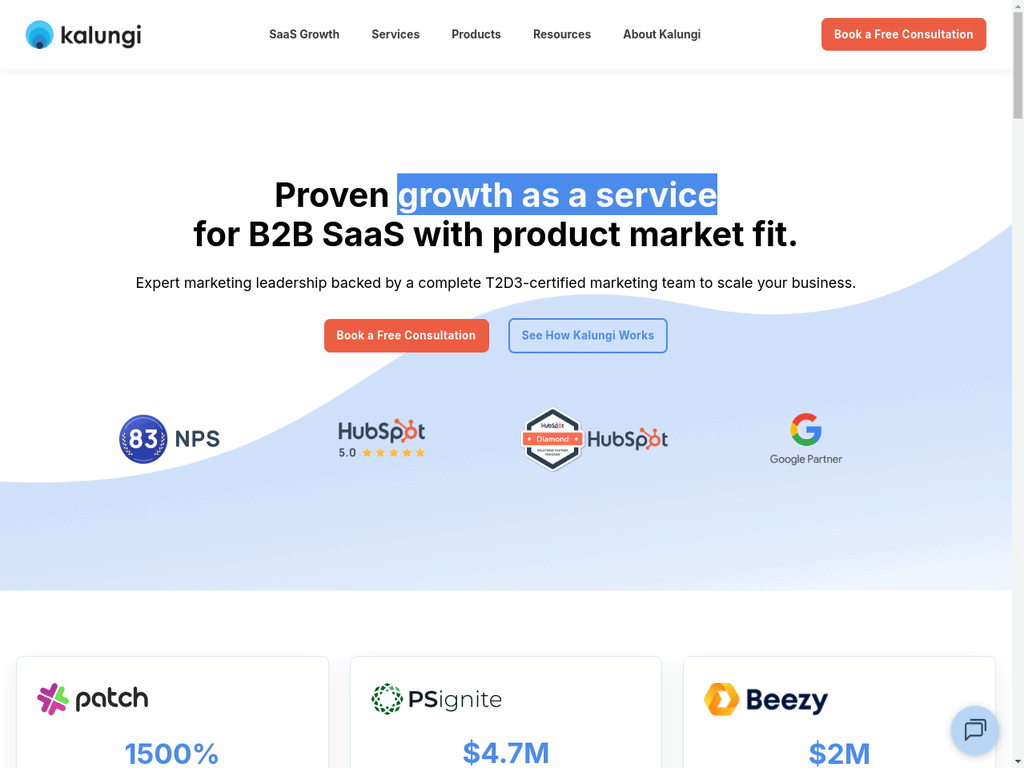
Quick Summary: Kalungi is a highly specialized, full-service marketing agency built exclusively for B2B SaaS companies. They offer a complete, outsourced marketing team, from fractional CMOs to tactical execution, with a unique pay-for-performance model.
| Evaluation Criteria | Assessment |
|---|---|
| Pricing Model | Pay-for-performance hybrid model. Full-service engagements start at $45,000/month, with a portion of the retainer tied to performance outcomes. |
| Stage Focus | Early-stage to growth-stage B2B SaaS companies ready to scale. |
| Service Scope | Full-service Sales + Marketing, including fractional CMO, content, paid media, SEO, ABM, branding, web development, and marketing automation. |
| Industry Specialization | Exclusively B2B Software as a Service (SaaS). |
| Technology Stack | HubSpot Diamond Partner, with expertise across the modern marketing technology stack. |
| Geographic Expertise | Primarily North America, but serves a global client base. |
| Engagement Model | Outsourced, acting as a complete, instant marketing team for clients. |
| Minimum Commitment | Engagements typically start with a two-day workshop, implying a significant initial commitment. |
What They Do Well:
- Deep SaaS Specialization: Kalungi’s exclusive focus on B2B SaaS gives them a profound understanding of the industry’s challenges, metrics, and growth levers. Their T2D3 growth playbook is specifically designed for this market.
- Full-Service, Integrated Team: They provide a complete marketing department in a box, from strategic leadership (fractional CMO) to execution across all key channels. This is ideal for startups that lack an internal marketing function.
- Pay-for-Performance Model: Their willingness to tie a portion of their fees to measurable outcomes (MQLs, pipeline, etc.) demonstrates a strong commitment to delivering ROI and aligns their incentives with their clients’ success.
Potential Limitations:
- High Cost of Entry: With full-service engagements starting at $45,000 per month, Kalungi is a significant investment that may be out of reach for many seed-stage or bootstrapped startups.
- Prescriptive Playbook: While their T2D3 playbook is proven, companies with highly unique or disruptive business models may find a one-size-fits-all approach to be less effective than a more customized strategy.
Best For: Venture-backed B2B SaaS companies with product-market fit that need to rapidly build and scale a professional marketing function to hit aggressive growth targets.
Not Ideal For: Very early-stage startups that are still in the process of validating their product or market, or companies with a limited budget.
Bottom Line: Kalungi is a top-tier choice for B2B SaaS companies that are ready to pour fuel on the fire. Their deep specialization and pay-for-performance model make them a compelling, albeit expensive, option for businesses that need a complete, experienced marketing team from day one.
Ironpaper
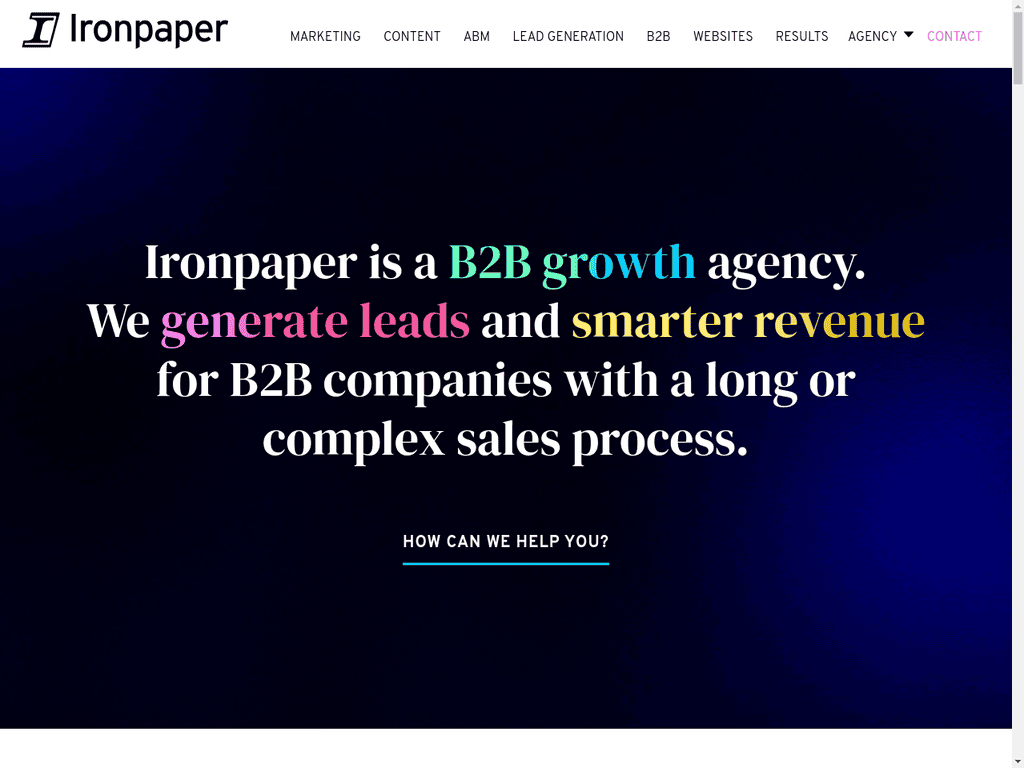
Quick Summary: Ironpaper is a B2B growth agency that focuses on generating qualified leads and accelerating revenue for companies with long or complex sales cycles. They specialize in integrating marketing, sales enablement, and content to improve the buyer’s journey.
| Evaluation Criteria | Assessment |
|---|---|
| Pricing Model | Retainer-based. Specific pricing is not publicly available. |
| Stage Focus | Mid-market to Enterprise, with experience across various company sizes. |
| Service Scope | Full-funnel B2B marketing, including ABM, demand generation, lead generation, content marketing, sales enablement, and website design. |
| Industry Specialization | Technology, SaaS, Professional Services, Healthcare (B2B), and Information Technology. |
| Technology Stack | HubSpot Diamond Partner, proficient with Salesforce and other B2B marketing and sales technologies. |
| Geographic Expertise | Primarily North America. |
| Engagement Model | Acts as a strategic partner and an extension of the client’s in-house team. |
| Minimum Commitment | Not publicly specified, but their model suggests a long-term partnership approach. |
What They Do Well:
- Sales and Marketing Alignment: Ironpaper places a strong emphasis on aligning marketing efforts with sales objectives to ensure that marketing activities translate directly into pipeline and revenue growth.
- Full-Funnel Expertise: They have a holistic approach that covers the entire buyer’s journey, from attracting attention with content to enabling sales teams to close deals more effectively.
- Data-Driven and Results-Oriented: The agency is focused on measurable results and uses data to inform its strategies, with a clear focus on metrics that matter to the C-suite, such as lead quality and marketing ROI.
Potential Limitations:
- Less Focus on Early-Stage Startups: While they work with a range of companies, their positioning and case studies suggest a stronger focus on more established mid-market and enterprise clients rather than seed-stage startups.
- Broad Service Offering: As a full-service agency, they may not have the same level of niche specialization in a single area (like pure-play SDR outsourcing) as some other firms.
Best For: B2B companies with a complex sales process that need a strategic partner to build a comprehensive, integrated marketing and sales engine that drives long-term, sustainable growth.
Not Ideal For: Early-stage startups looking for a low-cost, tactical solution for immediate lead generation, or companies that only need a single, specialized service.
Bottom Line: Ironpaper is a reputable and experienced B2B growth agency that is well-suited for companies that are ready to invest in a strategic, long-term marketing program. Their focus on aligning marketing with sales and their data-driven approach make them a strong partner for businesses looking to achieve scalable and measure real growth.
Gripped

Quick Summary: Gripped is a London-based B2B digital marketing agency that specializes in driving measurable growth for SaaS and technology companies. They focus on creating and capturing demand with a buyer-centric approach that prioritizes sales conversations, pipeline, and revenue.
| Evaluation Criteria | Assessment |
|---|---|
| Pricing Model | Not publicly specified, likely retainer-based. |
| Stage Focus | SaaS and technology companies, from startups to established businesses. |
| Service Scope | Sales + Marketing, including demand generation, ABM, content marketing, SEO, paid search, and website design. |
| Industry Specialization | Exclusively Software as a Service (SaaS) and Technology. |
| Technology Stack | Works with the client’s existing tech stack, with expertise in HubSpot and other common marketing and sales platforms. |
| Geographic Expertise | United Kingdom and Europe, with an understanding of the broader international market. |
| Engagement Model | Agile and collaborative, acting as an extension of the client’s team. |
| Minimum Commitment | Not publicly specified. |
What They Do Well:
- Strong Focus on Pipeline and Revenue: Gripped is laser-focused on marketing activities that drive sales conversations and revenue, avoiding vanity metrics and aligning their efforts with business outcomes.
- Buyer-Centric Approach: They invest time in deeply understanding their clients’ ideal customer profiles and buyer journeys, which allows them to create more resonant and effective marketing campaigns.
- Agile and Integrated Model: Their agile approach allows them to adapt to changing market dynamics and client needs, and they work closely with existing teams to ensure seamless execution.
Potential Limitations:
- Geographic Focus: As a London-based agency, they may be a better fit for UK and European companies than for North American businesses looking for a local partner.
- Newer Agency: While growing rapidly, they may not have the same long-term track record as some of the more established agencies in the market.
Best For: B2B SaaS and tech companies in the UK and Europe that are looking for a data-driven, revenue-focused marketing agency to help them build a scalable demand generation engine.
Not Ideal For: Companies outside of Europe looking for a US-based agency, or businesses that need a purely tactical, low-cost solution.
Bottom Line: Gripped is a modern, agile, and results-oriented agency that is well-positioned to help SaaS and tech companies drive growth. Their focus on pipeline and revenue, combined with their buyer-centric approach, makes them a strong contender for businesses looking for a true marketing partner.
Stratabeat
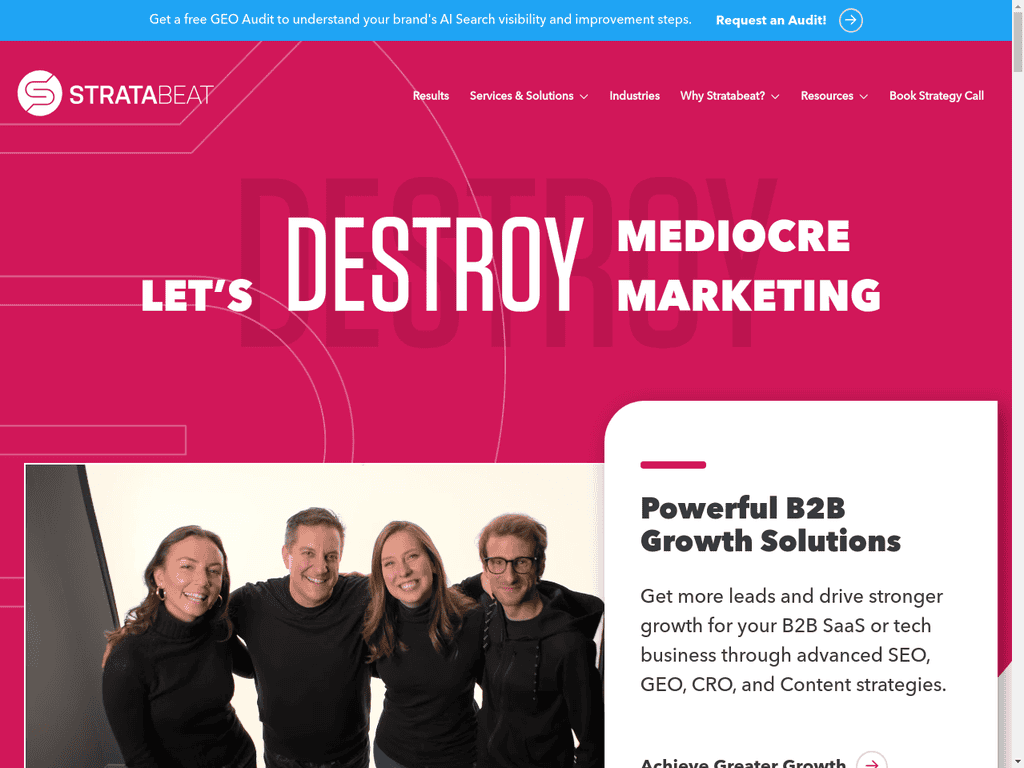
Quick Summary: Stratabeat is a B2B marketing and SEO agency that focuses on driving organic growth for SaaS and tech companies. They differentiate themselves through a neuroscience-based approach to marketing, using behavioral insights to create more impactful strategies.
| Evaluation Criteria | Assessment |
|---|---|
| Pricing Model | Not publicly specified, likely retainer-based. |
| Stage Focus | B2B SaaS and technology companies of various sizes. |
| Service Scope | Primarily focused on organic growth, including advanced SEO, content strategy, and conversion rate optimization (CRO). |
| Industry Specialization | B2B, SaaS, FinTech, HealthTech, Green Tech, and Venture Capital. |
| Technology Stack | Proficient with a wide range of SEO and marketing analytics tools. |
| Geographic Expertise | Primarily North America. |
| Engagement Model | Strategic and consultative, with a focus on delivering both quick wins and long-term, compounding results. |
| Minimum Commitment | Not publicly specified. |
What They Do Well:
- Neuroscience-Based Marketing: Stratabeat’s unique application of behavioral intelligence and neuroscience principles helps them create marketing strategies that are more likely to resonate with and influence target audiences.
- Advanced SEO and Content Strategy: They have deep expertise in technical SEO, content-ICP fit verification, and creating authority-building content that drives significant organic growth.
- Intense Focus on CRO: The agency goes beyond just driving traffic, with a strong emphasis on conversion rate optimization to ensure that website visitors are converted into qualified leads and customers.
Potential Limitations:
- Niche Focus on Organic Growth: While they excel at SEO and content, companies looking for a full-service agency that also handles paid media, social media management, and other channels may need to look elsewhere.
- Abstract Approach: The “neuroscience-based” positioning, while unique, may be too abstract for some founders who are looking for a more straightforward, tactical approach to lead generation.
Best For: B2B SaaS and tech companies that want to build a dominant organic search presence and are looking for a strategic partner to help them achieve long-term, sustainable growth through advanced SEO and content marketing.
Not Ideal For: Companies that need immediate, short-term lead generation through paid channels, or businesses that are not ready to invest in a long-term organic growth strategy.
Bottom Line: Stratabeat offers a unique and powerful approach to B2B marketing that is well-suited for companies that are serious about winning in organic search. Their combination of neuroscience, advanced SEO, and a relentless focus on CRO makes them a compelling choice for businesses looking to build a durable competitive advantage.
310 Creative

Quick Summary: 310 Creative is a full-funnel B2B marketing agency that specializes in inbound marketing, account-based marketing (ABM), and sales enablement. They focus on creating predictable and repeatable revenue streams for funded startups and large enterprise companies.
| Evaluation Criteria | Assessment |
|---|---|
| Pricing Model | Not publicly specified, likely retainer-based. |
| Stage Focus | Funded startups to large enterprise companies. |
| Service Scope | Full-funnel Sales + Marketing, including inbound marketing, ABM, SEO, PPC, web design, and sales enablement. |
| Industry Specialization | SaaS and professional service brands. |
| Technology Stack | HubSpot and WordPress expertise. |
| Geographic Expertise | Primarily North America. |
| Engagement Model | Collaborative partnership focused on aligning with client goals. |
| Minimum Commitment | Not publicly specified. |
What They Do Well:
- Full-Funnel Approach: 310 Creative has a comprehensive service offering that covers the entire customer lifecycle, from attracting visitors to delighting customers.
- Inbound and ABM Expertise: They have strong capabilities in both inbound marketing and ABM, allowing them to create integrated strategies that are tailored to the client’s specific needs.
- Revenue-Focused: The agency is focused on driving predictable revenue growth and has a proven track record of helping businesses scale their customer acquisition efforts.
Potential Limitations:
- Less Niche Than Some Competitors: While they have a focus on SaaS and professional services, their client base is more diverse than some of the other agencies on this list, which could mean less specialized expertise in certain niche verticals.
- Traditional Agency Model: Their approach appears to be more aligned with the traditional agency model, which may be less appealing to founders who are looking for a more modern, agile, or technology-driven partner.
Best For: B2B companies that are looking for a full-service agency to help them build and execute a comprehensive inbound and account-based marketing strategy.
Not Ideal For: Companies that are looking for a highly specialized, niche agency, or businesses that are seeking a more innovative or technology-driven approach to sales and marketing.
Bottom Line: 310 Creative is a solid, experienced B2B marketing agency with a strong track record of success. Their full-funnel approach and expertise in both inbound and ABM make them a good choice for companies that are looking for a reliable partner to help them drive revenue growth.
Directive Consulting
Quick Summary: Directive Consulting is a performance marketing agency that specializes in serving B2B, SaaS, and enterprise brands. They focus on building demand generation programs that fuel measurable pipeline growth and accelerate revenue.
| Evaluation Criteria | Assessment |
|---|---|
| Pricing Model | Not publicly specified, likely retainer-based. |
| Stage Focus | B2B, SaaS, and enterprise brands. |
| Service Scope | Performance marketing, including paid media, SEO, lifecycle marketing, and revenue operations. |
| Industry Specialization | B2B SaaS and enterprise technology companies. |
| Technology Stack | Proficient with a wide range of marketing and sales technologies. |
| Geographic Expertise | Primarily North America. |
| Engagement Model | Strategic and results-driven, with a focus on quantifiable business outcomes. |
| Minimum Commitment | Not publicly specified. |
What They Do Well:
- Customer Generation Methodology: Directive’s proprietary “Customer Generation” methodology ensures that all marketing activities are directly tied to the client’s bottom line, focusing on converting intent into pipeline at every stage of the buying cycle.
- Data-Driven and Creative Execution: They integrate a data-driven methodology with creative execution to deliver B2B campaigns that resonate with decision-making audiences and produce quantifiable business outcomes.
- Deep Industry Experience: Their team leverages deep industry experience to craft hyper-targeted strategies that address the unique challenges of B2B SaaS companies.
Potential Limitations:
- Focus on Performance Marketing: While they excel at performance marketing, companies looking for a broader range of services, such as comprehensive branding or content creation, may need to supplement their efforts.
- Enterprise Focus: Their positioning and client base suggest a stronger focus on larger, enterprise-level clients, which may make them a less ideal fit for early-stage startups.
Best For: B2B SaaS and enterprise companies that are looking for a performance-driven marketing agency to help them scale their demand generation and revenue growth efforts.
Not Ideal For: Early-stage startups with limited budgets, or companies that are looking for a full-service agency that can handle all aspects of their marketing and sales.
Bottom Line: Directive Consulting is a top-tier performance marketing agency that is well-suited for B2B SaaS and enterprise companies that are serious about driving measurable results. Their Customer Generation methodology and data-driven approach make them a strong partner for businesses looking to accelerate their growth.
Omniscient

Quick Summary: Omniscient is an organic growth agency that specializes in helping B2B software companies achieve scalable and sustainable growth through SEO, content marketing, and conversion rate optimization.
| Evaluation Criteria | Assessment |
|---|---|
| Pricing Model | Full-service engagements start at $10,000 a month. |
| Stage Focus | B2B software companies, from startups to large enterprises. |
| Service Scope | Organic growth, including SEO strategy, content marketing, programmatic SEO, and conversion rate optimization. |
| Industry Specialization | B2B Software as a Service (SaaS). |
| Technology Stack | Proficient with a wide range of SEO and content marketing tools. |
| Geographic Expertise | Primarily North America. |
| Engagement Model | Strategic partner that embeds with the client’s team. |
| Minimum Commitment | Not publicly specified, but their model suggests a long-term partnership. |
What They Do Well:
- Deep Specialization in Organic Growth: Omniscient has a laser focus on organic growth channels, allowing them to develop deep expertise in SEO and content marketing for B2B SaaS companies.
- Proven Track Record: They have a strong portfolio of case studies with impressive results, including significant increases in organic traffic, conversions, and pipeline for well-known SaaS brands like Jasper and SAP.
- Strategic Partnership Model: They position themselves as a strategic partner that works closely with the client’s team to develop and execute a tailored organic growth program.
Potential Limitations:
- Niche Focus: Similar to Stratabeat, their specialization in organic growth means that companies looking for a full-service agency will need to supplement their services with other partners.
- High Cost of Entry: With engagements starting at $10,000 per month, they may be out of reach for some early-stage startups.
Best For: B2B software companies that are ready to make a significant investment in building a long-term, sustainable organic growth engine.
Not Ideal For: Companies that need immediate, short-term results from paid channels, or businesses with limited budgets.
Bottom Line: Omniscient is a high-quality, specialized agency that can deliver impressive results for B2B SaaS companies that are serious about organic growth. Their strategic approach and proven track record make them a top choice for businesses that are looking to build a durable competitive advantage through SEO and content marketing.
SimpleTiger

Quick Summary: SimpleTiger is a SaaS marketing agency that focuses on delivering the fastest possible SEO and PPC results for SaaS businesses. They use a combination of proprietary AI technology and a proven playbook to expedite the typically slow process of organic and paid growth.
| Evaluation Criteria | Assessment |
|---|---|
| Pricing Model | Not publicly specified, but they offer a “Free Demo” and a “Get Pricing” option, suggesting a customized pricing model. |
| Stage Focus | SaaS companies of all sizes, from seed-funded startups to public and enterprise companies. |
| Service Scope | SEO, PPC, and Web Design for SaaS, with a focus on performance-driven marketing. |
| Industry Specialization | Exclusively SaaS, with experience in B2B, B2B2C, and B2C SaaS. |
| Technology Stack | Proprietary AI-powered keyword research process, and proficiency with a wide range of SEO and PPC tools. |
| Geographic Expertise | Primarily North America. |
| Engagement Model | Agile and scalable, with a focus on reducing time-to-results and increasing efficiency. |
| Minimum Commitment | Not publicly specified. |
What They Do Well:
- Focus on Speed and Efficiency: SimpleTiger’s core value proposition is their ability to deliver fast results. They use AI and a streamlined process to accelerate growth, which is highly appealing to startups under pressure to show traction.
- Synergized SEO and PPC: They have a strong understanding of how to synergize organic and paid channels to maximize results, using data from paid campaigns to inform SEO strategy and vice versa.
- SaaS-Specific Expertise: Their exclusive focus on SaaS gives them a deep understanding of the industry’s trends, tactics, and strategies, allowing them to deliver more effective campaigns.
Potential Limitations:
- “Fastest Possible” Claims: While appealing, the claim of the “fastest possible” results should be met with a degree of skepticism. SEO and organic growth are inherently long-term strategies, and while they can be accelerated, there are no silver bullets.
- Proprietary AI Technology: The reliance on proprietary AI technology can be a double-edged sword. While it may provide a competitive advantage, it can also create a lack of transparency and make it difficult for clients to understand the underlying methodology.
Best For: SaaS companies that are looking for a performance-driven marketing agency to help them achieve rapid growth in both organic and paid channels.
Not Ideal For: Companies that are looking for a more traditional, long-term strategic partner, or businesses that are skeptical of claims of rapid, AI-driven results.
Bottom Line: SimpleTiger is an intriguing option for SaaS companies that are looking for a fast-moving, results-oriented marketing agency. Their focus on speed and efficiency, combined with their deep SaaS expertise, makes them a compelling choice for businesses that are under pressure to deliver rapid growth.
SECTION 6: AGENCY COMPARISON BY CATEGORY
To help you navigate the diverse landscape of B2B sales and marketing agencies, we have categorized the firms reviewed in this article based on their primary service offerings.
Category 1: SDR-as-a-Service (Outbound Lead Generation Focus)
Agencies in this category specialize in top-of-funnel outbound prospecting and lead generation. They are an excellent choice when you need to rapidly fill your sales pipeline with qualified meetings.
- Agencies: While none of the agencies reviewed fall exclusively into this category, firms like Gripped and SimpleTiger have strong outbound and lead generation components within their broader service offerings.
- When to choose this category: You have a proven sales process and a team of account executives who can close deals, but you lack the internal capacity to consistently generate new leads and book meetings.
Category 2: Full-Cycle Sales Outsourcing
These agencies take on the entire sales process, from prospecting to closing deals. They are a good option for companies that want to completely outsource their sales function.
- Agencies: This is a less common model among the agencies reviewed, as most focus on a partnership approach. However, some agencies may offer this service on a case-by-case basis.
- When to choose this category: You have a well-defined product and a clear target market, but you lack any internal sales expertise and want a turnkey solution.
Category 3: Sales + Marketing Integrated
These firms offer a holistic approach, combining sales and marketing services to create a seamless and integrated revenue engine. This is the most common model among the agencies reviewed.
- Agencies: inBeat, Kalungi, Ironpaper, 310 Creative, Directive Consulting
- When to choose this category: You understand that modern B2B sales requires a tight alignment between marketing and sales, and you want a single partner who can manage the entire funnel.
Category 4: Strategic GTM Consulting + Execution
These agencies go beyond tactical execution to provide high-level strategic guidance on your go-to-market strategy, in addition to hands-on implementation.
- Agencies: M Studio, Stratabeat, Omniscient
- When to choose this category: You need more than just leads; you need a strategic partner to help you define your market, refine your messaging, and build a scalable and sustainable growth model.
Category 5: Industry-Specific Specialists
These firms have a deep focus on a particular industry or vertical, giving them a unique understanding of the market dynamics, buyer personas, and competitive landscape.
- Agencies: Kalungi (B2B SaaS), Gripped (SaaS & Tech), Omniscient (B2B Software), SimpleTiger (SaaS)
- When to choose this category: You operate in a highly specialized or regulated industry, and you need a partner who speaks your language and understands the nuances of your market.
Category 6: International/US Market Entry
These agencies specialize in helping international companies enter and succeed in the US market, providing not only sales and marketing services but also crucial local market expertise.
- Agencies: M Studio
- When to choose this category: You are an international company looking to expand into the US, and you need a partner who can help you navigate the complexities of a new market.
SECTION 7: THE BUILD VS. BUY DECISION FRAMEWORK
One of the most critical strategic decisions a founder will make is whether to build an in-house sales team or buy the services of an external agency. There is no single right answer, and the optimal choice depends on your company’s stage, resources, and long-term goals. This framework will help you make an informed decision.
When to Use a Traditional Agency (Buy):
✅ You need immediate pipeline this quarter. Agencies have the teams and processes in place to start generating leads and booking meetings right away.
✅ You have the budget but not the bandwidth to hire and train. Recruiting, onboarding, and managing a sales team is a full-time job. An agency can take this off your plate.
✅ You are validating a new market or product. Before committing to building a full-time team, you can use an agency to test the waters and gather market feedback.
✅ You need specialized expertise that you don’t plan to build internally. For example, if you need a one-time push in a specific channel or geography, an agency can provide that expertise on demand.
✅ Your sales motion is straightforward and repeatable. If your sales process is transactional and doesn’t require deep technical knowledge, it can be easily outsourced to an agency.
When to Build Internal Capability (The M Studio Approach):
✅ You plan to hire a sales team in the next 6-12 months. Building the systems and processes first will allow you to hire new salespeople into a proven, efficient system, dramatically increasing their chances of success.
✅ You want to own the systems that compound in value over time. An internal sales engine is a long-term asset that you control and can continuously improve. The data, the processes, and the learnings all belong to you.
✅ Your sales process requires deep product or technical knowledge. If your product is complex, it is often more effective to have an in-house team that is deeply integrated with the product and engineering teams.
✅ You are an international company that needs to build a US market infrastructure. Building your own GTM engine in the US will give you a much stronger foundation for long-term success than simply renting a local agency.
✅ You have tried agencies in the past, and the results did not persist after the contract ended. This is a clear sign that you need to build a sustainable, internal capability rather than continuing to rent temporary capacity.
✅ You have a complex sales process that requires strategic iteration. If your sales process is consultative and requires constant refinement, an in-house team that is close to the customer and the product will be much more effective.
The Hybrid Approach:
It is important to note that the “build vs. buy” decision is not always a binary choice. Many successful companies use a hybrid approach, leveraging agencies for tactical execution while building strategic capability internally.
- Example: An agency handles top-of-funnel SDR prospecting, while you use a partner like M Studio to build the internal qualification frameworks, demo processes, and post-demo automated sequences.
- Example: An agency generates a high volume of leads through paid channels, while you use M Studio to implement an AI-powered lead scoring and routing system to ensure that your internal team is only focusing on the highest-potential leads.
Cost-Benefit Analysis Framework:
| Factor | Traditional Agency (Buy) | Building Capability (Build) |
|---|---|---|
| Annual Cost | $60,000 – $300,000+ (retainer model) | $50,000 – $150,000 (mix of hires, systems, and strategic guidance) |
| Return on Investment | Pipeline and revenue generated during the contract period. | Pipeline, revenue, owned systems, and a trained team. |
| What You Own After | Nothing. The results, processes, and learnings stop when you stop paying. | Repeatable processes, trained people, and automated systems that you own forever. |
| The Compounding Effect | Linear. You get what you pay for each month. | Compounding. The value of your owned systems and trained team grows over time. |
SECTION 8: PRACTICAL IMPLEMENTATION GUIDE
Whether you choose to engage an agency or build your own team, a structured implementation plan is crucial for success. The following guides provide actionable steps for both paths.
If You Choose an Agency:
- Define Success Metrics Clearly: Before signing any contract, agree on specific, measurable, and outcome-oriented key performance indicators (KPIs). Go beyond vanity metrics like “more leads” and focus on what truly matters: meetings booked with qualified prospects, pipeline generated, and, ultimately, closed-won deals.
- Establish a Weekly Review Cadence: Schedule a mandatory weekly meeting with your agency partner to review progress against KPIs, discuss challenges, and iterate on strategy. This ensures accountability and keeps the engagement on track.
- Require Transparency into Their Process: A good agency partner should be willing to share their methodology and provide you with access to their campaign data. This transparency is essential for building trust and for your own internal learning.
- Plan Your Transition Strategy: From day one, you should be thinking about what happens when the contract ends. How will you transition the knowledge, processes, and data from the agency to your internal team? A well-planned transition is critical for long-term success.
- Document What Works for Your Future Internal Team: Treat the agency engagement as a learning opportunity. Document every successful campaign, messaging angle, and sales tactic so that you can use these insights to train your future in-house sales team.
If You Choose to Build (M Studio or Internal):
- Start with Process Design Before Hiring: The most common mistake founders make is hiring salespeople before they have a defined sales process. Before you even think about recruiting, you need to map out your entire sales process, from lead generation to closing.
- Implement Automation Infrastructure First: Build the foundational technology stack and automation workflows before you hire your first salesperson. This will ensure that your new hires can be productive from day one and are not bogged down with manual tasks.
- Hire Salespeople into a Proven System: When you hire salespeople into a well-defined and automated system, you dramatically increase their chances of success. They can focus on what they do best—selling—rather than trying to build the plane while they are flying it.
- Build Iteratively Based on Evidence: Your sales process should be a living, breathing thing. Continuously track your results, gather feedback from your team and your customers, and use this data to iteratively improve your process over time.
- Create Comprehensive Documentation for Scale: As you build and refine your sales process, document everything. This documentation will be invaluable for onboarding new hires and ensuring consistency as you scale your team.
SECTION 9: RED FLAGS TO WATCH FOR
When evaluating B2B sales agencies, it is crucial to be aware of common red flags that can signal a potentially problematic partnership. Here are some of the most important warning signs to look out for:
❌ Guaranteed results without understanding your business. Be wary of any agency that promises specific results before they have taken the time to deeply understand your product, market, and customers. Sales is not a one-size-fits-all endeavor, and a credible agency will be honest about the fact that results are not guaranteed.
❌ They won’t share their actual process or methodology. A reputable agency should be transparent about their process and willing to walk you through their methodology in detail. If they are cagey or evasive when you ask for specifics, it is a major red flag.
❌ They require long-term commitments (6-12 months) without a pilot program. A good agency will be confident enough in their abilities to offer a shorter-term pilot program to prove their value before locking you into a long-term contract.
❌ Their success metrics don’t align with your business goals. If an agency is focused on vanity metrics like impressions or website traffic, rather than on metrics that directly impact your bottom line (like qualified leads and revenue), they are not the right partner for you.
❌ They can’t provide relevant case studies or references. An experienced agency should be able to provide you with case studies and references from companies that are similar to yours in terms of size, industry, and stage.
❌ Their pricing seems too good to be true. While everyone loves a good deal, be skeptical of agencies that offer pricing that is significantly lower than the market average. This could be a sign of inexperience, a lack of resources, or a bait-and-switch tactic.
❌ There is no transparency into lead quality or sources. You should have full visibility into where your leads are coming from and how they are being qualified. If an agency is not willing to provide this information, it is a major red flag.
❌ They use a cookie-cutter approach regardless of your context. Every business is unique, and a good agency will take the time to develop a customized strategy that is tailored to your specific needs and goals. Be wary of agencies that try to shoehorn you into a one-size-fits-all solution.
SECTION 10: FREQUENTLY ASKED QUESTIONS
Q: How much do B2B sales agencies typically cost?
A: The cost of a B2B sales agency can vary widely depending on the scope of services, the agency’s experience, and the pricing model. Generally, you can expect to pay anywhere from $5,000 to $25,000+ per month for a retainer-based engagement. Some agencies also offer commission-based or hybrid models, which can be more cost-effective for early-stage startups.
Q: What is the typical ROI timeline for hiring a sales agency?
A: The ROI timeline can also vary, but it is important to have realistic expectations. It typically takes at least 3-6 months to ramp up a new sales program and start seeing a consistent flow of qualified leads and deals. Be wary of any agency that promises immediate results.
Q: Should seed-stage startups hire sales agencies?
A: It depends. If you are still in the process of validating your product and market, it may be too early to hire a sales agency. In this case, it is often more effective for the founders to be doing the selling themselves. However, if you have a clear product-market fit and are looking to accelerate your growth, a sales agency can be a valuable partner.
Q: What is the difference between an SDR agency and a full-service agency?
A: An SDR (Sales Development Representative) agency specializes in top-of-funnel lead generation, such as cold calling, email outreach, and social selling. A full-service agency, on the other hand, offers a broader range of services that can include everything from marketing and branding to closing deals.
Q: How do I know if an agency is right for my industry?
A: The best way to determine if an agency is right for your industry is to look at their track record. Ask for case studies and references from companies in your specific vertical. A good agency will have a deep understanding of your market and will be able to speak your language.
Q: What questions should I ask agencies during the evaluation process?
A: Here are a few critical questions to ask:
- What is your process for developing a sales strategy?
- How do you measure success?
- What is your communication and reporting cadence?
- Who will be on my account team, and what is their experience?
- Can you provide me with references from past clients?
Q: Can I use multiple agencies simultaneously?
A: It is possible to use multiple agencies, but it can be challenging to manage. If you do decide to go this route, it is important to have a clear division of labor and to ensure that all of your agencies are communicating and collaborating effectively.
Q: How long should I commit to an agency contract?
A: It is generally advisable to start with a shorter-term pilot program of 3-6 months to test the waters before committing to a longer-term contract. This will give you the opportunity to evaluate the agency’s performance and ensure that they are a good fit for your company.
Q: What if the agency doesn’t deliver results?
A: Before signing a contract, make sure that you have a clear understanding of the agency’s performance guarantees and exit clauses. A reputable agency will be willing to work with you to address any issues and will have a fair and transparent process for terminating the contract if they are not able to deliver on their promises.
Q: How is M Studio different from traditional sales agencies?
A: The primary difference is the focus on building capability vs. renting capacity. Traditional agencies provide temporary sales execution, and the results stop when the contract ends. M Studio, on the other hand, focuses on building permanent, AI-powered sales systems that you own and control, creating a long-term, compounding asset for your business.
SECTION 11: DOWNLOADABLE COMPARISON SPREADSHEET STRUCTURE
To help you compare the agencies reviewed in this article, we have created a downloadable spreadsheet with the following structure. This spreadsheet will allow you to filter and sort the agencies based on your specific criteria.
Spreadsheet Structure:
| Column Header | Example Data 1 (M Studio) | Example Data 2 (Kalungi) | Example Data 3 (inBeat) |
|---|---|---|---|
| Agency Name | M Studio (Strategic Alternative) | Kalungi | inBeat |
| Pricing Model | Membership, Project-based, Retainer + Equity | Pay-for-performance Hybrid | Project-based, Retainer |
| Est. Monthly Cost Range | $300 – $10,000+ | $45,000+ | $5,000 – $20,000 |
| Stage Focus | Seed, Series A, International Expansion | B2B SaaS (Growth Stage) | Seed, Series A/B |
| Service Type | Strategic GTM Consulting + AI Systems | Full-service Sales + Marketing | Creative + Influencer Marketing |
| Industries | Tech, SaaS, International | B2B SaaS | B2B, SaaS, Mobile, CPG, DTC |
| Geographic Focus | US Market Entry, Global | North America, Global | North America, Global |
| Min. Commitment | Monthly membership, Project-based | 2-day workshop, Retainer | Project-based, Retainer |
| Tech Stack | Tech-agnostic (builds on client’s stack) | HubSpot Diamond Partner | Proprietary creator network |
| Embedded vs. Outsourced | Hybrid (Consulting + Execution) | Outsourced (Full Team) | Outsourced (Campaign Management) |
| Best For | Building owned sales systems | Rapidly scaling a marketing function | Top-of-funnel brand building |
| Website | [Link to M Studio Website] | https://www.kalungi.com/ | https://inbeat.agency/ |
SECTION 12: CONCLUSION & NEXT STEPS
The B2B sales agency market offers a wide array of solutions, from tactical SDR outsourcing for immediate lead generation to comprehensive, integrated sales and marketing partnerships. As we have seen in this review, there are high-quality, specialized agencies that can deliver significant value for tech startups at every stage of their growth journey. However, the most critical decision is not which agency to choose, but whether renting temporary capacity or building a permanent, internal capability aligns with your long-term vision.
For early-stage startups that need to rapidly validate their market and generate initial traction, a flexible and results-oriented agency can be an invaluable partner. For more established companies that are looking to scale, a full-service agency with a proven track record in their vertical can provide the expertise and execution power needed to achieve aggressive growth targets.
But for founders who are thinking about the long-term health and scalability of their business, the “build vs. buy” decision becomes much more nuanced. The M Studio approach of building an owned, AI-powered sales system with expert guidance presents a compelling alternative to the traditional agency model. It is an investment in a long-term asset that will compound in value over time, rather than a short-term operational expense.
Ultimately, the right choice depends on your unique situation. To help you make the best decision for your business, we recommend the following next steps:
- Download the comparison spreadsheet to filter and compare the agencies reviewed in this article based on your specific criteria.
- If you are considering hiring an agency, use the evaluation framework and red flags in this report to conduct a thorough due diligence process. Start with a pilot program to test the waters before committing to a long-term contract.
- If you are considering building your internal capability, explore the M Studio approach and join their monthly Founders Meeting to learn more about how to build a scalable and sustainable sales engine.
- If you are unsure which path is right for you, ask yourself the following questions:
- Do I need immediate results, or can I invest in a long-term solution?
- Do I want to own my sales process, or am I comfortable outsourcing it?
- Does my sales process require deep product knowledge, or is it straightforward and repeatable?
Every startup’s situation is unique. Whether you choose to work with a traditional agency, build internal capability with strategic guidance, or take a hybrid approach, the key is to match your choice to your specific stage, resources, and long-term vision. The wrong choice isn’t picking an agency vs. building—it’s making that decision based on what others are doing rather than what your business actually needs.