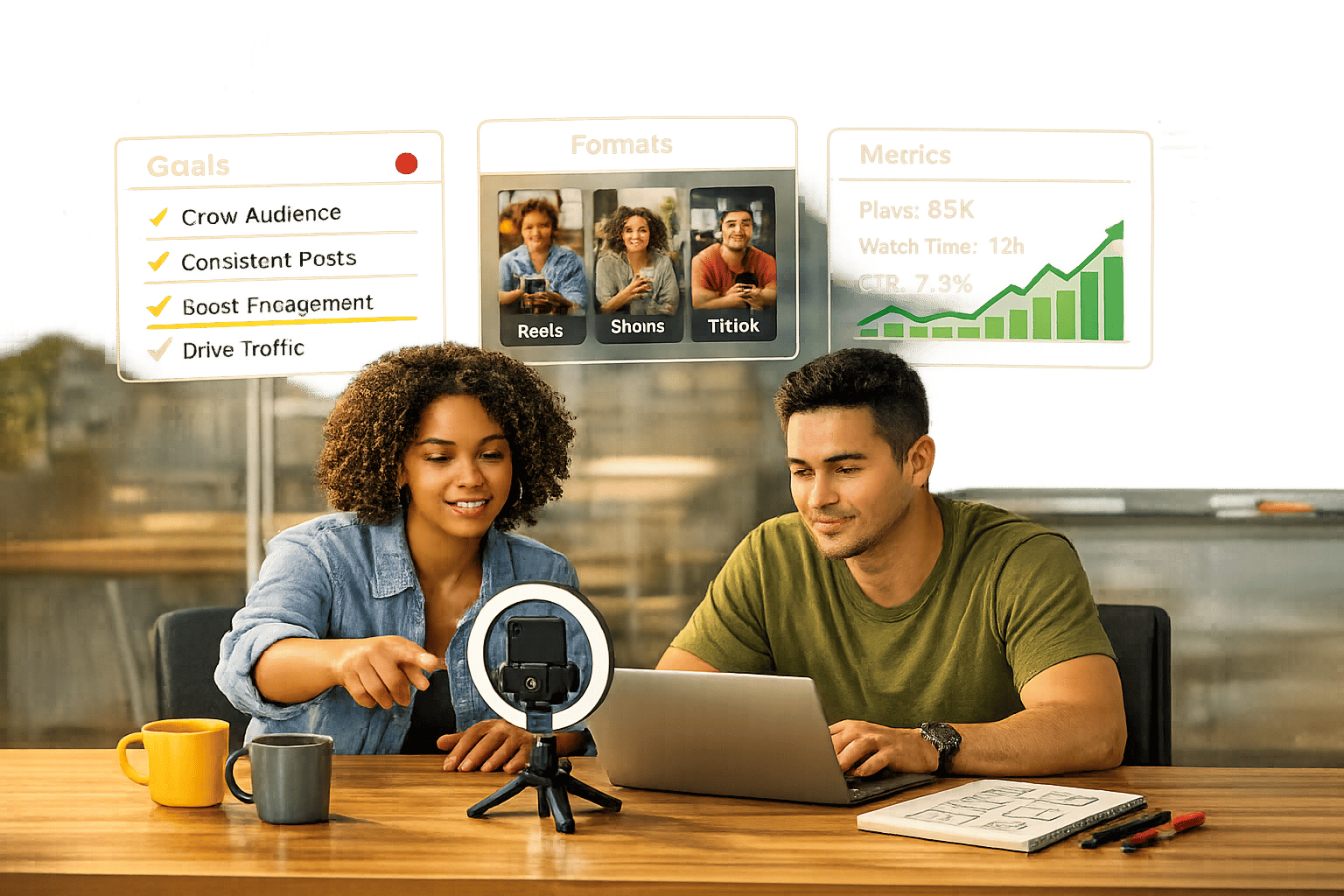
Short-form video is a game-changer for startups, offering a cost-effective way to reach millions, even with zero followers. Platforms like TikTok, Instagram Reels, and YouTube Shorts prioritize discovery, making it easier than ever to connect with your audience. By 2025, 85% of businesses will use short-form video, with many reporting a 40% increase in conversions within six months. Here’s how startups can create an effective strategy:
- Set Clear Goals: Define specific, measurable objectives like lead generation or sales.
- Know Your Audience: Understand their pain points, preferences, and where they spend time online.
- Create a Content Plan: Use the 70-20-10 rule (evergreen, trend-based, experimental) and map content to the buyer’s journey.
- Optimize for Platforms: Tailor videos for TikTok, Instagram Reels, and YouTube Shorts based on their unique styles and audience behaviors.
- Track Metrics: Focus on retention, watch time, and conversions rather than just views or likes.
Short-form videos thrive on simplicity, relatability, and consistency. By focusing on data-driven improvements and leveraging AI tools, startups can scale their efforts while keeping production efficient. Ready to start? Begin with clear goals, a solid content plan, and a commitment to testing and refining your approach.

4-Step Short-Form Video Strategy Framework for Startups
Step 1: Set Your Goals and Know Your Audience
Before hitting record, take a moment to define your goals and understand your audience. Publishing content without clear objectives is like throwing darts in the dark – it wastes time and resources. If you’re eager to explore how AI can supercharge your short-form video strategy, consider subscribing to the AI Acceleration Newsletter for practical tips on integrating AI tools into your marketing efforts.
Successful startups focus on strategies that align with their specific business goals rather than chasing fleeting viral trends. For founders looking to blend traditional methods with cutting-edge technology, partners like M Studio / M Accelerator can provide valuable expertise. This Los Angeles-based innovation studio specializes in building AI-powered go-to-market systems, helping businesses stay ahead of the curve. With clear goals in place, you’ll be better equipped to create a content plan that delivers measurable results.
Define What You Want to Achieve
Vague goals like "get more views" won’t cut it. Instead, focus on specific outcomes such as generating leads, boosting brand awareness, or driving sales. Each objective demands a tailored approach. For B2B and SaaS startups, in particular, the priority should be attracting qualified leads rather than racking up views from people unlikely to convert. As Dale Nel from ANTEATER wisely points out:
"It’s better to have 5 really interested prospects view your video than 1 million uninterested prospects."
Set SMART goals – Specific, Measurable, Achievable, Relevant, and Time-bound. For instance: "Generate 200 qualified leads in Q1 2025 with a cost per lead under $50." This kind of goal gives you a clear target to aim for and a way to evaluate your success. Tailor your content to the buyer’s journey: use educational videos for awareness, feature demos or testimonials during consideration, and include strong calls to action to encourage conversions.
Find Your Target Audience
Understanding your audience goes beyond knowing their age or location. It’s about identifying who they are, the challenges they face, and where they spend their time online. Start by talking to your sales team about common customer concerns, surveying current clients to understand the pain points that led them to your product, and analyzing social media comments to uncover recurring themes. This research helps you create detailed personas that reflect not just demographics but also values, lifestyles, and buying habits.
To refine your message, try the Content Analogy method: identify your expertise (e.g., "data security specialist"), the problem you solve (e.g., "helping businesses secure cloud data"), and your preferred video style (e.g., "easy-to-follow explainer videos"). This approach keeps your content focused and helps algorithms understand your niche.
Step 2: Build Your Content Plan
Once you’ve nailed down your goals and audience, it’s time to craft a content plan that ensures consistency and purpose. A strong plan balances tried-and-true formats with current trends, so you’re not just posting for the sake of it. If you’re curious about how AI can enhance your short-form video strategy, check out our free AI Acceleration Newsletter here.
A helpful approach is the 70-20-10 rule: dedicate 70% of your content to evergreen formats like tutorials and testimonials, 20% to trend-based content, and 10% to experimental ideas. Map your content to the buyer’s journey: use educational videos to build awareness, demos and testimonials for the consideration phase, and FAQs or walkthroughs to drive conversions. This ensures every video serves a meaningful purpose instead of chasing random engagement. Next, let’s talk about choosing the right video formats.
Pick the Right Video Formats
The effectiveness of a video format depends on where your audience is in their buying journey and the platform they’re using. For instance, educational videos like how-tos and quick tips are perfect for the awareness stage, while product demos and customer testimonials are ideal when your audience is in the consideration phase. It’s better to focus on reliable formats rather than fleeting viral trends.
Some proven ideas include formats like "Most people think [X], but actually [Y]" or "Top 5 things you didn’t know about [Topic]", which deliver quick, engaging value. Before-and-after comparisons are also great for showcasing results. To maximize efficiency, batch-produce 5–10 videos in one session. A single 5-minute video can be repurposed into several short clips, extending your reach without extra effort.
Develop Your Brand Voice
Your brand voice is what makes your content stand out. Authentic, behind-the-scenes videos often resonate more with Gen Z and millennials than overly polished productions. Instead of trying to mimic influencers, focus on your genuine expertise – your knowledge of your product is what connects prospects to customers.
To define your voice, try the Analogy Method: describe yourself as “[Role] helping [Audience] solve [Problem] with [Video Style].” For example, “Cybersecurity founder helping businesses keep data safe with simple explainer videos.” This helps keep your messaging focused and makes it easier for algorithms to understand your niche, improving your discoverability.
Establish 3–4 content pillars – like Educational, Motivational, Relatable, and Promotional – to give your content structure and clearly communicate your brand’s message. Diego Vetencourt and Danya Baratli, co-founders of Shortzy, highlight this idea:
"Short-form video succeeds only when it stays true to the ethos of its creator."
Creating repeatable series formats is another way to build a loyal audience. Consistent naming, visual styles, and posting schedules give viewers something to anticipate while reinforcing your expertise. For hands-on guidance on incorporating AI into your video strategy, check out M Studio / M Accelerator (https://maccelerator.com). Once your brand voice is set, it’s time to focus on structuring videos that keep your audience hooked.
Structure Videos That Keep People Watching
To grab and hold attention, use the Hook-Value-CTA framework: hook your audience in the first 3 seconds, deliver clear value by the 10-second mark, and end with a specific call to action.
Keep viewers engaged with pattern interrupts, such as zooming in or out, shifting camera angles, or adding text overlays every 2–4 seconds. With attention spans averaging just 8 seconds, these quick changes make a big difference.
Design your videos for silent viewing, too. Since up to 80% of users watch social media videos without sound, using dynamic captions and bold text ensures your message gets across in any setting.
Finally, include a clear call to action. Whether you want viewers to visit your website, download a resource, or comment, be specific about what you want them to do next. Vague prompts rarely lead to action – clear directions make all the difference.
Step 3: Optimize for Each Platform
Each platform has its own vibe and audience preferences. TikTok, Instagram Reels, YouTube Shorts, and LinkedIn operate more like discovery engines than traditional social networks – content is shown based on interests rather than follower count. To see how AI can streamline video production, consider subscribing to our AI Acceleration Newsletter. At M Studio / M Accelerator, we collaborate with founders to create AI-driven go-to-market systems through practical, hands-on strategies.
When it comes to measuring success, the top priority is retention rate – did viewers stick around for the entire video? Next up is watch time, followed by engagement metrics like shares (most impactful), saves, comments, and likes. Platforms reward videos that keep viewers engaged, so tailoring your content to fit each platform’s style and audience is key. Let’s break down how to optimize for specific platforms.
TikTok: Trends and Discovery

TikTok thrives on raw, unpolished content that feels real and relatable. Users, especially Gen Z, often use TikTok to search for tutorials, product reviews, and more. This means optimizing for search is just as critical as jumping on trends. Include keywords in captions, on-screen text, and voiceovers – TikTok transcribes audio, so this can help your content get discovered.
A great example is Marriott’s #30stays300days campaign. They teamed up with creators to explore 30 hotel brands, producing user-generated content that aligned with travel-related search terms. The mix of storytelling and keyword optimization made their posts relevant long after they were published. For TikTok, aim for videos between 21–34 seconds – long enough to provide value but short enough to hold attention. Use trending sounds naturally, ensuring they enhance your message without overshadowing it.
Instagram Reels: Visual Content

Instagram Reels lean toward polished, visually appealing content. While TikTok embraces a more casual style, Instagram users expect a higher level of production quality. Trends often appear on TikTok first, giving you time to refine and adapt them for Instagram. High engagement and trending audio are crucial to boosting your reach here, so incorporating popular sounds can make a big difference.
Chili’s nailed this approach by sharing 7–15 second clips featuring their food and restaurant experiences, paired with trending audio. This strategy blended brand identity with engaging content, attracting both loyal customers and new viewers. Reels, on average, reach 30.81% of users – more than double the reach of static images (13.14%). Keep your videos between 15–30 seconds and focus on creating visually striking content that grabs attention instantly.
YouTube Shorts: Educational Videos

YouTube Shorts is the go-to platform for quick, educational content. Think "did you know" facts, bite-sized tutorials, or practical tips that viewers will want to save or share. Shorts can act as a gateway to your longer YouTube videos, helping you grow your subscriber base and deepen audience engagement. With around 70 billion daily global views and projections of up to 200 billion by 2025, Shorts is a powerhouse for exposure.
For best results, keep your Shorts between 25–35 seconds. Optimize for search with clear, descriptive titles and captions, and include relevant keywords in both spoken content and text – YouTube indexes both. This ensures your videos remain discoverable long after they’re posted, driving steady traffic over time.
sbb-itb-32a2de3
Step 4: Track Results and Improve
Focusing on the right metrics is what separates startups that struggle from those that thrive. Chasing views and likes might feel rewarding, but they don’t necessarily translate into revenue. Instead, prioritize metrics that align directly with your business goals. Viral hits may come and go, but consistent, data-driven growth ensures long-term success. Want to learn how AI can supercharge your short-form video strategy? Join our AI Acceleration Newsletter for weekly tips, and see how M Accelerator helps founders build automated revenue systems. These strategies ensure your performance metrics are tied to real business outcomes.
Metrics That Matter
To succeed, you need to understand how platforms decide to distribute your videos. Metrics like retention rate and watch time carry the most weight – if viewers stay engaged, the platform will show your video to more people. Shares are another strong signal, followed by saves, comments, and likes. Here’s how it works: platforms test your video with a small group of 200–500 viewers. If your retention rate tops 50%, the algorithm rewards you by expanding its reach significantly.
Organize your metrics into five key categories:
- Awareness: Reach and impressions
- Interest: Thumbstop rate (calculated as 3-second views divided by impressions)
- Engagement: Shares and saves
- Retention: Completion rate
- Conversion: Click-through rate and cost per acquisition
For startups, the most critical metric is leads generated. This number shows the return on your video investment and helps convince stakeholders or investors of its value.
| Goal | Key Performance Indicators (KPIs) |
|---|---|
| Brand Awareness | Views, reach, impressions, share rate |
| Engagement | Watch time, completion rate, comments, saves |
| Consideration | Click-through rate (CTR), landing page visits, time on site |
| Conversion | Lead generation, sales, cost per acquisition (CPA) |
| Retention | Customer satisfaction, support ticket reduction, upsells |
Once you’ve identified the right metrics, the next step is to continuously test and refine your approach.
Use Data to Get Better
Improvement comes from experimentation. Try posting one video every day for 30 days to gather enough data to identify what works. Pay attention to your hook rate (the percentage of viewers still watching after 3 seconds) and hold rate (the percentage still watching at the halfway mark). If your hook rate is low, experiment with different opening lines or visuals to grab attention. For mid-video drop-offs, use techniques like pattern interrupts – quick zooms, text overlays, or B-roll every 2–5 seconds – to keep people engaged.
Tag your content as “trend” or “evergreen” in your analytics tool to see which type performs better over time. High save rates often signal that your content is useful or interesting – use this insight to create follow-up videos or explore the topic further. Since many users scroll with their sound off, optimize your videos for silent viewing by adding dynamic captions and bold text overlays. Businesses that embrace short-form video and consistently iterate based on data have reported a 40% boost in conversion rates within just six months.
Conclusion: Build a Video Strategy That Scales
Creating a short-form video strategy that scales is all about being consistent, staying genuine, and using data to improve over time. Startups that thrive in this space aren’t chasing fleeting viral hits – they’re building systems that reduce creative hurdles and deliver consistent results. A simple, recognizable visual setup can speed up production and reinforce your brand. Structuring content around proven, trending, and experimental formats adds variety while keeping things efficient. If you’re looking for more tips on using AI to supercharge your video content, check out the AI Acceleration Newsletter.
Once your strategy is locked in, focus on keeping production flowing smoothly. Batch production is a game-changer for maintaining output. For example, filming 3–5 videos in one session allows you to post consistently – daily or even multiple times a day if you’re aiming for faster growth. Take a note from Alex Garcia, who scaled his Instagram presence by sticking to a repeatable visual style and later branching into sub-series based on early wins.
As 351 Studio wisely points out:
Quality emerges from iteration. Ship three variations of the same idea (different cold opens, same body), then keep the winner and throw away the rest.
When it comes to short-form video, authenticity beats over-polished content. Raw, relatable videos build trust with your audience. Entrepreneur Simon Squibb and his team found that tweaking their opening question from "Have you ever wanted to start a business?" to "Do you have a dream?" significantly boosted engagement and reach between 2023 and 2024. This small shift became their signature, repeatable format.
Data is the backbone of a scalable system. Startups succeeding with short-form video treat every post as a learning opportunity. They iterate quickly, track the metrics that matter most for revenue, and develop systems that grow without requiring endless hours of work. With 85% of businesses now using short-form video and many reporting a 40% increase in conversion rates within six months, the real question isn’t whether to start – it’s how soon you can roll out a winning strategy. By combining a consistent approach, efficient production, and data-driven adjustments, you can amplify your startup’s reach.
For founders ready to take it to the next level with AI-powered tools, dive into the hands-on support available at M Studio / M Accelerator.
FAQs
How can AI tools help improve my startup’s short-form video strategy?
AI tools are reshaping how short-form videos are created and shared, making the entire process faster and more efficient. With AI, you can generate engaging scripts, automate editing tasks, and even tailor content to fit the preferences of your target audience. The result? Videos that are not only polished but also strike a chord with viewers.
Beyond creation, AI takes the guesswork out of strategy. It can analyze audience behavior and platform trends to pinpoint the best times to post, suggest trending topics, and refine video hooks to keep viewers watching longer. Tasks like captioning and distribution, which can be time-consuming, are easily automated – freeing up more time for creativity and storytelling.
By integrating AI into your workflow, you can ensure your videos resonate emotionally, build stronger connections with your audience, and ultimately drive better engagement and conversions.
What metrics should startups track to measure the success of short-form videos?
When evaluating the performance of short-form videos, startups should focus on key engagement metrics that show how audiences interact with your content. Metrics like views, likes, comments, shares, and saves are a great starting point. But don’t stop there – dig deeper into metrics that provide more meaningful insights, such as audience retention, click-through rates, and conversions. These indicators reveal how well your videos are actually driving results.
It’s also worth paying attention to platform-specific data, such as impressions and plays, to understand your video’s reach and the initial interest it generates. By analyzing these numbers, founders can fine-tune their video strategies to resonate more with their target audience and align with their business objectives.
Want to level up your startup’s video game with AI-driven insights? Subscribe to our free AI Acceleration Newsletter for weekly tips on building smarter systems.
How can I create content that works best for TikTok and Instagram Reels?
To make content work on TikTok and Instagram Reels, you need to adjust your strategy to match each platform’s vibe and audience. TikTok is all about trending sounds, snappy hooks, and raw, unpolished storytelling that grabs attention in seconds. Meanwhile, Instagram Reels leans toward crisp visuals, consistent branding, and content that fits seamlessly into your Instagram aesthetic.
For TikTok, focus on creating fast-paced, trend-driven videos that feel spontaneous and engaging. On Reels, aim for a more polished look with visuals that reflect your brand’s overall style. While staying true to your brand voice, tweak the tone, pacing, and style to suit the platform. This approach helps drive engagement and keeps your content in sync with each platform’s algorithm.
Related Blog Posts
- Case Study: How Startups Repurpose Content For Growth
- Case Study: Audience Targeting For Startup Growth
- Study: How Startups Improve Engagement Rates
- Q&A: Short-Form Storytelling for Founders