


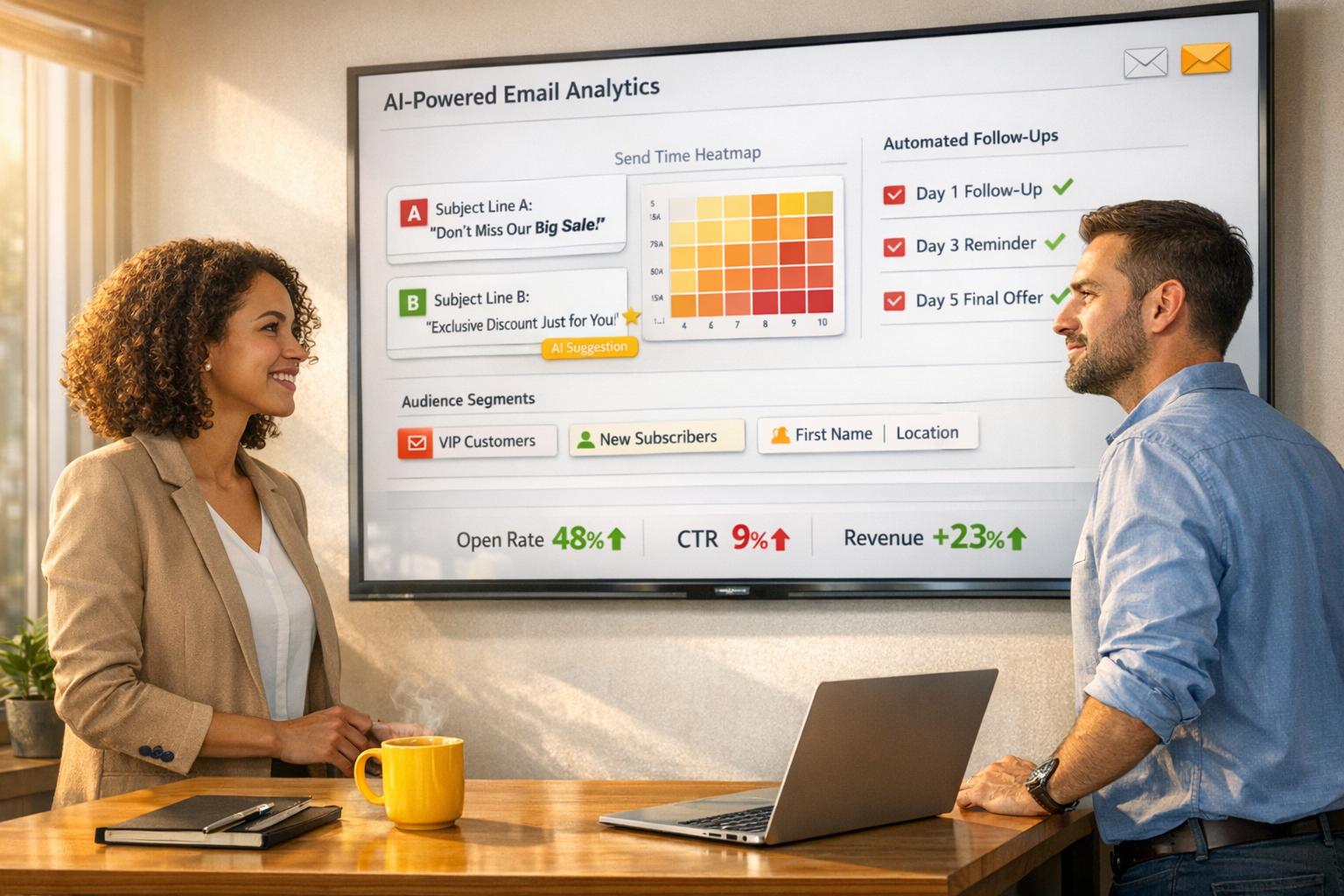
AI tools are transforming email marketing by solving common challenges like poor open rates, untimely sends, and lack of personalization. Here’s how AI boosts email performance:
- Higher Open Rates: AI optimizes subject lines and send times, increasing open rates by up to 50%.
- Improved Click-Through Rates: Dynamic content and behavioral segmentation drive up to 760% more revenue than generic emails.
- Faster Response Times: AI automates follow-ups and triggers emails instantly, achieving 86% higher open rates.
- Personalized Content: AI tailors email content in real time based on user behavior, boosting conversions by 35%.
- Operational Efficiency: Campaign production time drops from weeks to days, saving teams hours of manual work.

AI Email Marketing Performance Statistics: Open Rates, CTR, and Revenue Impact
How AI Increases Open Rates
Getting an email opened is the first challenge in any campaign, and AI steps in to make this easier. By analyzing recipient behavior – like when they’re most engaged and what language grabs their attention – AI can boost open rates by as much as 50% compared to traditional batch-and-blast methods. If you’re looking for smarter email marketing strategies, AI can be your game-changer. For weekly tips on optimizing your efforts, check out our AI Acceleration Newsletter. And for startups needing hands-on help, M Studio / M Accelerator provides expertise in building AI-powered go-to-market systems.
The stats are hard to ignore: automated emails drive 320% more revenue than manual ones, and AI-driven personalization can increase revenue by 41%. Let’s dive into how AI fine-tunes email timing with predictive send-time optimization.
Predictive Send-Time Optimization
AI doesn’t just pick random times to send emails. It studies your audience’s habits – like when they’ve opened emails in the past, their click patterns, time zones, work schedules, and even the devices they use. Over a 60-day period, AI gathers this data to create personalized delivery windows for each subscriber. Instead of blasting everyone at 8:00 AM, your email might reach one subscriber at 9:30 AM, another at 2:00 PM, and someone else at 7:00 PM – perfectly timed based on their engagement history.
This approach goes beyond just tracking opens; AI identifies the moments when recipients are most likely to click or reply. Take Revulytics, for example: by using AI to analyze reading patterns, they boosted open rates by 44% and clicks by 61.6% in just six months (Source: SendX Case Studies, 2023). Predictive timing can increase open rates by 23% and response rates by over 20%, but it’s important to allow the system enough time to learn and adapt.
AI-Powered Subject Line Generation
AI doesn’t stop at timing – it also revolutionizes subject line creation. Using Natural Language Processing (NLP), AI analyzes millions of data points, including tone, structure, emotional triggers, word choice, and even emojis, to craft subject lines tailored to specific audience segments. It reviews what’s worked in past campaigns, considers where recipients are in the customer journey (like a new lead versus a loyal customer), and avoids spam triggers such as "FREE" or "WINNER."
For example, Gumtree leveraged AI to A/B test subject lines and saw a 35% increase in open rates and a 44% boost in clicks within a quarter (Source: SendX Case Studies, 2023). The best results come from combining AI with human input: let AI generate 10–20 subject line options, then refine them to match your brand’s tone. Keep subject lines under 45 characters to avoid mobile cutoffs, and remember, personalized lines can increase response rates by 30.5%, while AI-generated lines can lift open rates by up to 22%.
sbb-itb-32a2de3
How AI Boosts Click-Through Rates
Getting someone to open your email is just the beginning – you also need them to click. This is where AI steps in, analyzing each recipient’s behavior and preferences to dynamically adjust content, images, and calls-to-action (CTAs) in real time. The results? Brands using dynamic content report a 76% increase in click-through rates (CTR), while behavioral segmentation drives 94% higher CTRs compared to generic email blasts. Want to see these strategies in action? Join our free AI Acceleration Newsletter for weekly insights. At M Studio / M Accelerator, we integrate these AI-driven techniques to create automated systems that supercharge email campaigns. Let’s dive into how AI personalizes content and segments audiences for better results.
AI-powered personalization makes every subscriber feel like the email was crafted just for them. Instead of sending the same product recommendation to everyone, AI can identify specific patterns – like one subscriber browsing on weekends and preferring educational content, while another checks emails on their lunch break and responds to quick deals. This level of precision is why segmented campaigns generate 760% more revenue than generic email blasts.
Dynamic Content Personalization
AI takes personalization to the next level by tailoring content in real time, increasing the chances of engagement. It doesn’t require you to create countless email variations manually. Instead, it dynamically swaps out content blocks, images, or offers the moment the email is opened, based on real-time data like location, browsing habits, purchase history, and even factors like weather or inventory levels.
For instance, 24S, LVMH’s luxury retailer, used Braze’s AI Item Recommendations in January 2026 to deliver personalized product suggestions via email and app notifications. Carla Rota, Senior CRM Project Manager, spearheaded this strategy, leading to a 7% rise in add-to-cart rates and a 35% increase in purchase conversions.
AI also leverages behavioral signals – like how far someone scrolls or how long they stay on a page – to predict what will catch their attention. If a customer abandons their cart, the AI can automatically include that product in a follow-up email with a tailored offer. Similarly, if a subscriber has been researching a specific category but hasn’t made a purchase, the email might highlight educational content or reviews instead of a direct sales pitch. The Willow Tree Boutique, for example, used Klaviyo’s predictive analytics in June 2023 to target high-value items based on predicted purchase dates. Within just 90 days, 17.1% of their email revenue came from these AI-driven segments, contributing to a 44.6% year-over-year growth in email revenue.
Real-Time Audience Segmentation
Dynamic content works even better when paired with real-time audience segmentation. Unlike static segmentation – which groups contacts by fixed traits like age or job title – AI creates micro-segments based on actual behavior. By analyzing over 200 signals, such as browsing patterns, content interactions, and device preferences, AI identifies highly specific groups like "Weekend Research Browsers" or "Mobile-Only Quick Clickers." These segments update in real time as behaviors evolve.
For example, YMCA of Alexandria implemented ActiveCampaign’s AI Brand Kit and predictive sending to improve communication across its branches. Digital Marketing Specialist Adam Sakry shared that this approach boosted their click-through rate to 12.8% while saving the team 10 hours of manual work per campaign. Additionally, AI can flag subscribers at risk of disengaging – identifying them 30–45 days before they churn – allowing businesses to send targeted re-engagement campaigns to keep their audience connected.
How AI Reduces Response Times
In email marketing, timing is everything. When a customer clicks a link, abandons their cart, or browses a product page, they’re showing interest in the moment – not hours or days later. AI bridges this timing gap by automating follow-ups and triggering responses instantly, keeping the momentum alive. This speed matters: companies using AI-driven automation report 320% more revenue compared to those using manual campaigns, and automated emails boast 86% higher open rates. Want to stay ahead in email engagement? Join the AI Acceleration Newsletter for weekly tips on maximizing email performance. With AI, responses happen in seconds, not hours. Let’s dive into how automated follow-ups and behavioral triggers make this possible.
At M Studio / M Accelerator, we integrate these automated systems into your existing tools – linking CRM data, behavioral triggers, and send-time optimization into one seamless process. The result? A self-sustaining revenue engine that operates 24/7 without manual input.
Automated Follow-Up Sequences
AI-powered follow-up sequences ensure leads are engaged right when it matters most. These sequences handle key email flows that account for 80% of automated revenue: welcome series, cart recovery, post-purchase engagement, re-engagement campaigns, and browse abandonment flows. Each sequence is triggered by specific user actions. For example, if a customer abandons their cart, AI sends a reminder within one hour, follows up with social proof at 24 hours, and offers an incentive at 72 hours. This three-step strategy alone recovers 3–5% of abandoned carts in the first email.
Take Tata Harper Skincare, for instance. After adopting Klaviyo’s AI-powered tools in February 2024, they experienced a 65% increase in sign-up form submissions and a 139% year-over-year revenue boost from automated flows. The AI tested 20 timing and placement variations to pinpoint the exact moments visitors were most likely to convert. Similarly, Vitrazza, a glass chair mat company, used personalized welcome flows and behavioral segmentation to generate $564,200 in sales from their automated welcome series in under four months.
AI doesn’t just send emails – it learns. By analyzing subscriber behavior, it schedules follow-ups 2–7 days apart, tailored to each sales cycle. Teams using platforms like Superhuman report responding to emails 12 hours faster on average, while campaign production time drops by 40% with AI managing the sequencing.
Behavioral Trigger Implementation
Behavioral triggers take automation a step further by responding to actions in real time. Unlike scheduled campaigns, these triggers activate the moment a user interacts – whether it’s clicking a link, submitting a form, or spending extra time on a page. For example, if a subscriber clicks on a product link but doesn’t purchase, AI can send a follow-up email featuring the product, customer reviews, and a limited-time discount – all within minutes. This approach achieves 94% higher click-through rates compared to traditional demographic-based segmentation.
Retailers using AI-driven triggers have seen email-driven revenue soar. By analyzing purchase patterns and preferences, AI predicts when customers are most likely to buy again and sends timely messages to drive conversions.
AI also plays a critical role in retaining at-risk subscribers. By monitoring subtle engagement changes – like reduced scroll depth or declining open rates – it flags users 30–45 days before they’re likely to churn. Specialized re-engagement campaigns are then triggered, retaining 34% of at-risk users who might have otherwise unsubscribed. As the Superhuman team explains:
One of the biggest benefits of using AI for email management is automatic prioritization. AI reads every message and decides what deserves your attention. – Superhuman Team
Measuring AI Impact on Email Campaigns
Tracking the influence of AI on your email campaigns is essential. Wondering how AI is reshaping email engagement? Sign up for our free AI Acceleration Newsletter here to get weekly tips on using AI to improve your campaign outcomes. Companies that use AI automation report 320% more revenue compared to those relying on manual campaigns. AI enables a shift from just reviewing past performance to leveraging predictive insights that highlight churn risks and buying intent. Without proper measurement, you’re essentially operating in the dark – unable to justify your investment or refine your strategy. At M Accelerator, we specialize in building AI-driven systems that turn data into actionable insights, helping startups boost revenue through real-time dashboards. These measurable results validate the AI strategies discussed earlier and help refine your overall approach.
Key Metrics for Success
Start by focusing on the basics: open rates, click-through rates (CTR), and conversion rates. These metrics directly reflect the AI-driven improvements in engagement, such as higher open rates and more clicks. For instance, AI-generated emails achieve an average 9.44% CTR, compared to 8.46% for manual campaigns, and automated campaigns see 86% higher open rates than generic ones. However, engagement metrics alone don’t tell the full story – you also need to track Revenue Per Email (RPE) and transaction rates to measure financial performance. Personalized automation can generate 6x higher transaction rates than generic messaging, significantly impacting your bottom line.
Operational efficiency is another critical area to monitor. Metrics like campaign production time and the hours saved on manual tasks highlight AI’s ability to streamline workflows. For example, in 2025, the YMCA of Alexandria used ActiveCampaign’s AI tools to achieve a 12.8% CTR and a 27% growth in their contact list, all while saving 10 staff hours per week. This demonstrates how AI not only boosts results but also frees up teams to focus on more strategic tasks.
Don’t forget to track deliverability and health metrics, such as unsubscribe and spam complaint rates. AI-optimized emails maintain a 0.16% unsubscribe rate and a 0.01% spam complaint rate, comparable to manual campaigns. Additionally, consider predictive metrics unique to AI, like engagement probability scores, churn risk, and targeting accuracy. These insights can guide proactive re-engagement strategies and help you stay ahead of potential issues.
Setting Up Performance Dashboards
Once you’ve identified the key metrics, the next step is to visualize them through an integrated dashboard. Focus on displaying real-time, critical metrics to continuously optimize your campaigns. Start by establishing baseline performance metrics before implementing AI, then centralize data from your CRM, email, and sales platforms into a single dashboard. For example, in 2025, DoorDash adopted HubSpot’s marketing automation, transitioning from fully manual campaigns to 80% automated workflows. This shift significantly reduced production time, and according to Director of Content Marketing Andrew McCarthy, the integrated dashboard was key to making the process seamless.
Your dashboard should also monitor real-time execution reliability – are emails being sent at the right times, and are triggers activating as expected? Keeping these metrics unified allows for quick, informed decisions that enhance AI-powered email campaigns. Daily reviews help catch delivery issues before they affect revenue, while weekly trend analyses can uncover opportunities for improvement. For example, studying which audience segments respond best to specific content can refine your targeting strategy. Using cohort analysis to track subscriber behavior over time also sheds light on how AI impacts long-term retention, not just immediate engagement.
Finally, incorporate attribution modeling to connect AI-driven touchpoints, like abandoned cart reminders or personalized recommendations, directly to revenue. In 2025, 24S, LVMH’s digital luxury retailer, used Braze’s AI Item Recommendations for cart recovery and back-in-stock alerts. Senior CRM Project Manager Carla Rota tracked the results through a dashboard, revealing a 7% increase in add-to-cart rates and a 35% boost in purchase conversions. These insights helped justify further investment in AI automation by clearly linking optimizations to revenue growth.
Implementing AI-Powered A/B Testing
Traditional A/B testing often focuses on one variable at a time, requiring days or even weeks to gather actionable results. AI takes this process to the next level by enabling simultaneous multi-variant testing. This means you can test multiple elements – like subject lines, email content, hero images, and CTAs – all at once. AI tracks performance in real time and automatically redirects traffic to the best-performing version during the campaign itself. This "mid-flight optimization" ensures your audience interacts with the most effective version immediately, rather than waiting for the next campaign cycle. Want to streamline your email testing process? Join our free AI Acceleration Newsletter for weekly tips on saving time and driving better results with AI.
This shift from sporadic testing to continuous optimization is reshaping how startups approach email marketing. At M Accelerator, we work closely with founders to build these automated workflows in real-time sessions. By leveraging tools like N8N and Make/Zapier, we help create systems that integrate seamlessly into your campaigns, ensuring your testing and optimization processes run without delay. This approach complements earlier discussions on dynamic personalization and automated workflows.
Automating A/B Testing Workflows
AI takes over the entire testing process, reducing the need for manual intervention. It begins by analyzing historical campaign data – such as engagement trends by time, device, and content type – to establish a baseline. Using predictive performance modeling, it forecasts which variations (e.g., subject lines, content styles, or send times) are likely to perform best even before the campaign launches. These forecasts come with "confidence scores", giving you a clear idea of which options are worth pursuing.
Once the campaign is live, AI deploys small-scale tests to sample audiences, monitors real-time engagement, and automatically eliminates underperforming versions while scaling up the winners. This iterative learning process ensures the system becomes smarter with every campaign, refining its predictions to match subscriber behavior. Similar to AI-driven segmentation or predictive send-time strategies, this method continuously improves email performance.
The automation doesn’t stop at picking a winner. AI also handles tedious tasks like segmenting lists, scheduling sends, and generating performance reports. This frees your team to focus on higher-level strategies. Platforms such as Mailchimp and ActiveCampaign include "auto-optimize" features, which adjust traffic mid-campaign to favor top-performing variations. For more advanced needs, tools like HubSpot’s Marketing Hub Professional offer AI-powered testing that ties directly into your CRM, ensuring every optimization aligns with broader revenue goals.
Real-Time Analytics for Test Results
AI doesn’t just identify winning variations – it also explains why they work. By analyzing factors like tone, structure, and keywords, AI uncovers what drives engagement. For instance, it might show that urgency-focused subject lines (e.g., "Last Chance") perform better for one segment, while curiosity-driven lines (e.g., "You Won’t Believe This") resonate with another. These insights help you fine-tune future campaigns, building a repository of proven strategies for different audience groups. AI can even pre-screen variations for potentially "spammy" language, protecting your deliverability rates and keeping metrics like your 0.16% unsubscribe rate and 0.01% spam complaint rate intact.
Beyond single-event performance, AI enables long-term tracking across entire customer journeys. Unlike manual tests that focus on isolated metrics, AI monitors subscriber behavior over time to identify patterns like drop-off points or cumulative impact. For example, it can connect a specific subject line to not only higher open rates but also downstream actions such as purchases or subscription renewals. This creates a comprehensive view of your campaign’s ROI, linking email variations to closed deals and calculating revenue attribution. Campaigns leveraging these insights have been shown to generate 320% more revenue compared to non-automated approaches, turning email marketing into a highly targeted revenue driver.
Conclusion
AI is revolutionizing email marketing, turning it into a highly efficient tool for driving revenue. Want to stay ahead? Subscribe to our free AI Acceleration Newsletter for weekly tips on optimizing your email campaigns with AI. The numbers speak for themselves: AI-optimized email strategies can boost revenue by up to 41% while saving countless hours on repetitive tasks.
Studies show that AI-powered automation significantly reduces the time it takes to produce campaigns. But this isn’t about replacing human creativity – it’s about empowering your team to focus on strategy. AI takes care of the heavy lifting, like data analysis, segmentation, and timing, at a scale that manual processes just can’t match. The result? A streamlined workflow and immediate improvements in campaign performance.
The best part? You don’t need to overhaul your entire system to get started. A single change, like predictive send-time optimization, can increase click-through rates by 13% without altering your content. From there, you can layer in AI-generated subject lines, which can boost open rates by 22%, and behavioral segmentation, which drives 760% more revenue compared to generic email blasts. These tactics work together to create a powerful, measurable engagement strategy – each improvement amplifying the next.
Of course, the technical foundation is just as critical as the tools. Clean CRM data, authenticated domains (SPF, DKIM, DMARC), and real-time event tracking are essential for AI to deliver accurate results. Think of it like building a house: you need a strong foundation before adding the high-tech features. With a solid setup, AI becomes even more effective.
Ready to see what AI can do for your email marketing? At M Studio / M Accelerator, we work directly with founders to implement AI systems that drive engagement and revenue. No waiting, no fluff – just real systems that start working in your business right away. Check out our Elite Founders program for hands-on support in building AI-driven automations that shorten sales cycles and dramatically improve conversions. We’ve helped over 500 founders generate more than $75 million in funding – let’s make your business the next success story. Learn more about the program here.
FAQs
What data do I need before using AI in email marketing?
To make the most of AI in email marketing, start by collecting data on how recipients interact with your emails. This includes tracking open times, click-through rates, and behavioral patterns. Use this information to segment your audience based on behavioral metrics such as recency, frequency, and monetary value (RFM scoring).
Next, take a close look at your current campaign performance. Pay attention to metrics like open rates, response times, and conversion rates to establish benchmarks. These insights allow AI to craft campaigns that are more personalized and delivered at the right time, ultimately improving engagement and driving a higher ROI.
How long does AI take to optimize send times and subject lines?
AI can analyze recipient behavior, engagement patterns, and data in just 14 minutes to fine-tune send times and subject lines. This means your emails can be timed more effectively and tailored for greater relevance, boosting their overall performance.
How do I measure AI’s impact on email revenue?
To understand how AI influences email revenue, focus on key metrics like open rates, click-through rates, and conversion rates. AI tools can dive deep into engagement data to attribute revenue to specific campaigns and even predict subscriber behavior. By examining figures like revenue per email and customer lifetime value (CLV), you can clearly gauge AI’s role in driving results. A simple yet effective approach is to compare campaign performance before and after integrating AI to see its true impact on revenue.