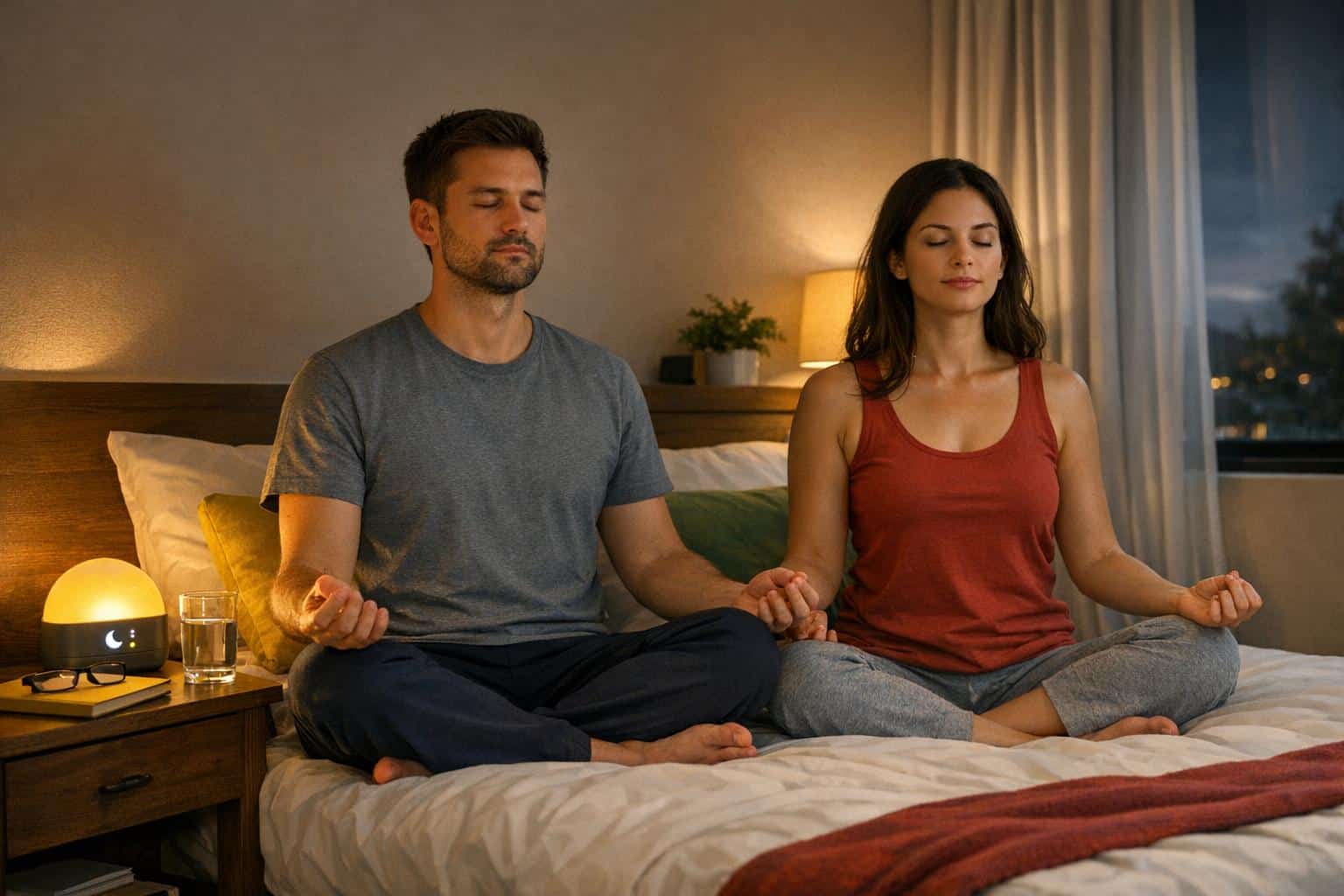
It’s 3 AM, and you’re wide awake, overwhelmed by startup stress. Founders often face sleepless nights due to racing thoughts, decision fatigue, and the constant pressure of running a business. Meditation can help. Here’s how:
- Why Founders Struggle with Sleep: Stress keeps your brain in overdrive, disrupting your ability to relax. Over 66% of insomnia sufferers wake up in the middle of the night, often replaying worries.
- How Meditation Helps: It activates your relaxation system, lowers cortisol, and shifts brainwaves from stress to calm. Studies show it improves sleep quality as effectively as exercise or therapy.
- Techniques to Try:
- Box Breathing: A 4-second inhale, hold, exhale, and pause cycle to ease stress.
- 4-7-8 Breathing: A method to calm your nervous system and fall back asleep.
- Body Scan: Focus on each part of your body to release tension.
- Non-Sleep Deep Rest (NSDR): A guided relaxation practice to reset your mind.
- Practical Tips:
- Stick to a regular bedtime routine.
- Avoid screens before bed.
- Create a sleep-friendly environment: cool temperature, no distractions, and a work-free zone.
- Use apps like Headspace or Calm for guided meditation.
Meditation isn’t just for better sleep – it builds resilience for the challenges of entrepreneurship. Start small with a few minutes a day, and watch your sleep and decision-making improve.
Building a Sleep-Friendly Night Routine
Meditation is most effective when it’s part of a larger plan designed to prepare your body and mind for rest. Jumping straight from late-night tasks to bed rarely works. A consistent pre-sleep routine can help signal your brain that it’s time to wind down.
Creating a Pre-Sleep Routine That Works
Stick to a regular sleep schedule – even on weekends. For example, if you need to wake up at 6:00 AM and aim for 7–8 hours of sleep, start winding down around 9:00 PM and be in bed by 10:00 PM.
Introduce a "digital sunset" by turning off screens at least an hour before bedtime. If you need to use a device, consider using red-light filters, blue-blocking glasses, or switching to airplane mode to minimize distractions.
Swap screen time for calming activities. You might read a physical book, work on a crossword puzzle, or try an adult coloring book. Another option is cognitive shuffling: pick a random word like "BED" and think of as many words as you can starting with "B", then "E", then "D." This simple exercise helps shift your brain away from problem-solving mode and into a more relaxed state.
Once your routine is in place, focus on creating an environment that supports sleep.
Setting Up Your Sleep Environment
Keep your bedroom cool, ideally between 60°F and 67°F. If you tend to overheat, use breathable bedding. Block out light with blackout curtains or an eye mask.
Position alarm clocks out of sight to avoid the anxiety of watching the clock when you can’t sleep. For noise, consider white noise machines or earplugs. Pink noise, such as steady rain or ocean waves, can also improve sleep quality and encourage deeper rest.
Make your bedroom a work-free zone. Avoid keeping laptops or phones near your bed to help your brain associate the space with relaxation. Dr. Alon Y. Avidan, Director of the UCLA Sleep Disorders Center, emphasizes this point:
"If you don’t get out of bed to record your thoughts, the bed then becomes a place for planning and thinking. It’s a place for hypervigilance."
Finally, address any mental clutter that might keep you awake.
Managing Late-Night Worries Before They Start
For many, bedtime can trigger a flood of worries. As Chris Hemsworth once shared, his mind fills with checklists the moment his head hits the pillow.
Take 5–10 minutes before bed to journal or do a quick brain dump. Write down any lingering thoughts or concerns to clear your mind. Keep a notebook nearby to jot down ideas or worries that pop up during the night, allowing you to return to sleep more easily.
You can also use task management apps or set reminders to assure your brain that tomorrow’s responsibilities are under control. Pair this practice with a warm bath or shower 1–2 hours before bed. The rapid drop in body temperature afterward mimics your body’s natural transition to sleep, making it easier to drift off.
5 Meditation Techniques for Better Sleep

4 Meditation Techniques for Startup Founders: Benefits and Best Use Cases
Once you’ve set up a comfortable sleep environment and established a bedtime routine, meditation can be a game-changer for those restless 3 AM wake-ups. These techniques are designed to calm your nervous system and activate your body’s natural relaxation response. Each method tackles a different aspect of stress – whether it’s racing thoughts or physical tension. Here are four effective approaches to help you shift from stress to deep relaxation.
Box Breathing to Ease Stress
Box breathing, also known as square breathing, is a simple yet powerful technique that follows a four-part rhythm. Breathe in for 4 seconds, hold for 4 seconds, exhale for 4 seconds, and hold again for 4 seconds. Picture each breath as one side of a square.
This method works by slowing your breathing and engaging your parasympathetic nervous system, which helps lower your heart rate and blood pressure. It’s a great way to anchor your mind in the present moment, whether you’re lying in bed, preparing for a big meeting, or navigating a stressful situation.
4-7-8 Breathing for Falling Back Asleep
Another effective breathing method is the 4-7-8 technique, developed by Dr. Andrew Weil. This practice naturally soothes the nervous system and can help you drift back to sleep. Start by placing the tip of your tongue against the ridge behind your upper front teeth and keep it there throughout the exercise. Exhale fully through your mouth with a "whoosh" sound, inhale through your nose for 4 seconds, hold your breath for 7 seconds, and exhale through your mouth for 8 seconds. Repeat this cycle four times.
"The 4-7-8 breathing technique is a natural tranquilizer for the nervous system." – Dr. Andrew Weil, Founder of the Integrative Medicine Center at the University of Arizona
The extended exhale helps trigger your body’s relaxation response, slowing your heart rate significantly. Some people find themselves falling asleep within just a couple of minutes. To get the most out of this technique, practice it twice daily and stick to four cycles at a time for the first month. Feeling lightheaded at first is normal, so it’s best to start while sitting or lying down.
Body Scan Meditation to Let Go of Tension
A body scan meditation shifts your attention from overthinking to tuning into your physical sensations. Lie flat on your back with your hands at your sides or resting on your stomach. Begin at the top of your head and slowly move your focus downward – through your face, neck, shoulders, arms, chest, stomach, hips, legs, and toes. Pause briefly on each area, noticing any tightness, tingling, or other sensations.
When you encounter tension, like in your neck or shoulders, gently encourage those muscles to relax. If they don’t, simply breathe into the area without forcing anything. If distracting thoughts arise, acknowledge them without judgment – imagine them as clouds passing by – and return your focus to your body. As Diana Winston from UCLA’s Mindful Awareness Research Center explains:
"We’ll be noticing these sensations without trying to change them or make them different, simply bringing a mindful attention of curiosity and openness to the present moment."
If you still can’t sleep, consider leaving the bed briefly to reset your mind without adding to your stress.
Non-Sleep Deep Rest (NSDR) and Yoga Nidra
For a more profound reset, try practices like Non-Sleep Deep Rest (NSDR) or Yoga Nidra. These techniques don’t require you to fall asleep but help you reach a deeply relaxed state where your body can let go of tension. Even a short session – 10 to 20 minutes – can provide restorative benefits, making it a great alternative to napping during high-stress days.
To practice, lie down in a comfortable position and focus on a calming thought or listen to a guided audio session. The goal is to give your mind and body a break, not necessarily to sleep. This is especially helpful for those who need a mental refresh during the day but can’t afford to lose time to a full nap.
| Technique | Primary Goal | Best Used For |
|---|---|---|
| Box Breathing | Nervous system reset | Immediate stress relief |
| 4-7-8 Breathing | Melatonin boost | Falling back asleep |
| Body Scan | Physical relaxation | Releasing tension in the jaw, shoulders, and back |
| NSDR / Yoga Nidra | Restorative reset | Mimicking deep rest during stressful periods |
Start small – just 3 to 10 minutes a few nights a week – and focus on building consistency over time. To make it a habit, try meditating right after brushing your teeth. It’s a simple way to weave calm into your nightly routine.
Making Meditation Part of Your Daily Schedule
The real strength of meditation lies in practicing it daily to keep stress from piling up. The idea is simple: build up your resilience during the day so your nervous system doesn’t spiral into overdrive by night.
Daytime Practices to Prevent Nighttime Stress
Incorporating meditation into your daily routine can help stop nighttime stress from sabotaging your sleep. Luis F. Buenaver, Ph.D., a sleep expert at Johns Hopkins, puts it this way:
"If you’re frequently triggering your stress response, your body never gets back to its baseline… It’s like running an engine in fifth gear all the time."
The good news? You don’t need a perfect 30-minute block to meditate. Short resets throughout the day – like 3-minute breathing exercises between meetings – can work wonders. Even a mindful coffee run, focusing on your footsteps instead of your inbox, or taking 10 minutes to sit quietly, can help ease the buildup of anxiety.
Sample Daily Meditation Schedule for Founders
You don’t need to overhaul your day to make meditation work. By weaving it into your existing routine, you can create a rhythm that aligns with the busy lives many founders lead. Here’s a simple schedule to try:
- Morning (7:00 AM – 7:10 AM): After brushing your teeth, drink a glass of water before diving into your coffee. Spend five minutes observing nature, even if it’s just the trees outside your window, or do some light stretching. This calm start helps set a positive tone for the day.
- Midday (1:00 PM – 1:03 PM): When that afternoon slump hits, take three minutes for box breathing. It’s a great way to reset before jumping into meetings or tackling big tasks.
- Evening (9:00 PM – 9:30 PM): Start winding down at least an hour before bed with a "digital sunset" by turning off your screens. Spend 10 minutes journaling to clear your mind of tomorrow’s to-dos, then try a 4-7-8 breathing exercise or a body scan to shift from "work mode" to "rest mode."
Short, consistent sessions – just 10 minutes a day – can improve sleep quality more effectively than infrequent, longer meditations. This routine not only calms your mind but also helps you tackle your day with more clarity.
Using AI Systems to Reduce Mental Load
For many founders, one of the biggest obstacles to restful sleep is the constant mental load: the endless stream of tasks, decisions, and worries that refuse to quiet down. This is where AI-powered tools can act as an unexpected ally, automating repetitive tasks like lead scoring, follow-ups, and time tracking. These systems don’t just save time; they also lighten the mental burden that keeps your brain buzzing at night.
sbb-itb-32a2de3
Apps and Tools to Support Your Meditation Practice
Sometimes, a well-designed app can be the difference between a restless night and a peaceful return to sleep. While meditation itself doesn’t demand fancy tools, a reliable app can provide structure when you’re too drained to recall techniques on your own. The key is finding one that aligns with your schedule and helps tackle those sleepless nights.
Best Meditation and Sleep Apps for Founders
Headspace is a standout choice, offering "SOS" exercises for late-night wake-ups and quick 3-minute resets. Subscriptions cost $12.99/month or $69.99/year, and you can try it out with a 7-14 day free trial. Research suggests that just 10 days of using Headspace can boost happiness and reduce stress, while two weeks can help lower anxiety. Its "Sleepcasts" are another highlight – 45 to 55-minute audio stories designed to shift your focus away from tomorrow’s to-do list.
Calm takes a unique approach with celebrity-narrated "Sleep Stories" and a "7 Days of Sleep" course. It boasts over 300 hours of content dedicated to better sleep.
BetterSleep (formerly Relax Melodies) lets you mix and match from 300+ sounds and includes "Sleep Moves" exercises to combat jet lag. According to the app, 91% of users reported better sleep after just one week. The app is free with limited access, but premium features require a subscription. It has a solid 4.4/5 star rating on Google Play, based on more than 394,000 reviews.
Insight Timer caters to meditation, sleep, and anxiety management. Like the others, it allows offline downloads, which is essential for avoiding distractions like email when you open the app during a sleepless night.
These apps are designed to help you build a nightly routine, but they’re just one piece of the puzzle.
App-Based vs. Self-Guided Meditation
While apps offer convenience and structure, they’re not the only way to improve your sleep. Here’s how app-based meditation compares to self-guided practices:
| Feature | App-Based Meditation | Self-Guided Practice |
|---|---|---|
| Ease of Use | High; guided sessions walk you through each step | Lower; requires familiarity with techniques like 4-7-8 breathing |
| Flexibility | Moderate; depends on available content and a device | High; can be done anytime, anywhere, without tools |
| Cost | Usually requires a subscription | Free |
| Variety | High; includes stories, music, and soundscapes | Limited to what you know |
| Tracking | Built-in progress logs and streaks | Manual tracking like journaling |
Apps are especially helpful when you’re new to meditation or your mind feels too scattered to focus. On the other hand, self-guided practices shine once you’ve mastered techniques and want to avoid screens before bed. Many people find a balance by using apps during the day to learn techniques and practicing self-guided meditation at night.
Why Consistency Matters More Than Tools
The best results come not from the tool itself but from how consistently you use it. A simple 3-minute breathing exercise practiced every night is far more effective than a 30-minute guided session you only do once a month. Repetition helps your brain associate specific cues – like a familiar voice or breathing pattern – with relaxation.
Most apps include built-in trackers to help you stay consistent, but even a quick note on your phone works just as well. The goal isn’t perfection; it’s creating a habit that sticks, even during your busiest weeks. Camille Reeves, a mental health coach at Headspace, explains it best:
"Think of [meditation] as a gentle way to help you slow down the spirals, relax your nervous system, and create the space your brain needs to finally power down."
Start small – three nights a week is a great beginning – and build from there. Over time, this consistency will become a valuable tool, especially during high-stress periods like product launches or funding rounds, when sleep feels harder to come by.
Conclusion: Building Better Sleep Habits as a Founder
Better sleep doesn’t require hours of effort – it starts with just 5 to 10 minutes a day. As Dr. Chris Winter, a neurologist and sleep specialist, explains:
"Meditation is a skill, and like any skill, the more you practice, the easier it gets – and the better you get at it."
The strategies discussed here, like 4-7-8 breathing and body scans, are effective because they help your nervous system switch gears – from the constant hustle to genuine rest.
But meditation is just one piece of the puzzle. Managing your workload during the day plays a big role too. Our AI Acceleration Newsletter offers practical ways for founders to streamline tasks like lead follow-ups and customer discovery. By lightening your mental load, you’ll find it easier to let your mind relax when it’s time to sleep.
Consistency is key. Take Yunha Kim, founder and CEO of Sleep Reset and Simple Habit, as an example. In February 2023, she overcame severe insomnia by sticking to a strict routine. Her approach included cutting off caffeine after lunch, wrapping up work by 4:00 PM, and dedicating 10 minutes to restorative yoga before bedtime. She also maintained a steady sleep schedule, going to bed at 8:30 PM and waking up at 5:00 AM. If she couldn’t fall asleep within 20 minutes, she left the bedroom – a habit that eventually helped her stop relying on sleeping pills. Her story highlights how discipline and routine can make a big difference.
The risks are real. Poor sleep not only raises the likelihood of depression but also hampers your ability to lead effectively. Taking your sleep seriously is a step toward better health and sharper decision-making.
FAQs
How can startup founders use meditation to sleep better?
Meditation is a powerful tool for calming the racing thoughts that often plague startup founders late at night. Whether it’s stress about meeting deadlines, securing funding, or preparing for a product launch, these worries can make restful sleep feel out of reach. Techniques like slow, deliberate breathing, practicing mindfulness, or imagining serene scenarios can help ease this anxiety. These methods work by lowering stress hormones like cortisol, allowing the body to shift into its natural "rest-and-digest" state, which makes falling and staying asleep much easier.
Over time, regular meditation can lead to better sleep quality by quieting nighttime overthinking and encouraging deeper, more restorative sleep cycles. Even simple practices – like a 5-minute breathing exercise, a 10-minute body scan, or a brief visualization – can become part of a nightly routine. For those with packed schedules, meditation apps offer guided sessions tailored to fit into their day, helping ensure better rest and sharper focus when it’s needed most.
What are some quick and effective meditation techniques to help founders manage stress and insomnia?
Managing startup stress and insomnia doesn’t have to be overwhelming. With a few simple meditation techniques, you can create moments of calm that fit seamlessly into your busy schedule.
Start with breath-focused exercises: inhale deeply through your nose for a count of four, hold your breath briefly, and then exhale slowly for a count of six. This technique helps soothe your nervous system and eases anxiety, making it ideal for a quick mental reset during a hectic day.
Another effective practice is a gratitude pause. Close your eyes, take a deep breath, and think of three things – big or small – that went well today. This simple shift in focus can help you center on the positive, easing stress and lifting your mood.
For a deeper sense of relaxation, try progressive muscle relaxation. Start by tensing and releasing the muscles in your feet, then gradually work your way up through each muscle group. This method not only reduces physical tension but also helps quiet a racing mind.
These quick, straightforward techniques can help you manage stress, sharpen your focus, and set the stage for better sleep – all without demanding much time from your day.
How can I fit meditation into my busy schedule as a startup founder?
Incorporating meditation into your daily life can be surprisingly simple, even if your schedule feels packed. Start small by carving out just 5 minutes at specific times – right after you wake up, during a quick lunch break, or before heading to bed. Treat these moments as non-negotiable appointments to build consistency.
One easy way to begin is with the 4-7-8 breathing technique: breathe in for 4 seconds, hold it for 7 seconds, and then exhale slowly for 8 seconds. Repeat this a few times to help calm your mind and regain focus. If you prefer guidance, meditation apps can walk you through sessions, making the practice even more accessible.
To create a lasting habit, pair meditation with something you already do daily, like brushing your teeth or sipping your morning coffee. These brief, intentional pauses can help lower stress, improve your sleep, and sharpen your mental focus – all without interrupting your day.
Related Blog Posts
- The Founder’s Achilles’ Heel: How Ignoring Sleep is Sabotaging Your Startup
- From Chaos to Calm: Busting Meditation Myths for Skeptical Startup Founders
- The 5-Minute Founder: How Micro-Meditations Can Transform Your Startup Day
- The 5-Minute Founder Reset: Meditation Techniques That Work Between Meetings