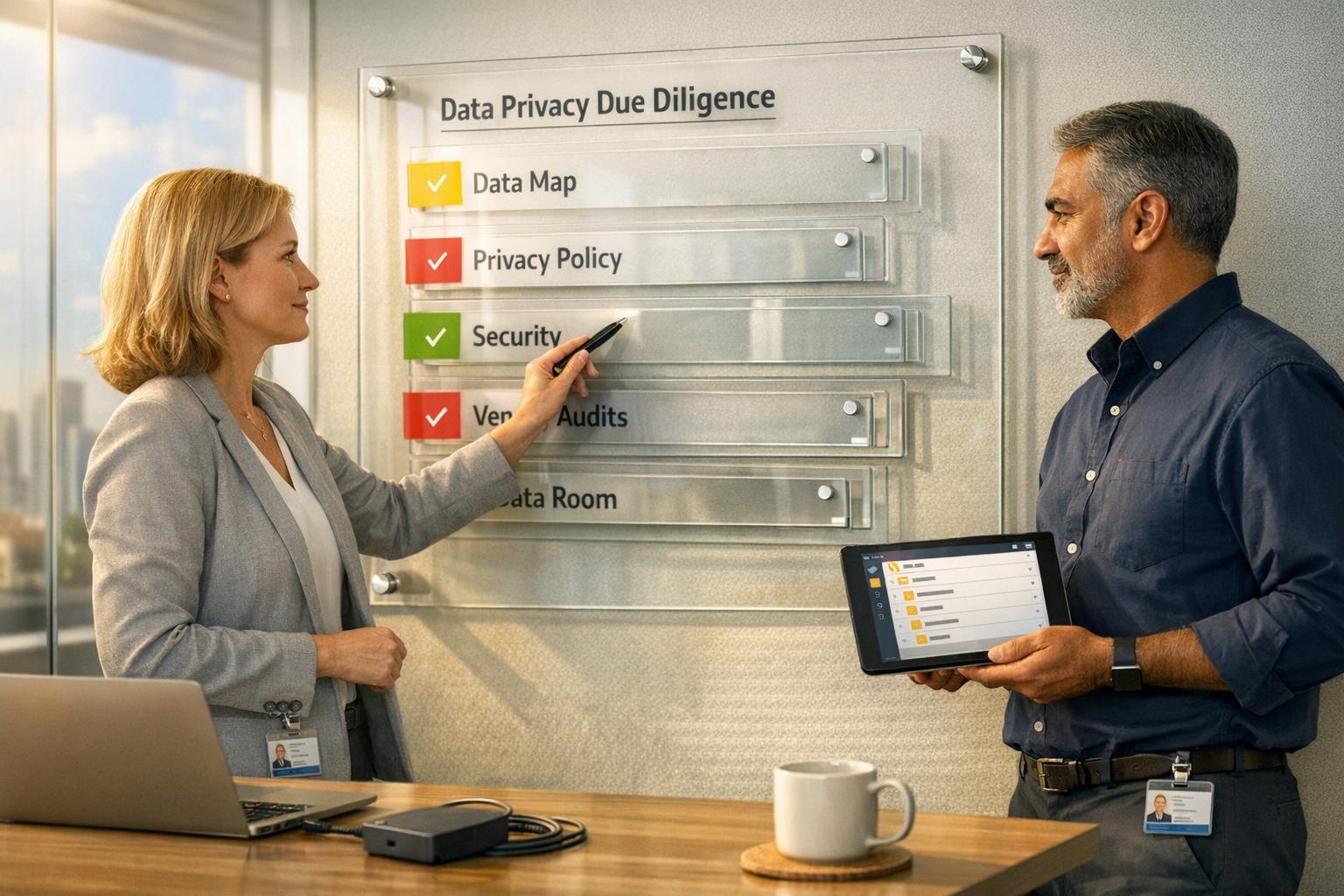
Investors are prioritizing data privacy during due diligence, and startups need to be ready. Poor compliance can lower valuations, delay deals, or even cause them to fall apart. To stand out, focus on these key steps:
- Map Your Data: Create a detailed inventory of the data you collect, store, and process. Include storage locations, retention policies, and third-party transfers.
- Update Privacy Policies: Ensure your policies clearly explain data collection, user rights, and compliance with regulations like GDPR and CCPA.
- Strengthen Security: Implement encryption, multi-factor authentication, and role-based access controls. Obtain certifications like SOC 2 Type II or ISO 27001.
- Audit Vendor Agreements: Review contracts for data protection clauses and confirm vendor compliance with certifications and security practices.
- Organize a Data Room: Prepare a virtual data room with machine-readable documents, vendor agreements, and compliance records. Conduct a mock audit to identify gaps.
Investors will scrutinize your breach history, regulatory compliance, and AI governance. Start preparing 12–24 months before a deal to avoid last-minute issues. By embedding privacy and security into your operations, you can boost investor confidence and protect your valuation.

6-Step Data Privacy Due Diligence Preparation Checklist for Startups
Step 1: Create a Complete Data Map and Inventory
Your data map is the cornerstone of privacy compliance. Without a clear understanding of the personal data you collect, where it’s stored, and how it flows, you can’t demonstrate compliance effectively. This step isn’t just about meeting legal requirements – it’s also a key part of building trust with investors. GDPR Article 30 mandates this documentation, and investors expect to see a well-organized data map before committing funds. Beyond compliance, a detailed data map simplifies future audits and certifications. Join the AI Acceleration Newsletter to see how AI tools can streamline your due diligence.
Start by creating a personal data inventory. List every type of data you handle – emails, payments, IP addresses, device identifiers, and user behavior. Then, map out the entire lifecycle of that data: where it’s collected, how it’s processed (e.g., analytics, marketing, AI training), where it’s stored (cloud or local), and any third-party transfers. For each data type, document the legal basis for processing, whether that’s user consent, contractual obligations, or legitimate interest.
What to Include in Your Data Map
To satisfy investor expectations, your data map needs five critical components:
- Storage infrastructure: Identify every cloud provider, database, and backup system where data is stored.
- Third-party dependencies: List all external APIs and integrations that interact with your data.
- Retention and deletion policies: Document how long data is kept, when it’s deleted, and any automated triggers for these actions.
- Consent mechanisms: Show how users opt in, and detail how you manage opt-out requests.
- Change-of-control clauses: Highlight these in customer contracts, as they can complicate acquisitions if overlooked.
To ensure nothing is missed, review your tech stack, architecture diagrams, and database schemas. Audit all Master Service Agreements (MSAs) and Data Processing Agreements (DPAs) to track data shared with vendors. Additionally, create a Software Bill of Materials (SBOM) to document all dependencies and open-source libraries that may process data. This level of detail demonstrates operational readiness to potential investors or buyers.
Tools That Simplify Data Mapping
Leverage tools to make data mapping more efficient. Virtual Data Rooms (VDRs) offer secure, role-based access and audit logs, which are invaluable during due diligence. For contract reviews, NLP-based tools can group agreements and extract key clauses about data handling, cutting review time by up to 75%. AI-powered task managers can help coordinate workflows and track progress as you build your data inventory.
Standardize all documentation by converting files into machine-readable formats. Use consistent naming conventions and OCR technology to make scanned documents searchable. This level of preparation is essential – 86% of acquirers now use AI tools in their deal pipelines, and these tools rely on clean, well-organized data. Ideally, start building your data room 12 to 18 months before a planned exit. This gives you time to address any gaps uncovered during the process and ensures smoother internal audits down the line.
sbb-itb-32a2de3
Step 2: Review and Update Privacy Policies and Notices
Your privacy policy is more than just a document – it’s the foundation of your data practices and plays a critical role in due diligence, particularly when assessing regulatory risks and operational readiness. If your policy is outdated, it can signal weak governance and potentially delay funding. With projections showing that 45% of M&A executives will use AI tools for due diligence by 2025, your documentation needs to be both legally compliant and easily processed by AI. Investors expect clear, straightforward language that demonstrates your adherence to regulations like GDPR and CCPA.
Ensure all privacy notices are in a searchable format. Scanned PDFs won’t cut it – AI audits require text-based documents. Use OCR technology and consistent file naming to make your documentation accessible to automated tools. Then, review the content of your policies. Are you covering all legal bases? For example, does your policy clearly explain what data you collect, why you collect it, and how long you keep it? Does it outline user rights, such as the ability to access, delete, or transfer their data? Missing these details can send up red flags, potentially impacting acquisition pricing by as much as 20%.
What Every Compliant Privacy Policy Needs
A strong privacy policy should address five key areas:
- Data Collection Methods: Identify all touchpoints where you gather data, from sign-up forms to analytics tools. Specify the legal basis for processing each type of data – whether it’s consent, contractual necessity, or legitimate interest.
- User Rights: Clearly explain how users can exercise their rights under GDPR or CCPA, including timelines for responding to requests.
- Data Sharing Practices: List all third parties that receive user data and clarify whether they act as processors or controllers.
- Change-of-Control Clauses: Detail what happens to user data in the event of an acquisition. This is a critical point for investors and can streamline M&A processes if addressed upfront.
- Anonymized vs. Identifiable Data: Clearly differentiate between anonymized metrics and identifiable customer data. Specify which data can be processed by external AI services and which must remain in secure environments.
Covering these areas not only shows you’re prepared but also demonstrates a level of operational precision that reduces compliance risks.
Verify Consent Mechanisms and Cookie Compliance
Your cookie banner isn’t just a box to check – it’s a visible sign of your commitment to transparency. Modern compliance requires more than a simple "Accept" button. Instead, provide granular options, like a "Manage Settings" link where users can customize their preferences, along with a clear "I Decline" option. These features are especially critical if you operate in industries with strict regulations or handle sensitive data.
AI tools can help you audit your consent mechanisms and identify inconsistencies. Use a shared prompt library with 10 to 20 core questions – like "Does the policy address third-party data transfers?" or "Are cookie preferences respected across sessions?" – to ensure everything is aligned with current standards.
"Well-governed AI reduces risk and speeds decisions; poorly governed AI can create compliance and reputational problems."
Step 3: Strengthen Security Controls and Get Certifications
Security controls are more than just technical requirements – they’re a visible sign that your infrastructure is built to withstand threats. Investors are increasingly focusing on security posture and technical readiness, making this a key factor in your valuation. With many acquirers leveraging AI tools to analyze your data during the due diligence process, your security documentation must be both thorough and machine-readable. Did you know? Poor security practices can result in up to 20% of the purchase price being tied to performance metrics or risks flagged during the review. For insights on staying ahead in data security compliance, check out our free AI Acceleration Newsletter.
Start by creating a Written Information Security Program (WISP) that aligns with frameworks like the NIST Cybersecurity Framework or ISO 27001. This document should define your security leadership structure. Even if you don’t have a full-time CISO, clearly outline who is responsible for security and how the board oversees it. Investors want to see that security is a priority at the highest levels, not an afterthought.
Security Controls You Need to Implement
Once your WISP is in place, focus on implementing critical security controls that build trust. At the core are three essential measures: encryption standards, multi-factor authentication (MFA), and role-based access controls (RBAC). Here’s what each entails:
- Encryption: Secure data both at rest and in transit using protocols like AES-256.
- MFA: Enforce it for all administrative access – recommendations aren’t enough.
- RBAC: Limit data access to only what’s necessary for specific roles, reducing risk and showing strong governance.
In addition to these basics, investors expect regular penetration testing conducted by third-party experts, along with documented plans to address any critical or high-risk findings. Your Incident Response Plan (IRP) should go beyond listing procedures. Include evidence of tabletop exercises, escalation protocols, and established connections with forensic experts. As KO Law points out:
"Security incidents don’t necessarily derail transactions, but poor incident response does."
If you’ve experienced security events in the past, be transparent about them. Highlight how your response was effective and detail the steps you’ve taken to prevent similar issues.
Certifications That Build Investor Confidence
Third-party certifications are another way to validate your security practices and reassure investors. For B2B SaaS companies, especially those serving enterprise clients or regulated sectors, SOC 2 Type II is the gold standard. Unlike one-time assessments, this certification demonstrates operational effectiveness over a minimum six-month period – exactly the kind of proof investors want. If you’re aiming for a sale within the next 6–12 months, securing this certification should be a top priority. Erin Locker, Partner at KO Law, explains:
"For B2B businesses, especially those serving enterprise customers or regulated industries, security documentation and certifications have become table stakes rather than differentiators."
For startups with global ambitions or plans to enter international markets, ISO 27001 certification carries significant weight. Both SOC 2 Type II and ISO 27001 require annual surveillance audits, and any lapse between audits can raise red flags about the consistency of your program. Keep certifications current and maintain a "board-ready proof pack" in your virtual data room. This should include policy reviews, scan results, and cyber insurance details. Organized, up-to-date documentation allows investor AI tools to verify your compliance status quickly, minimizing delays and reinforcing your readiness.
Step 4: Audit Vendor Agreements and Third-Party Compliance
Vendor relationships can make or break an acquisition. Did you know that 50% of technology M&A deals fall apart due to vendor compliance issues? Investors dig deep into every third-party relationship because any security failure by your vendors becomes your problem. At M Studio / M Accelerator, we craft AI-powered systems designed to strengthen vendor compliance. A single vendor lacking proper data protection agreements can lead to price cuts, escrow holdbacks, or even the collapse of a deal. The bright side? Most vendor issues can be resolved if you catch them early and address them systematically. For more insights on vendor compliance strategies, join our free AI Acceleration Newsletter. Once you’ve assessed vendor risks, the next step is ensuring your contracts fully address potential liabilities.
Start by reviewing every vendor contract that involves customer data, employee information, or proprietary systems. Begin with your top 10 vendors based on revenue impact or data sensitivity. Pay close attention to change-of-control clauses – these clauses could allow vendors to terminate their agreements if your company is sold. Alex Lubyansky, an M&A Attorney and Managing Partner at Acquisition Stars, shared a cautionary tale:
"A buyer acquired a distribution company without thoroughly reviewing its supplier agreements. Three of the five largest supplier contracts had change-of-control provisions allowing termination with 30 days’ notice. Within 60 days of closing, two suppliers exercised that right. The business lost 40% of its product line."
This same risk applies to data vendors. If your CRM provider, payment processor, or cloud hosting service can terminate their contract during an acquisition, investors will insist on safeguards like escrow holdbacks or adjusted pricing.
Required Clauses for Vendor Contracts
Every vendor contract involving customer or employee data must include a Data Processing Addendum (DPA). This document should clearly define security standards, confidentiality obligations, and how the vendor will assist with data subject requests (such as access, deletion, correction, or portability). If you’re in healthcare, you’ll also need HIPAA Business Associate Agreements (BAAs). For financial services, GLBA compliance terms are a must. Companies transferring data to or from the European Economic Area, UK, or Switzerland must include Standard Contractual Clauses (SCCs) to comply with cross-border data transfer laws.
Don’t overlook AI-specific restrictions. Your contracts should clarify whether vendors can use your customer data to train AI models and should prohibit sharing confidential information with public AI systems. Investors are now scrutinizing whether customer data is pooled or kept isolated, so document your data governance practices thoroughly. Additionally, ensure you have IP assignment clauses for contractors who developed custom tools or integrations. Without these written agreements, you might not actually own the software you’re selling.
How to Verify Vendor Compliance Standards
It’s not enough to have strong contract language – you also need proof that vendors follow the security standards they promise. Ask for up-to-date SOC 2 Type 2 or ISO 27001 certifications from all critical vendors. Make sure these certifications include annual surveillance audits without any gaps. Erin Locker, Partner at KO Law Firm, emphasizes:
"Certifications must be current and include annual surveillance audits. Stale certifications or gaps between audit periods can raise red flags during diligence and suggest either a lapsed security program or an attempt to avoid scrutiny of current practices."
Request additional documentation such as vendors’ WISP (Written Information Security Program), recent penetration test results, and incident response plans. Review their incident history and confirm they have cyber insurance. If a vendor has pending regulatory investigations (like HIPAA violations or CCPA complaints), flag it immediately. These liabilities will come up during investor diligence, and you’ll need a clear plan to address them – whether that means replacing the vendor, negotiating special indemnifications, or setting up escrow arrangements.
To stay organized, create a vendor compliance spreadsheet in your virtual data room. Include certification statuses, DPA execution dates, and any unresolved issues. This level of preparation shows professionalism and helps minimize transaction risks.
Step 5: Set Up a Data Room and Run Internal Audits
After securing vendor contracts, the next step is to organize your data. A virtual data room serves as the central hub for your data privacy documentation, making it accessible for investor review. In 2025, 45% of M&A executives integrated AI tools into their workflows, with roughly one-third of the 100 largest transactions citing AI-enabled due diligence as a key factor in deal success. This highlights the importance of a well-organized data room, which not only reassures investors but also speeds up the review process. A cluttered or chaotic data room, on the other hand, can raise red flags about your operations. Need help organizing your data privacy documentation? Check out our free AI Acceleration Newsletter for weekly tips and insights.
Before presenting your data room to investors, it’s crucial to conduct a mock audit. This internal review mirrors the investor’s due diligence process, helping you identify and fix issues like missing signatures, outdated certifications, conflicting document versions, or incomplete IP assignments. Addressing these gaps ahead of time allows you to avoid last-minute scrambles under investor scrutiny.
How to Set Up a Virtual Data Room
Start by selecting a platform that offers role-based access control and two-stage access. Organize your data room into two main sections:
- Pre-Term Sheet Room: Contains business summaries, traction metrics, financial overviews, team profiles, and cap table summaries for initial validation.
- Post-Term Sheet Room: Includes more detailed documentation like legal entity records, material agreements (over $25K), IP proofs, tax filings, and litigation history.
For early-stage startups, tools like Google Drive are often sufficient and preferred by investors for their simplicity. As your company grows, you might consider specialized M&A platforms that can track document views and timestamps for added security and efficiency.
Structure your data room into clear categories, such as:
- Core Privacy Documentation: Privacy policies, notices, data maps, and data inventories.
- Compliance and Audit Records: Internal and external audit reports, and certifications like SOC 2 Type 2 or ISO 27001.
- Legal and Vendor Materials: Vendor agreements and Data Processing Agreements (DPAs).
- Risk Management Assets: Red-flag matrices and risk registers.
Ensure all documents are machine-readable by converting scanned files into searchable text using OCR tools. Stick to standardized file naming conventions to make navigation easier for both human reviewers and AI tools. Studies show that NLP-based platforms can cut contract review time by 70% to 75%, but only if your documents are properly formatted.
Keep board decks and summaries separate from raw data sets to streamline navigation for reviewers. This also helps AI tools compare documents more effectively. Assign internal owners – from teams like legal, finance, or product – for each category to ensure investor questions are handled efficiently and consistently. Be upfront about any pending litigation or regulatory investigations in the Stage 2 data room; hiding issues can lead to bigger problems later during deeper due diligence.
Run a Mock Data Privacy Audit
Before opening your data room to external parties, run an internal audit using the same checklist investors will rely on. Review privacy policies, DPAs, vendor contracts, document versions, and IP assignments for any gaps or inconsistencies. Make sure all vendor contracts include current DPAs and verify that certifications are up to date.
AI-powered tools can help flag missing fields or mismatched data. For example, if your data map shows you collect email addresses but your privacy policy doesn’t mention email marketing, that’s a discrepancy investors will notice. Maintain a shared library of prompts for financial analysis and contract review to ensure consistency across audits. Clearly define which types of data (e.g., anonymized metrics versus identifiable customer information) can be processed by external AI tools and which should remain in secure environments.
Running a thorough mock audit gives you the chance to address issues early, ensuring a smoother and more confident presentation when investors dive into your data room.
For more advice on incorporating AI into your compliance processes, check out M Studio / M Accelerator, a Los Angeles-based innovation studio that helps founders implement AI-driven go-to-market strategies.
Step 6: Prepare for Investor Questions and Maintain Compliance
Get ready to tackle the tough questions investors will throw your way. A solid approach to data privacy due diligence can make all the difference – 85% of M&A deals face purchase price reductions during due diligence, and 50% of tech-related deals fall apart entirely due to findings in this stage. Thorough preparation is your best strategy for success.
Common Investor Questions About Data Privacy
Once your data room is in order, it’s time to focus on the specific questions investors are likely to ask. A major area of scrutiny will be your breach history and response strategies. Be upfront about any past breaches and show documented steps you’ve taken to address them. Transparency builds trust. Investors will also want to see proof of your regulatory compliance. If your business serves EU customers, be ready to demonstrate adherence to GDPR. For California users, show compliance with CCPA. Industry-specific regulations like HIPAA or PCI DSS may also come into play.
Another hot topic? AI readiness. Investment committees now dedicate 30% to 40% of their time evaluating a company’s AI capabilities and data governance. Expect detailed questions about your AI usage safeguards, such as how you segregate data for AI training or prevent misuse. Having well-documented data mapping will help you answer these efficiently.
Investors will also dig into your third-party risk management processes. This includes vendor security questionnaires, Data Processing Agreements (DPAs) with customers, and the security standards of your cloud providers. Be prepared to explain how you handle user consent, cookie policies, and Data Subject Access Requests (DSARs). To stay ahead, compile a "proof pack" of key documents like SOC 2 Type 2 reports, penetration test results, vulnerability assessments, and your DSAR response procedures.
Embed Privacy-by-Design in Your Operations
Make data protection an integral part of your product development process. This means conducting privacy impact assessments before launching new features, maintaining a Software Bill of Materials (SBOM) to monitor open-source dependencies, and ensuring your engineering team follows data minimization principles.
To keep things consistent and scalable, use attorney-reviewed DPA templates instead of negotiating custom terms with every customer. Staying current with security certifications through annual audits is also critical – gaps in audit periods can immediately turn off investors. Assign a Chief Information Security Officer (CISO) or establish clear security roles with defined reporting lines to show you take governance seriously. If you need help integrating AI-powered compliance tools, M Studio / M Accelerator offers expert assistance.
Streamline the management of data subject rights by implementing self-service portals or ticketing systems for handling access, deletion, and correction requests. Regularly practice your incident response plan with tabletop exercises, and maintain relationships with external forensic and legal experts to avoid last-minute scrambling in case of a breach. As Erin Locker, Partner at KO Law, wisely points out:
"The companies that succeed don’t scramble to create compliance documentation when buyers ask for it during diligence. They’ve built privacy protection, responsible AI deployment, and robust security practices into their operations from the beginning."
Building a mature compliance program takes time – usually 12 to 24 months – but it pays off. Companies that prioritize compliance from the start not only close deals 2-3x faster than those that don’t but also enjoy smoother negotiations and stronger investor confidence. By embedding compliance into your daily operations and addressing investor concerns head-on, you position your startup for long-term success.
Conclusion: Build Investor Trust Through Data Privacy
This guide has highlighted how strong data privacy practices can strengthen investor trust and enhance your company’s valuation. Treating data privacy as a core operational focus positions your startup as a trustworthy and competitive player. Companies that prioritize compliance from the outset often experience smoother deal negotiations and greater investor confidence. For more practical advice, consider subscribing to our free AI Acceleration Newsletter.
A great starting point is assembling a "proof pack" – a centralized collection of key compliance documents that showcase your operational readiness. This proactive step signals to investors that compliance is part of your company’s foundation. If you’re looking to scale with advanced AI solutions, M Studio / M Accelerator supports funded companies through tailored Venture Studio Partnerships.
Timing is critical. Quick updates, like revising privacy policies and organizing your data room, can be tackled within 3–6 months. Achieving SOC 2 certification or implementing broader privacy programs may take 6–12 months, while developing a fully mature compliance framework could extend to 12–24 months. Starting early gives you a significant advantage when investors begin their due diligence.
Key next steps include creating a data inventory, using attorney-reviewed DPA templates to standardize vendor contracts, establishing strong AI governance protocols, and keeping security certifications up to date. These measures lay the groundwork for long-term growth and increased investor confidence. Startups that prepare proactively – rather than reactively – are the ones best positioned to thrive. Take these steps now to build a compliance framework that supports your growth ambitions and investor trust.
FAQs
What documents should be in my data privacy proof pack?
Your data privacy proof pack should have a few critical components to ensure everything is in order:
- Catalog of Data Types: A detailed list classifying the kinds of data you handle – like personally identifiable information (PII) or financial data – along with their assigned security levels.
- Ownership Documentation: Signed agreements that confirm intellectual property (IP) rights have been transferred from all relevant parties.
- Protection Records: This includes certificates, details on renewal deadlines, and the security measures in place for safeguarding your IP assets.
- Legal Agreements: Licenses, contracts, and any records of disputes related to data or IP should be included.
Staying on top of these documents is essential for maintaining compliance and protecting your assets during due diligence processes.
How early should I start preparing for privacy due diligence?
Getting a head start on privacy due diligence is smart – ideally, you should begin well before any formal talks about investments or acquisitions. Taking this proactive route not only helps you spot potential issues but also ensures compliance and minimizes risks.
To get started, focus on these key areas:
- Classify your data: Organize and label information based on its sensitivity and importance.
- Set up access controls: Limit who can view or modify data to maintain security.
- Encrypt sensitive information: Protect critical data by making it unreadable to unauthorized users.
- Plan for incidents: Have a clear response strategy in place for data breaches or other emergencies.
By starting months in advance, you demonstrate strong data management practices, making the entire process smoother for investors or buyers.
Which security certification matters most: SOC 2 Type II or ISO 27001?
The decision between SOC 2 Type II and ISO 27001 comes down to what fits your business best. If you’re a U.S.-based SaaS or tech company, SOC 2 Type II is often the go-to option for showcasing your security measures to clients and investors. On the other hand, ISO 27001 serves as a globally recognized standard, making it a strong choice for startups with international operations or those looking for a more structured security framework. Choose based on your market focus and compliance objectives.