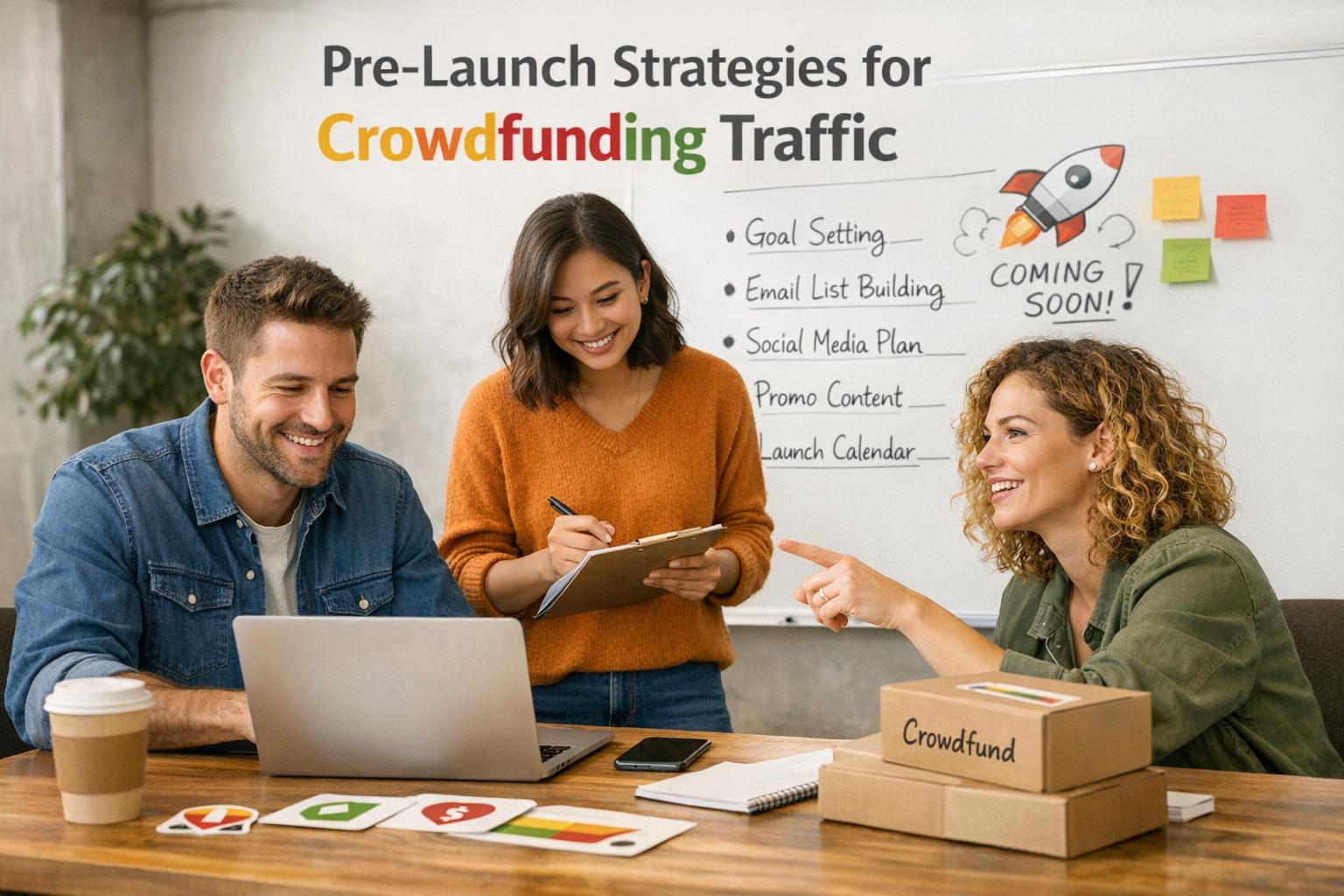
Crowdfunding success hinges on preparation before launch. Platforms like Kickstarter and Indiegogo amplify your existing audience – they don’t create one for you. Without building interest early, your campaign risks failure. Here’s how to set up for success:
- Build an Audience Early: Email lists and $1 reservation funnels attract serious backers. Pre-launch email lists convert 90% of backers within 48 hours.
- Test Ads Before Scaling: Start with a $5,000 budget to refine messaging and target audiences. Use Meta Pixels to track results.
- Engage Your Community: Share updates, prototypes, and design decisions on social media. Involve your audience to create a sense of ownership.
- Collaborate with Influencers: Partner with micro-influencers to reach niche communities that align with your product.
- Plan a Strong Launch Day: Focus on early momentum to trigger algorithms and drive organic traffic.
Start preparing 3–6 months before launch, combining email campaigns, paid ads, and social engagement to build trust and excitement. Early preparation is the key to exceeding your crowdfunding goals.
Building an Email List and Reservation Funnel

Email-Only vs Reservation Funnel: Conversion Rates and Performance Metrics for Crowdfunding Campaigns
Your email list is the backbone of your funding efforts. By incorporating a reservation funnel – a system where buyers make a $1 deposit to indicate their interest – you can boost conversion rates by up to 30 times compared to relying on email lists alone. That small deposit helps you separate casual visitors from serious buyers, giving your campaign a significant edge.
To make the most of this strategy, consider using AI-powered tools to fine-tune your reservation funnel. For regular tips on building automated marketing systems, check out the AI Acceleration Newsletter. And if you’re gearing up for a launch and want hands-on support, M Studio / M Accelerator offers expert guidance to help founders build marketing systems that drive growth.
Once you’ve built a qualified list, the next step is creating a landing page that converts.
Setting Up a Landing Page
A successful landing page needs three core elements: an eye-catching hero image, a clear and compelling value proposition, and an irresistible early-bird offer. These incentives often include steep discounts – think 30–40% off retail – or exclusive perks for early supporters.
Take Aaron’s launch of the Sea Beasts board game in 2024 as an example. For a $1 deposit, he offered a $15 deluxe upgrade called "Shimmering Scales." Out of 10,000 email subscribers, 2,488 became VIPs, generating $155,804 within the first 24 hours and eventually raising over $654,000 from 5,284 backers.
The $1 reservation model works because it identifies buyers who are genuinely interested. While email-only lists typically convert at 3–5%, reservation funnels see conversion rates between 20–50%. In some cases, tabletop game campaigns even hit the 50% mark. Once someone makes their $1 deposit, invite them to an exclusive community – like a Discord group – where they can preview prototypes, provide feedback, and feel connected to the project. As Aaron Radcliffe, the creator of the Fyro T22 Backpack, shared:
"By the time we launched, our community members weren’t just backers – they were evangelists who had a stake in seeing the T22 succeed."
Aaron’s reservation funnel brought in $232,000 from 1,165 backers in just 48 hours, eventually raising $373,464.
Using Paid Ads
If you’re running a crowdfunding campaign, Meta platforms (Facebook and Instagram) dominate the advertising space, often accounting for over 90% of successful ad budgets. Start with a $5,000 test budget to refine your messaging. Aim for a cost-per-lead of $3–$5 and click costs between $0.45–$0.75. Once you’ve fine-tuned your approach and see strong results, scale your ad spend.
Don’t forget to install Meta Pixels on your landing page. These tracking tools are essential for measuring conversions and creating lookalike audiences once your email list reaches 100 subscribers. When setting up your ads, focus on psychographics – interests, hobbies, and behaviors – rather than broad demographics. For instance, if you’re promoting a fantasy board game, target fans of Game of Thrones or The Witcher.
It’s also crucial to optimize your ads for mobile devices, as over 50% of Kickstarter traffic and 85% of Facebook ad clicks come from smartphones. Once your ads start driving traffic, the next step is keeping those leads engaged through email.
Nurturing Subscribers with Email Campaigns
Engagement begins the moment someone signs up. Send a welcome email right away, followed by updates leading up to your launch. A typical sequence might include a 7-day pre-launch update, a 24-hour reminder, and two launch-day emails. This approach helps turn subscribers into dedicated backers. VIP emails often achieve open rates above 70% and click-through rates exceeding 22%. Tools like Klaviyo or ConvertKit make it easy to automate these email sequences.
To keep your audience engaged, share behind-the-scenes updates, sneak peeks of prototypes, and ask for their input on design choices. This not only builds excitement but also turns your subscribers into active participants in your campaign. Data from over 1,000 campaigns shows that 90% of backers from a pre-launch list pledge within the first 48 hours.
Additionally, directing subscribers to your Kickstarter pre-launch page ensures they receive notifications from both your email campaigns and Kickstarter’s built-in alerts. Early followers on Kickstarter’s pre-launch page are 66% more likely to support your campaign.
Developing an Organic Social Media Presence
Social media is where relationships are built, turning casual followers into loyal supporters. A strong presence on these platforms complements your email campaigns and landing pages, while also working with platform algorithms to boost early engagement. One of the best strategies is "building in public" – sharing your prototypes, design decisions, and progress updates as they happen. This openness builds trust and transforms passive followers into active supporters who feel connected to your journey.
Take Aaron Radcliffe, creator of the Fyro T22 Backpack, as an example. In 2024, he embraced this approach on his YouTube channel, Nomads Nation. By sharing early prototypes and inviting his community to vote on design elements like colors and pocket layouts, he created a sense of collaboration. The result? $232,000 raised from 1,165 backers in just 48 hours, with a final total of $373,464. His story proves that authentic engagement can turn backers into advocates who promote your campaign.
To maximize your impact, focus on short-form video content that highlights specific features. Since over half of Kickstarter traffic comes from mobile devices, your content needs to grab attention within the first 3–5 seconds. Use tools like polls, Q&A sessions, and behind-the-scenes clips to keep your audience engaged. The key is to make your audience feel like collaborators in your journey, not just customers. This approach not only builds trust but also provides a foundation for creating compelling, data-driven paid ads.
Documenting Your Journey
Start sharing your story long before your launch. Post photos of early prototypes, discuss the problems your product solves, and be honest about the challenges you’re facing. This kind of transparency builds trust far more effectively than polished marketing materials. Platforms like Instagram, Reddit, and niche Facebook groups are perfect for this type of content.
Involve your audience by using polls to let them vote on design choices. This not only boosts engagement but also gives you valuable feedback to refine your product. As your launch date approaches, start posting countdown updates about two weeks in advance to build excitement. Keep in mind that it often takes around seven interactions for someone to feel truly connected to a brand, so consistency is more important than perfection. This momentum not only strengthens trust but also provides content that can be repurposed later for ads.
Repurposing Content for Paid Ads
Your organic social media posts can double as a testing ground for paid campaigns. Pay attention to which posts get the most saves, shares, and comments – these are your strongest performers. The authentic content that resonates organically can often shine even brighter when amplified through paid advertising.
When turning organic posts into ads, tailor them for mobile viewing. Add text overlays or captions since many people watch videos with the sound off. Instead of creating one long video, break it into 2–5 shorter clips, each showcasing a specific feature. Test these variations with small budgets before scaling up. Often, the content that worked well organically will perform even better with paid reach.
For more guidance on integrating AI into your crowdfunding efforts, check out the hands-on resources available at M Accelerator.
Running Paid Ad Campaigns for Pre-Launch Momentum
Paid advertising is a powerful way to build momentum before your launch, helping you reach a wider audience and turn casual visitors into dedicated backers. When it comes to platforms, Meta (which includes Facebook and Instagram) should be your top priority. Experts suggest allocating over 90% of your ad budget here because it consistently delivers better ROI compared to platforms like TikTok or YouTube. The main objective? Drive traffic to a landing page where visitors can either join your email list or, ideally, place a $1 reservation deposit. This small deposit is a strong signal of high intent, marking these individuals as VIP backers.
Streamline your crowdfunding funnel by incorporating AI-driven insights. For weekly tips and strategies, check out our AI Acceleration Newsletter.
The secret to success lies in testing before scaling. Take a page from the Botany board game campaign, which validated its messaging with a small budget before increasing ad spend. As Fulfillrite wisely advises:
"The mistake most creators make is dumping money into ads without testing first. Start lean… Once you find ad creative that works, then you scale."
Once you’ve tested your strategy, it’s time to refine your creative assets and prepare for scaling.
Testing and Optimizing Creatives
Begin with a modest budget – $5,000 or less – to experiment with different video formats and audience segments. Break your organic content into several short clips (2–5) that highlight specific features of your product. Keep in mind that over half of Kickstarter traffic comes from mobile devices, so your ads need to grab attention within the first 3–5 seconds. Adding text overlays or captions is essential since many users scroll without sound.
When targeting your ads, focus on psychographics rather than just broad demographics. For example, instead of targeting "men aged 25–40", narrow your focus to specific interests like combining "backpacks" with "Kickstarter" or "Indiegogo." This way, you’re more likely to reach experienced backers. Once you’ve collected at least 100 email addresses, upload the list to Meta to create lookalike audiences that closely resemble your most engaged leads.
To control costs, opt for manual bidding and aim for a cost-per-click between 45 and 75 cents. As Nalin Chuapetcharasopon, Founder of Crush Crowdfunding, explains:
"By clicking Manual, Facebook will show you an outrageous suggested bid to try to get the most out of you. Know that the average cost of a Facebook click is 38 cents."
This strategy helps you stay within budget while identifying what resonates with your audience. After refining your creatives, shift your focus to retargeting warm leads for higher conversions.
Retargeting to Convert Warm Leads
Install the Meta Pixel to track visitors and set up retargeting campaigns aimed at warm leads – people who are already familiar with your product but might need a little push to commit.
Combine retargeting ads with automated emails that share behind-the-scenes updates and emphasize your product’s unique features. In 2024, Aaron Radcliffe applied this strategy for the Sea Beasts board game by offering a special "Shimmering Scales" deluxe upgrade for a $1 deposit. Out of 10,000 email subscribers, 2,488 became VIP backers. This highly engaged group generated $155,804 within the first 24 hours and ultimately contributed to a total of $654,000 from 5,284 backers.
For more detailed guidance on building automated systems that turn leads into backers, visit M Accelerator.
Securing Influencer and Creator Partnerships
If you’re looking to go beyond paid ads, teaming up with influencers can supercharge your pre-launch efforts.
Collaborating with influencers – especially micro-influencers with 10,000 to 100,000 followers – can help you tap into trusted communities. Why micro-influencers? Because 92% of consumers trust their recommendations over traditional ads or celebrity endorsements. For more insights into leveraging AI for strategies like these, check out the AI Acceleration Newsletter or explore M Studio / M Accelerator.
Start by identifying 5–10 creators whose followers align with your target audience. S’wheat, a company that makes reusable plant-based water bottles, nailed this tactic. They analyzed competitors’ followers to pinpoint the right micro-influencers. By collaborating with these creators for a pre-launch contest in 2021, they generated over 20,000 leads before their official launch. You can replicate their success by using tools like SocialLadder, Insense, Shopify Collabs, or Klear to find creators in your niche.
Identifying Micro-Influencers
When scouting for creators, focus on how well their content and audience align with your brand. For example, Aaron Radcliffe, the mind behind the Sea Beasts board game, partnered with niche YouTube channels like Rahdo Runs Through (110,000+ subscribers) in 2024. By targeting a community already passionate about cooperative games, he sparked major excitement and raised $654,000 from 5,284 backers.
To find potential partners, tools like Moz Open Site Explorer can help you locate individuals who link to or mention products similar to yours. You can also join creator communities like the BackerKit Discord to connect with established names in your niche. When reaching out, make your pitch personal – ditch the cookie-cutter emails. Highlight why your product is a perfect fit for their audience and offer them prototypes or early access in exchange for feedback. Building rapport beforehand, like engaging with their content or giving them shoutouts, can go a long way in securing a partnership.
Once you’ve made the connection, focus on creating lasting collaborations rather than one-time deals.
Prioritizing Long-Term Relationships
One-off sponsored posts might get you some attention, but long-term partnerships deliver more credibility and trust. As Fulfillrite puts it:
"The best partnerships are long-term. A creator who genuinely loves your product might mention it multiple times, which builds more credibility than a one-off sponsored post ever could." – Fulfillrite
Aaron Radcliffe showcased this approach with his Fyro T22 Backpack campaign in 2024. Through his platform, Nomads Nation, he shared behind-the-scenes updates, including prototypes and design decisions, over several months. By the time the campaign launched, his audience wasn’t just interested – they were deeply invested. This strategy helped him raise $232,000 in just 48 hours and a total of $373,464.
Building genuine, ongoing relationships with creators can turn their followers into loyal advocates for your brand.
sbb-itb-32a2de3
Using Community Building Tactics
While working with influencers can expand your reach, connecting with niche communities often results in the most loyal supporters. The secret lies in showing up genuinely in spaces where your audience already spends time – whether that’s on Discord servers, Reddit threads, or Facebook groups. For more tips on using AI to boost your pre-launch efforts, join our free AI Acceleration Newsletter. This approach adds a personal touch to your email and ad strategies, making your outreach feel less transactional.
Building strong community ties complements your digital efforts by fostering meaningful relationships with potential backers. Start by identifying where your target audience gathers online. For instance, if you’re launching a board game, dive into discussions on BoardGameGeek or related subreddits. If it’s a tech product, explore Discord servers focused on gadgets or innovation. Begin engaging 3–6 months before your launch – this gives you enough time to build trust and avoid coming across as overly promotional.
In 2024, Aaron Radcliffe showcased the power of this strategy on his YouTube channel. By involving his audience as co-creators, he turned them into loyal supporters, which led to impressive early campaign backing. When people feel invested in a product, they naturally become its most enthusiastic advocates.
Providing Value in Niche Communities
The golden rule of community engagement? Give before you ask. Focus on being helpful – answer questions, share behind-the-scenes content, and host AMAs to address common challenges. Joe, the creator of AstroBrew, used this approach to great effect. During his Kickstarter launch in 2025, he raised $68,574 in the first 24 hours. His secret? Building a VIP community during the pre-launch phase by offering exclusive updates and early-bird pricing. This strategy also triggered Kickstarter’s discovery algorithm, bringing in an extra $35,359 – 24% of his total funding.
Engage your audience further with polls or by asking for feedback on design choices. This makes backers feel like part of the process. And don’t overlook in-person events – they can take these connections to the next level.
Integrating with In-Person Events
Meeting people face-to-face at industry events transforms online interest into genuine enthusiasm. For example, board game creators might attend Gen Con or PAX, while consumer tech innovators could focus on CES or Maker Faire. These events allow you to demo your product, gather immediate feedback, and collect contact information for your digital lead list. Make it easy for attendees to sign up by using QR codes or simple forms, and offer something exclusive – like a friends-and-family discount or early access – as an incentive.
Documenting these events on social media is another great way to engage followers who couldn’t attend. Share photos, videos, and behind-the-scenes moments to keep your audience involved. Statistics show that early followers who engage with a pre-launch page are 66% more likely to back a campaign than those who discover it after the launch.
The best campaigns blend digital and in-person strategies. Build your online presence through genuine participation, then strengthen those connections with face-to-face interactions. As Fulfillrite puts it:
"Face-to-face engagement builds the kind of advocacy that lasts beyond your campaign."
When supporters meet you in person, they’re not just backing a product – they’re backing you.
If you’re looking to supercharge your pre-launch strategy with AI-driven tools and expert support, check out M Studio / M Accelerator. They work closely with founders to create AI-powered systems that deliver measurable results.
Optimizing Your Pre-Launch Timeline and Metrics
A six-week pre-launch strategy can reduce failure rates to below 40% [1]. Want to refine your campaign with AI-driven strategies? Subscribe to the AI Acceleration Newsletter for weekly tips on automating your go-to-market efforts.
Break the six weeks into three focused phases: competitor research, funnel setup, and ad testing. Start with two weeks of research, where you dive into both successful and failed competitors. This helps you identify which reward tiers resonate, typical backer contributions, and emotional triggers that drive conversions. Next, dedicate weeks three and four to funnel setup. Build a landing page with a clear value proposition, and consider adding a $1 reservation deposit to pinpoint your most dedicated supporters. Tools like those from M Studio / M Accelerator can integrate AI solutions with expert guidance. Finally, use the last two weeks for ad testing and scaling. Run small-budget tests on Meta to identify high-performing creatives, then scale up your spend for a strong pre-launch push. These steps ensure your campaign has a solid foundation for a smooth launch.
Creating a Pre-Launch Timeline
Start your pre-launch efforts 3–6 months before the actual launch to allow time for metric-based adjustments. For example, the creators of the Piper pepper grinder carefully tracked their pre-launch data in 2025. They chose to delay their launch to avoid competing with Prime Day and July 4th, waiting until they hit key milestones – 10,000 email signups and 1,900 reservations – before going live. This careful planning paid off with a strong day-one performance.
Timing matters. Launching on a Tuesday between 7:00–10:00 AM ET can maximize visibility. Coordinate your email sequence around this: send a welcome email to new signups, a 7-day pre-launch announcement, a 24-hour reminder, and launch day updates in both the morning and evening. Since 90% of backers from your pre-launch email list typically convert within the first 48 hours [1], it’s crucial to prioritize communication during this window.
With a well-thought-out timeline, you can also evaluate the effectiveness of an email-only funnel versus a reservation funnel.
Comparing Email-Only vs. Reservation Funnels
Not all pre-launch leads are equal. While building an email list is important, incorporating a reservation funnel can significantly boost your chances of day-one success. The key difference lies in the level of commitment – a $1 reservation signals far greater intent than a simple email signup.
| Metric | Email-Only Funnel | Reservation Funnel ($1 Deposit) |
|---|---|---|
| Conversion Rate | Typically 3–5% | 20% to 50% |
| Backer Intent | Passive interest; low commitment | High intent; "Superfan" status |
| Predictive Accuracy | Low; hard to estimate Day 1 revenue | High; consistent conversion rates |
| Cost Per Lead (CPL) | Lower upfront cost | Higher CPL but better ROI |
Aaron Radcliffe’s success with the Sea Beasts board game highlights the power of the reservation model. His approach turned passive interest into committed backers who were already invested in the campaign’s success before launch day.
[1] Fulfillrite, 2025Conclusion: Key Steps for Crowdfunding Pre-Launch Success
The pre-launch phase is the backbone of any successful crowdfunding campaign. Spending 3–6 months building an audience before launch can significantly reduce failure rates to under 40%. Additionally, campaigns that secure an initial pre-commitment of just 5% of their funding goal boast a 50% success rate, compared to a mere 15% for those starting from scratch. The difference between campaigns that struggle and those that soar often comes down to preparation. To dive deeper into how AI can supercharge your pre-launch efforts, check out our free AI Acceleration Newsletter Join the AI Acceleration Newsletter.
To set your campaign up for success, focus on these critical steps: grow a high-intent email list using reservation funnels, fine-tune your messaging with small ad tests, and engage genuinely within your niche. Here’s a key insight – followers who interact with your pre-launch page are 66% more likely to back your campaign compared to those who find it during the live phase. Campaigns with strong pre-launch engagement consistently achieve better day-one results, setting the stage for long-term success.
Automation can take your pre-launch efforts to the next level by streamlining repetitive tasks. AI tools can handle email sequences, track pixel data, and optimize ad performance, giving you more time to focus on building meaningful connections with your audience. If you’re ready to incorporate AI-driven strategies into your crowdfunding efforts, M Accelerator’s Elite Founders program offers hands-on sessions to help you implement automations that deliver immediate results.
Success doesn’t hinge on having the best product – it’s about building an engaged audience early and turning passive interest into active support before your campaign even begins. By combining these strategies with a data-driven approach, your pre-launch efforts can become the foundation for a campaign that not only meets but exceeds its goals.
FAQs
What is a $1 reservation funnel, and how does it boost crowdfunding conversion rates?
A $1 reservation funnel is a clever pre-launch tactic for crowdfunding campaigns. It invites potential backers to make a small, low-risk commitment – just one dollar – before your campaign officially kicks off. This tiny investment helps establish trust, fosters a sense of early participation, and boosts the chances that these early supporters will contribute more once your campaign goes live.
By making it easy and affordable to get involved, this strategy not only expands your audience but also creates early buzz. That initial momentum is key for building social proof, which can, in turn, attract even more backers to your project.
How can micro-influencers boost your crowdfunding campaign during the pre-launch phase?
Micro-influencers can play a pivotal role in your crowdfunding pre-launch strategy. With their highly engaged and focused audiences, they have the ability to generate buzz and build trust around your campaign. Their close-knit connection with their followers makes them effective advocates, helping to spread the word and spark interest.
By working with micro-influencers, you can reach specific communities that are more likely to resonate with your project. Their endorsements act as powerful social proof, boosting credibility and creating a sense of urgency – or even FOMO (fear of missing out) – among potential backers. This kind of early traction is key for building trust and securing those crucial first pledges before your campaign officially goes live.
Why should you start preparing for your crowdfunding campaign 3 to 6 months in advance?
Starting your pre-launch efforts 3 to 6 months in advance is key to building excitement, growing a loyal audience, and refining your message before your campaign officially begins. This window gives you the chance to create buzz, collect email sign-ups, and connect with potential supporters early on, boosting the likelihood of hitting your funding goals faster.
Getting an early start also lets you validate your idea, experiment with different marketing approaches, and build anticipation among your audience. Plus, it gives you time to use strategies like reaching out to influencers, crafting engaging content, and running paid ads to spark interest. This forward-thinking approach not only minimizes stress but also boosts engagement and lays the groundwork for a strong campaign launch.
Related Blog Posts
- How Market Trends Impact Fundraising Timing
- What is Seed-strapping
- 10 Crowdfunding Marketing Tactics for Startups
- AI Tools for Crowdfunding Investor Outreach