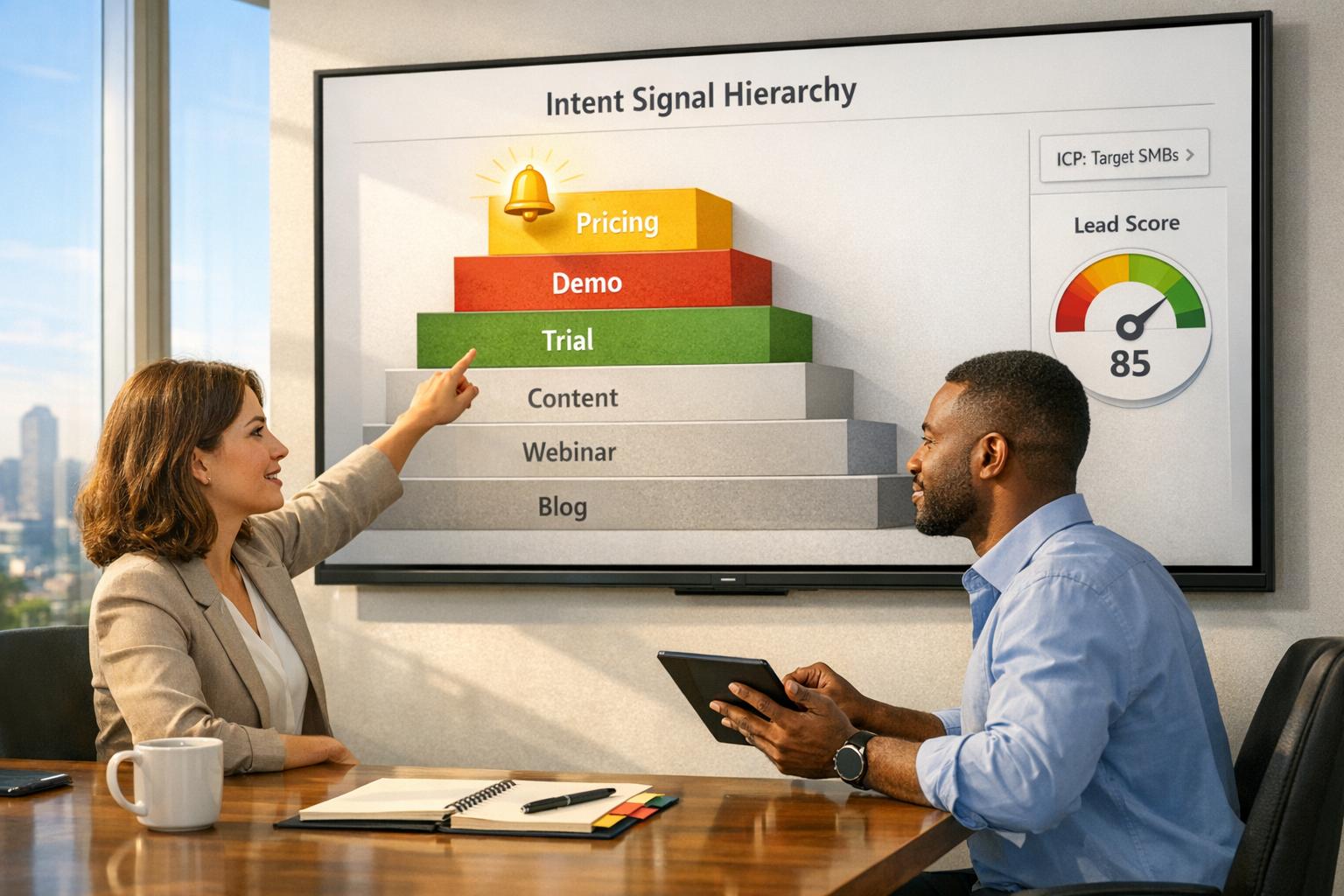
Not all website visits are created equal. Some pages reveal strong buying intent, while others are just noise. For B2B sales, knowing which visits matter can make or break your pipeline. Here’s the key takeaway: focus on high-intent signals like pricing page visits or demo requests. These actions often indicate a prospect is ready to buy.
Key Insights:
- Tier 1 (High Intent): Pricing pages, demo requests, or trial signups. Act fast – respond within 5–15 minutes for the best results.
- Tier 2 (Medium Intent): Case studies, product feature pages, or security details. Follow up within a day to nurture these leads.
- Tier 3 (Low Intent): Blog posts or resource pages. Use automated marketing to keep them engaged without wasting sales time.
- Data Matters: Use tools like IP-to-company matching and lead scoring to identify and prioritize high-value prospects.
By focusing on intent signals, your sales team can maximize efforts on leads that truly matter, boosting conversions and reducing wasted time.

B2B Intent Signal Hierarchy: 3-Tier Framework for Sales Prioritization
Tier 1: High-Priority Purchase Signals
Tier 1 signals are the clearest indicators that a prospect is on the verge of making a purchase decision. These actions suggest they’re no longer casually browsing but actively evaluating their options. For your sales team, this is the moment to act – and fast. The window for engagement is brief, often just minutes.
Pricing Page Visits
When a prospect visits your pricing page, it’s a clear sign they’ve moved from exploration to serious consideration. In lead scoring models, pricing page visits usually score 20-25 points, second only to direct demo requests in terms of intent.
The key is to monitor frequency and duration. A single visit might not mean much, but multiple visits or spending 30–60 seconds on the page often signals active evaluation. This behavior suggests they’re comparing options or building a case for purchase.
To maximize this opportunity, combine pricing page visits with Ideal Customer Profile (ICP) criteria such as company size, industry, and tech stack. Tools like IP-to-company matching can help identify anonymous visitors and focus your efforts on high-fit accounts. Not every visitor is worth chasing – prioritize those who align with your target profile.
Speed is critical. Reaching out within 5 minutes can increase conversion rates by 100x compared to waiting 30 minutes. Sales reps who act within 5 minutes see 900% more success than those who delay even 10 minutes. Use real-time alerts via Slack or your CRM to notify your team the moment a qualified lead hits your pricing page. Your outreach should be straightforward and helpful, like: "Noticed you were checking out our pricing – can I answer any questions for you?" This approach works far better than a generic pitch.
Demo or Trial Request Pages
Visits to demo or trial request pages are the ultimate buying signal. These prospects aren’t just curious – they’re ready to experience your product firsthand. This is as close to demand capture as it gets, and it requires an immediate response.
Route these leads directly to the appropriate SDR or account owner, and ensure your response time is within 5-15 minutes during business hours. Acting within the first hour boosts qualification rates by 7x, and being the first to respond gives you a 50% better chance of closing the deal compared to slower competitors.
Personalize your follow-up by referencing their specific interest in a demo or trial. Avoid overloading them with details about their visit; instead, focus on features or benefits relevant to their industry. If multiple individuals from the same company visit high-intent pages, coordinate a multi-threaded approach. For example, reach out to IT for technical concerns and executives for ROI discussions.
Here’s a pro tip: Leverage intent tracking to revive past opportunities. If a previously lost lead returns to your demo or pricing page, it’s a strong sign they’re re-entering the buying cycle. Notify your Account Executive immediately – this isn’t a cold call; it’s a warm lead with valuable context.
| Intent Level | Signal Example | Response SLA | Recommended Action |
|---|---|---|---|
| Tier 1 (Hot) | Demo/Trial Request, 3+ Pricing Visits in 24 Hours | 5-15 minutes | Immediate sales outreach with a personalized demo offer |
| Tier 2 (Warm) | Case Studies, Product Features, Integration Pages | 2-3 days | SDR personalized email with relevant resources |
| Tier 3 (Cold) | Blog Posts, Homepage, About Us | N/A | Automated nurture or ad retargeting |
Tier 1 signals require swift, decisive action. These interactions are often make-or-break moments, setting the tone for how you’ll handle lower-intent signals in subsequent tiers.
Tier 2: Product Evaluation Signals
Tier 2 signals mark the transition from casual interest to a more serious evaluation of whether your solution fits a prospect’s needs. At this stage, prospects are looking for validation, assessing technical requirements, and building internal cases to justify a purchase. These mid-funnel signals are essential for identifying leads with genuine intent, separating them from casual browsers.
Here’s how different pages – case studies, security pages, and product feature pages – can provide valuable insights into a prospect’s evaluation process.
Case Studies and Testimonials
When prospects dive into case studies, they’re looking for proof that your solution delivers results for companies like theirs. This behavior signals they’ve moved beyond basic awareness and are now seeking evidence to support their decision. The type of case study they view often highlights their specific challenge. For instance, if a healthcare company reviews your healthcare-focused case study, that’s a clear indicator of their pain points.
Assigning 15 lead scoring points to case study views reflects their importance in the validation process. Longer session durations suggest they’re exploring implementation details, not just skimming. If multiple stakeholders from the same company review the same case study, it could signal organizational-level buying intent. As Lindsay Hasz, Director of Insights and Optimization at SAP Concur, explains:
"Demandbase allowed us to create segments based on journey stage combined with our own first-party behavioral data."
For prospects who engage with a case study, follow up quickly – ideally within 24 hours. Tailor your outreach to reference the specific use case they reviewed, making your communication more relevant.
Security and Compliance Pages
When prospects visit security and compliance pages, it’s a sign they’re conducting in-depth due diligence. This is especially true for enterprise-level deals, where risk assessment and procurement processes are more formal. These visitors are rarely casual; they’re often nearing a decision.
Assign 20 points to visits on these pages, particularly when multiple stakeholders are involved, as this indicates a coordinated internal evaluation. Repeated visits to these pages further confirm serious intent, making these prospects a high priority for follow-up.
Product Features Pages
Frequent visits to product feature pages can reveal the specific challenges a prospect is trying to address. A single visit might indicate casual interest, but three or more visits to the same feature page within 48 hours suggest active evaluation. Longer dwell times – over three minutes – and deep engagement, such as scrolling through 80% of the technical specs, indicate strong technical interest.
Assign 15 points for these sessions, especially if the navigation shows a logical progression from high-level features to detailed implementation or integration pages. For example, if a prospect visits a Salesforce integration page and you know they use Salesforce, that’s a strong signal of intent. When you see three visits within 48 hours and extended time spent on at least two feature pages, it’s time for personalized outreach. Use the specific features they reviewed to craft your message.
| Signal Type | Intent Level | Lead Score | What It Reveals |
|---|---|---|---|
| Case Studies | Medium-High | +15 points | Validating use cases |
| Security/Compliance | High | +20 points | Enterprise-level due diligence |
| Product Features | Medium | +15 points | Assessing technical compatibility |
These signals serve as a bridge between early research and decisive purchase intent. By leveraging these insights, you can create timely, tailored outreach that aligns with your prospects’ needs, helping them move closer to making a decision.
Tier 3: Early-Stage Research Signals
Early-stage signals highlight when a prospect is just beginning their research journey. At this stage, visitors are usually not ready to buy or speak with sales. While these signals rarely lead to immediate conversions, they play a crucial role in setting the stage for future interactions.
Instead of pushing for a sales conversation, focus on nurturing these prospects through marketing efforts. The goal is to build trust, keep your brand in their mind, and guide them as they explore their options. Interactive tools can be especially helpful in shaping their evaluation process.
ROI Calculators and Interactive Tools
When prospects engage with ROI calculators, they’re not just clicking around – they’re actively assessing the potential value of your solution and figuring out their budget. This behavior shows medium-to-high interest and deserves more attention than a casual blog visit.
Assign 10 to 15 points to these interactions, especially if the prospect spends over three minutes using the tool or revisits it multiple times. These actions suggest they’re working on a business case or preparing for internal discussions. Instead of jumping in with a sales pitch, offer helpful resources, like a case study that highlights similar ROI results. This approach strengthens trust while subtly moving the conversation forward.
Blog and Resource Pages
After using interactive tools, many prospects dive deeper into their research by exploring blog posts or other resource pages. A single blog visit might only indicate casual interest and should score 2–5 points. However, if someone reads multiple related articles in one session, it’s a sign of focused research and deserves a 10-point boost. For example, a prospect exploring three or more articles on topics like account-based marketing or security compliance is clearly digging deeper.
"A single blog post read means little. But a sequence of actions – like reading a blog post then viewing a product demo and then visiting the pricing page – tells a compelling story of escalating intent." – LeadOps
Pay attention to dwell time, too. A visitor who spends more than three minutes on your site or views multiple pages is likely a "warm" lead. Additionally, if multiple people from the same company are active on your site around the same time, it could indicate organizational-level interest rather than just individual curiosity. These visitors should be routed into automated nurture campaigns with content tailored to their interests, keeping them engaged until they’re ready to talk sales.
| Signal Type | Intent Level | Lead Score | What It Reveals |
|---|---|---|---|
| ROI Calculators | Medium-High | +10-15 points | Quantifying value and building a business case |
| Blog Posts (Single) | Low | +2-5 points | General awareness or casual browsing |
| Blog Posts (Multi-Page) | Medium | +10 points | Focused research on specific topics |
While early-stage signals won’t lead to immediate deals, identifying these behaviors and nurturing them with relevant content ensures your brand stays top-of-mind. When these prospects are ready to make a decision, you’ll be the first they think of.
Intent Signal Hierarchy Comparison Table
This table breaks down how different page visits align with the buyer’s journey, helping your team zero in on the most important signals. Using the signal tiers outlined earlier, it highlights the key metrics that should shape your sales approach.
| Intent Tier | Signal Type (Page Visits) | Intent Level | Recommended Response Time | Sales Priority |
|---|---|---|---|---|
| Tier 1 | Pricing, Demo Request, Trial Signup, Contact Sales | High (Decision) | 5–15 Minutes | Critical – Immediate Outreach |
| Tier 2 | Case Studies, Product Features, Security/Compliance, Competitor Comparisons | Medium (Evaluation) | Same Business Day | High – Proactive Follow-up |
| Tier 3 | ROI Calculators, Blog Posts, Interactive Tools, Resource Pages | Low (Awareness) | 24–48 Hours (or Nurture) | Low – Marketing Nurture |
| Negative Signals | Careers Page, Investor Relations, Unsubscribe | Disqualified | No Sales Action | None |
This structure ensures your sales team prioritizes efforts based on intent. Timing is critical – responding to Tier 1 signals within 5–15 minutes can dramatically increase your chances of conversion.
"The difference between immediate follow-up and delayed response can make or break your conversion rates, especially when you’re dealing with high lead volumes." – Philip Schweizer, CEO, SalesWings
To implement this system effectively, set up CRM routing rules and alert mechanisms. For Tier 1 signals, ensure instant notifications – through tools like Slack or text – reach your sales team. Tier 2 signals should go to your SDR queue for follow-up within the same business day. Meanwhile, Tier 3 signals can be funneled into automated nurture campaigns, keeping prospects engaged without overwhelming your sales reps. Acting promptly on high-intent signals ensures you’re connecting with leads at the right moment, maximizing your chances of success.
sbb-itb-32a2de3
How to Track Page Visit Signals
Getting a handle on page visit signals starts with proper tracking. This step is crucial for identifying high-value interactions. To begin, install a JavaScript snippet or tracking pixel on your site. Tools like Clearbit Reveal, Dealfront, or Instantly use IP-to-company matching to reveal the companies behind anonymous visits. These scripts can be added directly or through Google Tag Manager. Once in place, you’ll be able to identify which companies are visiting your site – even if they don’t fill out a form. This is a game-changer because only 2% to 4% of B2B website visitors typically self-identify via forms, leaving the majority of your traffic hidden without proper tracking.
Want to automate your intent tracking? Join our AI Acceleration Newsletter to learn how.
The next step is to filter out irrelevant data. Configure your system to send alerts only when visitors match your Ideal Customer Profile (ICP). You can filter by factors like industry, company size, or revenue. For instance, you might set a rule to alert your team when a SaaS company with 50+ employees visits your pricing page twice in a week. This keeps your sales team focused on leads that actually matter, avoiding unnecessary distractions.
With irrelevant data filtered out, it’s time to choose the right tools to turn these signals into actionable insights.
Tools for Tracking Intent
A strong tracking system includes visitor identification, behavioral analytics, and CRM integration. Here’s how these components work together:
- Visitor Identification: Tools like Instantly, Clearbit Reveal, and Dealfront identify which companies are visiting your high-intent pages and sync this data to your CRM. For example, Instantly offers tracking starting at $97/month, while Clearbit uses a usage-based pricing model.
- Behavioral Analytics: Tools like Hotjar and FullStory provide heatmaps and session recordings, showing exactly how visitors interact with your site. You can see where they click, how far they scroll, and where they drop off. Hotjar offers a freemium plan, while pricing scales with session volume.
- Revenue Orchestration Platforms: For larger teams, platforms like Qualified or Demandbase unify intent signals from your website, CRM, and third-party sources into one place. This makes it easier to assess account readiness.
"Demandbase allowed us to create segments based on journey stage combined with our own first-party behavioral data." – Lindsay Hasz, Director of Insights and Optimization, SAP Concur
The key to making all of this work is CRM integration. Syncing visitor data directly to platforms like Salesforce or HubSpot ensures that high-intent signals don’t get lost. For example, if a target account visits your demo page, this data should automatically create a task for the account owner, update the lead score, and trigger a follow-up sequence. Without this integration, valuable insights might sit unused in a separate tool, out of reach for the sales team.
Once your tracking tools are in place, the next step is setting up alerts to turn these insights into immediate action.
Setting Up Alerts for High-Intent Pages
Real-time alerts are essential for converting intent data into revenue. Configure your system to send instant notifications via Slack, email, or mobile apps whenever a high-value signal occurs. For Tier 1 signals – like visits to pricing pages, demo requests, or trial signups – alerts should reach your sales team within seconds.
To avoid overwhelming your team, focus on high-value visits. Set up custom feeds filtered by specific URLs (e.g., /pricing, /demo, /vs-competitor) and engagement criteria. For instance, trigger an alert only if someone spends more than 30 seconds on your pricing page or visits it multiple times within 72 hours. Add ICP filters like industry, revenue, or employee count to ensure only target accounts trigger alerts.
Use tools like LeanData or Chili Piper to route alerts to the right team member. For example, if a West Coast account visits your pricing page, the alert should go directly to the West Coast account executive. Speed is critical – studies show that responding to a demo request within 5 minutes can boost conversion rates by up to 100x compared to a 30-minute delay. Configure your CRM to auto-create tasks with deadlines to ensure no high-intent signal slips through the cracks.
Lead Scoring and Sales Response Strategies
Tracking intent signals is just the beginning. The real challenge is converting those signals into a lead scoring system that helps prioritize leads effectively. Without this step, intent signals are just noise. Curious about AI-driven lead scoring? Sign up for our AI Acceleration Newsletter to learn how AI can reshape your strategy.
A solid scoring model combines Fit, Behavior, and Intent to turn random page visits into actionable sales priorities. Here’s how it works:
- Fit: Does the lead match your ideal customer profile?
- Behavior: What actions are they taking on your site?
- Intent: Are they actively researching solutions?
For instance, a VP at a 100-person SaaS company who repeatedly visits your pricing page should score much higher than a student downloading a blog post. Scoring weights can vary depending on your target market. For mid-market leads, you might assign 40% to Fit, 30% to Behavior, and 30% to Intent. For enterprise leads, Fit might carry 60%, with Behavior and Intent sharing the remaining 40%.
Avoiding Score Inflation
One common mistake in lead scoring is score inflation, where repetitive low-value actions skew scores unrealistically high. For example, opening 10 newsletters shouldn’t outweigh a single demo request. To address this, cap points for low-value actions and apply score decay. For instance, a pricing page visit might initially earn 25 points but drop to 12.5 points after 15 days. Regularly fine-tuning your scoring model ensures that scores accurately reflect recent, meaningful activity, leading to better conversion rates.
Building a Scoring Model Based on Intent
Assign point values to intent signals based on their likelihood of leading to closed deals. Here’s a simple framework:
- Tier 1 (High Intent): Actions like demo requests or pricing page visits should earn 25–50 points.
- Tier 2 (Evaluation): Behaviors like viewing case studies or attending webinars might earn 10–20 points.
- Tier 3 (Research): Activities such as reading blog posts or opening newsletters might earn just 2–5 points.
Conduct quarterly audits to identify which behaviors correlate most strongly with closed deals. Adjust point values accordingly to keep your scoring model sharp.
Recency modifiers can also keep scores relevant. For example, if someone visits your pricing page today, their score could get a 20% boost. But if they haven’t engaged in 30 days, their score might drop to zero. Negative scoring is equally important – subtract points for poor-fit signals like student email domains, competitor IP addresses, or visits to your careers page.
Instead of relying on a single score, group leads into tiers:
- Tier 1 (Hot Leads): High fit and high intent. These leads should trigger immediate sales alerts, with a response time of under 24 hours.
- Tier 2 (Warm Leads): High fit but medium intent. These leads are best suited for personalized nurture campaigns or SDR monitoring.
- Tier 3 (Cold Leads): Lower intent and less ideal fit. These leads are better handled through automated marketing nurtures.
| Signal Tier | Example Behaviors | Suggested Points | Recommended Action |
|---|---|---|---|
| Tier 1: High Intent | Demo request, Pricing page visit, Contact form | 25–50 | Immediate Sales/SDR outreach (<24h) |
| Tier 2: Evaluation | Case studies, Product webinars, Feature pages | 10–20 | Personalized nurture or SDR watchlist |
| Tier 3: Research | Blog posts, Infographics, Newsletter opens | 2–5 | Automated marketing nurture |
Once you’ve prioritized your leads, the next step is personalized outreach to turn potential into pipeline.
Personalized Outreach for High-Intent Leads
Timing is everything. Contact high-intent leads within five minutes to maximize your chances of conversion. Use CRM-generated trigger briefs to guide your follow-ups. These briefs summarize the lead’s recent activity and fit, giving your sales team the context they need to craft relevant messages. For example: "Viewed pricing page 3 times in 48 hours, downloaded ROI calculator, matches ICP (SaaS, 50+ employees)."
When reaching out, keep your message tailored and concise. Instead of saying, "I saw you spent 4 minutes and 37 seconds on our pricing page", try: "I noticed you checked out our pricing – I’d be happy to share how other SaaS companies like yours are using our solutions." The key is to act while interest is high, reference specific actions, and maintain a conversational tone.
For Tier 1 leads, avoid generic templates. Use the details in your trigger brief to craft a personalized message. For instance, if a lead has visited your competitor comparison page, you could say: "Noticed you’re comparing options – here’s how we excel in [specific feature]." This approach is vital since 77% of B2B buyers complete their research before ever speaking with sales.
"Lead scoring, in isolation, is useless. No matter how accurate your model, if it doesn’t drive timely, appropriate action from Sales or SDRs, it fails its only job: to turn buyer signals into pipeline motion."
- LeadOps
Finally, ensure alignment between your sales and marketing teams. Everyone should understand what each score tier represents and the actions that follow. This system requires regular updates – schedule quarterly reviews to analyze conversion rates by tier. If Tier 2 leads are outperforming Tier 1, it might be time to adjust your scoring weights. Businesses that align sales and marketing on lead scoring often see dramatic revenue growth from priority leads. As your business evolves, your scoring model should evolve with it.
Wrapping Things Up
Intent signals can completely reshape how you approach sales, turning scattered data into actionable insights that drive results.
For example, page visits often reveal where a prospect stands in their buying journey. A visit to your pricing page? That’s a strong buying signal. On the other hand, casually scrolling through a blog? Not so much. Looking to streamline intent tracking with AI? Subscribe to our AI Acceleration Newsletter for weekly tips on converting signals into sales.
The framework shared here helps your sales team zero in on the 3–5% of prospects who are actively ready to buy. By focusing on Tier 1 intent signals, your team can move away from broad, untargeted outreach and instead engage prospects already in the buying cycle. This targeted approach leads to higher conversion rates and bigger deals.
To make this work, effective systems combine scoring (based on fit, behavior, and intent), real-time notifications, and tailored outreach triggered by specific prospect actions. This method transforms scattered digital clues into measurable actions that fuel sales. Companies like SAP Concur have seen funnel velocity increase by 4x using these strategies. It’s all about turning intent data into revenue.
"Intent signals aren’t just data points; they’re insights into what your prospects are thinking and where they are in their decision-making process." – Adam Robinson, CEO, RB2B
At M Accelerator, our Elite Founders program helps businesses build AI-powered go-to-market systems with hands-on support. We collaborate with your sales and marketing teams to develop automations, scoring models, and alert systems designed to convert intent signals into revenue. Ready to ditch manual effort for automated intelligence? Check out our GTM Engineering services and create a scalable system tailored to your business.
FAQs
What are the best tools to identify high-intent B2B website visitors?
If you’re looking to pinpoint B2B prospects who are ready to take action, tools like buyer intent platforms and website visitor tracking solutions can make all the difference. These tools dig into behavioral signals – like which pages visitors view, what they click on, and how they interact with your content – to uncover prospects actively researching your products or services. These behaviors often indicate a strong likelihood to buy.
Buyer intent platforms take it a step further by combining first-party engagement data with predictive AI. This helps identify accounts that are deep into their buying journey. On the other hand, website visitor tracking tools can show you which companies are visiting your site and what they’re interested in. For example, spending extra time on pricing or case study pages could signal they’re seriously considering your offerings.
Using these insights, sales teams can focus on leads that show clear intent, making outreach more precise, improving lead qualification, and boosting conversion rates.
How does lead scoring identify and prioritize high-value buyer signals?
Lead scoring allows sales teams to zero in on the most promising opportunities by assigning greater value to actions that indicate strong buyer intent. For instance, behaviors like repeatedly visiting pricing or demo pages, downloading important resources, or interacting with case studies often signal a higher likelihood of purchase when compared to casual browsing.
Focusing on these high-intent behaviors enables sales teams to prioritize leads who are further along in their decision-making process, boosting both efficiency and conversion rates.
Why is it important to follow up immediately on high-priority intent signals?
Acting fast on high-priority intent signals is crucial because these moments indicate a prospect is deeply engaged and actively considering a purchase. Reaching out right away lets sales teams connect while interest is still fresh, boosting the likelihood of meaningful interactions and conversions.
Waiting too long to follow up can mean lost opportunities. Prospects might lose interest, choose a competitor, or simply move on. Responding in real-time shows you’re paying attention and allows you to seize the momentum of their interest, which can greatly improve your sales results.
Related Blog Posts
- Decoding Buying Intent Signals: Key Examples for Startups to Leverage
- Top B2B Signals for Market Analysis
- Ultimate Guide to B2B Signal Analysis
- Top 5 AI Tools for Detecting Buying Intent Signals