


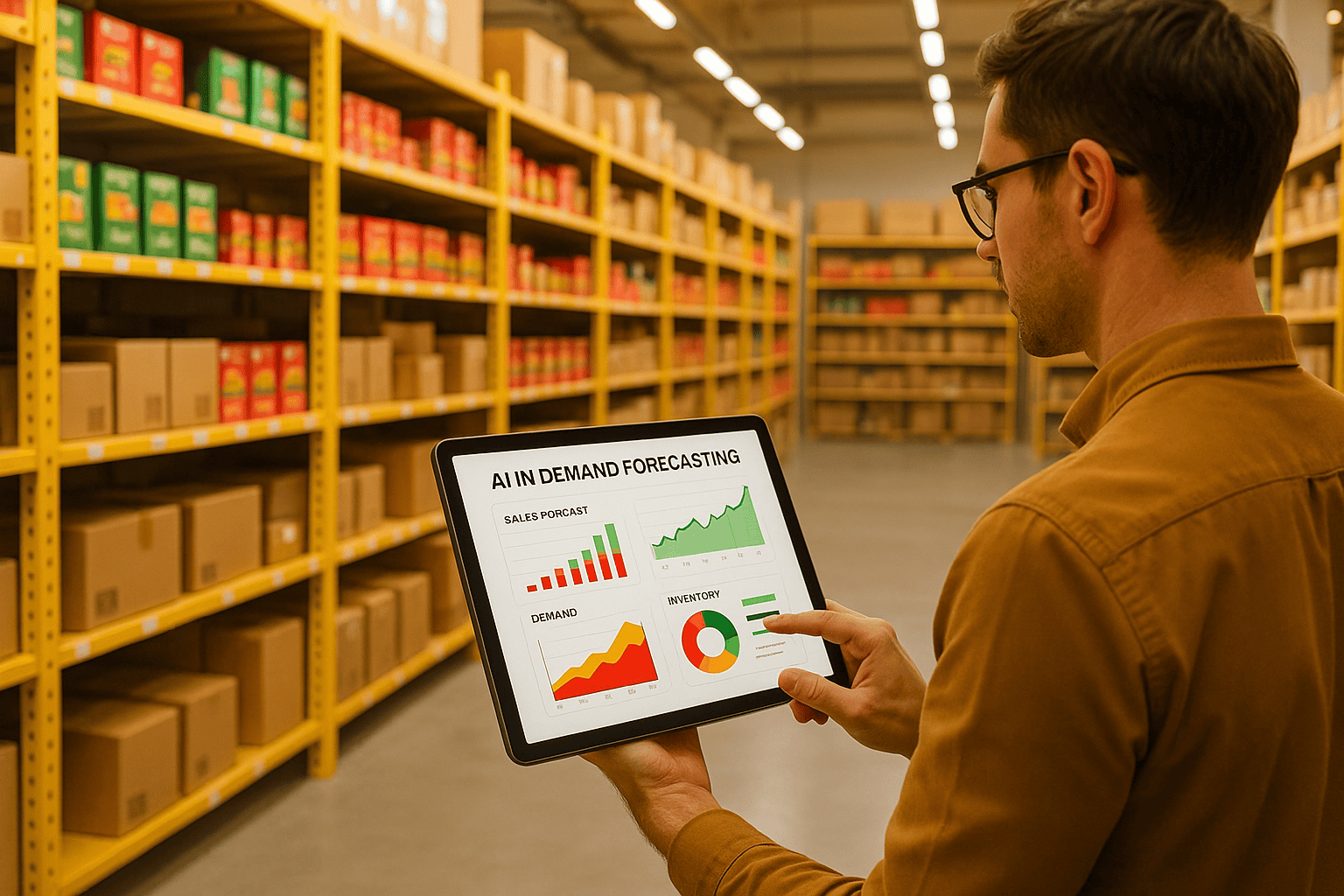
AI is transforming how e-commerce businesses predict demand. By analyzing vast amounts of data – like sales trends, weather, and social media activity – AI tools provide precise forecasts that help retailers manage inventory, reduce costs, and improve customer satisfaction. Here’s a quick breakdown of what AI-powered demand forecasting offers:
- Accurate Predictions: AI considers factors traditional methods often miss, like competitor pricing and real-time consumer behavior.
- Better Inventory Management: Retailers can maintain optimal stock levels, avoid overstocking, and reduce waste.
- Improved Customer Experience: Products stay in stock, delivery speeds improve, and personalized recommendations enhance satisfaction.
- Cost Savings: Fewer stockouts, lower shipping costs, and reduced markdowns boost profitability.
Adoption is growing across industries, from fashion to electronics, as AI tools become more accessible. While challenges like data quality and compliance exist, businesses that invest in AI forecasting gain a competitive edge in today’s fast-paced market.
Want to get started? Begin with a data audit, test small pilot programs, and ensure compliance with privacy laws. AI can help you make smarter decisions and stay ahead in e-commerce.
Demand Forecasting for Inventory Management with AI | Prevent Overstocking and Wasted Cost!

Key Benefits of AI in Demand Forecasting
AI-driven demand forecasting is changing the game for e-commerce businesses. By improving prediction accuracy, it helps optimize inventory and elevate customer satisfaction in ways traditional methods simply can’t match.
More Accurate Forecasting
AI systems excel at reducing errors by analyzing a much broader set of data compared to traditional methods. While older approaches rely heavily on historical sales and seasonal trends, AI takes it further by incorporating factors like weather conditions, economic shifts, social media trends, and even competitor pricing. This makes predictions far more precise.
During times of disruption, traditional models often fall short because they depend on past data that quickly becomes outdated. AI, however, adjusts in real time by factoring in new signals – like lockdown announcements, mobility changes, or shifts in buying behavior – making it much more adaptable to sudden changes.
Smarter Inventory Management
Accurate demand forecasts naturally lead to better inventory decisions. With AI, businesses can maintain the right stock levels to meet customer needs while avoiding overstocking, which ties up capital and creates waste.
AI tools can predict demand spikes, helping businesses stay ahead of trends and avoid stockouts, especially for seasonal or popular items. They also detect when demand is dropping, allowing for timely pricing adjustments or promotions to move inventory. By optimizing safety stock levels and accounting for variables like supplier reliability and lead times, AI ensures a more efficient use of resources, freeing up capital to invest in growth opportunities.
Enhanced Customer Experience
When inventory and pricing strategies are on point, the customer experience improves significantly. AI-powered demand forecasting ensures products are consistently available, which leads to faster order fulfillment and happier customers. When shoppers find what they need in stock and receive their orders quickly, satisfaction and loyalty naturally follow.
AI also helps position inventory strategically, so popular items are closer to areas with high demand, speeding up delivery times. Additionally, insights from AI can drive personalized product recommendations and pricing strategies that align with individual customer preferences. With real-time inventory visibility, e-commerce platforms enhance the omnichannel shopping experience, giving customers up-to-date information across all channels.
Adopting AI in demand forecasting not only streamlines operations but also strengthens customer trust. For e-commerce businesses ready to take advantage of these benefits, expert guidance can make all the difference. At M Accelerator, we specialize in helping businesses implement advanced analytics and strategic solutions to transform their operations and achieve lasting success.
How AI-Powered Demand Forecasting Works
AI-powered demand forecasting simplifies the decision-making process for e-commerce businesses by combining advanced algorithms with real-time data. Here’s how the system works, broken into three essential components.
Data Sources and Inputs
AI demand forecasting draws on a mix of data sources to reflect market conditions and consumer behavior.
- Internal sales data forms the foundation, including historical sales trends, product performance metrics, customer purchase patterns, and seasonal fluctuations. This data gives a baseline of how products have performed over time.
- External market data brings in factors like weather’s impact on seasonal items, economic indicators (e.g., unemployment rates, consumer confidence), and social media sentiment, which can reveal emerging trends or shifts in brand perception.
- Real-time operational data keeps forecasts up-to-date. Metrics like website traffic, search queries, cart abandonment rates, and email engagement provide early signals of changing demand. Competitor pricing, promotional activities, and market share data offer additional context.
- Supply chain data ensures practical constraints are factored in. Information like supplier lead times, manufacturing capacity, shipping delays, and inventory levels at distribution points help align demand predictions with operational realities. Geographic data adds another layer, tailoring forecasts to specific regions or customer segments.
All these inputs feed into advanced algorithms that process and analyze the data to generate predictions.
Machine Learning Models
AI forecasting systems use a combination of machine learning models to capture trends and predict demand accurately:
- Time series analysis models focus on historical data to identify patterns like seasonality and long-term trends. These models are the backbone of most forecasting systems.
- Neural networks handle complex relationships between variables, processing multiple data streams simultaneously and adapting as new data comes in.
- Ensemble methods combine outputs from multiple models to create more reliable predictions. By weighing the results from different algorithms, they minimize the risk of inaccuracies from any single model.
- Regression models quantify the impact of specific factors. For instance, they can calculate how a price increase or promotional campaign might influence sales.
These models not only generate forecasts but also adapt continuously, detecting anomalies and refining predictions as new data is introduced.
Real-Time Updates and Platform Integration
Modern AI systems don’t just produce forecasts – they update them in real time and integrate seamlessly with existing platforms.
- Streaming data processing ensures forecasts are updated within minutes as new information becomes available.
- API integrations connect forecasting systems with e-commerce platforms, inventory tools, and supply chain software. This enables automated actions like reorder recommendations, pricing adjustments, and promotional strategies, removing the need for manual data transfers.
- User-friendly dashboards give businesses access to forecasting insights without requiring technical expertise. These dashboards provide both high-level overviews and detailed breakdowns, allowing users to explore data by time period, region, or product category.
- Alert systems notify teams about significant changes or potential issues. For example, inventory managers might get alerts about low stock levels, or pricing teams could be warned about competitor actions affecting sales.
- Scenario modeling tools let businesses test strategies before implementation. Whether it’s a price change, a promotional campaign, or a new product launch, users can simulate potential outcomes and make more informed decisions.
These systems also include feedback loops that refine model accuracy over time. As actual sales data comes in, the system compares it with earlier forecasts and adjusts its algorithms to stay aligned with evolving market conditions. This continuous learning ensures the forecasts remain reliable and relevant.
sbb-itb-32a2de3
AI Applications in E-Commerce Demand Forecasting
AI is transforming e-commerce, bringing smarter ways to handle pricing, inventory, and operations. By tapping into advanced data analysis, businesses can make quicker, more informed decisions that improve efficiency and customer satisfaction. Let’s explore some of the key areas where AI is making a difference.
Dynamic Pricing Strategies
AI-driven pricing tools are reshaping how e-commerce companies set prices. These systems analyze massive datasets – including demand trends, competitor prices, and customer behavior – to adjust pricing in real time. The goal? To strike the perfect balance between maximizing revenue and boosting sales.
- Real-time competitor monitoring: AI keeps tabs on competitor pricing across various platforms, flagging any changes. Based on factors like brand value, inventory levels, and customer behavior, it calculates whether to lower prices, maintain a premium, or match competitors.
- Demand elasticity analysis: By studying how pricing changes affect customer buying habits, AI helps businesses predict the sweet spot for pricing. This allows companies to tweak prices in ways that protect market share or boost revenue without alienating customers.
- Customer segmentation pricing: AI personalizes pricing by dividing customers into distinct groups based on their shopping habits. This ensures pricing feels fair to each segment while maximizing profits across different buyer types.
- Inventory-driven pricing: Pricing strategies are linked directly to stock levels. Low inventory? Prices increase to moderate demand. Overstocked? Prices drop to clear space and move products faster.
Predictive Inventory Replenishment
AI takes the guesswork out of inventory management. By analyzing detailed sales patterns, seasonal trends, and supplier reliability, it ensures businesses have the right products at the right time, cutting down on both shortages and overstock.
- SKU-level demand prediction: AI digs into individual product data, considering factors like lifecycle stages, seasonal trends, and past promotions. This helps avoid over-ordering slow sellers while keeping popular items in stock.
- Lead time optimization: Supplier performance is tracked over time, letting AI adjust reorder schedules to account for delays or early shipments. This ensures inventory arrives precisely when needed.
- Multi-location inventory balancing: AI predicts demand across different locations and suggests moving stock between warehouses to avoid shortages in high-demand areas or excess stock in slower regions.
- Automated purchase order generation: When inventory dips below a certain level, AI automatically creates purchase orders. It factors in minimum order sizes, bulk discounts, and supplier terms to streamline the process and keep shelves stocked.
- Promotional planning: Planning for sales events or holidays? AI analyzes past promotions and upcoming trends to forecast inventory needs, ensuring businesses aren’t caught off guard during high-traffic periods.
Order Fulfillment and Logistics
AI doesn’t stop at pricing and inventory – it also streamlines fulfillment and logistics. By using real-time data, businesses can optimize everything from staffing to delivery routes, even during peak seasons.
- Demand-driven staffing optimization: AI predicts labor needs based on expected order volumes, ensuring enough staff during busy times while cutting costs during slower periods.
- Warehouse layout optimization: Fast-selling items are placed in easily accessible areas, while slower-moving products are repositioned based on demand forecasts. This reduces picking time and speeds up order fulfillment.
- Shipping method recommendations: AI evaluates factors like order value, customer location, and product type to recommend the best shipping options. This keeps delivery costs in check while meeting customer expectations.
- Peak period preparation: For events like Black Friday, AI forecasts order surges and pinpoints potential bottlenecks. Businesses can use this data to plan staffing, expand warehouse capacity, and secure additional carrier support.
- Route optimization for last-mile delivery: AI helps logistics teams map out the most efficient delivery routes, cutting travel time and fuel costs while meeting customer delivery windows.
- Return prediction and processing: By analyzing trends and customer behavior, AI forecasts return rates, helping businesses allocate resources for reverse logistics and minimize delays in processing returns.
AI is clearly reshaping every corner of e-commerce, from pricing strategies to last-mile delivery. These tools not only improve operational efficiency but also help businesses stay agile in a fast-changing market. By adopting these advancements, companies can ensure they’re ready to meet both current and future challenges head-on.
Challenges and Considerations for AI Implementation
AI has the potential to reshape businesses, but its adoption comes with hurdles that must be navigated carefully. For many e-commerce companies, successful AI integration requires meticulous planning, substantial resources, and a constant focus on data quality and regulatory compliance.
Data Quality and Preparation
Accurate, clean data is the foundation of AI forecasting. Without it, even the most advanced algorithms can lead to flawed predictions and costly mistakes.
One common problem is fragmented data. When customer, inventory, and sales information are stored in separate systems, or when historical records are incomplete, AI struggles to provide accurate results. Businesses should consolidate their data into unified systems and aim for at least 12–24 months of comprehensive records to ensure reliable forecasting.
Issues like duplicate entries, missing data, or inconsistent formatting can also throw a wrench in AI systems. For example, if product categories are labeled inconsistently over time, the AI might miss seasonal trends entirely. Regular audits and data-cleaning routines are essential to maintain accuracy.
Real-time data integration presents another challenge. Demand forecasting often relies on up-to-date inputs from sources like website traffic, social media trends, weather conditions, and economic data. Setting up automated systems to continuously feed clean, formatted data into AI platforms requires technical expertise and constant oversight.
These data challenges highlight the importance of having the right technical resources and skilled professionals in place.
Resource and Skill Requirements
AI-powered demand forecasting isn’t a plug-and-play solution – it requires significant investments in infrastructure and expertise.
For starters, businesses must invest in cloud computing, data storage, and specialized software licenses. These costs can quickly add up, especially for companies handling large volumes of transactions and customer data, often reaching thousands of dollars per month.
Hiring the right talent is another obstacle. Data scientists and machine learning engineers – the specialists needed to design and maintain AI systems – are in high demand and come with hefty price tags. In major U.S. cities, their salaries often range from $120,000 to $200,000 annually. Training existing staff to fill these roles is an option, but it delays implementation and adds to overall costs.
System integration is another area where unexpected challenges arise. Connecting AI tools to existing platforms often requires custom solutions, which can lead to hidden costs and ongoing maintenance needs to ensure seamless data flow.
Finally, AI systems require regular upkeep. Models need retraining as market conditions shift, new products are introduced, or customer behaviors evolve. This means businesses must allocate resources for performance monitoring, system updates, and data quality checks on an ongoing basis.
Once these resource hurdles are addressed, companies also need to consider the ethical and regulatory implications of AI.
Ethical and Regulatory Compliance
Data privacy laws like the California Consumer Privacy Act (CCPA) introduce specific requirements for businesses using AI. Companies must disclose how they collect, use, and share customer data. AI systems analyzing purchasing habits or browsing behavior need built-in consent mechanisms and robust data protection measures.
Transparency is equally critical. AI systems must explain their decisions and address biases in historical data. For instance, if an AI system determines pricing or inventory strategies, businesses must understand and justify those decisions. Black-box algorithms that lack transparency can lead to legal and ethical risks, especially if they appear to discriminate against certain customer groups.
Customer consent and opt-out options are increasingly expected. People want control over how their data is used, and balancing these privacy demands with accurate forecasting requires thoughtful system design and clear communication.
When working with third-party AI providers, vendor due diligence is a must. Companies need to ensure their partners comply with security standards, follow regulations, and provide strong data protection guarantees. Service agreements should clearly outline responsibilities around data ownership, liability, and compliance.
Finally, documentation and audit trails play a key role in compliance. AI systems should maintain detailed records of their decision-making processes, data sources, and performance metrics. These records not only help with regulatory reviews but also allow businesses to quickly identify and address issues.
While these challenges may seem daunting, they are manageable with careful planning, realistic resource allocation, and a commitment to ongoing improvement. AI-powered demand forecasting can deliver substantial benefits, but success depends on navigating these complexities effectively.
Conclusion and Next Steps
AI-powered demand forecasting is reshaping the e-commerce world by offering more precise predictions that improve inventory management, dynamic pricing, and customer satisfaction. To truly benefit, businesses must tackle challenges like data quality, resource allocation, and regulatory compliance while making thoughtful, strategic investments.
With the improvements in forecasting and operational efficiency discussed earlier, companies that treat AI as a long-term investment and prepare accordingly often see impressive returns. These steps lay the groundwork for a scalable and forward-thinking AI implementation strategy.
Start with a detailed data audit. Before diving into AI tools, take a close look at your current data systems. Make sure you have 12–24 months of clean, well-organized records covering sales, inventory, and customer interactions. If your data is scattered or inconsistent, focus on consolidating and cleaning it. This foundational step is critical for a successful AI rollout.
Assess your resource readiness. Implementing AI-based forecasting requires ongoing investments in technology, talent, and upkeep. Account for costs like cloud computing, specialized software licenses, and either hiring data science professionals or training your existing team. Remember, implementation is just the beginning – these systems need regular updates and monitoring to stay effective.
Test with pilot programs. Start small by applying AI forecasting to specific product lines or market segments where your data is strongest. This approach helps you refine processes, learn from early results, and build a case for scaling up.
Focus on compliance from the start. Build data privacy safeguards, consent mechanisms, and audit trails into your AI systems from day one. Work with legal experts to ensure your approach aligns with regulations like the CCPA and positions you for future requirements.
As e-commerce continues to evolve, businesses that embrace AI-powered demand forecasting stand to gain a competitive edge. The real question isn’t whether AI will transform demand forecasting – it’s whether your business will be ready to make the most of it.
Need help getting started? Check out M Accelerator for expert guidance that connects strategy, execution, and communication.
Take the first step by evaluating your current forecasting accuracy. Identify key pain points – whether it’s reducing stockouts, cutting down excess inventory, or improving customer satisfaction – and set clear, measurable goals to guide your efforts.
FAQs
How is AI demand forecasting different from traditional methods in terms of data and accuracy?
AI demand forecasting takes prediction to the next level by processing massive amounts of real-time data from diverse sources. This enables it to uncover subtle patterns and adjust swiftly to market changes. The result? Businesses often see prediction accuracy improve by 20% or more compared to older forecasting methods.
Traditional approaches, on the other hand, depend largely on historical data and straightforward models. These methods often fall short when it comes to handling sudden shifts in demand or unexpected market trends. With AI, companies can refine their predictions, leading to smarter inventory management and happier customers.
What are the key steps for successfully using AI in demand forecasting for e-commerce?
To make AI work effectively for demand forecasting in e-commerce, the first step is collecting reliable and detailed data. This data should cover past sales records, market trends, and external influences like seasonal shifts or economic factors. The better the quality of your data, the more precise your AI predictions will be.
Next, define your business objectives and set clear success metrics. This helps ensure that the AI’s forecasts align closely with your overall strategy and decision-making needs.
Once you’ve got your data and goals in place, it’s time to build and train machine learning models. Use the relevant data to create models that can analyze patterns and predict demand. Then, integrate these models into your existing systems to enable real-time forecasting. Keep in mind that the work doesn’t stop there – regularly review and tweak your models to adapt to changing market conditions and improve their accuracy over time.
By taking these steps, e-commerce businesses can leverage AI to make smarter, data-driven decisions about inventory and demand.
What challenges and ethical concerns should businesses consider when using AI for demand forecasting?
Businesses incorporating AI into demand forecasting often encounter hurdles like unreliable data, biases in algorithms, and a lack of clarity about how AI systems make decisions. These problems can undermine the accuracy of forecasts, which is why tackling them head-on is so important.
On the ethical side, companies need to prioritize data privacy, reduce bias in AI models, and ensure transparency to prevent any unintended consequences. By adopting responsible AI practices, businesses can build trust, promote fairness, and still harness the advantages of AI-driven forecasting.
Related posts
- Beyond Broadcast: Using Automation for Personalized Marketing That Actually Connects
- Engineering Serendipity: Using Predictive Signals to Proactively Engage Potential Customers
- Unlocking Growth: The Impact of Digital Transformation and E-Commerce on Emerging Markets
- AI-Powered Customer Personalization: Case Studies from Successful Startups